 Add to Chrome
 Add to Firefox
 Add to Edge
Position Encoding in Transformers: From Absolute and Relative Methods to Rotary Position Embeddings and Long-Context Scaling
Aug 09, 2026
Self-attention models content-dependent interactions between tokens but does not by itself encode token order. Position encoding addresses this limitation by introducing absolute coordinates, relative distances, or position-dependent rotations into Transformer representations and attention scores. This technical survey develops a unified account of sinusoidal and learned absolute position embeddings, Shaw-style relative position representations, Transformer-XL, T5 relative position bias, ALiBi, and Rotary Position Embeddings (RoPE). We derive how RoPE converts absolute position indices into relative phase differences in Query-Key inner products and compare these methods in terms of where position is injected, computational cost, compatibility with KV caching, and length extrapolation. We then examine long-context extensions, including Position Interpolation, RoPE scaling laws, NTK-aware scaling, Dynamic NTK, NTK-by-parts, YaRN, LongRoPE, and LongRoPE2, with emphasis on frequency allocation, attention rescaling, training length, and target context length. We also summarize implementation considerations, evaluation protocols, and position-encoding choices in representative large language models. A central conclusion is that the ability to compute positional features beyond the training length does not imply reliable long-context generalization; context extension must be evaluated through short-context retention, position-wise perplexity, retrieval, reasoning, and long-context code tasks.

The Evolution of Mixture-of-Experts Architectures in Large Language Models: Routing, Topology, Load Balancing, and Expert Parallelism
Aug 09, 2026Mixture-of-Experts models increase parameter capacity while keeping the computation activated by each token bounded, but their architectural evolution cannot be explained by a chronological list of model releases alone. This technical survey synthesizes primary papers, official technical reports, and prior surveys to organize modern Mixture-of-Experts systems along five coupled dimensions: expert granularity, expert topology, routing freedom, the scope of load balancing, and execution structure. We describe eight architectural milestones as a dependency graph with six mainline developments and two orthogonal branches, rather than as eight successive generations. We then analyze individual systems through four control planes: Expert Topology, Routing, Balance, and Expert Parallelism. These planes specify which experts exist, which experts process each token, how aggregate load is controlled, and how selected computation is mapped onto physical devices. The framework connects algorithmic choices such as Top-k routing, shared experts, fine-grained experts, and dynamic expert composition with systems concerns including token dispatch, device placement, all-to-all communication, and communication-computation overlap. We conclude with equal-budget pretraining experiments, quality and systems metrics, and open research questions. The main trend is a shift from merely activating more sparse parameters toward decoupling semantic routing, computational budgets, and physical execution.
MUSE: Multi-Domain Chinese User Simulation via Self-Evolving Profiles and Rubric-Guided Alignment
Apr 15, 2026User simulators are essential for the scalable training and evaluation of interactive AI systems. However, existing approaches often rely on shallow user profiling, struggle to maintain persona consistency over long interactions, and are largely limited to English or single-domain settings. We present MUSE, a multi-domain Chinese user simulation framework designed to generate human-like, controllable, and behaviorally consistent responses. First, we propose Iterative Profile Self-Evolution (IPSE), which gradually optimizes user profiles by comparing and reasoning discrepancies between simulated trajectories and real dialogue behaviors. We then apply Role-Reversal Supervised Fine-Tuning to improve local response realism and human-like expression. To enable fine-grained behavioral alignment, we further train a specialized rubric-based reward model and incorporate it into rubric-guided multi-turn reinforcement learning, which optimizes the simulator at the dialogue level and enhances long-horizon behavioral consistency. Experiments show that MUSE consistently outperforms strong baselines in both utterance-level and session-level evaluations, generating responses that are more realistic, coherent, and persona-consistent over extended interactions.
GeoRA: Geometry-Aware Low-Rank Adaptation for RLVR
Jan 14, 2026Reinforcement Learning with Verifiable Rewards (RLVR) is crucial for advancing large-scale reasoning models. However, existing parameter-efficient methods, such as PiSSA and MiLoRA, are designed for Supervised Fine-Tuning (SFT) and do not account for the distinct optimization dynamics and geometric structures of RLVR. Applying these methods directly leads to spectral collapse and optimization instability, which severely limit model performance. Meanwhile, alternative approaches that leverage update sparsity encounter significant efficiency bottlenecks on modern hardware due to unstructured computations. To address these challenges, we propose GeoRA (Geometry-Aware Low-Rank Adaptation), which exploits the anisotropic and compressible nature of RL update subspaces. GeoRA initializes adapters by extracting principal directions via Singular Value Decomposition (SVD) within a geometrically constrained subspace while freezing the residual components. This method preserves the pre-trained geometric structure and enables efficient GPU computation through dense operators. Experiments on Qwen and Llama demonstrate that GeoRA mitigates optimization bottlenecks caused by geometric misalignment. It consistently outperforms established low-rank baselines on key mathematical benchmarks, achieving state-of-the-art (SOTA) results. Moreover, GeoRA shows superior generalization and resilience to catastrophic forgetting in out-of-domain tasks.
Long-term Task-oriented Agent: Proactive Long-term Intent Maintenance in Dynamic Environments
Jan 14, 2026Current large language model agents predominantly operate under a reactive paradigm, responding only to immediate user queries within short-term sessions. This limitation hinders their ability to maintain long-term user's intents and dynamically adapt to evolving external environments. In this paper, we propose a novel interaction paradigm for proactive Task-oriented Agents capable of bridging the gap between relatively static user's needs and a dynamic environment. We formalize proactivity through two key capabilities, (i) Intent-Conditioned Monitoring: The agent autonomously formulates trigger conditions based on dialog history; (ii) Event-Triggered Follow-up: The agent actively engages the user upon detecting useful environmental updates. We introduce a high-quality data synthesis pipeline to construct complex, multi-turn dialog data in a dynamic environment. Furthermore, we attempt to address the lack of evaluation criteria of task-oriented interaction in a dynamic environment by proposing a new benchmark, namely ChronosBench. We evaluated some leading close-source and open-source models at present and revealed their flaws in long-term task-oriented interaction. Furthermore, our fine-tuned model trained using synthetic data for supervised learning achieves a task completion rate of 85.19% for complex tasks including shifts in user intent, outperforming other models under test. And the result validated the effectiveness of our data-driven strategy.
Factor Decomposed Generative Adversarial Networks for Text-to-Image Synthesis
Mar 24, 2023
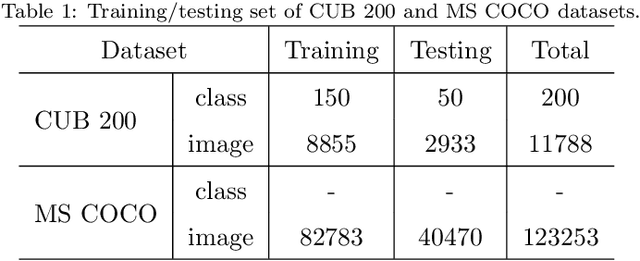
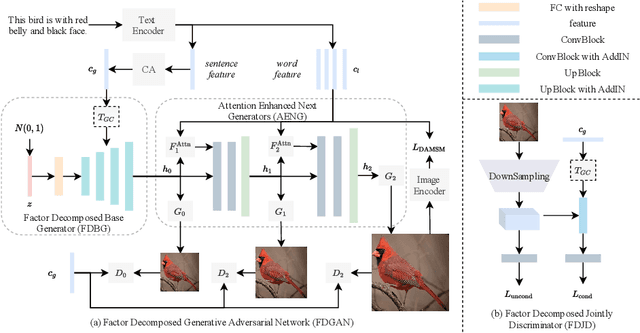
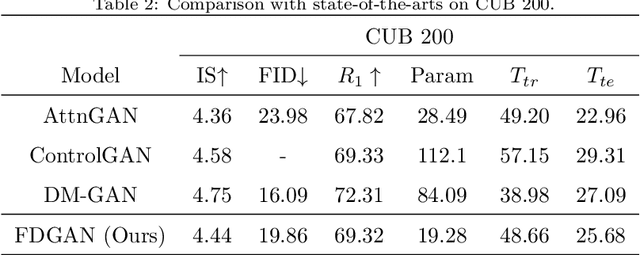
Prior works about text-to-image synthesis typically concatenated the sentence embedding with the noise vector, while the sentence embedding and the noise vector are two different factors, which control the different aspects of the generation. Simply concatenating them will entangle the latent factors and encumber the generative model. In this paper, we attempt to decompose these two factors and propose Factor Decomposed Generative Adversarial Networks~(FDGAN). To achieve this, we firstly generate images from the noise vector and then apply the sentence embedding in the normalization layer for both generator and discriminators. We also design an additive norm layer to align and fuse the text-image features. The experimental results show that decomposing the noise and the sentence embedding can disentangle latent factors in text-to-image synthesis, and make the generative model more efficient. Compared with the baseline, FDGAN can achieve better performance, while fewer parameters are used.
Time-frequency Network for Robust Speaker Recognition
Mar 07, 2023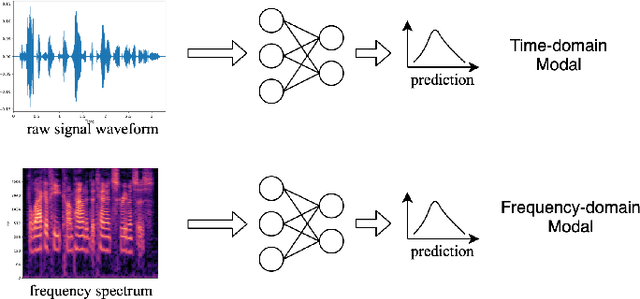
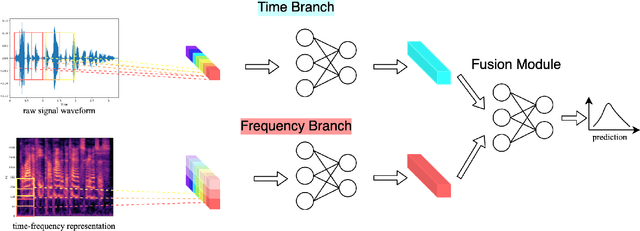
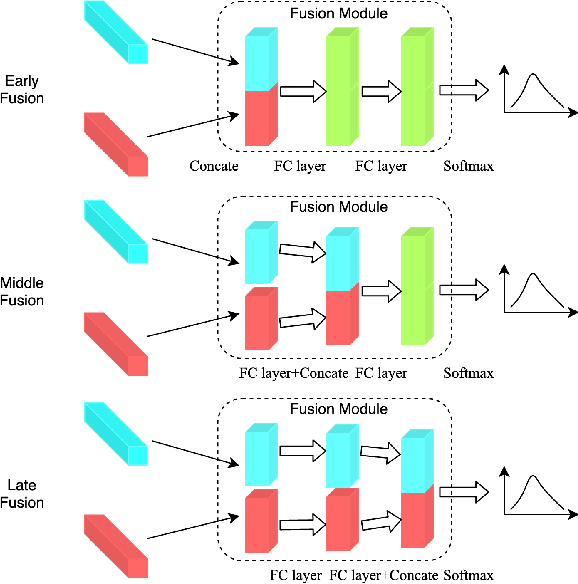
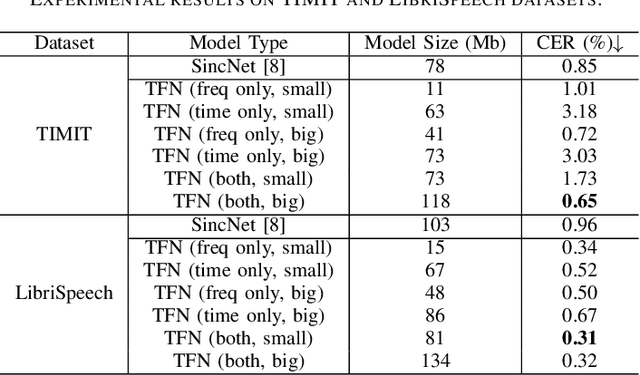
The wide deployment of speech-based biometric systems usually demands high-performance speaker recognition algorithms. However, most of the prior works for speaker recognition either process the speech in the frequency domain or time domain, which may produce suboptimal results because both time and frequency domains are important for speaker recognition. In this paper, we attempt to analyze the speech signal in both time and frequency domains and propose the time-frequency network~(TFN) for speaker recognition by extracting and fusing the features in the two domains. Based on the recent advance of deep neural networks, we propose a convolution neural network to encode the raw speech waveform and the frequency spectrum into domain-specific features, which are then fused and transformed into a classification feature space for speaker recognition. Experimental results on the publicly available datasets TIMIT and LibriSpeech show that our framework is effective to combine the information in the two domains and performs better than the state-of-the-art methods for speaker recognition.
Cross Modal Compression: Towards Human-comprehensible Semantic Compression
Sep 06, 2022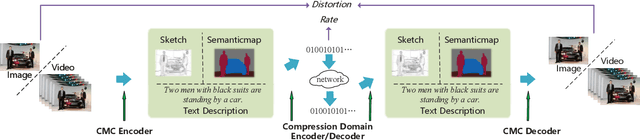
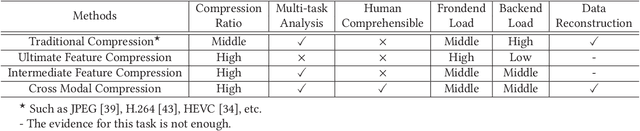
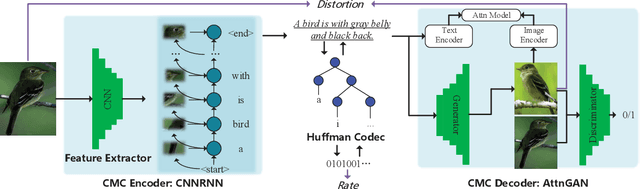
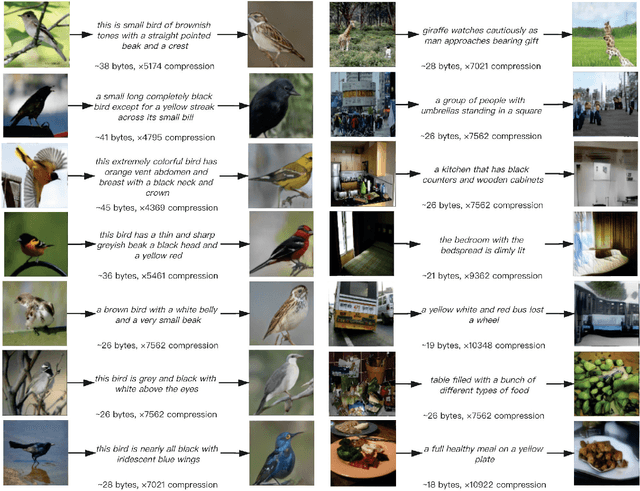
Traditional image/video compression aims to reduce the transmission/storage cost with signal fidelity as high as possible. However, with the increasing demand for machine analysis and semantic monitoring in recent years, semantic fidelity rather than signal fidelity is becoming another emerging concern in image/video compression. With the recent advances in cross modal translation and generation, in this paper, we propose the cross modal compression~(CMC), a semantic compression framework for visual data, to transform the high redundant visual data~(such as image, video, etc.) into a compact, human-comprehensible domain~(such as text, sketch, semantic map, attributions, etc.), while preserving the semantic. Specifically, we first formulate the CMC problem as a rate-distortion optimization problem. Secondly, we investigate the relationship with the traditional image/video compression and the recent feature compression frameworks, showing the difference between our CMC and these prior frameworks. Then we propose a novel paradigm for CMC to demonstrate its effectiveness. The qualitative and quantitative results show that our proposed CMC can achieve encouraging reconstructed results with an ultrahigh compression ratio, showing better compression performance than the widely used JPEG baseline.