 Add to Chrome
 Add to Firefox
 Add to Edge
Deit
Papers and Code
Understanding vision transformer robustness through the lens of out-of-distribution detection
Feb 01, 2026
Vision transformers have shown remarkable performance in vision tasks, but enabling them for accessible and real-time use is still challenging. Quantization reduces memory and inference costs at the risk of performance loss. Strides have been made to mitigate low precision issues mainly by understanding in-distribution (ID) task behaviour, but the attention mechanism may provide insight on quantization attributes by exploring out-of-distribution (OOD) situations. We investigate the behaviour of quantized small-variant popular vision transformers (DeiT, DeiT3, and ViT) on common OOD datasets. ID analyses show the initial instabilities of 4-bit models, particularly of those trained on the larger ImageNet-22k, as the strongest FP32 model, DeiT3, sharply drop 17% from quantization error to be one of the weakest 4-bit models. While ViT shows reasonable quantization robustness for ID calibration, OOD detection reveals more: ViT and DeiT3 pretrained on ImageNet-22k respectively experienced a 15.0% and 19.2% average quantization delta in AUPR-out between full precision to 4-bit while their ImageNet-1k-only counterparts experienced a 9.5% and 12.0% delta. Overall, our results suggest pretraining on large scale datasets may hinder low-bit quantization robustness in OOD detection and that data augmentation may be a more beneficial option.

Rethinking Intelligence: Brain-like Neuron Network
Jan 27, 2026Since their inception, artificial neural networks have relied on manually designed architectures and inductive biases to better adapt to data and tasks. With the rise of deep learning and the expansion of parameter spaces, they have begun to exhibit brain-like functional behaviors. Nevertheless, artificial neural networks remain fundamentally different from biological neural systems in structural organization, learning mechanisms, and evolutionary pathways. From the perspective of neuroscience, we rethink the formation and evolution of intelligence and proposes a new neural network paradigm, Brain-like Neural Network (BNN). We further present the first instantiation of a BNN termed LuminaNet that operates without convolutions or self-attention and is capable of autonomously modifying its architecture. We conduct extensive experiments demonstrating that LuminaNet can achieve self-evolution through dynamic architectural changes. On the CIFAR-10, LuminaNet achieves top-1 accuracy improvements of 11.19%, 5.46% over LeNet-5 and AlexNet, respectively, outperforming MLP-Mixer, ResMLP, and DeiT-Tiny among MLP/ViT architectures. On the TinyStories text generation task, LuminaNet attains a perplexity of 8.4, comparable to a single-layer GPT-2-style Transformer, while reducing computational cost by approximately 25% and peak memory usage by nearly 50%. Code and interactive structures are available at https://github.com/aaroncomo/LuminaNet.
Hybrid Vision Transformer_GAN Attribute Neutralizer for Mitigating Bias in Chest X_Ray Diagnosis
Jan 21, 2026Bias in chest X-ray classifiers frequently stems from sex- and age-related shortcuts, leading to systematic underdiagnosis of minority subgroups. Previous pixel-space attribute neutralizers, which rely on convolutional encoders, lessen but do not fully remove this attribute leakage at clinically usable edit strengths. This study evaluates whether substituting the U-Net convolutional encoder with a Vision Transformer backbone in the Attribute-Neutral Framework can reduce demographic attribute leakage while preserving diagnostic accuracy. A data-efficient Image Transformer Small (DeiT-S) neutralizer was trained on the ChestX-ray14 dataset. Its edited images, generated across eleven edit-intensity levels, were evaluated with an independent AI judge for attribute leakage and with a convolutional neural network (ConvNet) for disease prediction. At a moderate edit level (alpha = 0.5), the Vision Transformer (ViT) neutralizer reduces patient sex-recognition area under the curve (AUC) to approximately 0.80, about 10 percentage points below the original framework's convolutional U-Net encoder, despite being trained for only half as many epochs. Meanwhile, macro receiver operating characteristic area under the curve (ROC AUC) across 15 findings stays within five percentage points of the unedited baseline, and the worst-case subgroup AUC remains near 0.70. These results indicate that global self-attention vision models can further suppress attribute leakage without sacrificing clinical utility, suggesting a practical route toward fairer chest X-ray AI.
Transformer based Multi-task Fusion Network for Food Spoilage Detection and Shelf life Forecasting
Jan 20, 2026Food wastage is one of the critical challenges in the agricultural supply chain, and accurate and effective spoilage detection can help to reduce it. Further, it is highly important to forecast the spoilage information. This aids the longevity of the supply chain management in the agriculture field. This motivated us to propose fusion based architectures by combining CNN with LSTM and DeiT transformer for the following multi-tasks simultaneously: (i) vegetable classification, (ii) food spoilage detection, and (iii) shelf life forecasting. We developed a dataset by capturing images of vegetables from their fresh state until they were completely spoiled. From the experimental analysis it is concluded that the proposed fusion architectures CNN+CNN-LSTM and CNN+DeiT Transformer outperformed several deep learning models such as CNN, VGG16, ResNet50, Capsule Networks, and DeiT Transformers. Overall, CNN + DeiT Transformer yielded F1-score of 0.98 and 0.61 in vegetable classification and spoilage detection respectively and mean squared error (MSE) and symmetric mean absolute percentage error (SMAPE) of 3.58, and 41.66% respectively in spoilage forecasting. Further, the reliability of the fusion models was validated on noisy images and integrated with LIME to visualize the model decisions.
AgenticPruner: MAC-Constrained Neural Network Compression via LLM-Driven Strategy Search
Jan 18, 2026Neural network pruning remains essential for deploying deep learning models on resource-constrained devices, yet existing approaches primarily target parameter reduction without directly controlling computational cost. This yields unpredictable inference latency in deployment scenarios where strict Multiply-Accumulate (MAC) operation budgets must be met. We propose AgenticPruner, a framework utilizing large language models to achieve MAC-constrained optimization through iterative strategy learning. Our approach coordinates three specialized agents: a Profiling Agent that analyzes model architecture and MAC distributions, a Master Agent that orchestrates the workflow with divergence monitoring, and an Analysis Agent powered by Claude 3.5 Sonnet that learns optimal strategies from historical attempts. Through in-context learning, the Analysis Agent improves convergence success rate from 48% to 71% compared to grid search. Building upon isomorphic pruning's graph-based structural grouping, our method adds context-aware adaptation by analyzing patterns across pruning iterations, enabling automatic convergence to target MAC budgets within user-defined tolerance bands. We validate our framework on ImageNet-1K across ResNet, ConvNeXt, and DeiT architectures. On CNNs, our approach achieves MAC targeting while maintaining or improving accuracy: ResNet-50 reaches 1.77G MACs with 77.04% accuracy (+0.91% vs baseline); ResNet-101 achieves 4.22G MACs with 78.94% accuracy (+1.56% vs baseline). For ConvNeXt-Small, pruning to 8.17G MACs yields 1.41x GPU and 1.07x CPU speedup with 45% parameter reduction. On Vision Transformers, we demonstrate MAC-budget compliance within user-defined tolerance bands (typically +1% to +5% overshoot, -5% to -15% undershoot), establishing feasibility for deployment scenarios requiring strict computational guarantees.
$D^2Prune$: Sparsifying Large Language Models via Dual Taylor Expansion and Attention Distribution Awareness
Jan 14, 2026Large language models (LLMs) face significant deployment challenges due to their massive computational demands. % While pruning offers a promising compression solution, existing methods suffer from two critical limitations: (1) They neglect activation distribution shifts between calibration data and test data, resulting in inaccurate error estimations; (2) They overlook the long-tail distribution characteristics of activations in the attention module. To address these limitations, this paper proposes a novel pruning method, $D^2Prune$. First, we propose a dual Taylor expansion-based method that jointly models weight and activation perturbations for precise error estimation, leading to precise pruning mask selection and weight updating and facilitating error minimization during pruning. % Second, we propose an attention-aware dynamic update strategy that preserves the long-tail attention pattern by jointly minimizing the KL divergence of attention distributions and the reconstruction error. Extensive experiments show that $D^2Prune$ consistently outperforms SOTA methods across various LLMs (e.g., OPT-125M, LLaMA2/3, and Qwen3). Moreover, the dynamic attention update mechanism also generalizes well to ViT-based vision models like DeiT, achieving superior accuracy on ImageNet-1K.
HEART-VIT: Hessian-Guided Efficient Dynamic Attention and Token Pruning in Vision Transformer
Dec 23, 2025Vision Transformers (ViTs) deliver state-of-the-art accuracy but their quadratic attention cost and redundant computations severely hinder deployment on latency and resource-constrained platforms. Existing pruning approaches treat either tokens or heads in isolation, relying on heuristics or first-order signals, which often sacrifice accuracy or fail to generalize across inputs. We introduce HEART-ViT, a Hessian-guided efficient dynamic attention and token pruning framework for vision transformers, which to the best of our knowledge is the first unified, second-order, input-adaptive framework for ViT optimization. HEART-ViT estimates curvature-weighted sensitivities of both tokens and attention heads using efficient Hessian-vector products, enabling principled pruning decisions under explicit loss budgets.This dual-view sensitivity reveals an important structural insight: token pruning dominates computational savings, while head pruning provides fine-grained redundancy removal, and their combination achieves a superior trade-off. On ImageNet-100 and ImageNet-1K with ViT-B/16 and DeiT-B/16, HEART-ViT achieves up to 49.4 percent FLOPs reduction, 36 percent lower latency, and 46 percent higher throughput, while consistently matching or even surpassing baseline accuracy after fine-tuning, for example 4.7 percent recovery at 40 percent token pruning. Beyond theoretical benchmarks, we deploy HEART-ViT on different edge devices such as AGX Orin, demonstrating that our reductions in FLOPs and latency translate directly into real-world gains in inference speed and energy efficiency. HEART-ViT bridges the gap between theory and practice, delivering the first unified, curvature-driven pruning framework that is both accuracy-preserving and edge-efficient.
A Comparative Analysis of Semiconductor Wafer Map Defect Detection with Image Transformer
Dec 12, 2025Predictive maintenance is an important sector in modern industries which improves fault detection and cost reduction processes. By using machine learning algorithms in the whole process, the defects detection process can be implemented smoothly. Semiconductor is a sensitive maintenance field that requires predictability in work. While convolutional neural networks (CNNs) such as VGG-19, Xception and Squeeze-Net have demonstrated solid performance in image classification for semiconductor wafer industry, their effectiveness often declines in scenarios with limited and imbalanced data. This study investigates the use of the Data-Efficient Image Transformer (DeiT) for classifying wafer map defects under data-constrained conditions. Experimental results reveal that the DeiT model achieves highest classification accuracy of 90.83%, outperforming CNN models such as VGG-19(65%), SqueezeNet(82%), Xception(66%) and Hybrid(67%). DeiT also demonstrated superior F1-score (90.78%) and faster training convergence, with enhanced robustness in detecting minority defect classes. These findings highlight the potential of transformer-based models like DeiT in semiconductor wafer defect detection and support predictive maintenance strategies within semiconductor fabrication processes.
From Low-Rank Features to Encoding Mismatch: Rethinking Feature Distillation in Vision Transformers
Nov 19, 2025Feature-map knowledge distillation (KD) is highly effective for convolutional networks but often fails for Vision Transformers (ViTs). To understand this failure and guide method design, we conduct a two-view representation analysis of ViTs. First, a layer-wise Singular Value Decomposition (SVD) of full feature matrices shows that final-layer representations are globally low-rank: for CaiT-S24, only $121/61/34/14$ dimensions suffice to capture $99\%/95\%/90\%/80\%$ of the energy. In principle, this suggests that a compact student plus a simple linear projector should be enough for feature alignment, contradicting the weak empirical performance of standard feature KD. To resolve this paradox, we introduce a token-level Spectral Energy Pattern (SEP) analysis that measures how each token uses channel capacity. SEP reveals that, despite the global low-rank structure, individual tokens distribute energy over most channels, forming a high-bandwidth encoding pattern. This results in an encoding mismatch between wide teachers and narrow students. Motivated by this insight, we propose two minimal, mismatch-driven strategies: (1) post-hoc feature lifting with a lightweight projector retained during inference, or (2) native width alignment that widens only the student's last block to the teacher's width. On ImageNet-1K, these strategies reactivate simple feature-map distillation in ViTs, raising DeiT-Tiny accuracy from $74.86\%$ to $77.53\%$ and $78.23\%$ when distilling from CaiT-S24, while also improving standalone students trained without any teacher. Our analysis thus explains why ViT feature distillation fails and shows how exploiting low-rank structure yields effective, interpretable remedies and concrete design guidance for compact ViTs.
DeiTFake: Deepfake Detection Model using DeiT Multi-Stage Training
Nov 15, 2025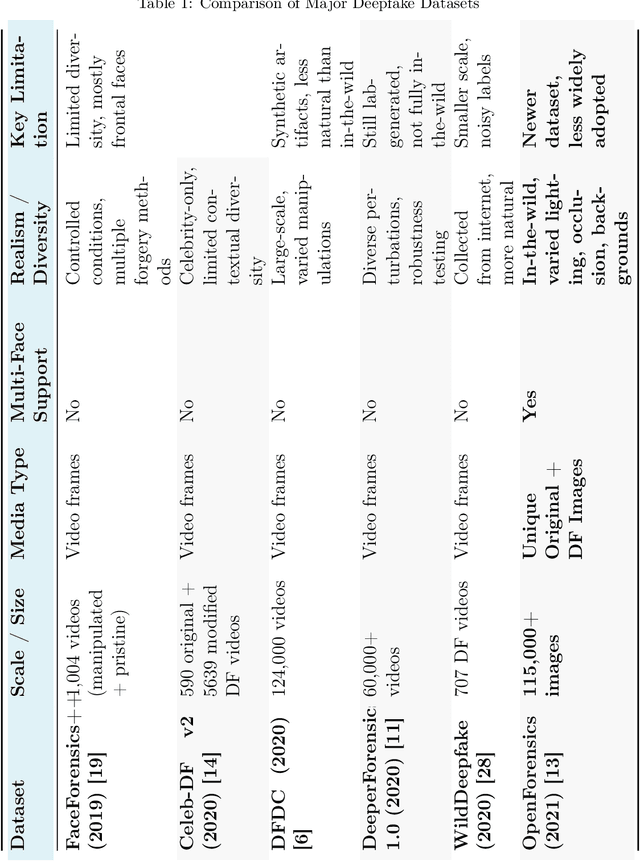
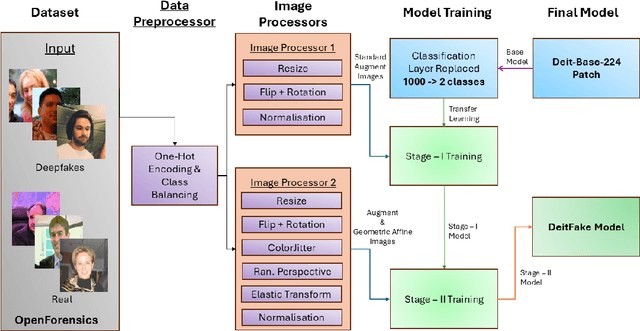
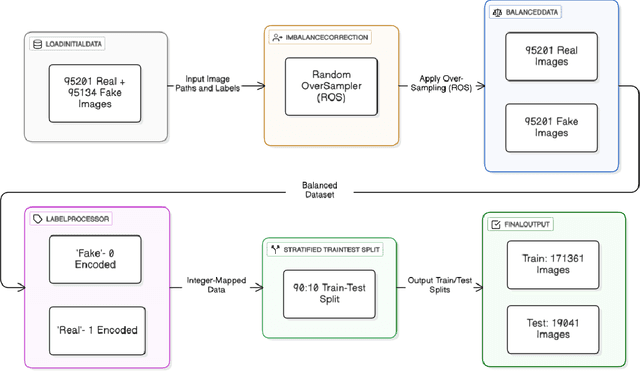
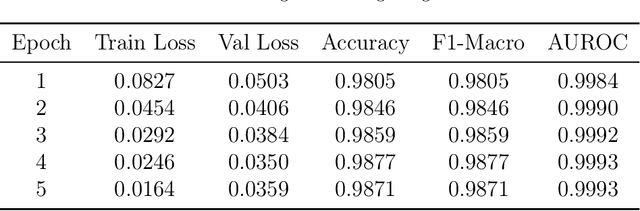
Deepfakes are major threats to the integrity of digital media. We propose DeiTFake, a DeiT-based transformer and a novel two-stage progressive training strategy with increasing augmentation complexity. The approach applies an initial transfer-learning phase with standard augmentations followed by a fine-tuning phase using advanced affine and deepfake-specific augmentations. DeiT's knowledge distillation model captures subtle manipulation artifacts, increasing robustness of the detection model. Trained on the OpenForensics dataset (190,335 images), DeiTFake achieves 98.71\% accuracy after stage one and 99.22\% accuracy with an AUROC of 0.9997, after stage two, outperforming the latest OpenForensics baselines. We analyze augmentation impact and training schedules, and provide practical benchmarks for facial deepfake detection.