 Add to Chrome
 Add to Firefox
 Add to Edge
AlloEgo-VLM: Disambiguating Allocentric and Egocentric Reference Frames in Vision-Language Models
Aug 16, 2026
This study investigates the challenge of ambiguity faced by Vision-Language Models (VLMs) in understanding spatial semantics. Spatial cognition, shaped by cognitive psychology, spatial science, and cultural context, often assigns directionality to objects. However, natural language descriptions of spatial relations frequently omit explicit reference frames, leading to semantic ambiguity and potentially serious errors for embodied AI robots. Existing VLMs, due to insufficient training on reference frames and object orientations, often produce inconsistent responses. To address this issue, we construct a new dataset, AlloEgo-View, comprising (image, query, view-specific answer) triplets that capture key object relations from both allocentric and egocentric perspectives. The view-specific descriptions follow a structured spatial representation that annotate detailed scene descriptions, reference and target objects, their orientations, reference frames, and view types. Building on AlloEgo-View, we develop AlloEgo-VLM, a framework to disambiguate allocentric and egocentric reference frames, even under ambiguous queries, and to be easily integrated into existing VLMs via supervised fine-tuning. Furthermore, we deploy our framework onto an embodied robotic platform within NVIDIA Isaac Sim to validate its real-world feasibility in open-ended object searching tasks. Experiments highlight the limitations of current VLMs in handling view-specific queries and demonstrate the strong disambiguation ability of AlloEgo-VLM.

DynoDINO: Harnessing Dynamic Latent Information from DINO Features for Multi-Phase Medical Image Segmentation
Jul 31, 2026Multi-phase Contrast-Enhanced Computed Tomography (CECT) plays a central role in the diagnosis and characterization of focal lesions by capturing temporal enhancement patterns across multiple acquisition phases. Accurate lesion segmentation from such data remains challenging because clinically relevant contrast kinetics are distributed across phases, while anatomical inconsistencies, respiratory motion, and incomplete acquisitions often lead to inter-phase misalignment and interrupted temporal information. Conventional segmentation frameworks typically process each phase independently or rely on simple fusion strategies, limiting their temporal reasoning capability. To address these challenges, we propose DynoDINO, a unified framework tailored to address the core challenges of multi-phase medical image segmentation. DynoDINO first performs slice-level alignment to establish inter-phase anatomical correspondence and then employs a Multi-phase Fusion Model to jointly enhance temporal correlations across phases. Our fusion model incorporates a Mix-attention (MA) mechanism for efficient multi-phase feature calibration and an Adaptive Gating Mechanism with difference-based residual learning to selectively preserve diagnostically relevant contrast variations while suppressing artifacts caused by residual misalignment. In addition, the adaptive gating mechanism improves training stability by preventing feature degradation caused by unguided subtraction operations. Experiments on three large-scale datasets, including LiTS, PLC-CECT, and WAW-TACE, demonstrate that DynoDINO consistently improves boundary delineation and structural fidelity under standard, shifted, and missing-phase conditions.
ViewMind3D: Modular View-Aware Inference for Training-Free 3D-QA
Jul 30, 2026Recent advances in large language models (LLMs) and vision-language models (VLMs) have enabled new possibilities for 3D question answering (3D-QA), a key capability for embodied AI and robotic perception. However, most existing methods rely on 3D-specific training or fine-tuning with costly annotations, limiting their scalability and real-world applicability. We present \textbf{ViewMind3D}, a fully training-free and modular framework for 3D spatial reasoning over multi-view observations of a scene without requiring complete 3D reconstruction. The framework decomposes the 3D-QA task into four interpretable components: (1) question-driven multi-view selection, (2) guided visual grounding with language-conditioned object cues, (3) spatial context encoding via a bird's-eye-view (BEV) viewpoint indicator, and (4) structured answer generation through role-based reasoning. This design enables structured, robust, and interpretable reasoning without requiring model tuning. Experimental results on ScanQA and SQA3D show that ViewMind3D achieves competitive performance compared to prior training-free and fine-tuned 3D-LLMs. In particular, our method improves performance on spatially grounded question types, such as ``What'' questions in SQA3D, while maintaining strong overall accuracy (50.8\%) and achieving 73.4 CIDEr on ScanQA. These results demonstrate that effective 3D reasoning can be achieved through modular orchestration of general-purpose LLMs and VLMs for robotic perception in real-world environments.
LongE2V: Long-Horizon Event-based Video Reconstruction, Prediction, and Frame Interpolation with Video Diffusion Models
Jul 09, 2026Recovering high-quality video from sparse event streams is a challenging task. Regression methods often blur textures, while existing generative models struggle with long-term stability. We propose LongE2V, a novel approach that leverages pre-trained video diffusion priors to jointly handle event-based video reconstruction, prediction, and frame interpolation. By fine-tuning a foundational video model, our approach achieves high data efficiency and superior perceptual quality. We introduce Autoregressive Unrolling and Adaptive Context Switching to mitigate temporal drift in extremely long sequences. We also propose Reencoding Alignment with Cross Residual Correction to ensure precise bidirectional consistency during frame interpolation. Furthermore, Event Voxel Density Augmentation ensures robustness across varying sensor resolutions. Extensive experiments on real-world benchmarks demonstrate that LongE2V outperforms state-of-the-art methods across all three tasks, exhibiting exceptional temporal coherence and zero-shot generalization. Project page: https://cdfan0627.github.io/LongE2V-page/
WiFi2Cap: Semantic Action Captioning from Wi-Fi CSI via Limb-Level Semantic Alignment
Mar 24, 2026Privacy-preserving semantic understanding of human activities is important for indoor sensing, yet existing Wi-Fi CSI-based systems mainly focus on pose estimation or predefined action classification rather than fine-grained language generation. Mapping CSI to natural-language descriptions remains challenging because of the semantic gap between wireless signals and language and direction-sensitive ambiguities such as left/right limb confusion. We propose WiFi2Cap, a three-stage framework for generating action captions directly from Wi-Fi CSI. A vision-language teacher learns transferable supervision from synchronized video-text pairs, and a CSI student is aligned to the teacher's visual space and text embeddings. To improve direction-sensitive captioning, we introduce a Mirror-Consistency Loss that reduces mirrored-action and left-right ambiguities during cross-modal alignment. A prefix-tuned language model then generates action descriptions from CSI embeddings. We also introduce the WiFi2Cap Dataset, a synchronized CSI-RGB-sentence benchmark for semantic captioning from Wi-Fi signals. Experimental results show that WiFi2Cap consistently outperforms baseline methods on BLEU-4, METEOR, ROUGE-L, CIDEr, and SPICE, demonstrating effective privacy-friendly semantic sensing.
Partial Ring Scan: Revisiting Scan Order in Vision State Space Models
Feb 04, 2026State Space Models (SSMs) have emerged as efficient alternatives to attention for vision tasks, offering lineartime sequence processing with competitive accuracy. Vision SSMs, however, require serializing 2D images into 1D token sequences along a predefined scan order, a factor often overlooked. We show that scan order critically affects performance by altering spatial adjacency, fracturing object continuity, and amplifying degradation under geometric transformations such as rotation. We present Partial RIng Scan Mamba (PRISMamba), a rotation-robust traversal that partitions an image into concentric rings, performs order-agnostic aggregation within each ring, and propagates context across rings through a set of short radial SSMs. Efficiency is further improved via partial channel filtering, which routes only the most informative channels through the recurrent ring pathway while keeping the rest on a lightweight residual branch. On ImageNet-1K, PRISMamba achieves 84.5% Top-1 with 3.9G FLOPs and 3,054 img/s on A100, outperforming VMamba in both accuracy and throughput while requiring fewer FLOPs. It also maintains performance under rotation, whereas fixed-path scans drop by 1~2%. These results highlight scan-order design, together with channel filtering, as a crucial, underexplored factor for accuracy, efficiency, and rotation robustness in Vision SSMs. Code will be released upon acceptance.
Block-based Symmetric Pruning and Fusion for Efficient Vision Transformers
Jul 16, 2025Vision Transformer (ViT) has achieved impressive results across various vision tasks, yet its high computational cost limits practical applications. Recent methods have aimed to reduce ViT's $O(n^2)$ complexity by pruning unimportant tokens. However, these techniques often sacrifice accuracy by independently pruning query (Q) and key (K) tokens, leading to performance degradation due to overlooked token interactions. To address this limitation, we introduce a novel {\bf Block-based Symmetric Pruning and Fusion} for efficient ViT (BSPF-ViT) that optimizes the pruning of Q/K tokens jointly. Unlike previous methods that consider only a single direction, our approach evaluates each token and its neighbors to decide which tokens to retain by taking token interaction into account. The retained tokens are compressed through a similarity fusion step, preserving key information while reducing computational costs. The shared weights of Q/K tokens create a symmetric attention matrix, allowing pruning only the upper triangular part for speed up. BSPF-ViT consistently outperforms state-of-the-art ViT methods at all pruning levels, increasing ImageNet classification accuracy by 1.3% on DeiT-T and 2.0% on DeiT-S, while reducing computational overhead by 50%. It achieves 40% speedup with improved accuracy across various ViTs.
DaMO: A Data-Efficient Multimodal Orchestrator for Temporal Reasoning with Video LLMs
Jun 13, 2025Large Language Models (LLMs) have recently been extended to the video domain, enabling sophisticated video-language understanding. However, existing Video LLMs often exhibit limitations in fine-grained temporal reasoning, restricting their ability to precisely attribute responses to specific video moments, especially under constrained supervision. We introduce DaMO, a data-efficient Video LLM explicitly designed for accurate temporal reasoning and multimodal understanding. At its core, the proposed Temporal-aware Fuseformer employs a hierarchical dual-stream architecture that progressively captures temporal dynamics within each modality and effectively fuses complementary visual and audio information. To further enhance computational efficiency, DaMO integrates a global residual that reduces spatial redundancy while preserving essential semantic details. We train DaMO via a structured four-stage progressive training paradigm, incrementally equipping the model with multimodal alignment, semantic grounding, and temporal reasoning capabilities. This work also contributes multiple datasets augmented from existing ones with GPT-generated temporally grounded QA pairs for tasks requiring temporal supervision. Comprehensive experiments on temporal grounding and video QA benchmarks demonstrate that DaMO consistently surpasses prior methods, particularly in tasks demanding precise temporal alignment and reasoning. Our work establishes a promising direction for data-efficient video-language modeling.
GCC: Generative Color Constancy via Diffusing a Color Checker
Feb 24, 2025
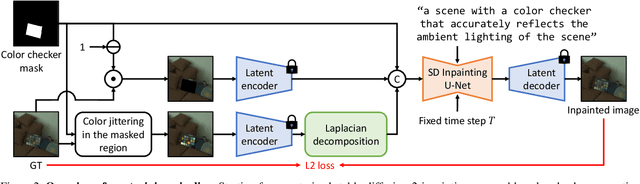

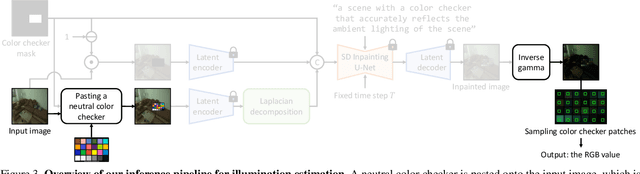
Color constancy methods often struggle to generalize across different camera sensors due to varying spectral sensitivities. We present GCC, which leverages diffusion models to inpaint color checkers into images for illumination estimation. Our key innovations include (1) a single-step deterministic inference approach that inpaints color checkers reflecting scene illumination, (2) a Laplacian decomposition technique that preserves checker structure while allowing illumination-dependent color adaptation, and (3) a mask-based data augmentation strategy for handling imprecise color checker annotations. GCC demonstrates superior robustness in cross-camera scenarios, achieving state-of-the-art worst-25% error rates of 5.15{\deg} and 4.32{\deg} in bi-directional evaluations. These results highlight our method's stability and generalization capability across different camera characteristics without requiring sensor-specific training, making it a versatile solution for real-world applications.
SpectroMotion: Dynamic 3D Reconstruction of Specular Scenes
Oct 22, 2024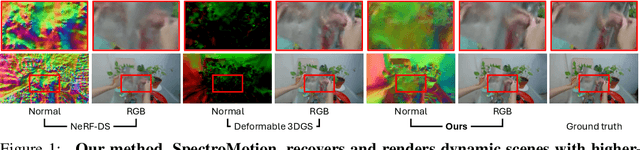
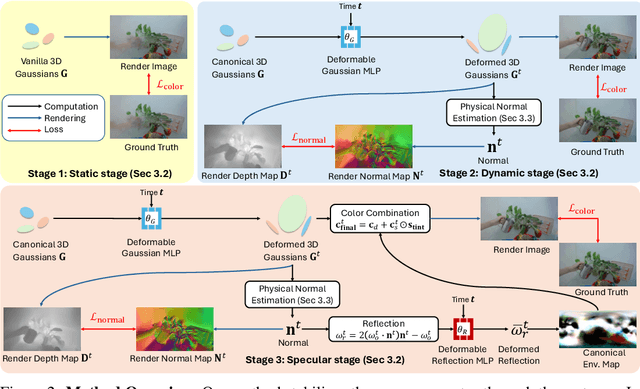
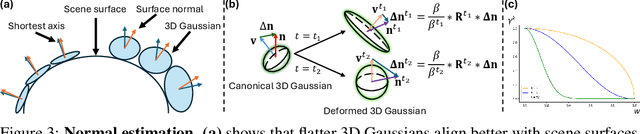

We present SpectroMotion, a novel approach that combines 3D Gaussian Splatting (3DGS) with physically-based rendering (PBR) and deformation fields to reconstruct dynamic specular scenes. Previous methods extending 3DGS to model dynamic scenes have struggled to accurately represent specular surfaces. Our method addresses this limitation by introducing a residual correction technique for accurate surface normal computation during deformation, complemented by a deformable environment map that adapts to time-varying lighting conditions. We implement a coarse-to-fine training strategy that significantly enhances both scene geometry and specular color prediction. We demonstrate that our model outperforms prior methods for view synthesis of scenes containing dynamic specular objects and that it is the only existing 3DGS method capable of synthesizing photorealistic real-world dynamic specular scenes, outperforming state-of-the-art methods in rendering complex, dynamic, and specular scenes.