 Add to Chrome
 Add to Firefox
 Add to Edge
Tunable Soft Equivariance with Guarantees
Mar 27, 2026
Equivariance is a fundamental property in computer vision models, yet strict equivariance is rarely satisfied in real-world data, which can limit a model's performance. Controlling the degree of equivariance is therefore desirable. We propose a general framework for constructing soft equivariant models by projecting the model weights into a designed subspace. The method applies to any pre-trained architecture and provides theoretical bounds on the induced equivariance error. Empirically, we demonstrate the effectiveness of our method on multiple pre-trained backbones, including ViT and ResNet, across image classification, semantic segmentation, and human-trajectory prediction tasks. Notably, our approach improves the performance while simultaneously reducing equivariance error on the competitive ImageNet benchmark.

Local Scale Equivariance with Latent Deep Equilibrium Canonicalizer
Aug 19, 2025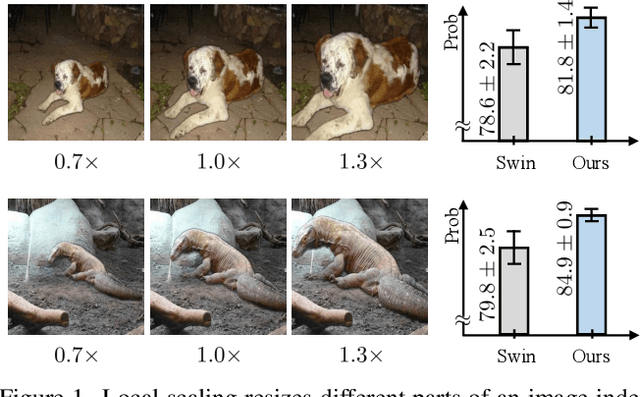
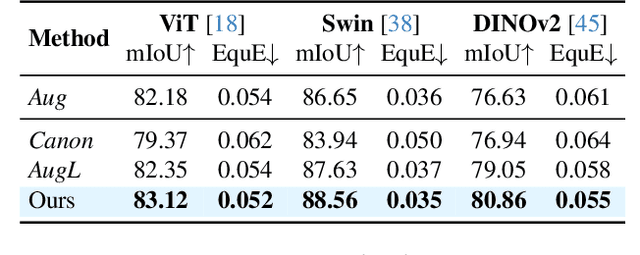
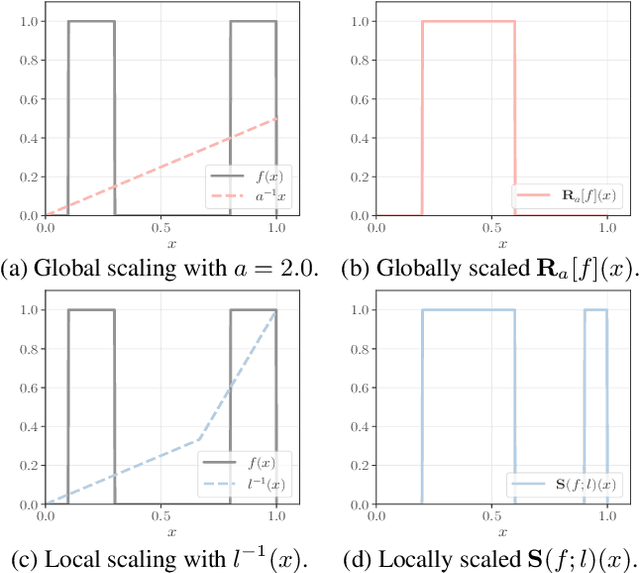

Scale variation is a fundamental challenge in computer vision. Objects of the same class can have different sizes, and their perceived size is further affected by the distance from the camera. These variations are local to the objects, i.e., different object sizes may change differently within the same image. To effectively handle scale variations, we present a deep equilibrium canonicalizer (DEC) to improve the local scale equivariance of a model. DEC can be easily incorporated into existing network architectures and can be adapted to a pre-trained model. Notably, we show that on the competitive ImageNet benchmark, DEC improves both model performance and local scale consistency across four popular pre-trained deep-nets, e.g., ViT, DeiT, Swin, and BEiT. Our code is available at https://github.com/ashiq24/local-scale-equivariance.