 Add to Chrome
 Add to Firefox
 Add to Edge
Data Valuation
Papers and Code
An Odd Estimator for Shapley Values
Feb 01, 2026
The Shapley value is a ubiquitous framework for attribution in machine learning, encompassing feature importance, data valuation, and causal inference. However, its exact computation is generally intractable, necessitating efficient approximation methods. While the most effective and popular estimators leverage the paired sampling heuristic to reduce estimation error, the theoretical mechanism driving this improvement has remained opaque. In this work, we provide an elegant and fundamental justification for paired sampling: we prove that the Shapley value depends exclusively on the odd component of the set function, and that paired sampling orthogonalizes the regression objective to filter out the irrelevant even component. Leveraging this insight, we propose OddSHAP, a novel consistent estimator that performs polynomial regression solely on the odd subspace. By utilizing the Fourier basis to isolate this subspace and employing a proxy model to identify high-impact interactions, OddSHAP overcomes the combinatorial explosion of higher-order approximations. Through an extensive benchmark evaluation, we find that OddSHAP achieves state-of-the-art estimation accuracy.

From Tags to Trees: Structuring Fine-Grained Knowledge for Controllable Data Selection in LLM Instruction Tuning
Jan 20, 2026Effective and controllable data selection is critical for LLM instruction tuning, especially with massive open-source datasets. Existing approaches primarily rely on instance-level quality scores, or diversity metrics based on embedding clusters or semantic tags. However, constrained by the flatness of embedding spaces or the coarseness of tags, these approaches overlook fine-grained knowledge and its intrinsic hierarchical dependencies, consequently hindering precise data valuation and knowledge-aligned sampling. To address this challenge, we propose Tree-aware Aligned Global Sampling (TAGS), a unified framework that leverages a knowledge tree built from fine-grained tags, thereby enabling joint control of global quality, diversity, and target alignment. Using an LLM-based tagger, we extract atomic knowledge concepts, which are organized into a global tree through bottom-up hierarchical clustering. By grounding data instances onto this tree, a tree-aware metric then quantifies data quality and diversity, facilitating effective sampling. Our controllable sampling strategy maximizes tree-level information gain and enforces leaf-level alignment via KL-divergence for specific domains. Extensive experiments demonstrate that TAGS significantly outperforms state-of-the-art baselines. Notably, it surpasses the full-dataset model by \textbf{+5.84\%} using only \textbf{5\%} of the data, while our aligned sampling strategy further boosts average performance by \textbf{+4.24\%}.
A New Strategy for Artificial Intelligence: Training Foundation Models Directly on Human Brain Data
Jan 17, 2026While foundation models have achieved remarkable results across a diversity of domains, they still rely on human-generated data, such as text, as a fundamental source of knowledge. However, this data is ultimately the product of human brains, the filtered projection of a deeper neural complexity. In this paper, we explore a new strategy for artificial intelligence: moving beyond surface-level statistical regularities by training foundation models directly on human brain data. We hypothesize that neuroimaging data could open a window into elements of human cognition that are not accessible through observable actions, and argue that this additional knowledge could be used, alongside classical training data, to overcome some of the current limitations of foundation models. While previous research has demonstrated the possibility to train classical machine learning or deep learning models on neural patterns, this path remains largely unexplored for high-level cognitive functions. Here, we classify the current limitations of foundation models, as well as the promising brain regions and cognitive processes that could be leveraged to address them, along four levels: perception, valuation, execution, and integration. Then, we propose two methods that could be implemented to prioritize the use of limited neuroimaging data for strategically chosen, high-value steps in foundation model training: reinforcement learning from human brain (RLHB) and chain of thought from human brain (CoTHB). We also discuss the potential implications for agents, artificial general intelligence, and artificial superintelligence, as well as the ethical, social, and technical challenges and opportunities. We argue that brain-trained foundation models could represent a realistic and effective middle ground between continuing to scale current architectures and exploring alternative, neuroscience-inspired solutions.
From Points to Coalitions: Hierarchical Contrastive Shapley Values for Prioritizing Data Samples
Dec 22, 2025How should we quantify the value of each training example when datasets are large, heterogeneous, and geometrically structured? Classical Data-Shapley answers in principle, but its O(n!) complexity and point-wise perspective are ill-suited to modern scales. We propose Hierarchical Contrastive Data Valuation (HCDV), a three-stage framework that (i) learns a contrastive, geometry-preserving representation, (ii) organizes the data into a balanced coarse-to-fine hierarchy of clusters, and (iii) assigns Shapley-style payoffs to coalitions via local Monte-Carlo games whose budgets are propagated downward. HCDV collapses the factorial burden to O(T sum_{l} K_{l}) = O(T K_max log n), rewards examples that sharpen decision boundaries, and regularizes outliers through curvature-based smoothness. We prove that HCDV approximately satisfies the four Shapley axioms with surplus loss O(eta log n), enjoys sub-Gaussian coalition deviation tilde O(1/sqrt{T}), and incurs at most k epsilon_infty regret for top-k selection. Experiments on four benchmarks--tabular, vision, streaming, and a 45M-sample CTR task--plus the OpenDataVal suite show that HCDV lifts accuracy by up to +5 pp, slashes valuation time by up to 100x, and directly supports tasks such as augmentation filtering, low-latency streaming updates, and fair marketplace payouts.
Deep Learning for Art Market Valuation
Dec 28, 2025We study how deep learning can improve valuation in the art market by incorporating the visual content of artworks into predictive models. Using a large repeated-sales dataset from major auction houses, we benchmark classical hedonic regressions and tree-based methods against modern deep architectures, including multi-modal models that fuse tabular and image data. We find that while artist identity and prior transaction history dominate overall predictive power, visual embeddings provide a distinct and economically meaningful contribution for fresh-to-market works where historical anchors are absent. Interpretability analyses using Grad-CAM and embedding visualizations show that models attend to compositional and stylistic cues. Our findings demonstrate that multi-modal deep learning delivers significant value precisely when valuation is hardest, namely first-time sales, and thus offers new insights for both academic research and practice in art market valuation.
Data Valuation for LLM Fine-Tuning: Efficient Shapley Value Approximation via Language Model Arithmetic
Dec 12, 2025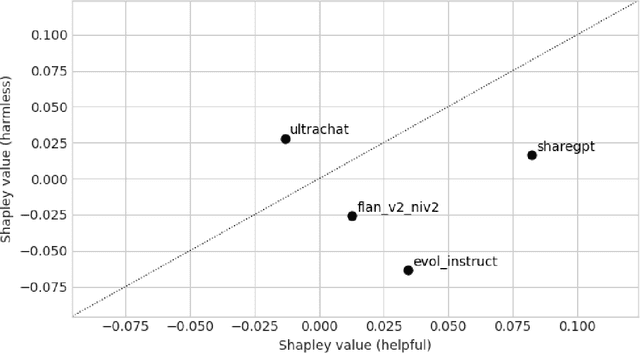
Data is a critical asset for training large language models (LLMs), alongside compute resources and skilled workers. While some training data is publicly available, substantial investment is required to generate proprietary datasets, such as human preference annotations or to curate new ones from existing sources. As larger datasets generally yield better model performance, two natural questions arise. First, how can data owners make informed decisions about curation strategies and data sources investment? Second, how can multiple data owners collaboratively pool their resources to train superior models while fairly distributing the benefits? This problem, data valuation, which is not specific to large language models, has been addressed by the machine learning community through the lens of cooperative game theory, with the Shapley value being the prevalent solution concept. However, computing Shapley values is notoriously expensive for data valuation, typically requiring numerous model retrainings, which can become prohibitive for large machine learning models. In this work, we demonstrate that this computational challenge is dramatically simplified for LLMs trained with Direct Preference Optimization (DPO). We show how the specific mathematical structure of DPO enables scalable Shapley value computation. We believe this observation unlocks many applications at the intersection of data valuation and large language models.
Privacy-Preserving Feature Valuation in Vertical Federated Learning Using Shapley-CMI and PSI Permutation
Dec 16, 2025Federated Learning (FL) is an emerging machine learning paradigm that enables multiple parties to collaboratively train models without sharing raw data, ensuring data privacy. In Vertical FL (VFL), where each party holds different features for the same users, a key challenge is to evaluate the feature contribution of each party before any model is trained, particularly in the early stages when no model exists. To address this, the Shapley-CMI method was recently proposed as a model-free, information-theoretic approach to feature valuation using Conditional Mutual Information (CMI). However, its original formulation did not provide a practical implementation capable of computing the required permutations and intersections securely. This paper presents a novel privacy-preserving implementation of Shapley-CMI for VFL. Our system introduces a private set intersection (PSI) server that performs all necessary feature permutations and computes encrypted intersection sizes across discretized and encrypted ID groups, without the need for raw data exchange. Each party then uses these intersection results to compute Shapley-CMI values, computing the marginal utility of their features. Initial experiments confirm the correctness and privacy of the proposed system, demonstrating its viability for secure and efficient feature contribution estimation in VFL. This approach ensures data confidentiality, scales across multiple parties, and enables fair data valuation without requiring the sharing of raw data or training models.
Limits To (Machine) Learning
Dec 14, 2025


Machine learning (ML) methods are highly flexible, but their ability to approximate the true data-generating process is fundamentally constrained by finite samples. We characterize a universal lower bound, the Limits-to-Learning Gap (LLG), quantifying the unavoidable discrepancy between a model's empirical fit and the population benchmark. Recovering the true population $R^2$, therefore, requires correcting observed predictive performance by this bound. Using a broad set of variables, including excess returns, yields, credit spreads, and valuation ratios, we find that the implied LLGs are large. This indicates that standard ML approaches can substantially understate true predictability in financial data. We also derive LLG-based refinements to the classic Hansen and Jagannathan (1991) bounds, analyze implications for parameter learning in general-equilibrium settings, and show that the LLG provides a natural mechanism for generating excess volatility.
Better Prevent than Tackle: Valuing Defense in Soccer Based on Graph Neural Networks
Dec 11, 2025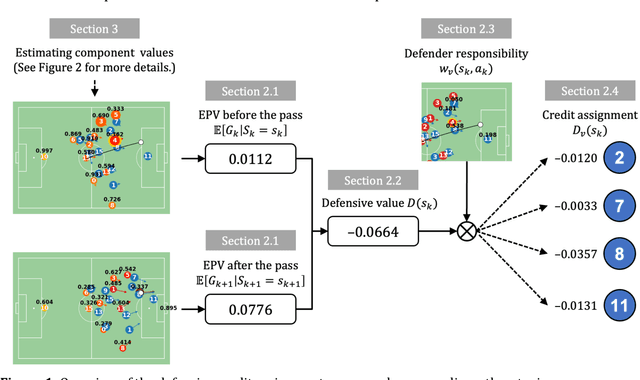
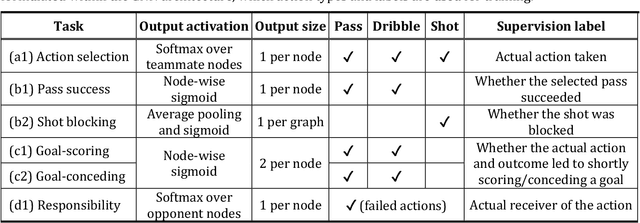
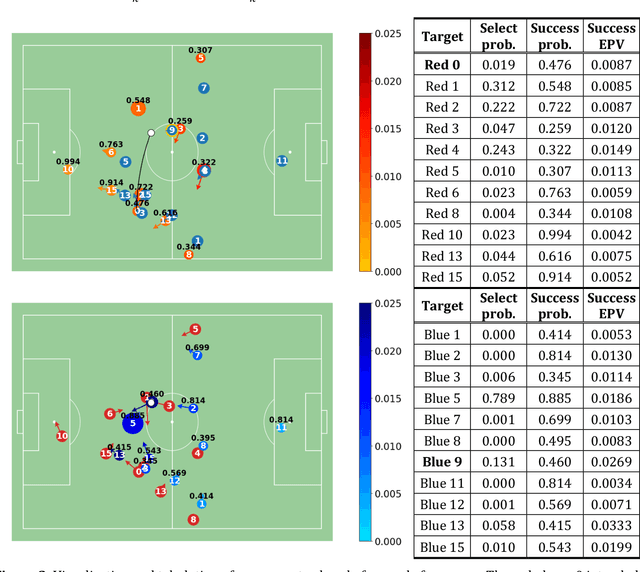
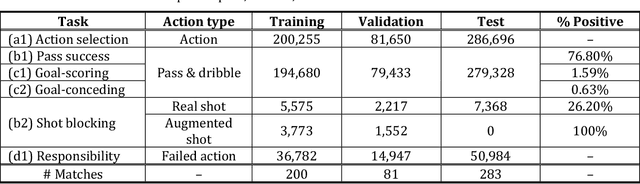
Evaluating defensive performance in soccer remains challenging, as effective defending is often expressed not through visible on-ball actions such as interceptions and tackles, but through preventing dangerous opportunities before they arise. Existing approaches have largely focused on valuing on-ball actions, leaving much of defenders' true impact unmeasured. To address this gap, we propose DEFCON (DEFensive CONtribution evaluator), a comprehensive framework that quantifies player-level defensive contributions for every attacking situation in soccer. Leveraging Graph Attention Networks, DEFCON estimates the success probability and expected value of each attacking option, along with each defender's responsibility for stopping it. These components yield an Expected Possession Value (EPV) for the attacking team before and after each action, and DEFCON assigns positive or negative credits to defenders according to whether they reduced or increased the opponent's EPV. Trained on 2023-24 and evaluated on 2024-25 Eredivisie event and tracking data, DEFCON's aggregated player credits exhibit strong positive correlations with market valuations. Finally, we showcase several practical applications, including in-game timelines of defensive contributions, spatial analyses across pitch zones, and pairwise summaries of attacker-defender interactions.
ERA-IT: Aligning Semantic Models with Revealed Economic Preference for Real-Time and Explainable Patent Valuation
Dec 14, 2025Valuing intangible assets under uncertainty remains a critical challenge in the strategic management of technological innovation due to the information asymmetry inherent in high-dimensional technical specifications. Traditional bibliometric indicators, such as citation counts, fail to address this friction in a timely manner due to the systemic latency inherent in data accumulation. To bridge this gap, this study proposes the Economic Reasoning Alignment via Instruction Tuning (ERA-IT) framework. We theoretically conceptualize patent renewal history as a revealed economic preference and leverage it as an objective supervisory signal to align the generative reasoning of Large Language Models (LLMs) with market realities, a process we term Eco-Semantic Alignment. Using a randomly sampled dataset of 10,000 European Patent Office patents across diverse technological domains, we trained the model not only to predict value tiers but also to reverse-engineer the Economic Chain-of-Thought from unstructured text. Empirical results demonstrate that ERA-IT significantly outperforms both conventional econometric models and zero-shot LLMs in predictive accuracy. More importantly, by generating explicit, logically grounded rationales for valuation, the framework serves as a transparent cognitive scaffold for decision-makers, reducing the opacity of black-box AI in high-stakes intellectual property management.