 Add to Chrome
 Add to Firefox
 Add to Edge
Deep Learning for Art Market Valuation
Dec 28, 2025
We study how deep learning can improve valuation in the art market by incorporating the visual content of artworks into predictive models. Using a large repeated-sales dataset from major auction houses, we benchmark classical hedonic regressions and tree-based methods against modern deep architectures, including multi-modal models that fuse tabular and image data. We find that while artist identity and prior transaction history dominate overall predictive power, visual embeddings provide a distinct and economically meaningful contribution for fresh-to-market works where historical anchors are absent. Interpretability analyses using Grad-CAM and embedding visualizations show that models attend to compositional and stylistic cues. Our findings demonstrate that multi-modal deep learning delivers significant value precisely when valuation is hardest, namely first-time sales, and thus offers new insights for both academic research and practice in art market valuation.

A Multi-scale Fused Graph Neural Network with Inter-view Contrastive Learning for Spatial Transcriptomics Data Clustering
Dec 18, 2025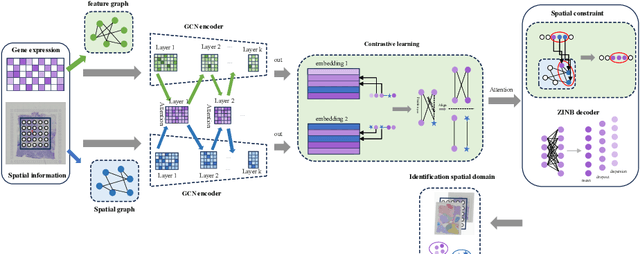
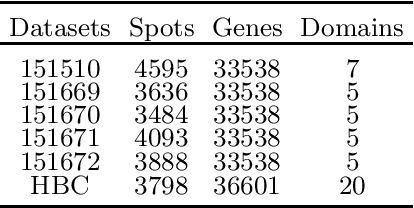
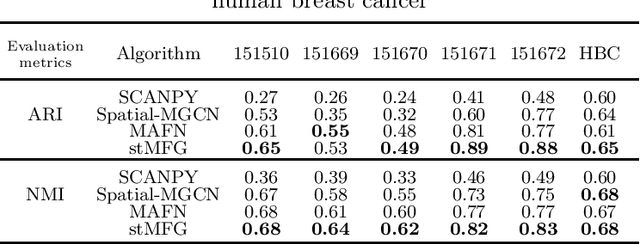

Spatial transcriptomics enables genome-wide expression analysis within native tissue context, yet identifying spatial domains remains challenging due to complex gene-spatial interactions. Existing methods typically process spatial and feature views separately, fusing only at output level - an "encode-separately, fuse-late" paradigm that limits multi-scale semantic capture and cross-view interaction. Accordingly, stMFG is proposed, a multi-scale interactive fusion graph network that introduces layer-wise cross-view attention to dynamically integrate spatial and gene features after each convolution. The model combines cross-view contrastive learning with spatial constraints to enhance discriminability while maintaining spatial continuity. On DLPFC and breast cancer datasets, stMFG outperforms state-of-the-art methods, achieving up to 14% ARI improvement on certain slices.