 Add to Chrome
 Add to Firefox
 Add to Edge
Learning to Bid in Repeated Second-Price Auctions with Dynamic Values and Aggregated Feedback
May 27, 2026
We study the problem of learning to bid when the bidder's value is dynamic, i.e., when the current value depends on past outcomes. Specifically, we consider a bidder participating in repeated second-price auctions whose value depends on the time elapsed since their last successful bid, with auctions arriving in continuous time and only aggregated feedback revealed at the end of the horizon. Such a bidder must (1) balance the immediate benefit of winning the current auction against its impact on future values and (2) learn unknown environmental parameters. We derive regret bounds for a class of learning methods that combine plug-in estimators with a differential-equation characterization of the optimal policy, and show that a specific confidence bound algorithm learns the optimal policy with a near optimal regret of $\widetilde{O}(\log N)$ for piecewise linear primitives, and $\widetilde{O}(N^{1/3})$ for general, smooth primitives, achieving these regrets without explicit randomization. These theoretical results are supported by numerical experiments.

Off-Policy Learning to Reason Works Because It Is More Pessimistic Than You Think
May 27, 2026Large scale reinforcement learning has become a central tool for improving reasoning in large language models. At this scale, generation is often lagged or asynchronous, so updates are performed on data collected by older policies. This makes learning inherently off-policy. Most existing approaches nevertheless remain rooted in PPO-style trust-region objectives, treating training as approximately on-policy and using importance weights to correct distribution mismatch. These corrections can introduce high variance, destabilize optimization, and accelerate entropy collapse. Recent work suggests an alternative: rather than correcting the mismatch, one can embrace off-policy data and remove importance weights, often yielding stronger algorithms. In this paper, we provide an intuitive construction of off-policy objectives that include successful off-policy objectives and show that their effectiveness can be understood through implicit pessimism: they optimize toward target policies that are more conservative than their nominal objectives suggest. This perspective explains why some particular implementation choices improve stability: they implicitly control the effective target distribution. We then propose a principled modification that stabilize this induced distribution and improve off-policy learning.
Self-Consistency via Marginal Sharpening
May 27, 2026Inference-time sampling can elicit strong reasoning abilities from language models without additional training. Existing power-sampling methods do so by sharpening the distribution over full generated outputs, favoring completions that are individually likely under the model. We argue that this is the wrong object to target for reasoning: a completion entangles a reasoning trace with a final answer, whereas what matters is whether an answer is supported by many plausible reasoning paths. We therefore shift the target from the full-output distribution to the sharpened answer marginal, making self-consistency an inference-time objective rather than a post-hoc voting criterion. Surprisingly, this marginal target admits an efficient approximation: we propose a simple, purely autoregressive parallel sampling algorithm that approximately samples from the sharpened answer marginal, eliciting stronger performance than standard power sampling on mathematics and coding benchmarks while being orders of magnitude faster.
Data Valuation for LLM Fine-Tuning: Efficient Shapley Value Approximation via Language Model Arithmetic
Dec 12, 2025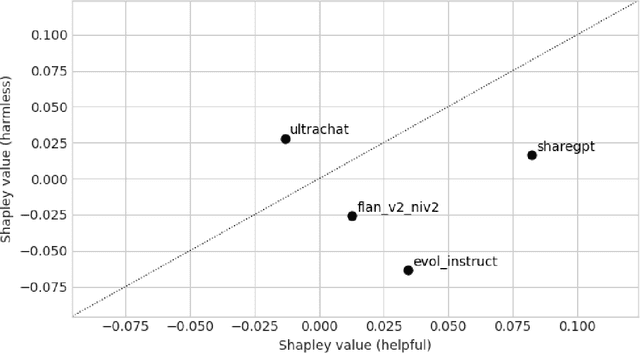
Data is a critical asset for training large language models (LLMs), alongside compute resources and skilled workers. While some training data is publicly available, substantial investment is required to generate proprietary datasets, such as human preference annotations or to curate new ones from existing sources. As larger datasets generally yield better model performance, two natural questions arise. First, how can data owners make informed decisions about curation strategies and data sources investment? Second, how can multiple data owners collaboratively pool their resources to train superior models while fairly distributing the benefits? This problem, data valuation, which is not specific to large language models, has been addressed by the machine learning community through the lens of cooperative game theory, with the Shapley value being the prevalent solution concept. However, computing Shapley values is notoriously expensive for data valuation, typically requiring numerous model retrainings, which can become prohibitive for large machine learning models. In this work, we demonstrate that this computational challenge is dramatically simplified for LLMs trained with Direct Preference Optimization (DPO). We show how the specific mathematical structure of DPO enables scalable Shapley value computation. We believe this observation unlocks many applications at the intersection of data valuation and large language models.
Off-Policy Learning in Large Action Spaces: Optimization Matters More Than Estimation
Sep 03, 2025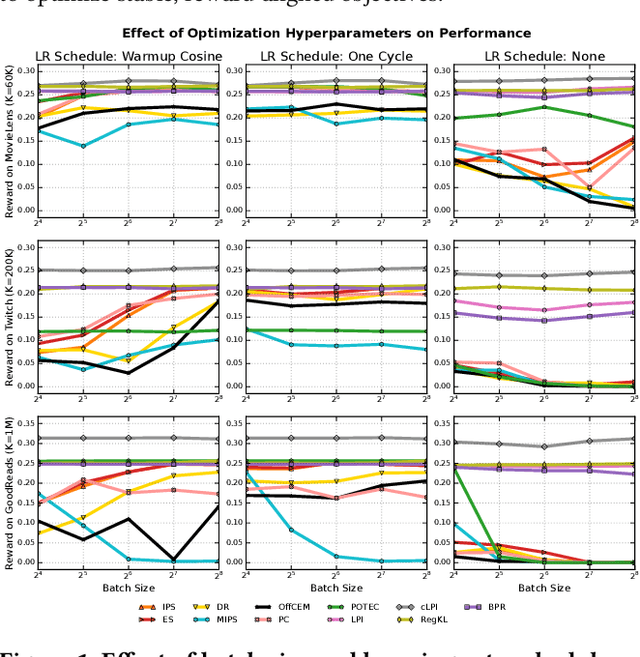
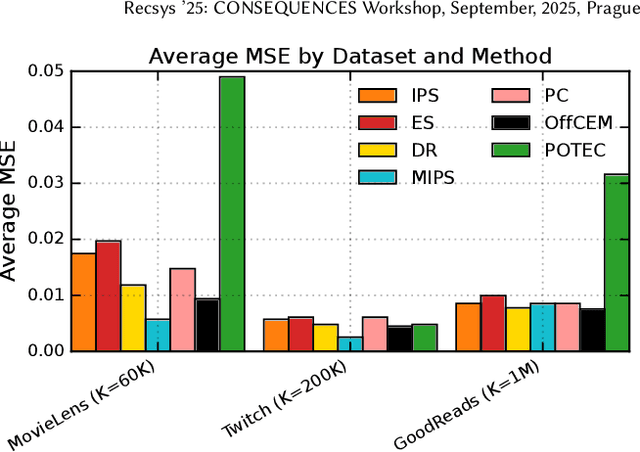

Off-policy evaluation (OPE) and off-policy learning (OPL) are foundational for decision-making in offline contextual bandits. Recent advances in OPL primarily optimize OPE estimators with improved statistical properties, assuming that better estimators inherently yield superior policies. Although theoretically justified, we argue this estimator-centric approach neglects a critical practical obstacle: challenging optimization landscapes. In this paper, we provide theoretical insights and extensive empirical evidence showing that current OPL methods encounter severe optimization issues, particularly as action spaces become large. We demonstrate that simpler weighted log-likelihood objectives enjoy substantially better optimization properties and still recover competitive, often superior, learned policies. Our findings emphasize the necessity of explicitly addressing optimization considerations in the development of OPL algorithms for large action spaces.
Non-Linear Counterfactual Aggregate Optimization
Sep 03, 2025We consider the problem of directly optimizing a non-linear function of an outcome, where this outcome itself is the sum of many small contributions. The non-linearity of the function means that the problem is not equivalent to the maximization of the expectation of the individual contribution. By leveraging the concentration properties of the sum of individual outcomes, we derive a scalable descent algorithm that directly optimizes for our stated objective. This allows for instance to maximize the probability of successful A/B test, for which it can be wiser to target a success criterion, such as exceeding a given uplift, rather than chasing the highest expected payoff.
Logarithmic Smoothing for Adaptive PAC-Bayesian Off-Policy Learning
Jun 12, 2025Off-policy learning serves as the primary framework for learning optimal policies from logged interactions collected under a static behavior policy. In this work, we investigate the more practical and flexible setting of adaptive off-policy learning, where policies are iteratively refined and re-deployed to collect higher-quality data. Building on the success of PAC-Bayesian learning with Logarithmic Smoothing (LS) in static settings, we extend this framework to the adaptive scenario using tools from online PAC-Bayesian theory. Furthermore, we demonstrate that a principled adjustment to the LS estimator naturally accommodates multiple rounds of deployment and yields faster convergence rates under mild conditions. Our method matches the performance of leading offline approaches in static settings, and significantly outperforms them when intermediate policy deployments are allowed. Empirical evaluations across diverse scenarios highlight both the advantages of adaptive data collection and the strength of the PAC-Bayesian formulation.
Logarithmic Smoothing for Pessimistic Off-Policy Evaluation, Selection and Learning
May 23, 2024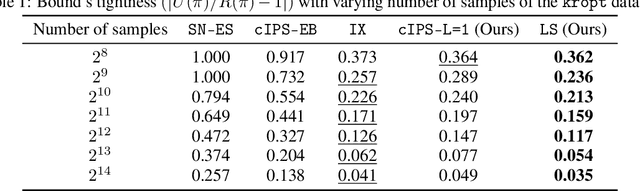
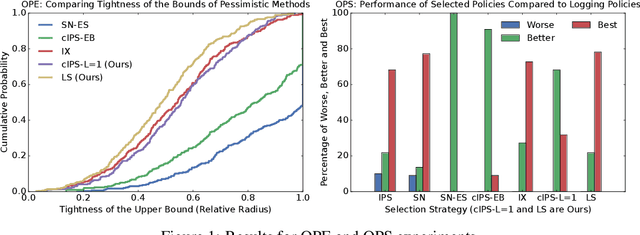

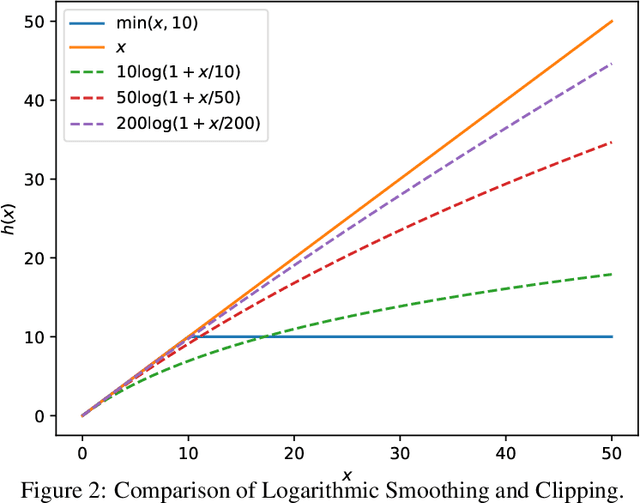
This work investigates the offline formulation of the contextual bandit problem, where the goal is to leverage past interactions collected under a behavior policy to evaluate, select, and learn new, potentially better-performing, policies. Motivated by critical applications, we move beyond point estimators. Instead, we adopt the principle of pessimism where we construct upper bounds that assess a policy's worst-case performance, enabling us to confidently select and learn improved policies. Precisely, we introduce novel, fully empirical concentration bounds for a broad class of importance weighting risk estimators. These bounds are general enough to cover most existing estimators and pave the way for the development of new ones. In particular, our pursuit of the tightest bound within this class motivates a novel estimator (LS), that logarithmically smooths large importance weights. The bound for LS is provably tighter than all its competitors, and naturally results in improved policy selection and learning strategies. Extensive policy evaluation, selection, and learning experiments highlight the versatility and favorable performance of LS.
Fast Slate Policy Optimization: Going Beyond Plackett-Luce
Aug 03, 2023An increasingly important building block of large scale machine learning systems is based on returning slates; an ordered lists of items given a query. Applications of this technology include: search, information retrieval and recommender systems. When the action space is large, decision systems are restricted to a particular structure to complete online queries quickly. This paper addresses the optimization of these large scale decision systems given an arbitrary reward function. We cast this learning problem in a policy optimization framework and propose a new class of policies, born from a novel relaxation of decision functions. This results in a simple, yet efficient learning algorithm that scales to massive action spaces. We compare our method to the commonly adopted Plackett-Luce policy class and demonstrate the effectiveness of our approach on problems with action space sizes in the order of millions.
PAC-Bayesian Offline Contextual Bandits With Guarantees
Oct 24, 2022
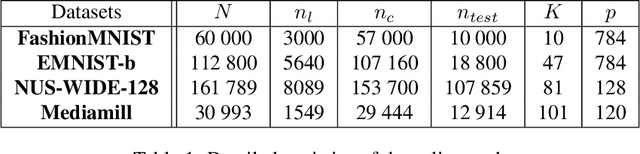


This paper introduces a new principled approach for offline policy optimisation in contextual bandits. For two well-established risk estimators, we propose novel generalisation bounds able to confidently improve upon the logging policy offline. Unlike previous work, our approach does not require tuning hyperparameters on held-out sets, and enables deployment with no prior A/B testing. This is achieved by analysing the problem through the PAC-Bayesian lens; mainly, we let go of traditional policy parametrisation (e.g. softmax) and instead interpret the policies as mixtures of deterministic strategies. We demonstrate through extensive experiments evidence of our bounds tightness and the effectiveness of our approach in practical scenarios.