 Add to Chrome
 Add to Firefox
 Add to Edge
Data Valuation for LLM Fine-Tuning: Efficient Shapley Value Approximation via Language Model Arithmetic
Dec 12, 2025
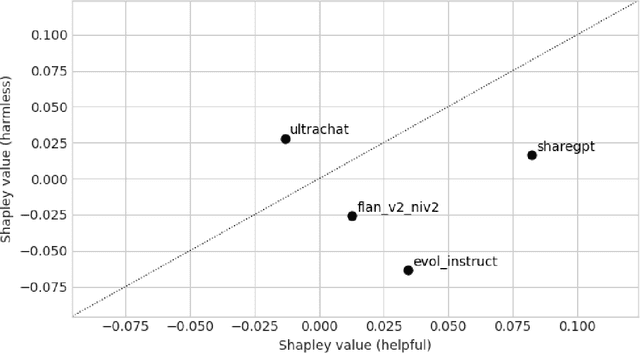
Data is a critical asset for training large language models (LLMs), alongside compute resources and skilled workers. While some training data is publicly available, substantial investment is required to generate proprietary datasets, such as human preference annotations or to curate new ones from existing sources. As larger datasets generally yield better model performance, two natural questions arise. First, how can data owners make informed decisions about curation strategies and data sources investment? Second, how can multiple data owners collaboratively pool their resources to train superior models while fairly distributing the benefits? This problem, data valuation, which is not specific to large language models, has been addressed by the machine learning community through the lens of cooperative game theory, with the Shapley value being the prevalent solution concept. However, computing Shapley values is notoriously expensive for data valuation, typically requiring numerous model retrainings, which can become prohibitive for large machine learning models. In this work, we demonstrate that this computational challenge is dramatically simplified for LLMs trained with Direct Preference Optimization (DPO). We show how the specific mathematical structure of DPO enables scalable Shapley value computation. We believe this observation unlocks many applications at the intersection of data valuation and large language models.

On the Impact of the Utility in Semivalue-based Data Valuation
Feb 10, 2025Semivalue-based data valuation in machine learning (ML) quantifies the contribution of individual data points to a downstream ML task by leveraging principles from cooperative game theory and the notion of utility. While this framework has been used in practice for assessing data quality, our experiments reveal inconsistent valuation outcomes across different utilities, albeit all related to ML performance. Beyond raising concerns about the reliability of data valuation, this inconsistency is challenging to interpret, as it stems from the complex interaction of the utility with data points and semivalue weights, which has barely been studied in prior work. In this paper, we take a first step toward clarifying the utility impact on semivalue-based data valuation. Specifically, we provide geometric interpretations of this impact for a broad family of classification utilities, which includes the accuracy and the arithmetic mean. We introduce the notion of spatial signatures: given a semivalue, data points can be embedded into a two-dimensional space, and utility functions map to the dual of this space. This geometric perspective separates the influence of the dataset and semivalue from that of the utility, providing a theoretical explanation for the experimentally observed sensitivity of valuation outcomes to the utility choice.