 Add to Chrome
 Add to Firefox
 Add to Edge
Concepts_in_deep_learning_solutions
Papers and Code
Toward Aristotelian Medical Representations: Backpropagation-Free Layer-wise Analysis for Interpretable Generalized Metric Learning on MedMNIST
Apr 07, 2026
While deep learning has achieved remarkable success in medical imaging, the "black-box" nature of backpropagation-based models remains a significant barrier to clinical adoption. To bridge this gap, we propose Aristotelian Rapid Object Modeling (A-ROM), a framework built upon the Platonic Representation Hypothesis (PRH). This hypothesis posits that models trained on vast, diverse datasets converge toward a universal and objective representation of reality. By leveraging the generalizable metric space of pretrained Vision Transformers (ViTs), A-ROM enables the rapid modeling of novel medical concepts without the computational burden or opacity of further gradient-based fine-tuning. We replace traditional, opaque decision layers with a human-readable concept dictionary and a k-Nearest Neighbors (kNN) classifier to ensure the model's logic remains interpretable. Experiments on the MedMNIST v2 suite demonstrate that A-ROM delivers performance competitive with standard benchmarks while providing a simple and scalable, "few-shot" solution that meets the rigorous transparency demands of modern clinical environments.

Physics-Informed Untrained Learning for RGB-Guided Superresolution Single-Pixel Hyperspectral Imaging
Apr 04, 2026Single-pixel imaging (SPI) offers a cost-effective route to hyperspectral acquisition but struggles to recover high-fidelity spatial and spectral details under extremely low sampling rates, a severely ill-posed inverse problem. While deep learning has shown potential, existing data-driven methods demand large-scale pretraining datasets that are often impractical in hyperspectral imaging. To overcome this limitation, we propose an end-to-end physics-informed framework that leverages untrained neural networks and RGB guidance for joint hyperspectral reconstruction and super-resolution without any external training data. The framework comprises three physically grounded stages: (1) a Regularized Least-Squares method with RGB-derived Grayscale Priors (LS-RGP) that initializes the solution by exploiting cross-modal structural correlations; (2) an Untrained Hyperspectral Recovery Network (UHRNet) that refines the reconstruction through measurement consistency and hybrid regularization; and (3) a Transformer-based Untrained Super-Resolution Network (USRNet) that upsamples the spatial resolution via cross-modal attention, transferring high-frequency details from the RGB guide. Extensive experiments on benchmark datasets demonstrate that our approach significantly surpasses state-of-the-art algorithms in both reconstruction accuracy and spectral fidelity. Moreover, a proof-of-concept experiment using a physical single-pixel imaging system validates the framework's practical applicability, successfully reconstructing a 144-band hyperspectral data cube at a mere 6.25% sampling rate. The proposed method thus provides a robust, data-efficient solution for computational hyperspectral imaging.
Wavelength-multiplexed massively parallel diffractive optical information storage and image projection
Apr 03, 2026We introduce a wavelength-multiplexed massively parallel diffractive information storage platform composed of dielectric surfaces that are structurally optimized at the wavelength scale using deep learning to store and project thousands of distinct image patterns, each assigned to a unique wavelength. Through numerical simulations in the visible spectrum, we demonstrated that our wavelength-multiplexed diffractive system can store and project over 4,000 independent desired images/patterns within its output field-of-view, with high image quality and minimal crosstalk between spectral channels. Furthermore, in a proof-of-concept experiment, we demonstrated a two-layer diffractive design that stored six distinct patterns and projected them onto the same output field of view at six different wavelengths (500, 548, 596, 644, 692, and 740 nm). This diffractive architecture is scalable and can operate at various parts of the electromagnetic spectrum without the need for material dispersion engineering or redesigning its optimized diffractive layers. The demonstrated storage capacity, reconstruction image fidelity, and wavelength-encoded massively parallel read-out of our diffractive platform offer a compact and fast-access solution for large-scale optical information storage, image projection applications.
TA-RNN-Medical-Hybrid: A Time-Aware and Interpretable Framework for Mortality Risk Prediction
Mar 09, 2026Accurate and interpretable mortality risk prediction in intensive care units (ICUs) remains a critical challenge due to the irregular temporal structure of electronic health records (EHRs), the complexity of longitudinal disease trajectories, and the lack of clinically grounded explanations in many data-driven models. To address these challenges, we propose \textit{TA-RNN-Medical-Hybrid}, a time-aware and knowledge-enriched deep learning framework that jointly models longitudinal clinical sequences and irregular temporal dynamics through explicit continuous-time encoding, along with standardized medical concept representations. The proposed framework extends time-aware recurrent modeling by integrating explicit continuous-time embeddings that operate independently of visit indexing, SNOMED-based disease representations, and a hierarchical dual-level attention mechanism that captures both visit-level temporal importance and feature/concept-level clinical relevance. This design enables accurate mortality risk estimation while providing transparent and clinically meaningful explanations aligned with established medical knowledge. We evaluate the proposed approach on the MIMIC-III critical care dataset and compare it against strong time-aware and sequential baselines. Experimental results demonstrate that TA-RNN-Medical-Hybrid consistently improves predictive performance in terms of AUC, accuracy, and recall-oriented F$_2$-score. Moreover, qualitative analysis shows that the model effectively decomposes mortality risk across time and clinical concepts, yielding interpretable insights into disease severity, chronicity, and temporal progression. Overall, the proposed framework bridges the gap between predictive accuracy and clinical interpretability, offering a scalable and transparent solution for high-stakes ICU decision support systems.
Metasurfaces-Integrated Wireless Neural Networks for Lightweight Over-The-Air Edge Inference
Feb 22, 2026The upcoming sixth Generation (6G) of wireless networks envisions ultra-low latency and energy efficient Edge Inference (EI) for diverse Internet of Things (IoT) applications. However, traditional digital hardware for machine learning is power intensive, motivating the need for alternative computation paradigms. Over-The-Air (OTA) computation is regarded as an emerging transformative approach assigning the wireless channel to actively perform computational tasks. This article introduces the concept of Metasurfaces-Integrated Neural Networks (MINNs), a physical-layer-enabled deep learning framework that leverages programmable multi-layer metasurface structures and Multiple-Input Multiple-Output (MIMO) channels to realize computational layers in the wave propagation domain. The MINN system is conceptualized as three modules: Encoder, Channel (uncontrollable propagation features and metasurfaces), and Decoder. The first and last modules, realized respectively at the multi-antenna transmitter and receiver, consist of conventional digital or purposely designed analog Deep Neural Network (DNN) layers, and the metasurfaces responses of the Channel module are optimized alongside all modules as trainable weights. This architecture enables computation offloading into the end-to-end physical layer, flexibly among its constituent modules, achieving performance comparable to fully digital DNNs while significantly reducing power consumption. The training of the MINN framework, two representative variations, and performance results for indicative applications are presented, highlighting the potential of MINNs as a lightweight and sustainable solution for future EI-enabled wireless systems. The article is concluded with a list of open challenges and promising research directions.
Ensemble-size-dependence of deep-learning post-processing methods that minimize an (un)fair score: motivating examples and a proof-of-concept solution
Feb 17, 2026Fair scores reward ensemble forecast members that behave like samples from the same distribution as the verifying observations. They are therefore an attractive choice as loss functions to train data-driven ensemble forecasts or post-processing methods when large training ensembles are either unavailable or computationally prohibitive. The adjusted continuous ranked probability score (aCRPS) is fair and unbiased with respect to ensemble size, provided forecast members are exchangeable and interpretable as conditionally independent draws from an underlying predictive distribution. However, distribution-aware post-processing methods that introduce structural dependency between members can violate this assumption, rendering aCRPS unfair. We demonstrate this effect using two approaches designed to minimize the expected aCRPS of a finite ensemble: (1) a linear member-by-member calibration, which couples members through a common dependency on the sample ensemble mean, and (2) a deep-learning method, which couples members via transformer self-attention across the ensemble dimension. In both cases, the results are sensitive to ensemble size and apparent gains in aCRPS can correspond to systematic unreliability characterized by over-dispersion. We introduce trajectory transformers as a proof-of-concept that ensemble-size independence can be achieved. This approach is an adaptation of the Post-processing Ensembles with Transformers (PoET) framework and applies self-attention over lead time while preserving the conditional independence required by aCRPS. When applied to weekly mean $T_{2m}$ forecasts from the ECMWF subseasonal forecasting system, this approach successfully reduces systematic model biases whilst also improving or maintaining forecast reliability regardless of the ensemble size used in training (3 vs 9 members) or real-time forecasts (9 vs 100 members).
SymbXRL: Symbolic Explainable Deep Reinforcement Learning for Mobile Networks
Jan 29, 2026The operation of future 6th-generation (6G) mobile networks will increasingly rely on the ability of deep reinforcement learning (DRL) to optimize network decisions in real-time. DRL yields demonstrated efficacy in various resource allocation problems, such as joint decisions on user scheduling and antenna allocation or simultaneous control of computing resources and modulation. However, trained DRL agents are closed-boxes and inherently difficult to explain, which hinders their adoption in production settings. In this paper, we make a step towards removing this critical barrier by presenting SymbXRL, a novel technique for explainable reinforcement learning (XRL) that synthesizes human-interpretable explanations for DRL agents. SymbXRL leverages symbolic AI to produce explanations where key concepts and their relationships are described via intuitive symbols and rules; coupling such a representation with logical reasoning exposes the decision process of DRL agents and offers more comprehensible descriptions of their behaviors compared to existing approaches. We validate SymbXRL in practical network management use cases supported by DRL, proving that it not only improves the semantics of the explanations but also paves the way for explicit agent control: for instance, it enables intent-based programmatic action steering that improves by 12% the median cumulative reward over a pure DRL solution.
* 10 pages, 9 figures, published in IEEE INFOCOM 2025
Coordinate Matrix Machine: A Human-level Concept Learning to Classify Very Similar Documents
Dec 26, 2025Human-level concept learning argues that humans typically learn new concepts from a single example, whereas machine learning algorithms typically require hundreds of samples to learn a single concept. Our brain subconsciously identifies important features and learns more effectively. \vspace*{6pt} Contribution: In this paper, we present the Coordinate Matrix Machine (CM$^2$). This purpose-built small model augments human intelligence by learning document structures and using this information to classify documents. While modern "Red AI" trends rely on massive pre-training and energy-intensive GPU infrastructure, CM$^2$ is designed as a Green AI solution. It achieves human-level concept learning by identifying only the structural "important features" a human would consider, allowing it to classify very similar documents using only one sample per class. Advantage: Our algorithm outperforms traditional vectorizers and complex deep learning models that require larger datasets and significant compute. By focusing on structural coordinates rather than exhaustive semantic vectors, CM$^2$ offers: 1. High accuracy with minimal data (one-shot learning) 2. Geometric and structural intelligence 3. Green AI and environmental sustainability 4. Optimized for CPU-only environments 5. Inherent explainability (glass-box model) 6. Faster computation and low latency 7. Robustness against unbalanced classes 8. Economic viability 9. Generic, expandable, and extendable
TWLR: Text-Guided Weakly-Supervised Lesion Localization and Severity Regression for Explainable Diabetic Retinopathy Grading
Dec 15, 2025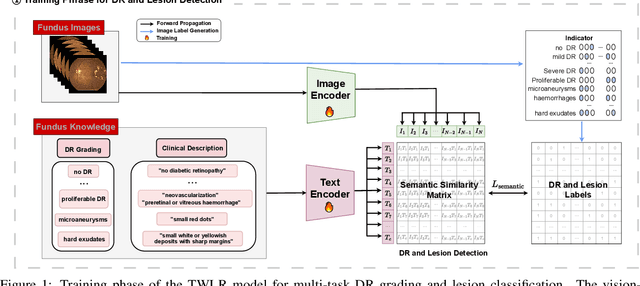

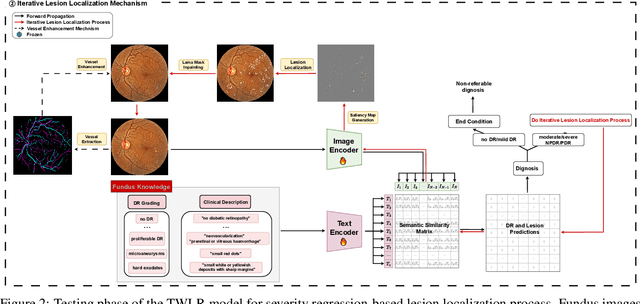
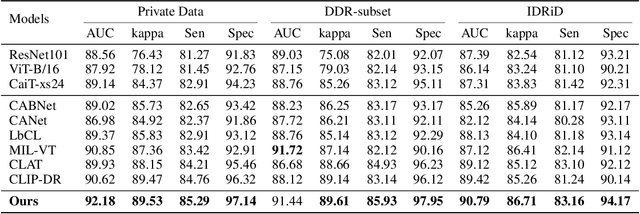
Accurate medical image analysis can greatly assist clinical diagnosis, but its effectiveness relies on high-quality expert annotations Obtaining pixel-level labels for medical images, particularly fundus images, remains costly and time-consuming. Meanwhile, despite the success of deep learning in medical imaging, the lack of interpretability limits its clinical adoption. To address these challenges, we propose TWLR, a two-stage framework for interpretable diabetic retinopathy (DR) assessment. In the first stage, a vision-language model integrates domain-specific ophthalmological knowledge into text embeddings to jointly perform DR grading and lesion classification, effectively linking semantic medical concepts with visual features. The second stage introduces an iterative severity regression framework based on weakly-supervised semantic segmentation. Lesion saliency maps generated through iterative refinement direct a progressive inpainting mechanism that systematically eliminates pathological features, effectively downgrading disease severity toward healthier fundus appearances. Critically, this severity regression approach achieves dual benefits: accurate lesion localization without pixel-level supervision and providing an interpretable visualization of disease-to-healthy transformations. Experimental results on the FGADR, DDR, and a private dataset demonstrate that TWLR achieves competitive performance in both DR classification and lesion segmentation, offering a more explainable and annotation-efficient solution for automated retinal image analysis.
Synthetic Swarm Mosquito Dataset for Acoustic Classification: A Proof of Concept
Dec 13, 2025Mosquito-borne diseases pose a serious global health threat, causing over 700,000 deaths annually. This work introduces a proof-of-concept Synthetic Swarm Mosquito Dataset for Acoustic Classification, created to simulate realistic multi-species and noisy swarm conditions. Unlike conventional datasets that require labor-intensive recording of individual mosquitoes, the synthetic approach enables scalable data generation while reducing human resource demands. Using log-mel spectrograms, we evaluated lightweight deep learning architectures for the classification of mosquito species. Experiments show that these models can effectively identify six major mosquito vectors and are suitable for deployment on embedded low-power devices. The study demonstrates the potential of synthetic swarm audio datasets to accelerate acoustic mosquito research and enable scalable real-time surveillance solutions.