 Add to Chrome
 Add to Firefox
 Add to Edge
Wavelength-multiplexed massively parallel diffractive optical information storage and image projection
Apr 03, 2026
We introduce a wavelength-multiplexed massively parallel diffractive information storage platform composed of dielectric surfaces that are structurally optimized at the wavelength scale using deep learning to store and project thousands of distinct image patterns, each assigned to a unique wavelength. Through numerical simulations in the visible spectrum, we demonstrated that our wavelength-multiplexed diffractive system can store and project over 4,000 independent desired images/patterns within its output field-of-view, with high image quality and minimal crosstalk between spectral channels. Furthermore, in a proof-of-concept experiment, we demonstrated a two-layer diffractive design that stored six distinct patterns and projected them onto the same output field of view at six different wavelengths (500, 548, 596, 644, 692, and 740 nm). This diffractive architecture is scalable and can operate at various parts of the electromagnetic spectrum without the need for material dispersion engineering or redesigning its optimized diffractive layers. The demonstrated storage capacity, reconstruction image fidelity, and wavelength-encoded massively parallel read-out of our diffractive platform offer a compact and fast-access solution for large-scale optical information storage, image projection applications.

Unidirectional imaging with partially coherent light
Aug 10, 2024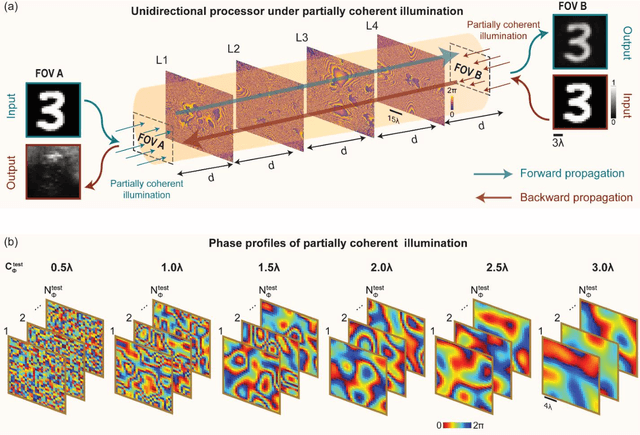

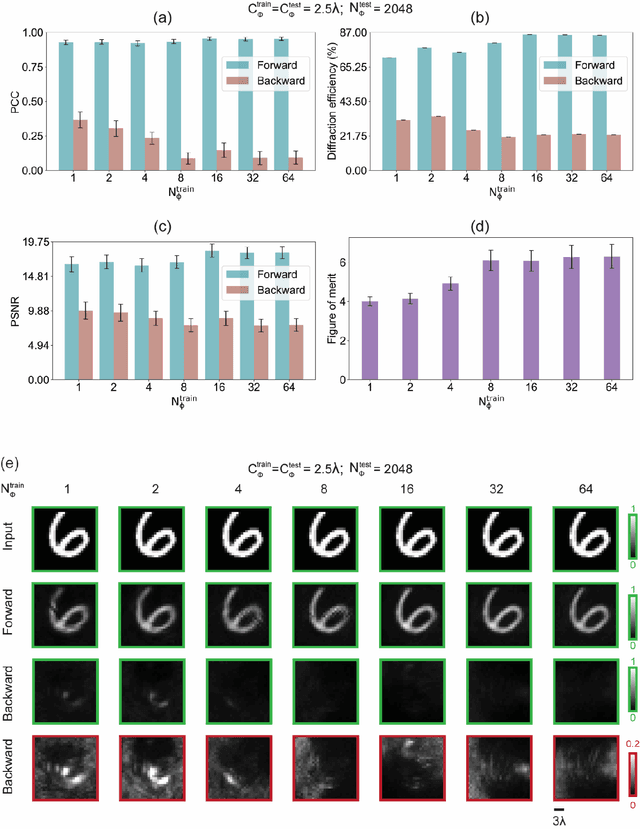
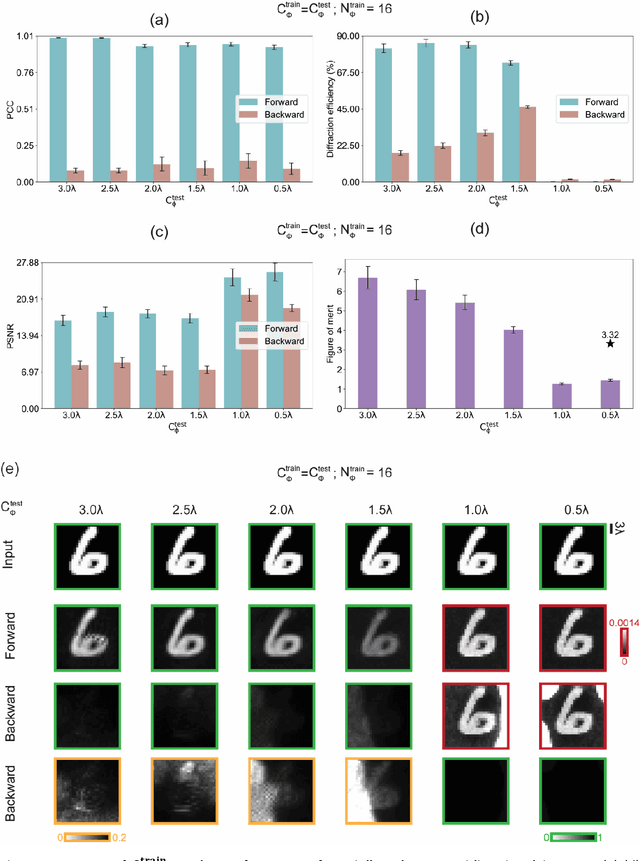
Unidirectional imagers form images of input objects only in one direction, e.g., from field-of-view (FOV) A to FOV B, while blocking the image formation in the reverse direction, from FOV B to FOV A. Here, we report unidirectional imaging under spatially partially coherent light and demonstrate high-quality imaging only in the forward direction (A->B) with high power efficiency while distorting the image formation in the backward direction (B->A) along with low power efficiency. Our reciprocal design features a set of spatially engineered linear diffractive layers that are statistically optimized for partially coherent illumination with a given phase correlation length. Our analyses reveal that when illuminated by a partially coherent beam with a correlation length of ~1.5 w or larger, where w is the wavelength of light, diffractive unidirectional imagers achieve robust performance, exhibiting asymmetric imaging performance between the forward and backward directions - as desired. A partially coherent unidirectional imager designed with a smaller correlation length of less than 1.5 w still supports unidirectional image transmission, but with a reduced figure of merit. These partially coherent diffractive unidirectional imagers are compact (axially spanning less than 75 w), polarization-independent, and compatible with various types of illumination sources, making them well-suited for applications in asymmetric visual information processing and communication.