 Add to Chrome
 Add to Firefox
 Add to Edge
StageGuard: Physiologically Constrained Sleep Staging
Jul 25, 2026
Automated sleep staging is increasingly used in large-scale studies to derive sleep-architecture endpoints: total sleep time, REM latency, sleep efficiency, and bout-duration statistics. Deep learning models achieve epoch-level accuracy approaching inter-rater agreement, yet often produce hypnograms that violate physiological invariants, such as rare transitions (e.g., direct Wake -> REM) or excessively fragmented sequences. Such violations can bias downstream sleep metrics, regardless of overall accuracy. We propose StageGuard, a plug-and-play, backbone-agnostic structured-inference framework that wraps any neural sleep-staging backbone with physiology-informed priors. StageGuard combines (1) a differentiable soft transition penalty that discourages physiologically rare transitions during training, and (2) a semi-Markov constrained decoder with a duration-augmented state space that jointly enforces transition penalties and minimum bout durations at inference. Unlike hard-prohibition methods, it admits rare transitions when emission evidence is overwhelming, leaving informative pathological events recoverable rather than blocked. StageGuard constrains staging outputs to satisfy known physiological priors rather than modeling sleep generatively. We quantify the validity gap using transition-violation rate (TVR) and fragmentation index (FI) and demonstrate that, across six backbones and four datasets, StageGuard reduces TVR to physiologically plausible levels and lowers FI by 56-62%, while maintaining or slightly improving classification accuracy. Crucially, improved constraint satisfaction translates into 59-79% lower error on derived sleep-architecture statistics not directly optimized by the method, and recovers the direction and effect size of expert-defined subgroup differences (OSA severity, age) more faithfully than the unconstrained baseline.

TabLoRA: Parameter-Efficient Low-Rank Ensemble Learning for Large-Scale Tabular Data
Jul 11, 2026Tabular learning is still dominated by gradient-boosted decision trees (GBDTs), while recent deep learning approaches have become increasingly competitive. However, applying deep tabular models to large-scale datasets remains challenging, as large sample sizes, high feature dimensionality, or many target classes can introduce substantial computational cost. We propose TabLoRA, a parameter-efficient trainable neural ensemble for large-scale tabular learning. Instead of using fully independent ensemble backbones, TabLoRA shares a common backbone across predictors and introduces predictor-specific low-rank adaptations, enabling ensemble-style prediction without full parameter duplication. Across benchmarks, TabLoRA achieves a favorable balance between predictive performance and practical efficiency compared with GBDT methods and recent deep learning baselines under the same resource constraints. Memory analysis and ablation studies further show that the proposed design improves the feasibility of neural ensemble learning while preserving much of the benefit of full ensembles.
TWLR: Text-Guided Weakly-Supervised Lesion Localization and Severity Regression for Explainable Diabetic Retinopathy Grading
Dec 15, 2025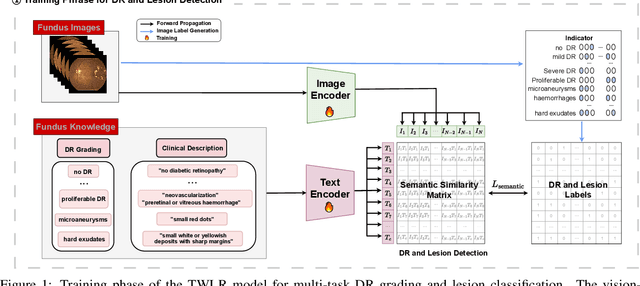

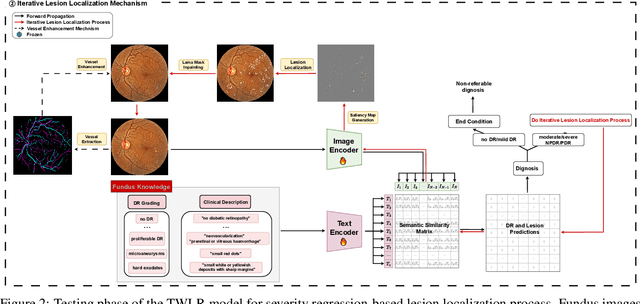
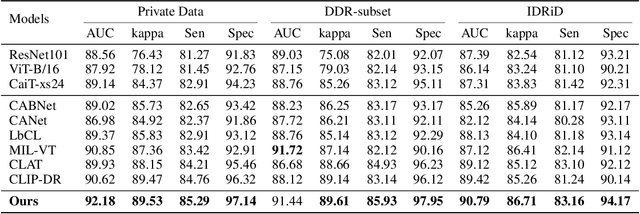
Accurate medical image analysis can greatly assist clinical diagnosis, but its effectiveness relies on high-quality expert annotations Obtaining pixel-level labels for medical images, particularly fundus images, remains costly and time-consuming. Meanwhile, despite the success of deep learning in medical imaging, the lack of interpretability limits its clinical adoption. To address these challenges, we propose TWLR, a two-stage framework for interpretable diabetic retinopathy (DR) assessment. In the first stage, a vision-language model integrates domain-specific ophthalmological knowledge into text embeddings to jointly perform DR grading and lesion classification, effectively linking semantic medical concepts with visual features. The second stage introduces an iterative severity regression framework based on weakly-supervised semantic segmentation. Lesion saliency maps generated through iterative refinement direct a progressive inpainting mechanism that systematically eliminates pathological features, effectively downgrading disease severity toward healthier fundus appearances. Critically, this severity regression approach achieves dual benefits: accurate lesion localization without pixel-level supervision and providing an interpretable visualization of disease-to-healthy transformations. Experimental results on the FGADR, DDR, and a private dataset demonstrate that TWLR achieves competitive performance in both DR classification and lesion segmentation, offering a more explainable and annotation-efficient solution for automated retinal image analysis.
Brain-Inspired Perspective on Configurations: Unsupervised Similarity and Early Cognition
Oct 22, 2025Infants discover categories, detect novelty, and adapt to new contexts without supervision -- a challenge for current machine learning. We present a brain-inspired perspective on configurations, a finite-resolution clustering framework that uses a single resolution parameter and attraction-repulsion dynamics to yield hierarchical organization, novelty sensitivity, and flexible adaptation. To evaluate these properties, we introduce mheatmap, which provides proportional heatmaps and a reassignment algorithm to fairly assess multi-resolution and dynamic behavior. Across datasets, configurations are competitive on standard clustering metrics, achieve 87% AUC in novelty detection, and show 35% better stability during dynamic category evolution. These results position configurations as a principled computational model of early cognitive categorization and a step toward brain-inspired AI.
Mixing Configurations for Downstream Prediction
Oct 22, 2025Humans possess an innate ability to group objects by similarity, a cognitive mechanism that clustering algorithms aim to emulate. Recent advances in community detection have enabled the discovery of configurations -- valid hierarchical clusterings across multiple resolution scales -- without requiring labeled data. In this paper, we formally characterize these configurations and identify similar emergent structures in register tokens within Vision Transformers. Unlike register tokens, configurations exhibit lower redundancy and eliminate the need for ad hoc selection. They can be learned through unsupervised or self-supervised methods, yet their selection or composition remains specific to the downstream task and input. Building on these insights, we introduce GraMixC, a plug-and-play module that extracts configurations, aligns them using our Reverse Merge/Split (RMS) technique, and fuses them via attention heads before forwarding them to any downstream predictor. On the DSN1 16S rRNA cultivation-media prediction task, GraMixC improves the R2 score from 0.6 to 0.9 across multiple methods, setting a new state of the art. We further validate GraMixC on standard tabular benchmarks, where it consistently outperforms single-resolution and static-feature baselines.
Beyond 1D: Vision Transformers and Multichannel Signal Images for PPG-to-ECG Reconstruction
May 27, 2025Reconstructing ECG from PPG is a promising yet challenging task. While recent advancements in generative models have significantly improved ECG reconstruction, accurately capturing fine-grained waveform features remains a key challenge. To address this, we propose a novel PPG-to-ECG reconstruction method that leverages a Vision Transformer (ViT) as the core network. Unlike conventional approaches that rely on single-channel PPG, our method employs a four-channel signal image representation, incorporating the original PPG, its first-order difference, second-order difference, and area under the curve. This multi-channel design enriches feature extraction by preserving both temporal and physiological variations within the PPG. By leveraging the self-attention mechanism in ViT, our approach effectively captures both inter-beat and intra-beat dependencies, leading to more robust and accurate ECG reconstruction. Experimental results demonstrate that our method consistently outperforms existing 1D convolution-based approaches, achieving up to 29% reduction in PRD and 15% reduction in RMSE. The proposed approach also produces improvements in other evaluation metrics, highlighting its robustness and effectiveness in reconstructing ECG signals. Furthermore, to ensure a clinically relevant evaluation, we introduce new performance metrics, including QRS area error, PR interval error, RT interval error, and RT amplitude difference error. Our findings suggest that integrating a four-channel signal image representation with the self-attention mechanism of ViT enables more effective extraction of informative PPG features and improved modeling of beat-to-beat variations for PPG-to-ECG mapping. Beyond demonstrating the potential of PPG as a viable alternative for heart activity monitoring, our approach opens new avenues for cyclic signal analysis and prediction.
CLEP-GAN: An Innovative Approach to Subject-Independent ECG Reconstruction from PPG Signals
Feb 24, 2025
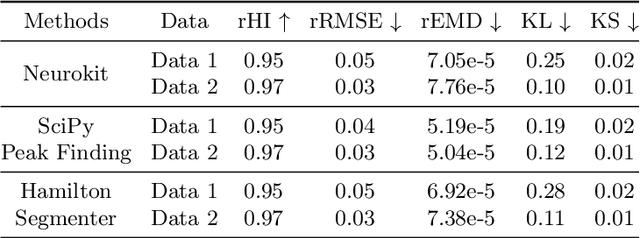

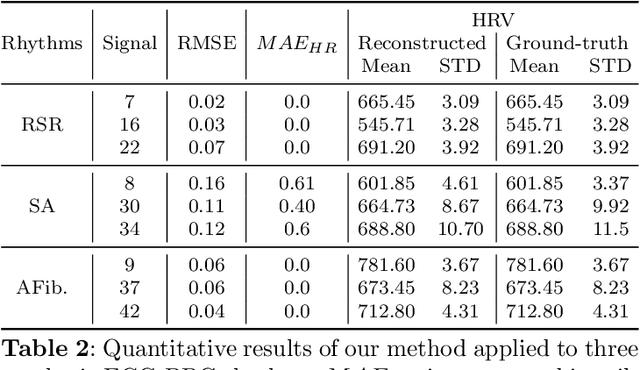
This study addresses the challenge of reconstructing unseen ECG signals from PPG signals, a critical task for non-invasive cardiac monitoring. While numerous public ECG-PPG datasets are available, they lack the diversity seen in image datasets, and data collection processes often introduce noise, complicating ECG reconstruction from PPG even with advanced machine learning models. To tackle these challenges, we first introduce a novel synthetic ECG-PPG data generation technique using an ODE model to enhance training diversity. Next, we develop a novel subject-independent PPG-to-ECG reconstruction model that integrates contrastive learning, adversarial learning, and attention gating, achieving results comparable to or even surpassing existing approaches for unseen ECG reconstruction. Finally, we examine factors such as sex and age that impact reconstruction accuracy, emphasizing the importance of considering demographic diversity during model training and dataset augmentation.
An Imbalanced Learning-based Sampling Method for Physics-informed Neural Networks
Jan 20, 2025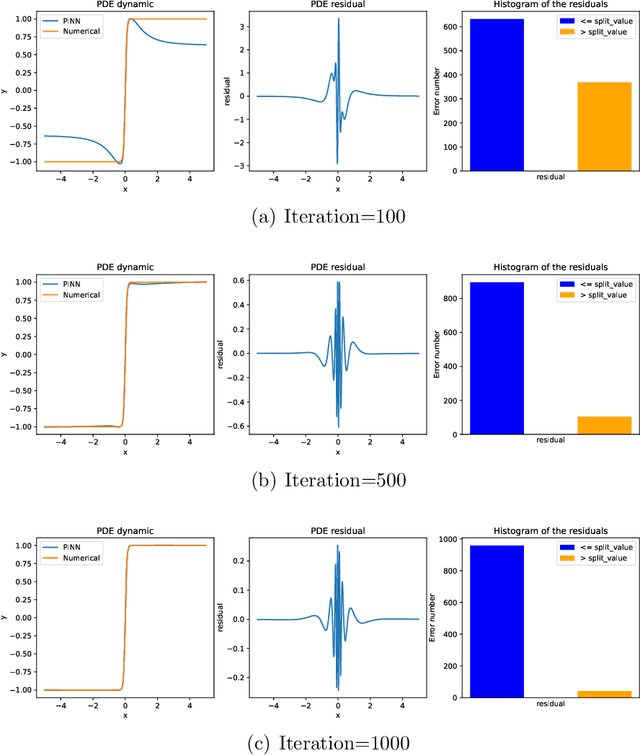
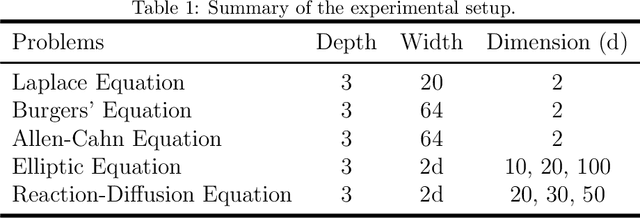
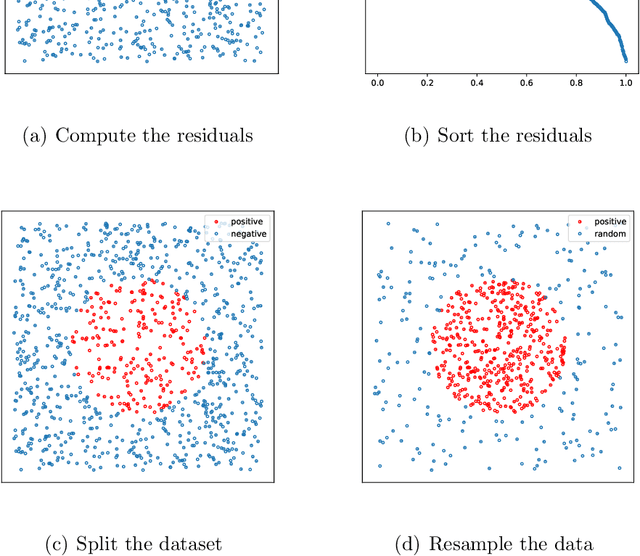

This paper introduces Residual-based Smote (RSmote), an innovative local adaptive sampling technique tailored to improve the performance of Physics-Informed Neural Networks (PINNs) through imbalanced learning strategies. Traditional residual-based adaptive sampling methods, while effective in enhancing PINN accuracy, often struggle with efficiency and high memory consumption, particularly in high-dimensional problems. RSmote addresses these challenges by targeting regions with high residuals and employing oversampling techniques from imbalanced learning to refine the sampling process. Our approach is underpinned by a rigorous theoretical analysis that supports the effectiveness of RSmote in managing computational resources more efficiently. Through extensive evaluations, we benchmark RSmote against the state-of-the-art Residual-based Adaptive Distribution (RAD) method across a variety of dimensions and differential equations. The results demonstrate that RSmote not only achieves or exceeds the accuracy of RAD but also significantly reduces memory usage, making it particularly advantageous in high-dimensional scenarios. These contributions position RSmote as a robust and resource-efficient solution for solving complex partial differential equations, especially when computational constraints are a critical consideration.
Improving GBDT Performance on Imbalanced Datasets: An Empirical Study of Class-Balanced Loss Functions
Jul 19, 2024Class imbalance remains a significant challenge in machine learning, particularly for tabular data classification tasks. While Gradient Boosting Decision Trees (GBDT) models have proven highly effective for such tasks, their performance can be compromised when dealing with imbalanced datasets. This paper presents the first comprehensive study on adapting class-balanced loss functions to three GBDT algorithms across various tabular classification tasks, including binary, multi-class, and multi-label classification. We conduct extensive experiments on multiple datasets to evaluate the impact of class-balanced losses on different GBDT models, establishing a valuable benchmark. Our results demonstrate the potential of class-balanced loss functions to enhance GBDT performance on imbalanced datasets, offering a robust approach for practitioners facing class imbalance challenges in real-world applications. Additionally, we introduce a Python package that facilitates the integration of class-balanced loss functions into GBDT workflows, making these advanced techniques accessible to a wider audience.
Gradient-flow adaptive importance sampling for Bayesian leave one out cross-validation for sigmoidal classification models
Feb 13, 2024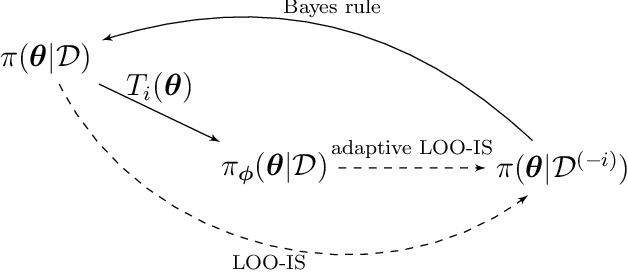
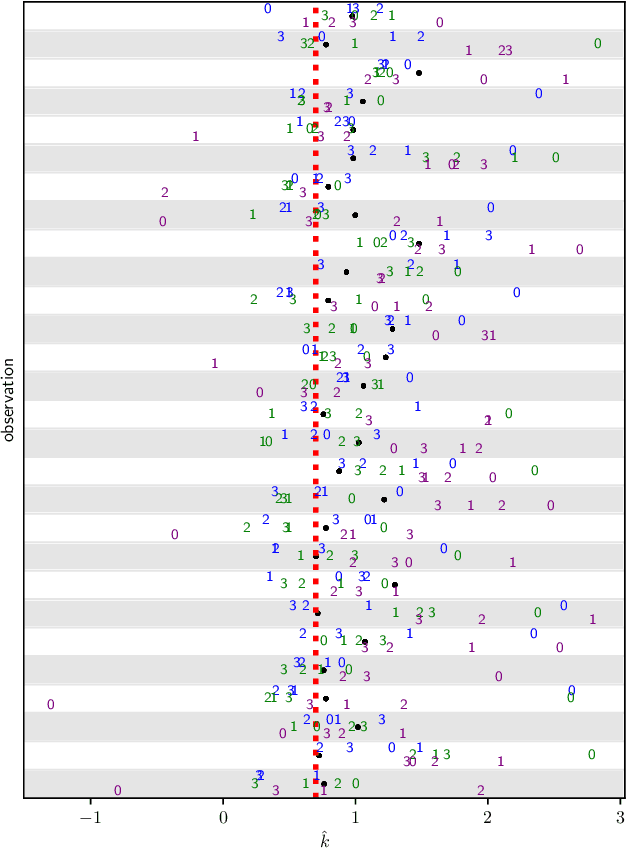
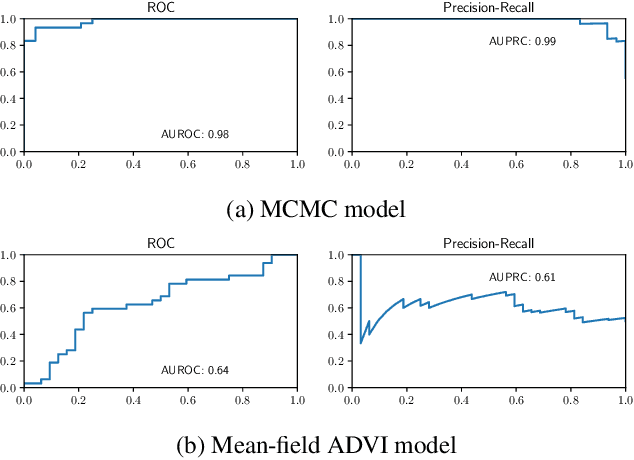
We introduce a set of gradient-flow-guided adaptive importance sampling (IS) transformations to stabilize Monte-Carlo approximations of point-wise leave one out cross-validated (LOO) predictions for Bayesian classification models. One can leverage this methodology for assessing model generalizability by for instance computing a LOO analogue to the AIC or computing LOO ROC/PRC curves and derived metrics like the AUROC and AUPRC. By the calculus of variations and gradient flow, we derive two simple nonlinear single-step transformations that utilize gradient information to shift a model's pre-trained full-data posterior closer to the target LOO posterior predictive distributions. In doing so, the transformations stabilize importance weights. Because the transformations involve the gradient of the likelihood function, the resulting Monte Carlo integral depends on Jacobian determinants with respect to the model Hessian. We derive closed-form exact formulae for these Jacobian determinants in the cases of logistic regression and shallow ReLU-activated artificial neural networks, and provide a simple approximation that sidesteps the need to compute full Hessian matrices and their spectra. We test the methodology on an $n\ll p$ dataset that is known to produce unstable LOO IS weights.