 Add to Chrome
 Add to Firefox
 Add to Edge
Learning to Distributedly Estimate under Partially Known Dynamics: A Covariance-Agnostic Neural Kalman Consensus Filter
Jun 26, 2026
Online latent state estimation constitutes a fundamental challenge within the artificial intelligence field, serving as a foundational tool for diverse applications, including sequential decision making, anomaly and change-point detection. In this paper, a novel online distributed sensing framework, where agents collaborate and exchange information to perform latent state estimation, is presented. The proposed estimator combines available partial domain knowledge with the representation capabilities of deep neural networks. In particular, the designed sensing framework incorporates prior estimates, optimized consensus weights, and Kalman-like recursive updates to perform decentralized inference, without relying on knowledge of noise statistics. Extensive experiments on linear, chaotic (Lorenz), and practical wireless tracking environments reveal that the proposed Covariance-Agnostic Neural Kalman Consensus Filter (CA-NKCF) outperforms traditional distributed Kalman and particle filters as well as purely model-free deep neural networks, exhibiting robustness even when the underlying motion and observation models are misspecified. It is also demonstrated that CA-NKCF's performance advantage remains stable across varying noise levels, random communication topologies, latent state dimensions, and observation clutter densities induced by scattering objects in wireless systems.

Control Plane for Reconfigurable Intelligent Surfaces
Mar 02, 2026Research on reconfigurable intelligent surfaces (RISs) has predominantly focused on purely physical (PHY)-layer aspects, particularly, on how signals are dynamically shaped by a controllable wireless propagation environment. However, integrating RISs as system-level network elements requires the development of an RIS-compatible control plane. In this article, we explore design options for such a control plane across two key dimensions: i) the allocation of spectral resources for the control plane (in- or out-of-band), and ii) the rate selection for the data plane (multiplexing or diversity). While our analysis is necessarily simplified, it reveals the fundamental trade-offs inherent in these design choices, which are crucial for integrating RIS technology into future networks.
Metasurfaces-Integrated Wireless Neural Networks for Lightweight Over-The-Air Edge Inference
Feb 22, 2026The upcoming sixth Generation (6G) of wireless networks envisions ultra-low latency and energy efficient Edge Inference (EI) for diverse Internet of Things (IoT) applications. However, traditional digital hardware for machine learning is power intensive, motivating the need for alternative computation paradigms. Over-The-Air (OTA) computation is regarded as an emerging transformative approach assigning the wireless channel to actively perform computational tasks. This article introduces the concept of Metasurfaces-Integrated Neural Networks (MINNs), a physical-layer-enabled deep learning framework that leverages programmable multi-layer metasurface structures and Multiple-Input Multiple-Output (MIMO) channels to realize computational layers in the wave propagation domain. The MINN system is conceptualized as three modules: Encoder, Channel (uncontrollable propagation features and metasurfaces), and Decoder. The first and last modules, realized respectively at the multi-antenna transmitter and receiver, consist of conventional digital or purposely designed analog Deep Neural Network (DNN) layers, and the metasurfaces responses of the Channel module are optimized alongside all modules as trainable weights. This architecture enables computation offloading into the end-to-end physical layer, flexibly among its constituent modules, achieving performance comparable to fully digital DNNs while significantly reducing power consumption. The training of the MINN framework, two representative variations, and performance results for indicative applications are presented, highlighting the potential of MINNs as a lightweight and sustainable solution for future EI-enabled wireless systems. The article is concluded with a list of open challenges and promising research directions.
Over-The-Air Extreme Learning Machines with XL Reception via Nonlinear Cascaded Metasurfaces
Jan 25, 2026The recently envisioned goal-oriented communications paradigm calls for the application of inference on wirelessly transferred data via Machine Learning (ML) tools. An emerging research direction deals with the realization of inference ML models directly in the physical layer of Multiple-Input Multiple-Output (MIMO) systems, which, however, entails certain significant challenges. In this paper, leveraging the technology of programmable MetaSurfaces (MSs), we present an eXtremely Large (XL) MIMO system that acts as an Extreme Learning Machine (ELM) performing binary classification tasks completely Over-The-Air (OTA), which can be trained in closed form. The proposed system comprises a receiver architecture consisting of densely parallel placed diffractive layers of XL MSs followed by a single reception radio-frequency chain. The front layer facing the MIMO channel consists of identical unit cells of a fixed NonLinear (NL) response, while the remaining layers of elements of tunable linear responses are utilized to approximate OTA the trained ELM weights. Our numerical investigations showcase that, in the XL regime of MS elements, the proposed XL-MIMO-ELM system achieves performance comparable to that of digital and idealized ML models across diverse datasets and wireless scenarios, thereby demonstrating the feasibility of embedding OTA learning capabilities into future communication systems.
Over-the-Air Goal-Oriented Communications
Dec 23, 2025Goal-oriented communications offer an attractive alternative to the Shannon-based communication paradigm, where the data is never reconstructed at the Receiver (RX) side. Rather, focusing on the case of edge inference, the Transmitter (TX) and the RX cooperate to exchange features of the input data that will be used to predict an unseen attribute of them, leveraging information from collected data sets. This chapter demonstrates that the wireless channel can be used to perform computations over the data, when equipped with programmable metasurfaces. The end-to-end system of the TX, RX, and MS-based channel is treated as a single deep neural network which is trained through backpropagation to perform inference on unseen data. Using Stacked Intelligent Metasurfaces (SIM), it is shown that this Metasurfaces-Integrated Neural Network (MINN) can achieve performance comparable to fully digital neural networks under various system parameters and data sets. By offloading computations onto the channel itself, important benefits may be achieved in terms of energy consumption, arising from reduced computations at the transceivers and smaller transmission power required for successful inference.
MIMO Communications with 1-bit RIS: Asymptotic Analysis and Over-the-Air Channel Diagonalization
Nov 11, 2025This paper presents an asymptotic analysis of Multiple-Input Multiple-Output (MIMO) systems assisted by a 1-bit Reconfigurable Intelligent Surface (RIS) under Ricean fading conditions. Using random matrix theory, we show that, in the asymptotic regime, the dominant singular values and vectors of the transmitter-RIS and RIS-receiver channels converge to their deterministic Line-of-Sight (LoS) components, almost irrespective of the Ricean factors. This enables RIS phase configuration using only LoS information through a closed-form Sign Alignment (SA) rule that maximizes the channel gain. Furthermore, when the RIS is asymptotically larger than the transceiver arrays, proper RIS configuration can render the end-to-end MIMO channel in the capacity formula asymptotically diagonal, thereby eliminating inter-stream interference and enabling Over-The-Air (OTA) spatial multiplexing without channel knowledge at the transmitter. Building on this result, a waterfilling-inspired SA algorithm that allocates RIS elements to spatial streams, based on the asymptotic singular values and statistical channel parameters, is proposed. Simulation results validate the theoretical analyses, demonstrating that the proposed schemes achieve performance comparable to conventional Riemannian manifold optimization, but with orders of magnitude lower runtime.
Universal Approximation with XL MIMO Systems: OTA Classification via Trainable Analog Combining
Apr 17, 2025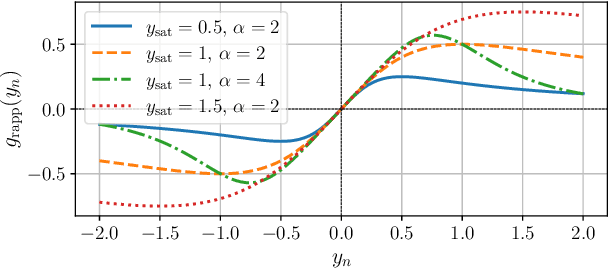
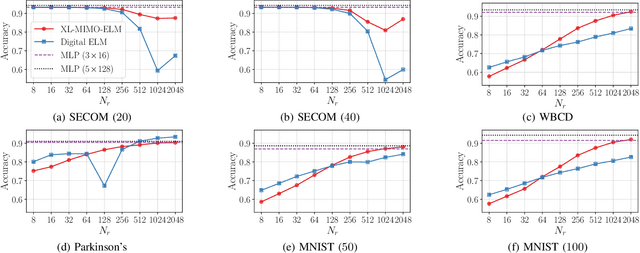
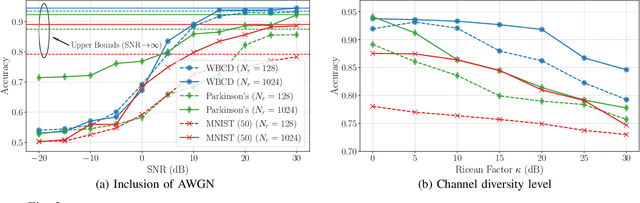
In this paper, we demonstrate that an eXtremely Large (XL) Multiple-Input Multiple-Output (MIMO) wireless system with appropriate analog combining components exhibits the properties of a universal function approximator, similar to a feedforward neural network. By treating the XL MIMO channel coefficients as the random nodes of a hidden layer, and the receiver's analog combiner as a trainable output layer, we cast the end-to-end system to the Extreme Learning Machine (ELM) framework, leading to a novel formulation for Over-The-Air (OTA) edge inference without requiring traditional digital processing nor pre-processing at the transmitter. Through theoretical analysis and numerical evaluation, we showcase that XL-MIMO-ELM enables near-instantaneous training and efficient classification, suggesting the paradigm shift of beyond massive MIMO systems as neural networks alongside their profound communications role. Compared to deep learning approaches and conventional ELMs, the proposed framework achieves on par performance with orders of magnitude lower complexity, making it highly attractive for ultra low power wireless devices.
Distributed Intelligent Sensing and Communications for 6G: Architecture and Use Cases
Apr 17, 2025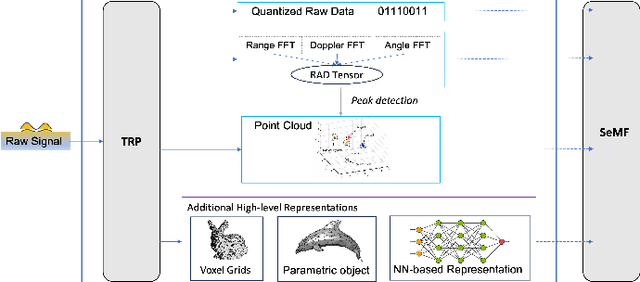
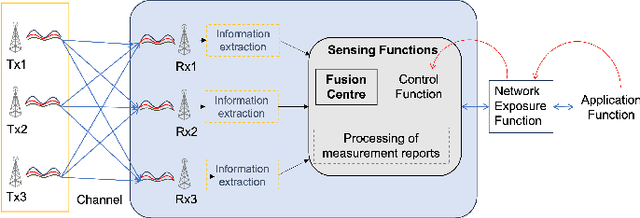
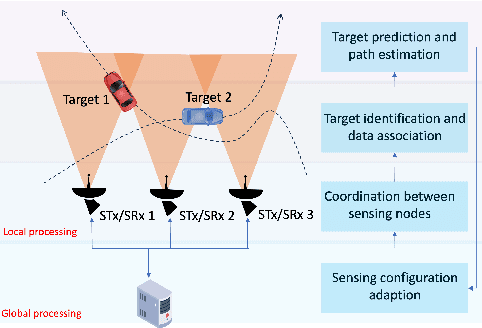
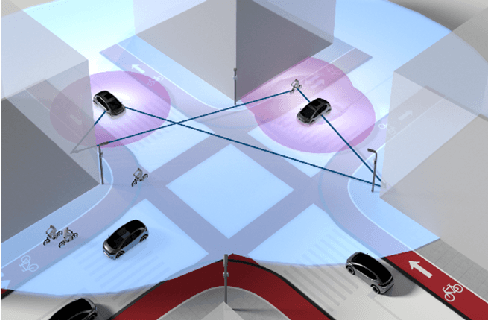
The Distributed Intelligent Sensing and Communication (DISAC) framework redefines Integrated Sensing and Communication (ISAC) for 6G by leveraging distributed architectures to enhance scalability, adaptability, and resource efficiency. This paper presents key architectural enablers, including advanced data representation, seamless target handover, support for heterogeneous devices, and semantic integration. Two use cases illustrate the transformative potential of DISAC: smart factory shop floors and Vulnerable Road User (VRU) protection at smart intersections. These scenarios demonstrate significant improvements in precision, safety, and operational efficiency compared to traditional ISAC systems. The preliminary DISAC architecture incorporates intelligent data processing, distributed coordination, and emerging technologies such as Reconfigurable Intelligent Surfaces (RIS) to meet 6G's stringent requirements. By addressing critical challenges in sensing accuracy, latency, and real-time decision-making, DISAC positions itself as a cornerstone for next-generation wireless networks, advancing innovation in dynamic and complex environments.
Over-the-Air Edge Inference via End-to-End Metasurfaces-Integrated Artificial Neural Networks
Mar 31, 2025
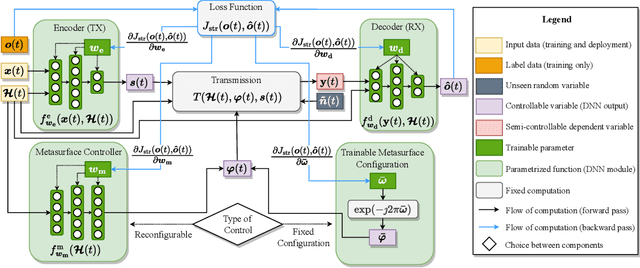
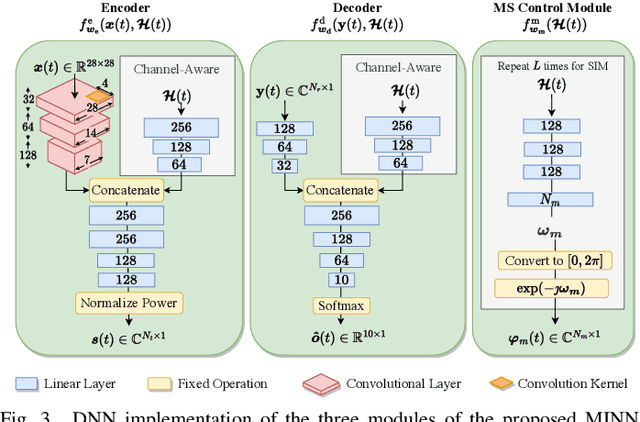
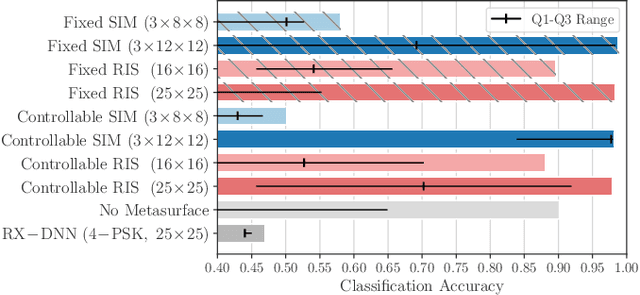
In the Edge Inference (EI) paradigm, where a Deep Neural Network (DNN) is split across the transceivers to wirelessly communicate goal-defined features in solving a computational task, the wireless medium has been commonly treated as a source of noise. In this paper, motivated by the emerging technologies of Reconfigurable Intelligent Surfaces (RISs) and Stacked Intelligent Metasurfaces (SIM) that offer programmable propagation of wireless signals, either through controllable reflections or diffractions, we optimize the RIS/SIM-enabled smart wireless environment as a means of over-the-air computing, resembling the operations of DNN layers. We propose a framework of Metasurfaces-Integrated Neural Networks (MINNs) for EI, presenting its modeling, training through a backpropagation variation for fading channels, and deployment aspects. The overall end-to-end DNN architecture is general enough to admit RIS and SIM devices, through controllable reconfiguration before each transmission or fixed configurations after training, while both channel-aware and channel-agnostic transceivers are considered. Our numerical evaluation showcases metasurfaces to be instrumental in performing image classification under link budgets that impede conventional communications or metasurface-free systems. It is demonstrated that our MINN framework can significantly simplify EI requirements, achieving near-optimal performance with $50~$dB lower testing signal-to-noise ratio compared to training, even without transceiver channel knowledge.
Graph-CNNs for RF Imaging: Learning the Electric Field Integral Equations
Mar 18, 2025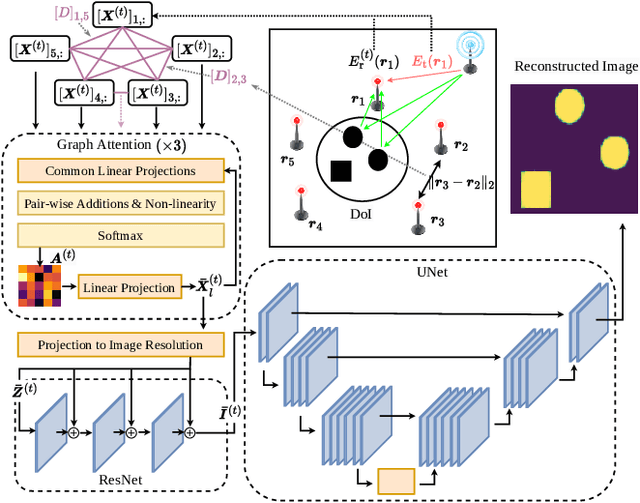
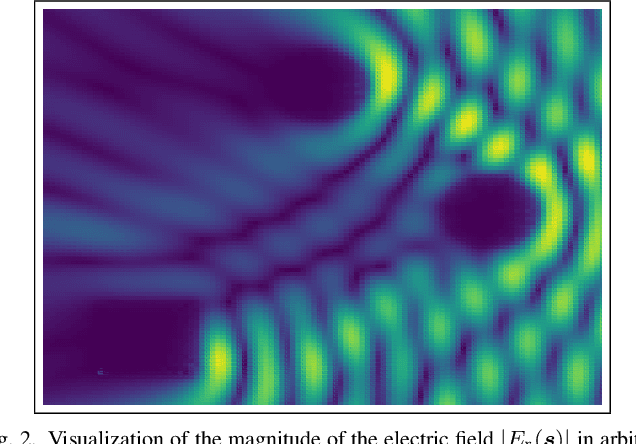
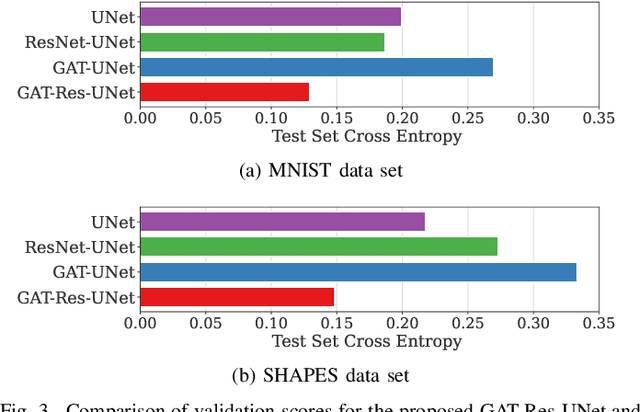
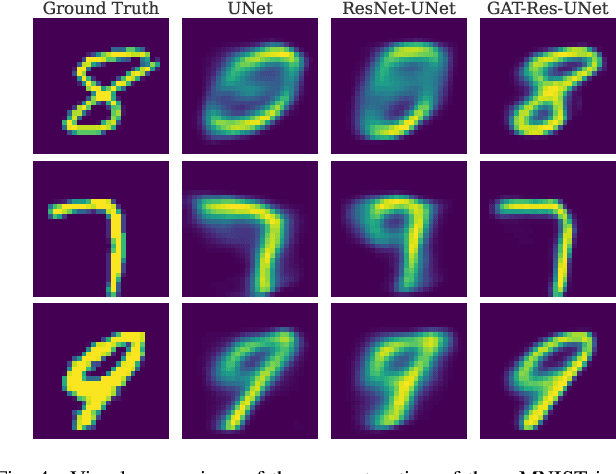
Radio-Frequency (RF) imaging concerns the digital recreation of the surfaces of scene objects based on the scattered field at distributed receivers. To solve this difficult inverse scattering problems, data-driven methods are often employed that extract patterns from similar training examples, while offering minimal latency. In this paper, we first provide an approximate yet fast electromagnetic model, which is based on the electric field integral equations, for data generation, and subsequently propose a Deep Neural Network (DNN) architecture to learn the corresponding inverse model. A graph-attention backbone allows for the system geometry to be passed to the DNN, where residual convolutional layers extract features about the objects, while a UNet head performs the final image reconstruction. Our quantitative and qualitative evaluations on two synthetic data sets of different characteristics showcase the performance gains of thee proposed advanced architecture and its relative resilience to signal noise levels and various reception configurations.