 Add to Chrome
 Add to Firefox
 Add to Edge
Cater
Papers and Code
Age Matters: Analyzing Age-Related Discussions in App Reviews
Jan 29, 2026
In recent years, mobile applications have become indispensable tools for managing various aspects of life. From enhancing productivity to providing personalized entertainment, mobile apps have revolutionized people's daily routines. Despite this rapid growth and popularity, gaps remain in how these apps address the needs of users from different age groups. Users of varying ages face distinct challenges when interacting with mobile apps, from younger users dealing with inappropriate content to older users having difficulty with usability due to age-related vision and cognition impairments. Although there have been initiatives to create age-inclusive apps, a limited understanding of user perspectives on age-related issues may hinder developers from recognizing specific challenges and implementing effective solutions. In this study, we explore age discussions in app reviews to gain insights into how mobile apps should cater to users across different age groups.We manually curated a dataset of 4,163 app reviews from the Google Play Store and identified 1,429 age-related reviews and 2,734 non-age-related reviews. We employed eight machine learning, deep learning, and large language models to automatically detect age discussions, with RoBERTa performing the best, achieving a precision of 92.46%. Additionally, a qualitative analysis of the 1,429 age-related reviews uncovers six dominant themes reflecting user concerns.

See, Explain, and Intervene: A Few-Shot Multimodal Agent Framework for Hateful Meme Moderation
Jan 08, 2026In this work, we examine hateful memes from three complementary angles - how to detect them, how to explain their content and how to intervene them prior to being posted - by applying a range of strategies built on top of generative AI models. To the best of our knowledge, explanation and intervention have typically been studied separately from detection, which does not reflect real-world conditions. Further, since curating large annotated datasets for meme moderation is prohibitively expensive, we propose a novel framework that leverages task-specific generative multimodal agents and the few-shot adaptability of large multimodal models to cater to different types of memes. We believe this is the first work focused on generalizable hateful meme moderation under limited data conditions, and has strong potential for deployment in real-world production scenarios. Warning: Contains potentially toxic contents.
IELTS Writing Revision Platform with Automated Essay Scoring and Adaptive Feedback
Dec 30, 2025This paper presents the design, development, and evaluation of a proposed revision platform assisting candidates for the International English Language Testing System (IELTS) writing exam. Traditional IELTS preparation methods lack personalised feedback, catered to the IELTS writing rubric. To address these shortcomings, the platform features an attractive user interface (UI), an Automated Essay Scoring system (AES), and targeted feedback tailored to candidates and the IELTS writing rubric. The platform architecture separates conversational guidance from a dedicated writing interface to reduce cognitive load and simulate exam conditions. Through iterative, Design-Based Research (DBR) cycles, the study progressed from rule-based to transformer-based with a regression head scoring, mounted with adaptive feedback. Early cycles (2-3) revealed fundamental limitations of rule-based approaches: mid-band compression, low accuracy, and negative $R^2$ values. DBR Cycle 4 implemented a DistilBERT transformer model with a regression head, yielding substantial improvements with MAE of 0.66 and positive $R^2$. This enabled Cycle 5's adaptive feedback implementation, which demonstrated statistically significant score improvements (mean +0.060 bands, p = 0.011, Cohen's d = 0.504), though effectiveness varied by revision strategy. Findings suggest automated feedback functions are most suited as a supplement to human instruction, with conservative surface-level corrections proving more reliable than aggressive structural interventions for IELTS preparation contexts. Challenges remain in assessing higher-band essays, and future work should incorporate longitudinal studies with real IELTS candidates and validation from official examiners.
WebRec: Enhancing LLM-based Recommendations with Attention-guided RAG from Web
Nov 18, 2025Recommender systems play a vital role in alleviating information overload and enriching users' online experience. In the era of large language models (LLMs), LLM-based recommender systems have emerged as a prevalent paradigm for advancing personalized recommendations. Recently, retrieval-augmented generation (RAG) has drawn growing interest to facilitate the recommendation capability of LLMs, incorporating useful information retrieved from external knowledge bases. However, as a rich source of up-to-date information, the web remains under-explored by existing RAG-based recommendations. In particular, unique challenges are posed from two perspectives: one is to generate effective queries for web retrieval, considering the inherent knowledge gap between web search and recommendations; another challenge lies in harnessing online websites that contain substantial noisy content. To tackle these limitations, we propose WebRec, a novel web-based RAG framework, which takes advantage of the reasoning capability of LLMs to interpret recommendation tasks into queries of user preferences that cater to web retrieval. Moreover, given noisy web-retrieved information, where relevant pieces of evidence are scattered far apart, an insightful MP-Head is designed to enhance LLM attentions between distant tokens of relevant information via message passing. Extensive experiments have been conducted to demonstrate the effectiveness of our proposed web-based RAG methods in recommendation scenarios.
AfriSpeech-MultiBench: A Verticalized Multidomain Multicountry Benchmark Suite for African Accented English ASR
Nov 18, 2025Recent advances in speech-enabled AI, including Google's NotebookLM and OpenAI's speech-to-speech API, are driving widespread interest in voice interfaces globally. Despite this momentum, there exists no publicly available application-specific model evaluation that caters to Africa's linguistic diversity. We present AfriSpeech-MultiBench, the first domain-specific evaluation suite for over 100 African English accents across 10+ countries and seven application domains: Finance, Legal, Medical, General dialogue, Call Center, Named Entities and Hallucination Robustness. We benchmark a diverse range of open, closed, unimodal ASR and multimodal LLM-based speech recognition systems using both spontaneous and non-spontaneous speech conversation drawn from various open African accented English speech datasets. Our empirical analysis reveals systematic variation: open-source ASR models excels in spontaneous speech contexts but degrades on noisy, non-native dialogue; multimodal LLMs are more accent-robust yet struggle with domain-specific named entities; proprietary models deliver high accuracy on clean speech but vary significantly by country and domain. Models fine-tuned on African English achieve competitive accuracy with lower latency, a practical advantage for deployment, hallucinations still remain a big problem for most SOTA models. By releasing this comprehensive benchmark, we empower practitioners and researchers to select voice technologies suited to African use-cases, fostering inclusive voice applications for underserved communities.
NILC: Discovering New Intents with LLM-assisted Clustering
Nov 08, 2025New intent discovery (NID) seeks to recognize both new and known intents from unlabeled user utterances, which finds prevalent use in practical dialogue systems. Existing works towards NID mainly adopt a cascaded architecture, wherein the first stage focuses on encoding the utterances into informative text embeddings beforehand, while the latter is to group similar embeddings into clusters (i.e., intents), typically by K-Means. However, such a cascaded pipeline fails to leverage the feedback from both steps for mutual refinement, and, meanwhile, the embedding-only clustering overlooks nuanced textual semantics, leading to suboptimal performance. To bridge this gap, this paper proposes NILC, a novel clustering framework specially catered for effective NID. Particularly, NILC follows an iterative workflow, in which clustering assignments are judiciously updated by carefully refining cluster centroids and text embeddings of uncertain utterances with the aid of large language models (LLMs). Specifically, NILC first taps into LLMs to create additional semantic centroids for clusters, thereby enriching the contextual semantics of the Euclidean centroids of embeddings. Moreover, LLMs are then harnessed to augment hard samples (ambiguous or terse utterances) identified from clusters via rewriting for subsequent cluster correction. Further, we inject supervision signals through non-trivial techniques seeding and soft must links for more accurate NID in the semi-supervised setting. Extensive experiments comparing NILC against multiple recent baselines under both unsupervised and semi-supervised settings showcase that NILC can achieve significant performance improvements over six benchmark datasets of diverse domains consistently.
DiffRhythm 2: Efficient and High Fidelity Song Generation via Block Flow Matching
Oct 27, 2025Generating full-length, high-quality songs is challenging, as it requires maintaining long-term coherence both across text and music modalities and within the music modality itself. Existing non-autoregressive (NAR) frameworks, while capable of producing high-quality songs, often struggle with the alignment between lyrics and vocal. Concurrently, catering to diverse musical preferences necessitates reinforcement learning from human feedback (RLHF). However, existing methods often rely on merging multiple models during multi-preference optimization, which results in significant performance degradation. To address these challenges, we introduce DiffRhythm 2, an end-to-end framework designed for high-fidelity, controllable song generation. To tackle the lyric alignment problem, DiffRhythm 2 employs a semi-autoregressive architecture based on block flow matching. This design enables faithful alignment of lyrics to singing vocals without relying on external labels and constraints, all while preserving the high generation quality and efficiency of NAR models. To make this framework computationally tractable for long sequences, we implement a music variational autoencoder (VAE) that achieves a low frame rate of 5 Hz while still enabling high-fidelity audio reconstruction. In addition, to overcome the limitations of multi-preference optimization in RLHF, we propose cross-pair preference optimization. This method effectively mitigates the performance drop typically associated with model merging, allowing for more robust optimization across diverse human preferences. We further enhance musicality and structural coherence by introducing stochastic block representation alignment loss.
Adaptive Weighted Loss for Sequential Recommendations on Sparse Domains
Oct 05, 2025The effectiveness of single-model sequential recommendation architectures, while scalable, is often limited when catering to "power users" in sparse or niche domains. Our previous research, PinnerFormerLite, addressed this by using a fixed weighted loss to prioritize specific domains. However, this approach can be sub-optimal, as a single, uniform weight may not be sufficient for domains with very few interactions, where the training signal is easily diluted by the vast, generic dataset. This paper proposes a novel, data-driven approach: a Dynamic Weighted Loss function with comprehensive theoretical foundations and extensive empirical validation. We introduce an adaptive algorithm that adjusts the loss weight for each domain based on its sparsity in the training data, assigning a higher weight to sparser domains and a lower weight to denser ones. This ensures that even rare user interests contribute a meaningful gradient signal, preventing them from being overshadowed. We provide rigorous theoretical analysis including convergence proofs, complexity analysis, and bounds analysis to establish the stability and efficiency of our approach. Our comprehensive empirical validation across four diverse datasets (MovieLens, Amazon Electronics, Yelp Business, LastFM Music) with state-of-the-art baselines (SIGMA, CALRec, SparseEnNet) demonstrates that this dynamic weighting system significantly outperforms all comparison methods, particularly for sparse domains, achieving substantial lifts in key metrics like Recall at 10 and NDCG at 10 while maintaining performance on denser domains and introducing minimal computational overhead.
TAP: Two-Stage Adaptive Personalization of Multi-task and Multi-Modal Foundation Models in Federated Learning
Sep 30, 2025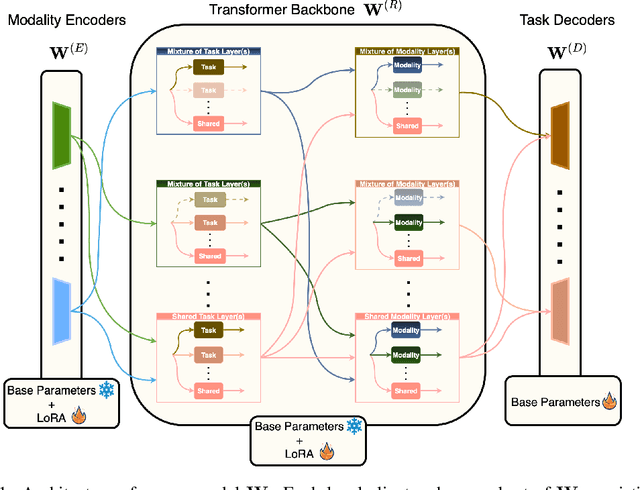
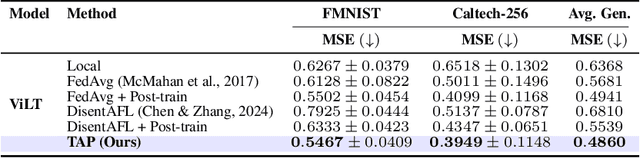
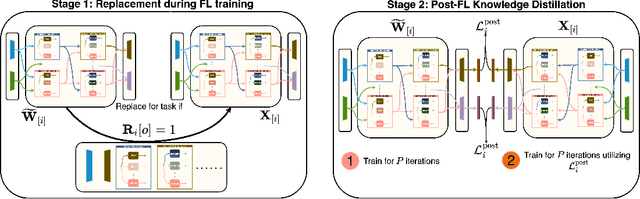
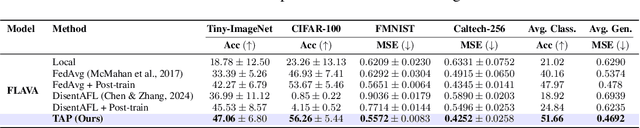
Federated Learning (FL), despite demonstrating impressive capabilities in the training of multiple models in a decentralized manner, has been shown to produce a final model not necessarily well-suited to the needs of each client. While extensive work has been conducted on how to create tailored personalized models, called Personalized Federated Learning (PFL), less attention has been given to personalization via fine-tuning of foundation models with multi-task and multi-modal properties. Moreover, there exists a lack of understanding in the literature on how to fine-tune and personalize such models in a setting that is heterogeneous across clients not only in data, but also in tasks and modalities. To address this gap in the literature, we propose TAP (Two-Stage Adaptive Personalization), which (i) leverages mismatched model architectures between the clients and server to selectively conduct replacement operations when it benefits a client's local tasks and (ii) engages in post-FL knowledge distillation for capturing beneficial general knowledge without compromising personalization. We also introduce the first convergence analysis of the server model under its modality-task pair architecture, and demonstrate that as the number of modality-task pairs increases, its ability to cater to all tasks suffers. Through extensive experiments, we demonstrate the effectiveness of our proposed algorithm across a variety of datasets and tasks in comparison to a multitude of baselines. Implementation code is publicly available at https://github.com/lee3296/TAP.
$γ$-Quant: Towards Learnable Quantization for Low-bit Pattern Recognition
Sep 26, 2025Most pattern recognition models are developed on pre-proce\-ssed data. In computer vision, for instance, RGB images processed through image signal processing (ISP) pipelines designed to cater to human perception are the most frequent input to image analysis networks. However, many modern vision tasks operate without a human in the loop, raising the question of whether such pre-processing is optimal for automated analysis. Similarly, human activity recognition (HAR) on body-worn sensor data commonly takes normalized floating-point data arising from a high-bit analog-to-digital converter (ADC) as an input, despite such an approach being highly inefficient in terms of data transmission, significantly affecting the battery life of wearable devices. In this work, we target low-bandwidth and energy-constrained settings where sensors are limited to low-bit-depth capture. We propose $\gamma$-Quant, i.e.~the task-specific learning of a non-linear quantization for pattern recognition. We exemplify our approach on raw-image object detection as well as HAR of wearable data, and demonstrate that raw data with a learnable quantization using as few as 4-bits can perform on par with the use of raw 12-bit data. All code to reproduce our experiments is publicly available via https://github.com/Mishalfatima/Gamma-Quant