 Add to Chrome
 Add to Firefox
 Add to Edge
PluraMath: Extending Mathematical Reasoning Evaluation Beyond High-Resource Languages
Jul 07, 2026
Mathematical reasoning has become a central task for evaluating and tuning reasoning Large Language Models (LLMs), yet existing benchmarks remain heavily biased toward high-resource languages, with English and Chinese dominating both pre-training corpora and evaluation suites. The recently released PolyMath (Wang et al., 2025) dataset represents a significant step forward, yet its coverage is still limited to 18 only high-resource languages. To address this gap, we introduce PluraMath, an extension of PolyMath to 18 additional {underrepresented languages spanning 6 language families -- ranging from mid-resource to extreme low-resource settings. We constructed the dataset through a human-curated pipeline, where native speakers thoroughly validated pre-computed translations. Using PluraMath, we then benchmark 27 reasoning LLMs across four model scales -- small, mid-size, large, and closed-source ensembles -- probing the multilingual mathematical reasoning capabilities of state-of-the-art models under diverse linguistic conditions. Our fine-grained analysis confirms a persistent gap in mathematical reasoning performance between high-resource and underrepresented languages, with stronger results largely associated with better instruction-following ability. We fully open-source our dataset, data acquisition pipeline, and evaluation framework, with the goal of lowering the barrier to multilingual benchmark development for underrepresented communities.

See, Explain, and Intervene: A Few-Shot Multimodal Agent Framework for Hateful Meme Moderation
Jan 08, 2026In this work, we examine hateful memes from three complementary angles - how to detect them, how to explain their content and how to intervene them prior to being posted - by applying a range of strategies built on top of generative AI models. To the best of our knowledge, explanation and intervention have typically been studied separately from detection, which does not reflect real-world conditions. Further, since curating large annotated datasets for meme moderation is prohibitively expensive, we propose a novel framework that leverages task-specific generative multimodal agents and the few-shot adaptability of large multimodal models to cater to different types of memes. We believe this is the first work focused on generalizable hateful meme moderation under limited data conditions, and has strong potential for deployment in real-world production scenarios. Warning: Contains potentially toxic contents.
ToxicTAGS: Decoding Toxic Memes with Rich Tag Annotations
Aug 06, 2025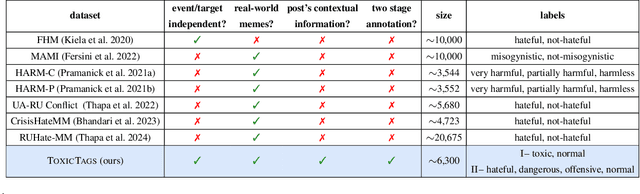
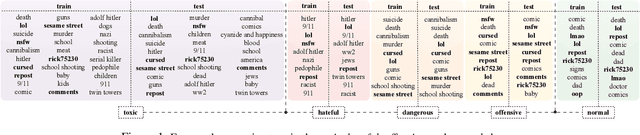
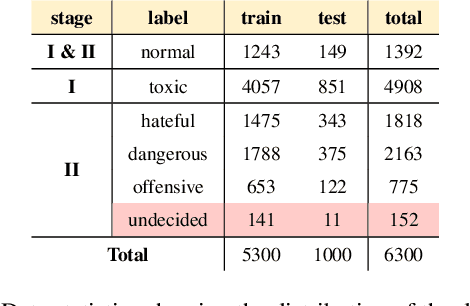
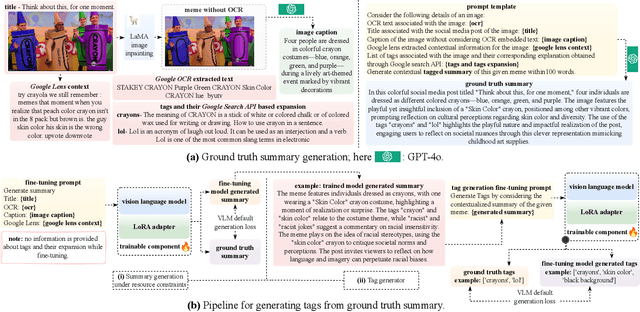
The 2025 Global Risks Report identifies state-based armed conflict and societal polarisation among the most pressing global threats, with social media playing a central role in amplifying toxic discourse. Memes, as a widely used mode of online communication, often serve as vehicles for spreading harmful content. However, limitations in data accessibility and the high cost of dataset curation hinder the development of robust meme moderation systems. To address this challenge, in this work, we introduce a first-of-its-kind dataset of 6,300 real-world meme-based posts annotated in two stages: (i) binary classification into toxic and normal, and (ii) fine-grained labelling of toxic memes as hateful, dangerous, or offensive. A key feature of this dataset is that it is enriched with auxiliary metadata of socially relevant tags, enhancing the context of each meme. In addition, we propose a tag generation module that produces socially grounded tags, because most in-the-wild memes often do not come with tags. Experimental results show that incorporating these tags substantially enhances the performance of state-of-the-art VLMs detection tasks. Our contributions offer a novel and scalable foundation for improved content moderation in multimodal online environments.