 Add to Chrome
 Add to Firefox
 Add to Edge
VideoSearch-R1: Iterative Video Retrieval and Reasoning via Soft Query Refinement
Jul 01, 2026
As video corpora continue to expand in both scale and task complexity, there is increasing demand for approaches that retrieve relevant videos from large-scale corpora (inter-video reasoning) and subsequently perform fine-grained, query-conditioned tasks (intra-video reasoning) within the retrieved content, such as temporal grounding. However, existing approaches typically treat retrieval as a preprocessing step, and consequently, when the initial retrieval fails, there is no mechanism to refine the search, leading to the failure of subsequent fine-grained intra-video reasoning. Moreover, while recent agentic frameworks have advanced video understanding, they typically assume that the query-relevant video is already given, focusing exclusively on intra-video reasoning tasks. To address these limitations, we propose VideoSearch-R1, an agentic framework for iterative video retrieval and reasoning through multi-turn interaction with a video search engine. Specifically, we introduce Soft Query Refinement (SQR) to refine search query tokens in a continuous latent space rather than rewriting queries in the discrete text space, enabling more efficient and fine-grained adjustments. SQR and its reasoning process are trained using Group Relative Policy Optimization (GRPO), guided by task-level reward signals derived from retrieval and downstream tasks. Building upon this, VideoSearch-R1 achieves state-of-the-art performance across three datasets on Video Corpus Moment Retrieval (VCMR), iteratively retrieving videos from large-scale corpora, refining search queries, and performing precise query-conditioned temporal grounding within the retrieved content. Our analyses show that SQR effectively refines the original query, requiring significantly fewer generated tokens than explicit text-level query refinement. Code and model checkpoints are publicly available at mlvlab.github.io/VideoSearch-R1.

MoE-GRPO: Optimizing Mixture-of-Experts via Reinforcement Learning in Vision-Language Models
Mar 26, 2026Mixture-of-Experts (MoE) has emerged as an effective approach to reduce the computational overhead of Transformer architectures by sparsely activating a subset of parameters for each token while preserving high model capacity. This paradigm has recently been extended to Vision-Language Models (VLMs), enabling scalable multi-modal understanding with reduced computational cost. However, the widely adopted deterministic top-K routing mechanism may overlook more optimal expert combinations and lead to expert overfitting. To address this limitation and improve the diversity of expert selection, we propose MoE-GRPO, a reinforcement learning (RL)-based framework for optimizing expert routing in MoE-based VLMs. Specifically, we formulate expert selection as a sequential decision-making problem and optimize it using Group Relative Policy Optimization (GRPO), allowing the model to learn adaptive expert routing policies through exploration and reward-based feedback. Furthermore, we introduce a modality-aware router guidance that enhances training stability and efficiency by discouraging the router from exploring experts that are infrequently activated for a given modality. Extensive experiments on multi-modal image and video benchmarks show that MoE-GRPO consistently outperforms standard top-K routing and its variants by promoting more diverse expert selection, thereby mitigating expert overfitting and enabling a task-level expert specialization.
TAP: Two-Stage Adaptive Personalization of Multi-task and Multi-Modal Foundation Models in Federated Learning
Sep 30, 2025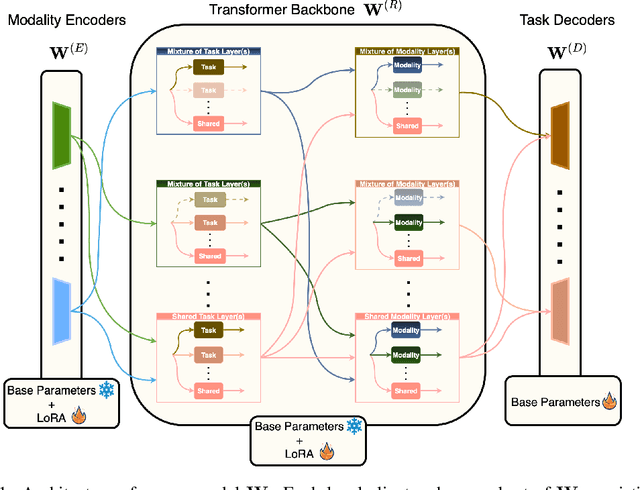
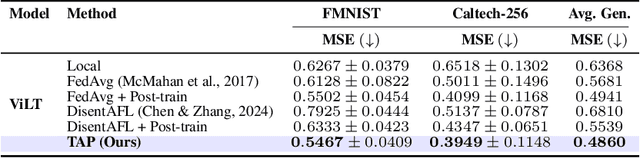
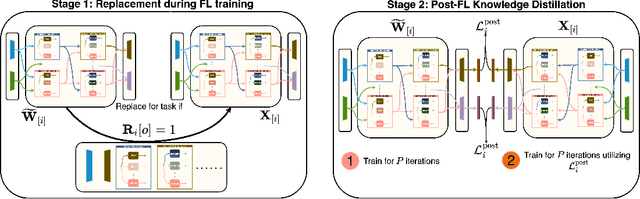
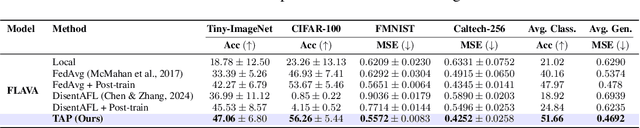
Federated Learning (FL), despite demonstrating impressive capabilities in the training of multiple models in a decentralized manner, has been shown to produce a final model not necessarily well-suited to the needs of each client. While extensive work has been conducted on how to create tailored personalized models, called Personalized Federated Learning (PFL), less attention has been given to personalization via fine-tuning of foundation models with multi-task and multi-modal properties. Moreover, there exists a lack of understanding in the literature on how to fine-tune and personalize such models in a setting that is heterogeneous across clients not only in data, but also in tasks and modalities. To address this gap in the literature, we propose TAP (Two-Stage Adaptive Personalization), which (i) leverages mismatched model architectures between the clients and server to selectively conduct replacement operations when it benefits a client's local tasks and (ii) engages in post-FL knowledge distillation for capturing beneficial general knowledge without compromising personalization. We also introduce the first convergence analysis of the server model under its modality-task pair architecture, and demonstrate that as the number of modality-task pairs increases, its ability to cater to all tasks suffers. Through extensive experiments, we demonstrate the effectiveness of our proposed algorithm across a variety of datasets and tasks in comparison to a multitude of baselines. Implementation code is publicly available at https://github.com/lee3296/TAP.
Cooperative Decentralized Backdoor Attacks on Vertical Federated Learning
Jan 16, 2025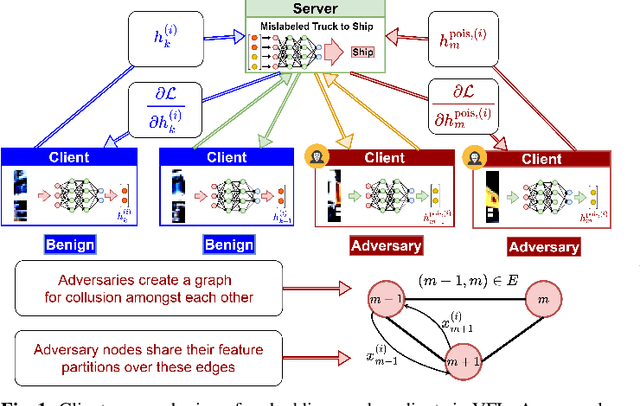
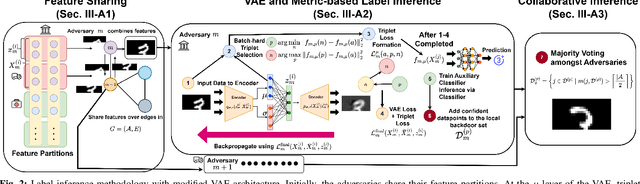
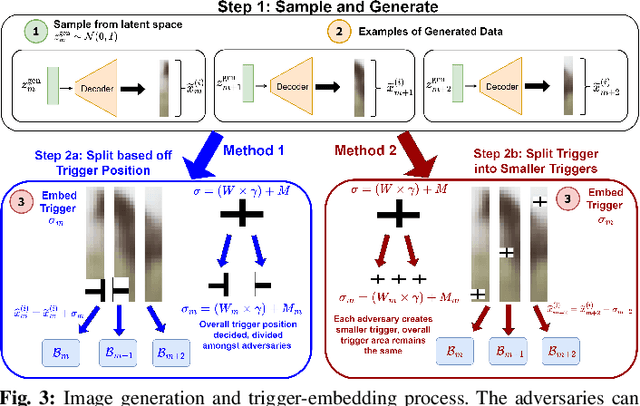
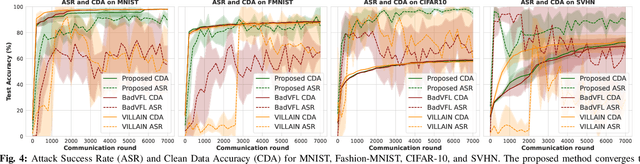
Federated learning (FL) is vulnerable to backdoor attacks, where adversaries alter model behavior on target classification labels by embedding triggers into data samples. While these attacks have received considerable attention in horizontal FL, they are less understood for vertical FL (VFL), where devices hold different features of the samples, and only the server holds the labels. In this work, we propose a novel backdoor attack on VFL which (i) does not rely on gradient information from the server and (ii) considers potential collusion among multiple adversaries for sample selection and trigger embedding. Our label inference model augments variational autoencoders with metric learning, which adversaries can train locally. A consensus process over the adversary graph topology determines which datapoints to poison. We further propose methods for trigger splitting across the adversaries, with an intensity-based implantation scheme skewing the server towards the trigger. Our convergence analysis reveals the impact of backdoor perturbations on VFL indicated by a stationarity gap for the trained model, which we verify empirically as well. We conduct experiments comparing our attack with recent backdoor VFL approaches, finding that ours obtains significantly higher success rates for the same main task performance despite not using server information. Additionally, our results verify the impact of collusion on attack performance.
ODPG: Outfitting Diffusion with Pose Guided Condition
Jan 12, 2025Virtual Try-On (VTON) technology allows users to visualize how clothes would look on them without physically trying them on, gaining traction with the rise of digitalization and online shopping. Traditional VTON methods, often using Generative Adversarial Networks (GANs) and Diffusion models, face challenges in achieving high realism and handling dynamic poses. This paper introduces Outfitting Diffusion with Pose Guided Condition (ODPG), a novel approach that leverages a latent diffusion model with multiple conditioning inputs during the denoising process. By transforming garment, pose, and appearance images into latent features and integrating these features in a UNet-based denoising model, ODPG achieves non-explicit synthesis of garments on dynamically posed human images. Our experiments on the FashionTryOn and a subset of the DeepFashion dataset demonstrate that ODPG generates realistic VTON images with fine-grained texture details across various poses, utilizing an end-to-end architecture without the need for explicit garment warping processes. Future work will focus on generating VTON outputs in video format and on applying our attention mechanism, as detailed in the Method section, to other domains with limited data.
Smart Information Exchange for Unsupervised Federated Learning via Reinforcement Learning
Feb 15, 2024


One of the main challenges of decentralized machine learning paradigms such as Federated Learning (FL) is the presence of local non-i.i.d. datasets. Device-to-device transfers (D2D) between distributed devices has been shown to be an effective tool for dealing with this problem and robust to stragglers. In an unsupervised case, however, it is not obvious how data exchanges should take place due to the absence of labels. In this paper, we propose an approach to create an optimal graph for data transfer using Reinforcement Learning. The goal is to form links that will provide the most benefit considering the environment's constraints and improve convergence speed in an unsupervised FL environment. Numerical analysis shows the advantages in terms of convergence speed and straggler resilience of the proposed method to different available FL schemes and benchmark datasets.