 Add to Chrome
 Add to Firefox
 Add to Edge
Antibody Antigen Binding Prediction
Papers and Code
EpiFormer: Learning Antigen-Antibody Interactions for Epitope Prediction via Geometric Deep Learning
Jun 02, 2026
Antibodies neutralize foreign antigens by binding to specific surface regions called epitopes. Computational epitope prediction is critical for understanding immune recognition and guiding antibody engineering. However, existing methods face three fundamental challenges: antibody-aware models encode each chain independently and combine them only at a late stage, failing to capture co-dependent structural features that define binding interfaces, whereas severe class imbalance and scarcity of known antibody-antigen complexes render standard training objectives ineffective. We propose EpiFormer, a general encoder-decoder framework that addresses these challenges jointly. Our key design principle is interleaved cross-attention within GNN encoding layers, enabling bidirectional antigen-antibody information flow throughout representation learning rather than only at the output. This early-fusion principle is backbone-agnostic, providing consistent gains across GNN architectures from simple GCNs to equivariant models. We further show that sparsity-aware objectives are effective when paired with early-fusion architectures for the epitope prediction task. EpiFormer improves over the previous best method by over 40% in F1 score on standard benchmarks, demonstrating generalizability and cross-dataset transferability. Notably, EpiFormer discovers known biological principles as emergent behaviors of end-to-end training, where the learned cross-attention gates favor antigen-to-antibody information flow, consistent with the asymmetric roles of the two chains at the binding interface, and the model's preference for geometric over evolutionary features aligns with the established finding that epitope residues are not evolutionarily conserved. The source code is available at: https://github.com/mansoor181/epiformer.git

Computational Modeling of Antibody-Antigen Complexes: PLM-Based and MSA-Based Approaches
May 27, 2026Antibodies play a central role in the immune response by specifically recognizing and neutralizing antigens, and therapeutic antibodies have become major drugs for cancer and autoimmune diseases. However, their discovery still relies on extensive in vitro screening, and accurate computational modeling of antibody structures and antibody-antigen interactions can prioritize candidates, reduce experimental burden, and accelerate rational design. Despite recent advances in high-accuracy protein and complex prediction, a persistent performance gap remains for antibody-related tasks compared with general protein-protein interactions, limiting downstream design. This thesis investigates why antibody-related tasks are harder and proposes improvements along two complementary directions. First, we investigate protein language model (PLM)-based methods for antibody and antibody-antigen structure prediction. Using embeddings from multiple PLMs, our approach achieves the best CDR-H3 accuracy among compared PLM-based methods on antibody monomer prediction. Extending it to complex prediction does not generalize: without co-evolutionary signals between antibody and antigen, single-sequence PLM representations do not reliably identify binding interfaces. Second, we develop two MSA-based interventions for antibody-antigen complex prediction: MSA refinement, which combines CDR-focused filtering with depth recovery from a larger sequence database, and convergence-aware recycling, which selects a stable intermediate recycle state for final diffusion sampling. Together, these interventions provide consistent gains over the AlphaFold3 baseline on a held-out antibody-antigen test set. Because the methods modify MSA construction and recycling behavior rather than model parameters, they apply without retraining or weight access.
ConTact: Contact-First Antibody CDR Design via Explicit Interface Reasoning
May 20, 2026Computational antibody CDR design methods condition on antigen structure to generate binding loops, yet existing architectures conflate two fundamentally distinct sub-problems: identifying which CDR positions will contact the antigen, and selecting amino acids at those positions. This conflation forces models to learn contact reasoning implicitly through uniform message passing, diluting antigen signal across all positions equally. We introduce ConTact, a contact-then-act architecture that explicitly decomposes CDR design into three cascaded stages: learning surface complementarity fingerprints, predicting CDR-antigen contacts, and injecting contact-gated antigen features into the sequence head. A distance-biased cross-attention module encodes geometric priors favoring spatial neighbors, while a contact-weighted cross-entropy loss concentrates gradient signal on binding-critical positions. On CHIMERA-Bench dataset, ConTact achieves the best structural quality (7% RMSD improvement over the next-best baseline), best epitope awareness (10% F1 score over GNN baselines), and competitive sequence recovery (AAR 0.38) among several CDR-H3 design baselines.
AgForce Enables Antigen-conditioned Generative Antibody Design
May 20, 2026Antibody design methods condition on antigen structure to generate complementarity-determining regions (CDR), yet a systematic evaluation of baseline methods reveals that they largely ignore the antigen input. We identify three failure modes that explain this behavior. Antigen blindness arises because models derive predictions from antibody framework context rather than antigen information, producing nearly identical CDRs regardless of the target. Vocabulary collapse reduces predicted amino acids to three to five per position, far below the ground truth distribution in native sequences. Moreover, any model trained with standard per-position cross-entropy converges to the positional marginal distribution, making it provably unable to produce antigen-specific sequence predictions. We propose a novel encoder-decoder architecture called AgForce, that uses a graph neural network (GNN) as the encoder and specialized decoders for sequence-structure co-design. Specifically, we apply framework dropout, gated bottlenecks, and hyperbolic cross attention that prevent the antibody shortcut path. In the decoder, a Mixture Density Network (MDN) sequence head with Potts-like pairwise coupling and annealed Multiple Choice Learning (aMCL) replaces the cross-entropy objective with a multi-component distribution whose optimal solution differs from the positional marginal. An antigen cycle consistency head routes gradients through the sequence decoder, forcing predicted distributions to encode antigen identity. AgForce achieves the best binding quality and sequence recovery simultaneously on the CHIMERA-Bench dataset, improving amino acid recovery by 8% over the strongest sequence baseline while surpassing the baselines across all interface metrics, and nearly doubling the effective vocabulary of GNN methods. The source code is available at: https://github.com/mansoor181/ag-force.git
AbLWR:A Context-Aware Listwise Ranking Framework for Antibody-Antigen Binding Affinity Prediction via Positive-Unlabeled Learning
Apr 13, 2026Accurate prediction of antibody-antigen binding affinity is fundamental to therapeutic design, yet remains constrained by severe label sparsity and the complexity of antigenic variations. In this paper, we propose AbLWR (Antibody-antigen binding affinity List-Wise Ranking), a novel framework that reformulates the conventional affinity regression task as a listwise ranking problem. To mitigate label sparsity, AbLWR incorporates a PU (Positive-Unlabeled) learning mechanism leveraging a dual-level contrastive objective and meta-optimized label refinement to learn robust representations. Furthermore, we address antigenic variation by employing a homologous antigen sampling strategy where Multi-Head Self-Attention (MHSA) explicitly models inter-sample relationships within training lists to capture subtle affinity nuances. Extensive experiments demonstrate that AbLWR significantly outperforms state-of-the-art baselines, improving the Precision@1 (P@1) by over 10$\%$ in randomized cross-validation experiments. Notably, case studies on Influenza and IL-33 validate its practical utility, demonstrating robust ranking consistency in distinguishing subtle viral mutations and efficiently prioritizing top-tier candidates for wet-lab screening.
AbAffinity: A Large Language Model for Predicting Antibody Binding Affinity against SARS-CoV-2
Mar 04, 2026Machine learning-based antibody design is emerging as one of the most promising approaches to combat infectious diseases, due to significant advancements in the field of artificial intelligence and an exponential surge in experimental antibody data (in particular related to COVID-19). The ability of an antibody to bind to an antigens (called binding affinity) is one of the the most critical properties in designing neutralizing antibodies. In this study we introduce Ab-Affinity, a new large language model that can accurately predict the binding affinity of antibodies against a target peptide, e.g., the SARS-CoV-2 spike protein. Code and model are available at https://github.com/ucrbioinfo/AbAffinity.
IgPose: A Generative Data-Augmented Pipeline for Robust Immunoglobulin-Antigen Binding Prediction
Mar 16, 2026Predicting immunoglobulin-antigen (Ig-Ag) binding remains a significant challenge due to the paucity of experimentally-resolved complexes and the limited accuracy of de novo Ig structure prediction. We introduce IgPose, a generalizable framework for Ig-Ag pose identification and scoring, built on a generative data-augmentation pipeline. To mitigate data scarcity, we constructed the Structural Immunoglobulin Decoy Database (SIDD), a comprehensive repository of high-fidelity synthetic decoys. IgPose integrates equivariant graph neural networks, ESM-2 embeddings, and gated recurrent units to synergistically capture both geometric and evolutionary features. We implemented interface-focused k-hop sampling with biologically guided pooling to enhance generalization across diverse interfaces. The framework comprises two sub-networks--IgPoseClassifier for binding pose discrimination and IgPoseScore for DockQ score estimation--and achieves robust performance on curated internal test sets and the CASP-16 benchmark compared to physics and deep learning baselines. IgPose serves as a versatile computational tool for high-throughput antibody discovery pipelines by providing accurate pose filtering and ranking. IgPose is available on GitHub (https://github.com/arontier/igpose).
* 11 pages, 4 figures, Bioinformatics
AbFlow : End-to-end Paratope-Centric Antibody Design by Interaction Enhanced Flow Matching
Feb 06, 2026Antigen-antibody binding is a critical process in the immune response. Although recent progress has advanced antibody design, current methods lack a generative framework for end-to-end modeling of full-atom antibody structures and struggle to fully exploit antigen-specific geometric information for optimizing local binding interfaces and global structures. To overcome these limitations, we introduce AbFlow, a flow-matching framework that leverages optimal transport to design full-atom antibodies end-to-end. AbFlow incorporates an extended velocity field network featuring an equivariant Surface Multi-channel Encoder, which uses surface-level antigen interaction data to refine the antibody structure, particularly the CDR-H3 region. Extensive experiments in paratoep-centric antibody design, multi-CDRs and full-atom antibody design, binding affinity optimization, and complex structure prediction show that AbFlow produces superior antigen-antibody complexes, especially at the contact interface, and markedly improves the binding affinity of generated antibodies.
Conditionally Site-Independent Neural Evolution of Antibody Sequences
Feb 21, 2026Common deep learning approaches for antibody engineering focus on modeling the marginal distribution of sequences. By treating sequences as independent samples, however, these methods overlook affinity maturation as a rich and largely untapped source of information about the evolutionary process by which antibodies explore the underlying fitness landscape. In contrast, classical phylogenetic models explicitly represent evolutionary dynamics but lack the expressivity to capture complex epistatic interactions. We bridge this gap with CoSiNE, a continuous-time Markov chain parameterized by a deep neural network. Mathematically, we prove that CoSiNE provides a first-order approximation to the intractable sequential point mutation process, capturing epistatic effects with an error bound that is quadratic in branch length. Empirically, CoSiNE outperforms state-of-the-art language models in zero-shot variant effect prediction by explicitly disentangling selection from context-dependent somatic hypermutation. Finally, we introduce Guided Gillespie, a classifier-guided sampling scheme that steers CoSiNE at inference time, enabling efficient optimization of antibody binding affinity toward specific antigens.
DuaDeep-SeqAffinity: Dual-Stream Deep Learning Framework for Sequence-Only Antigen-Antibody Affinity Prediction
Dec 26, 2025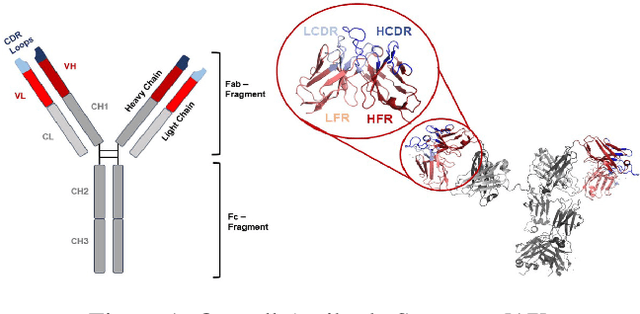

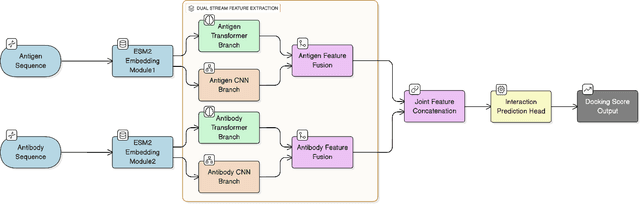

Predicting the binding affinity between antigens and antibodies is fundamental to drug discovery and vaccine development. Traditional computational approaches often rely on experimentally determined 3D structures, which are scarce and computationally expensive to obtain. This paper introduces DuaDeep-SeqAffinity, a novel sequence-only deep learning framework that predicts affinity scores solely from their amino acid sequences using a dual-stream hybrid architecture. Our approach leverages pre-trained ESM-2 protein language model embeddings, combining 1D Convolutional Neural Networks (CNNs) for local motif detection with Transformer encoders for global contextual representation. A subsequent fusion module integrates these multi-faceted features, which are then passed to a fully connected network for final score regression. Experimental results demonstrate that DuaDeep-SeqAffinity significantly outperforms individual architectural components and existing state-of-the-art (SOTA) methods. DuaDeep achieved a superior Pearson correlation of 0.688, an R^2 of 0.460, and a Root Mean Square Error (RMSE) of 0.737, surpassing single-branch variants ESM-CNN and ESM-Transformer. Notably, the model achieved an Area Under the Curve (AUC) of 0.890, outperforming sequence-only benchmarks and even surpassing structure-sequence hybrid models. These findings prove that high-fidelity sequence embeddings can capture essential binding patterns typically reserved for structural modeling. By eliminating the reliance on 3D structures, DuaDeep-SeqAffinity provides a highly scalable and efficient solution for high-throughput screening of vast sequence libraries, significantly accelerating the therapeutic discovery pipeline.