 Add to Chrome
 Add to Firefox
 Add to Edge
Accented Speech Recognition
Papers and Code
Mixture-of-Experts with Intermediate CTC Supervision for Accented Speech Recognition
Feb 02, 2026
Accented speech remains a persistent challenge for automatic speech recognition (ASR), as most models are trained on data dominated by a few high-resource English varieties, leading to substantial performance degradation for other accents. Accent-agnostic approaches improve robustness yet struggle with heavily accented or unseen varieties, while accent-specific methods rely on limited and often noisy labels. We introduce Moe-Ctc, a Mixture-of-Experts architecture with intermediate CTC supervision that jointly promotes expert specialization and generalization. During training, accent-aware routing encourages experts to capture accent-specific patterns, which gradually transitions to label-free routing for inference. Each expert is equipped with its own CTC head to align routing with transcription quality, and a routing-augmented loss further stabilizes optimization. Experiments on the Mcv-Accent benchmark demonstrate consistent gains across both seen and unseen accents in low- and high-resource conditions, achieving up to 29.3% relative WER reduction over strong FastConformer baselines.

Deaf and Hard of Hearing Access to Intelligent Personal Assistants: Comparison of Voice-Based Options with an LLM-Powered Touch Interface
Jan 21, 2026We investigate intelligent personal assistants (IPAs) accessibility for deaf and hard of hearing (DHH) people who can use their voice in everyday communication. The inability of IPAs to understand diverse accents including deaf speech renders them largely inaccessible to non-signing and speaking DHH individuals. Using an Echo Show, we compare the usability of natural language input via spoken English; with Alexa's automatic speech recognition and a Wizard-of-Oz setting with a trained facilitator re-speaking commands against that of a large language model (LLM)-assisted touch interface in a mixed-methods study. The touch method was navigated through an LLM-powered "task prompter," which integrated the user's history and smart environment to suggest contextually-appropriate commands. Quantitative results showed no significant differences across both spoken English conditions vs LLM-assisted touch. Qualitative results showed variability in opinions on the usability of each method. Ultimately, it will be necessary to have robust deaf-accented speech recognized natively by IPAs.
SSVD-O: Parameter-Efficient Fine-Tuning with Structured SVD for Speech Recognition
Jan 18, 2026Parameter-efficient fine-tuning (PEFT) is a scalable approach for adapting large speech foundation models to new domains. While methods such as LoRA and its state-of-the-art variants reduce adaptation costs, they typically allocate parameters uniformly across model subspaces, which limits their efficiency and scalability in speech applications. Building on our prior work, this paper introduces SSVD-Outer (SSVD-O), an extension of the structured SVD-guided (SSVD) fine-tuning method. SSVD-O combines input acoustic feature space-associated inner transformations with output semantic feature space-associated outer transformations to enable scalable and balanced adaptation. We conduct the first systematic analysis of parameter budget allocation across model subspaces in PEFT for automatic speech recognition (ASR), and investigate the trade-off between learning and forgetting under constrained resources. SSVD-O is benchmarked against LoRA, DoRA, PiSSA, and SSVD on domain-shifted ASR tasks, including child speech and regional accents, across model scales from 0.1B to 2B within the ESPnet framework. Experimental results show that SSVD-O consistently narrows the performance gap to full fine-tuning while improving generalization and mitigating catastrophic forgetting.
Categorize Early, Integrate Late: Divergent Processing Strategies in Automatic Speech Recognition
Jan 11, 2026In speech language modeling, two architectures dominate the frontier: the Transformer and the Conformer. However, it remains unknown whether their comparable performance stems from convergent processing strategies or distinct architectural inductive biases. We introduce Architectural Fingerprinting, a probing framework that isolates the effect of architecture on representation, and apply it to a controlled suite of 24 pre-trained encoders (39M-3.3B parameters). Our analysis reveals divergent hierarchies: Conformers implement a "Categorize Early" strategy, resolving phoneme categories 29% earlier in depth and speaker gender by 16% depth. In contrast, Transformers "Integrate Late," deferring phoneme, accent, and duration encoding to deep layers (49-57%). These fingerprints suggest design heuristics: Conformers' front-loaded categorization may benefit low-latency streaming, while Transformers' deep integration may favor tasks requiring rich context and cross-utterance normalization.
PROFASR-BENCH: A Benchmark for Context-Conditioned ASR in High-Stakes Professional Speech
Dec 29, 2025Automatic Speech Recognition (ASR) in professional settings faces challenges that existing benchmarks underplay: dense domain terminology, formal register variation, and near-zero tolerance for critical entity errors. We present ProfASR-Bench, a professional-talk evaluation suite for high-stakes applications across finance, medicine, legal, and technology. Each example pairs a natural-language prompt (domain cue and/or speaker profile) with an entity-rich target utterance, enabling controlled measurement of context-conditioned recognition. The corpus supports conventional ASR metrics alongside entity-aware scores and slice-wise reporting by accent and gender. Using representative families Whisper (encoder-decoder ASR) and Qwen-Omni (audio language models) under matched no-context, profile, domain+profile, oracle, and adversarial conditions, we find a consistent pattern: lightweight textual context produces little to no change in average word error rate (WER), even with oracle prompts, and adversarial prompts do not reliably degrade performance. We term this the context-utilization gap (CUG): current systems are nominally promptable yet underuse readily available side information. ProfASR-Bench provides a standardized context ladder, entity- and slice-aware reporting with confidence intervals, and a reproducible testbed for comparing fusion strategies across model families. Dataset: https://huggingface.co/datasets/prdeepakbabu/ProfASR-Bench Code: https://github.com/prdeepakbabu/ProfASR-Bench
TRIDENT: A Redundant Architecture for Caribbean-Accented Emergency Speech Triage
Dec 11, 2025Emergency speech recognition systems exhibit systematic performance degradation on non-standard English varieties, creating a critical gap in services for Caribbean populations. We present TRIDENT (Transcription and Routing Intelligence for Dispatcher-Empowered National Triage), a three-layer dispatcher-support architecture designed to structure emergency call inputs for human application of established triage protocols (the ESI for routine operations and START for mass casualty events), even when automatic speech recognition fails. The system combines Caribbean-accent-tuned ASR, local entity extraction via large language models, and bio-acoustic distress detection to provide dispatchers with three complementary signals: transcription confidence, structured clinical entities, and vocal stress indicators. Our key insight is that low ASR confidence, rather than representing system failure, serves as a valuable queue prioritization signal -- particularly when combined with elevated vocal distress markers indicating a caller in crisis whose speech may have shifted toward basilectal registers. A complementary insight drives the entity extraction layer: trained responders and composed bystanders may report life-threatening emergencies without elevated vocal stress, requiring semantic analysis to capture clinical indicators that paralinguistic features miss. We describe the architectural design, theoretical grounding in psycholinguistic research on stress-induced code-switching, and deployment considerations for offline operation during disaster scenarios. This work establishes a framework for accent-resilient emergency AI that ensures Caribbean voices receive equitable access to established national triage protocols. Empirical validation on Caribbean emergency calls remains future work.
AfriSpeech-MultiBench: A Verticalized Multidomain Multicountry Benchmark Suite for African Accented English ASR
Nov 18, 2025Recent advances in speech-enabled AI, including Google's NotebookLM and OpenAI's speech-to-speech API, are driving widespread interest in voice interfaces globally. Despite this momentum, there exists no publicly available application-specific model evaluation that caters to Africa's linguistic diversity. We present AfriSpeech-MultiBench, the first domain-specific evaluation suite for over 100 African English accents across 10+ countries and seven application domains: Finance, Legal, Medical, General dialogue, Call Center, Named Entities and Hallucination Robustness. We benchmark a diverse range of open, closed, unimodal ASR and multimodal LLM-based speech recognition systems using both spontaneous and non-spontaneous speech conversation drawn from various open African accented English speech datasets. Our empirical analysis reveals systematic variation: open-source ASR models excels in spontaneous speech contexts but degrades on noisy, non-native dialogue; multimodal LLMs are more accent-robust yet struggle with domain-specific named entities; proprietary models deliver high accuracy on clean speech but vary significantly by country and domain. Models fine-tuned on African English achieve competitive accuracy with lower latency, a practical advantage for deployment, hallucinations still remain a big problem for most SOTA models. By releasing this comprehensive benchmark, we empower practitioners and researchers to select voice technologies suited to African use-cases, fostering inclusive voice applications for underserved communities.
TEDxTN: A Three-way Speech Translation Corpus for Code-Switched Tunisian Arabic - English
Nov 13, 2025In this paper, we introduce TEDxTN, the first publicly available Tunisian Arabic to English speech translation dataset. This work is in line with the ongoing effort to mitigate the data scarcity obstacle for a number of Arabic dialects. We collected, segmented, transcribed and translated 108 TEDx talks following our internally developed annotations guidelines. The collected talks represent 25 hours of speech with code-switching that cover speakers with various accents from over 11 different regions of Tunisia. We make the annotation guidelines and corpus publicly available. This will enable the extension of TEDxTN to new talks as they become available. We also report results for strong baseline systems of Speech Recognition and Speech Translation using multiple pre-trained and fine-tuned end-to-end models. This corpus is the first open source and publicly available speech translation corpus of Code-Switching Tunisian dialect. We believe that this is a valuable resource that can motivate and facilitate further research on the natural language processing of Tunisian Dialect.
CantoASR: Prosody-Aware ASR-LALM Collaboration for Low-Resource Cantonese
Nov 06, 2025Automatic speech recognition (ASR) is critical for language accessibility, yet low-resource Cantonese remains challenging due to limited annotated data, six lexical tones, tone sandhi, and accent variation. Existing ASR models, such as Whisper, often suffer from high word error rates. Large audio-language models (LALMs), in contrast, can leverage broader contextual reasoning but still require explicit tonal and prosodic acoustic cues. We introduce CantoASR, a collaborative ASR-LALM error correction framework that integrates forced alignment for acoustic feature extraction, a LoRA-finetuned Whisper for improved tone discrimination, and an instruction-tuned Qwen-Audio for prosody-aware correction. Evaluations on spontaneous Cantonese data show substantial CER gains over Whisper-Large-V3. These findings suggest that integrating acoustic cues with LALM reasoning provides a scalable strategy for low-resource tonal and dialectal ASR.
Accent-Invariant Automatic Speech Recognition via Saliency-Driven Spectrogram Masking
Oct 10, 2025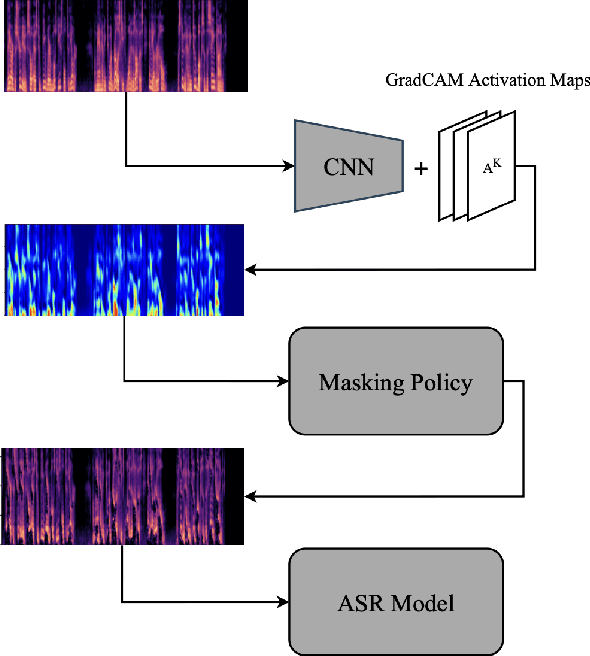
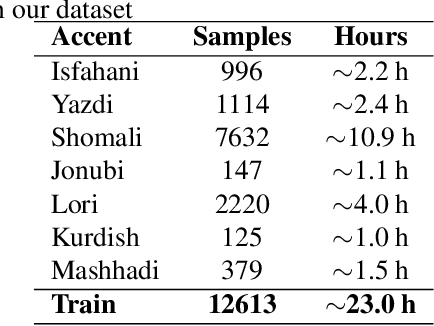
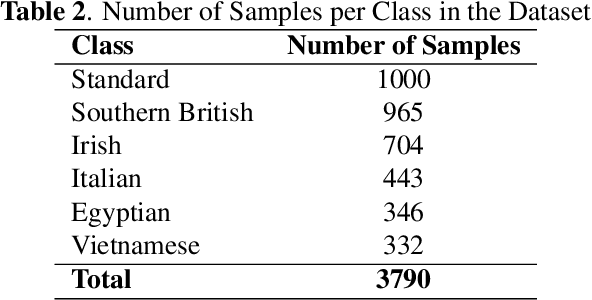
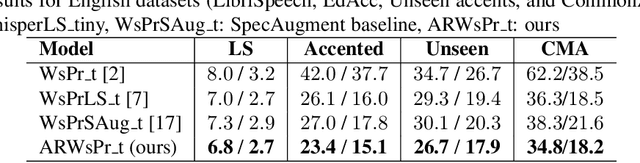
Pre-trained transformer-based models have significantly advanced automatic speech recognition (ASR), yet they remain sensitive to accent and dialectal variations, resulting in elevated word error rates (WER) in linguistically diverse languages such as English and Persian. To address this challenge, we propose an accent-invariant ASR framework that integrates accent and dialect classification into the recognition pipeline. Our approach involves training a spectrogram-based classifier to capture accent-specific cues, masking the regions most influential to its predictions, and using the masked spectrograms for data augmentation. This enhances the robustness of ASR models against accent variability. We evaluate the method using both English and Persian speech. For Persian, we introduce a newly collected dataset spanning multiple regional accents, establishing the first systematic benchmark for accent variation in Persian ASR that fills a critical gap in multilingual speech research and provides a foundation for future studies on low-resource, linguistically diverse languages. Experimental results with the Whisper model demonstrate that our masking and augmentation strategy yields substantial WER reductions in both English and Persian settings, confirming the effectiveness of the approach. This research advances the development of multilingual ASR systems that are resilient to accent and dialect diversity. Code and dataset are publicly available at: https://github.com/MH-Sameti/Accent_invariant_ASR