 Add to Chrome
 Add to Firefox
 Add to Edge
Persian MusicGen: A Large-Scale Dataset and Culturally-Aware Generative Model for Persian Music
May 14, 2026
Persian music, with its unique tonalities, modal systems (Dastgah), and rhythmic structures, presents significant challenges for music generation models trained primarily on Western music. We address this gap by curating the first large-scale dataset of Persian songs, comprising over 900 hours high-quality audio samples across diverse sub-genres, including pop, traditional, and contemporary styles. This dataset captures the rich melodic and cultural diversity of Persian music and serves as the foundation for fine-tuning MusicGen, a state-of-the-art generative music model. We adapt MusicGen to this domain and evaluate its performance by utilizing subjective and objective metrics. To assess the semantic alignment between generated music and intended style tags, we report the proportion of relevant tags accurately reflected in the generated outputs. Our results demonstrate that the fine-tuned model produces compositions that more align with Persian stylistic conventions. This work introduces a new resource for generative music research and illustrates the adaptability of music generation models to underrepresented cultural and linguistic contexts.

Toward IIT-Inspired Consciousness in LLMs: A Reward-Based Learning Framework
Jan 30, 2026The pursuit of Artificial General Intelligence (AGI) is a central goal in language model development, in which consciousness-like processing could serve as a key facilitator. While current language models are not conscious, they exhibit behaviors analogous to certain aspects of consciousness. This paper investigates the implementation of a leading theory of consciousness, Integrated Information Theory (IIT), within language models via a reward-based learning paradigm. IIT provides a formal, axiom-based mathematical framework for quantifying consciousness. Drawing inspiration from its core principles, we formulate a novel reward function that quantifies a text's causality, coherence and integration, characteristics associated with conscious processing. Empirically, it is found that optimizing for this IIT-inspired reward leads to more concise text generation. On out of domain tasks, careful tuning achieves up to a 31% reduction in output length while preserving accuracy levels comparable to the base model. In addition to primary task performance, the broader effects of this training methodology on the model's confidence calibration and test-time computational scaling is analyzed. The proposed framework offers significant practical advantages: it is conceptually simple, computationally efficient, requires no external data or auxiliary models, and leverages a general, capability-driven signal rather than task-specific heuristics. Code available at https://github.com/MH-Sameti/LLM_PostTraining.git
Persian Musical Instruments Classification Using Polyphonic Data Augmentation
Nov 07, 2025Musical instrument classification is essential for music information retrieval (MIR) and generative music systems. However, research on non-Western traditions, particularly Persian music, remains limited. We address this gap by introducing a new dataset of isolated recordings covering seven traditional Persian instruments, two common but originally non-Persian instruments (i.e., violin, piano), and vocals. We propose a culturally informed data augmentation strategy that generates realistic polyphonic mixtures from monophonic samples. Using the MERT model (Music undERstanding with large-scale self-supervised Training) with a classification head, we evaluate our approach with out-of-distribution data which was obtained by manually labeling segments of traditional songs. On real-world polyphonic Persian music, the proposed method yielded the best ROC-AUC (0.795), highlighting complementary benefits of tonal and temporal coherence. These results demonstrate the effectiveness of culturally grounded augmentation for robust Persian instrument recognition and provide a foundation for culturally inclusive MIR and diverse music generation systems.
Accent-Invariant Automatic Speech Recognition via Saliency-Driven Spectrogram Masking
Oct 10, 2025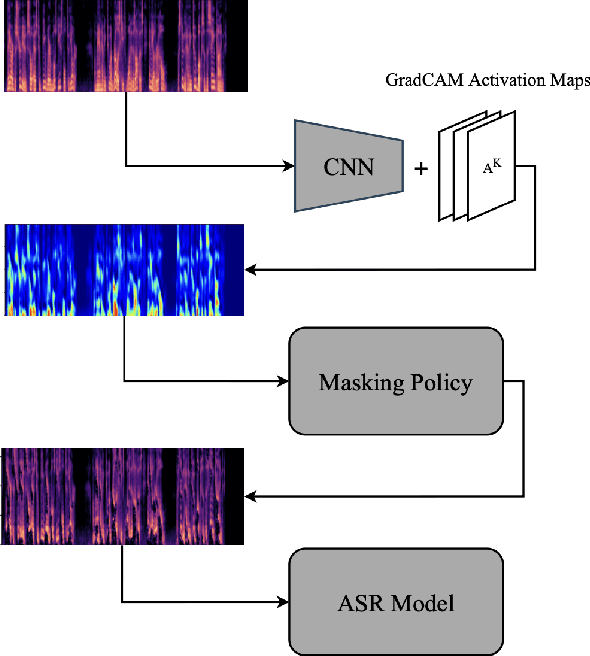
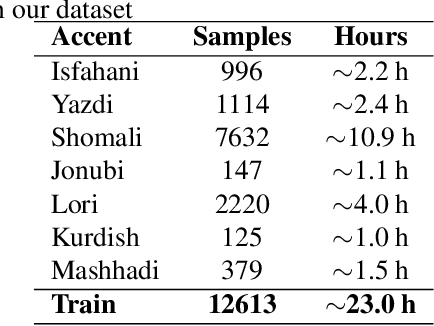
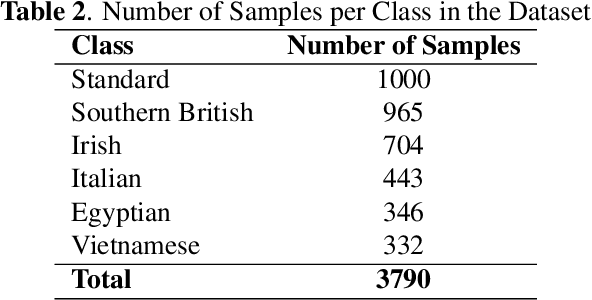
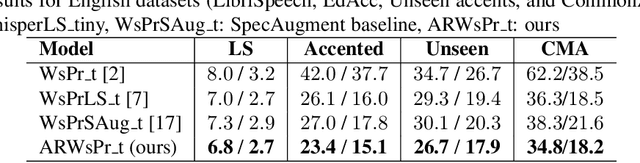
Pre-trained transformer-based models have significantly advanced automatic speech recognition (ASR), yet they remain sensitive to accent and dialectal variations, resulting in elevated word error rates (WER) in linguistically diverse languages such as English and Persian. To address this challenge, we propose an accent-invariant ASR framework that integrates accent and dialect classification into the recognition pipeline. Our approach involves training a spectrogram-based classifier to capture accent-specific cues, masking the regions most influential to its predictions, and using the masked spectrograms for data augmentation. This enhances the robustness of ASR models against accent variability. We evaluate the method using both English and Persian speech. For Persian, we introduce a newly collected dataset spanning multiple regional accents, establishing the first systematic benchmark for accent variation in Persian ASR that fills a critical gap in multilingual speech research and provides a foundation for future studies on low-resource, linguistically diverse languages. Experimental results with the Whisper model demonstrate that our masking and augmentation strategy yields substantial WER reductions in both English and Persian settings, confirming the effectiveness of the approach. This research advances the development of multilingual ASR systems that are resilient to accent and dialect diversity. Code and dataset are publicly available at: https://github.com/MH-Sameti/Accent_invariant_ASR