 Add to Chrome
 Add to Firefox
 Add to Edge
Achieving Almost Exact Recovery in Almost Quadratic Time: Rank-Based Graph Matching via Local Tree Correlation Tests
Jul 14, 2026
This paper studies graph matching under the correlated $\text{Erdős-Rényi}$ (ER) graph pair model. This model first samples an $\mathrm{ER}(n,\fracλ{ns})$ base graph, whose edges are then independently subsampled twice with probability $s$ to produce two correlated $\mathrm{ER}(n,\fracλ{n})$ graphs. We propose a graph matching algorithm that has $n^{2+o(1)}$ time complexity and achieves almost exact recovery with high probability under the assumptions $λ=(\log n)^{α+o(1)}$ for some $α\in(0,1)$ and $s\in(\sqrt{C_{\mathrm{Otter}}},1]$, where $C_{\mathrm{Otter}}\approx 0.338$ is Otter's tree-counting constant. This is the first algorithm with almost quadratic time complexity in this regime of $λ$, while the best known result in this regime is the chandelier-counting algorithm with time complexity $O(n^{c(s)})$, where $c(s)\rightarrow \infty$ as $s$ approaches $\sqrt{C_\mathrm{Otter}}$ from above. The proposed algorithm is based on local tree correlation tests. It uses a rank-based algorithm to match the vertex pairs instead of threshold-based rules in the literature. This avoids the need of computing an explicit threshold, which is computationally difficult to obtain. To prove the almost exact recovery result, we establish a new analysis of tree correlation tests in the diverging-degree regime, where both the mean degree and the tree depth grow with $n$. Based on this new result, we establish the existence of a threshold for a threshold-based graph matching algorithm via local tree correlation tests. Finally, we couple the performance of the rank-based algorithm with the threshold-based algorithm to show almost exact recovery.

Diffusion-Network Alignment: An Efficient Algorithm and Explicit Probability Bounds
Jun 11, 2026This paper studies a variation of the classic network alignment problem, named diffusion-network alignment. The goal is to align the vertices of a rooted diffusion tree to the vertices of a network, where the diffusion tree could be from a communication trace or contact tracing, and the network could be an online or offline social network. Different from the classic network alignment where both networks are fully observed, this model captures the information asymmetry of two networks. To solve this problem, this paper presents an efficient algorithm based on tree correlation tests to extract alignment information from local neighborhoods. We analyze the performance of the algorithm in the sparse graph regime and show that with high probability, all matched pairs are correct. Furthermore, for each vertex on the diffusion tree, this paper establishes an explicit lower bound on the probability that the vertex is correctly matched. These lower bounds are depth-dependent and increase as vertices get closer to the root.
GRACE: Gradient-aligned Reasoning Data Curation for Efficient Post-training
May 13, 2026Existing reasoning data curation pipelines score whole samples, treating every intermediate step as equally valuable. In reality, steps within a trace contribute very unevenly, and selecting reasoning data well requires assessing them individually. We present GRACE, a gradient-aligned curation method that views each reasoning trace as a sequence of optimization events and scores every step by two complementary signals: its alignment with the answer-oriented gradient direction, and its consistency with the preceding reasoning trajectory. Step-level scores are aggregated into a sample-level value for subset selection, using only the model's internal optimization signals and no external reward models or step annotations. To make this scalable, GRACE introduces a representation-level gradient proxy that estimates step-level alignment from token-level upstream signals in a single forward pass. Post-training Qwen3-VL-2B-Instruct on MMathCoT-1M, GRACE reaches 108.8% of the full-data performance with 20% of the data and retains 100.2% with only 5%, with subsets that transfer effectively across model backbones.
Multi-Agent SAC Enabled Beamforming Design for Joint Secret Key Generation and Data Transmission
Mar 14, 2026Physical layer key generation (PLKG) has emerged as a promising solution for achieving highly secured and low-latency key distribution, offering information-theoretic security that is inherently resilient to quantum attacks. However, simultaneously ensuring a high data transmission rate and a high secret key generation rate under eavesdropping attacks remains a major challenge. In time-division duplex (TDD) systems with multiple antennas, we derive closed-form expressions for both rates by modeling the legitimate channel as a time-correlated autoregressive (AR) process. This formulation leads to a highly nonconvex and time-coupled optimization problem, rendering traditional optimization methods ineffective. To address this issue, we propose a multi-agent soft actor-critic (SAC) framework equipped with a long short-term memory (LSTM) adversary prediction module to cope with the partial observability of the eavesdropper's mode. Simulation results demonstrate that the proposed approach achieves superior performance compared with other benchmark algorithms, while effectively balancing the trade-off between secret key generation rate and data transmission rate. The results also confirm the robustness of the proposed framework against intelligent eavesdropping and partial observation uncertainty.
Training deep physical neural networks with local physical information bottleneck
Feb 10, 2026Deep learning has revolutionized modern society but faces growing energy and latency constraints. Deep physical neural networks (PNNs) are interconnected computing systems that directly exploit analog dynamics for energy-efficient, ultrafast AI execution. Realizing this potential, however, requires universal training methods tailored to physical intricacies. Here, we present the Physical Information Bottleneck (PIB), a general and efficient framework that integrates information theory and local learning, enabling deep PNNs to learn under arbitrary physical dynamics. By allocating matrix-based information bottlenecks to each unit, we demonstrate supervised, unsupervised, and reinforcement learning across electronic memristive chips and optical computing platforms. PIB also adapts to severe hardware faults and allows for parallel training via geographically distributed resources. Bypassing auxiliary digital models and contrastive measurements, PIB recasts PNN training as an intrinsic, scalable information-theoretic process compatible with diverse physical substrates.
Noisy Computing of the $\mathsf{OR}$ and $\mathsf{MAX}$ Functions
Sep 07, 2023We consider the problem of computing a function of $n$ variables using noisy queries, where each query is incorrect with some fixed and known probability $p \in (0,1/2)$. Specifically, we consider the computation of the $\mathsf{OR}$ function of $n$ bits (where queries correspond to noisy readings of the bits) and the $\mathsf{MAX}$ function of $n$ real numbers (where queries correspond to noisy pairwise comparisons). We show that an expected number of queries of \[ (1 \pm o(1)) \frac{n\log \frac{1}{\delta}}{D_{\mathsf{KL}}(p \| 1-p)} \] is both sufficient and necessary to compute both functions with a vanishing error probability $\delta = o(1)$, where $D_{\mathsf{KL}}(p \| 1-p)$ denotes the Kullback-Leibler divergence between $\mathsf{Bern}(p)$ and $\mathsf{Bern}(1-p)$ distributions. Compared to previous work, our results tighten the dependence on $p$ in both the upper and lower bounds for the two functions.
An Effective Data Creation Pipeline to Generate High-quality Financial Instruction Data for Large Language Model
Jul 31, 2023At the beginning era of large language model, it is quite critical to generate a high-quality financial dataset to fine-tune a large language model for financial related tasks. Thus, this paper presents a carefully designed data creation pipeline for this purpose. Particularly, we initiate a dialogue between an AI investor and financial expert using ChatGPT and incorporate the feedback of human financial experts, leading to the refinement of the dataset. This pipeline yielded a robust instruction tuning dataset comprised of 103k multi-turn chats. Extensive experiments have been conducted on this dataset to evaluate the model's performance by adopting an external GPT-4 as the judge. The promising experimental results verify that our approach led to significant advancements in generating accurate, relevant, and financial-style responses from AI models, and thus providing a powerful tool for applications within the financial sector.
FinVis-GPT: A Multimodal Large Language Model for Financial Chart Analysis
Jul 31, 2023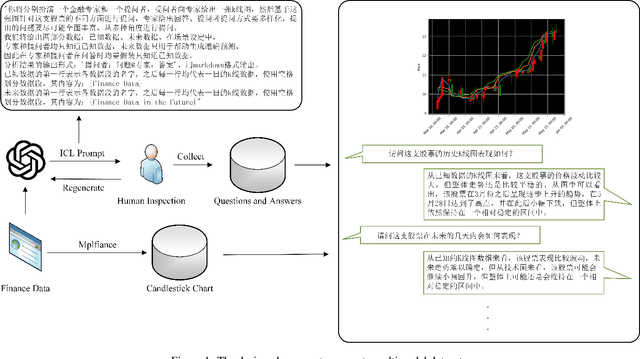
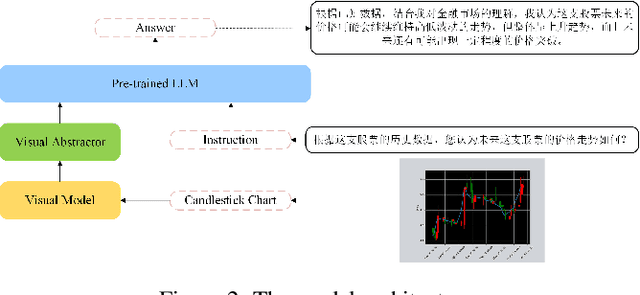
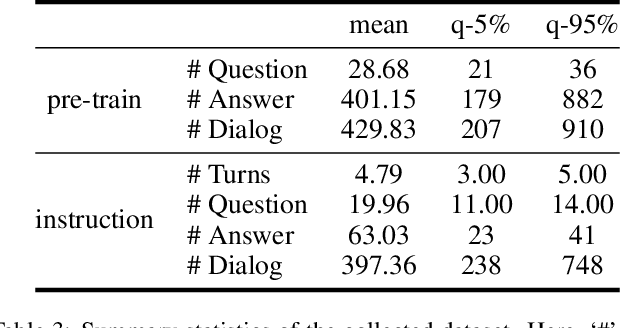
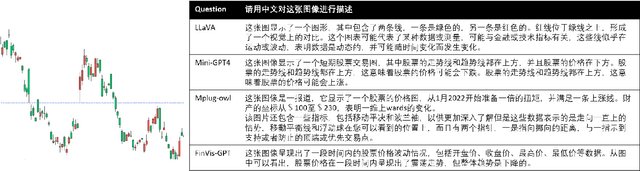
In this paper, we propose FinVis-GPT, a novel multimodal large language model (LLM) specifically designed for financial chart analysis. By leveraging the power of LLMs and incorporating instruction tuning and multimodal capabilities, FinVis-GPT is capable of interpreting financial charts and providing valuable analysis. To train FinVis-GPT, a financial task oriented dataset was generated for pre-training alignment and instruction tuning, comprising various types of financial charts and their corresponding descriptions. We evaluate the model performance via several case studies due to the time limit, and the promising results demonstrated that FinVis-GPT is superior in various financial chart related tasks, including generating descriptions, answering questions and predicting future market trends, surpassing existing state-of-the-art multimodal LLMs. The proposed FinVis-GPT serves as a pioneering effort in utilizing multimodal LLMs in the finance domain and our generated dataset will be release for public use in the near future to speedup related research.
On the Optimal Bounds for Noisy Computing
Jun 21, 2023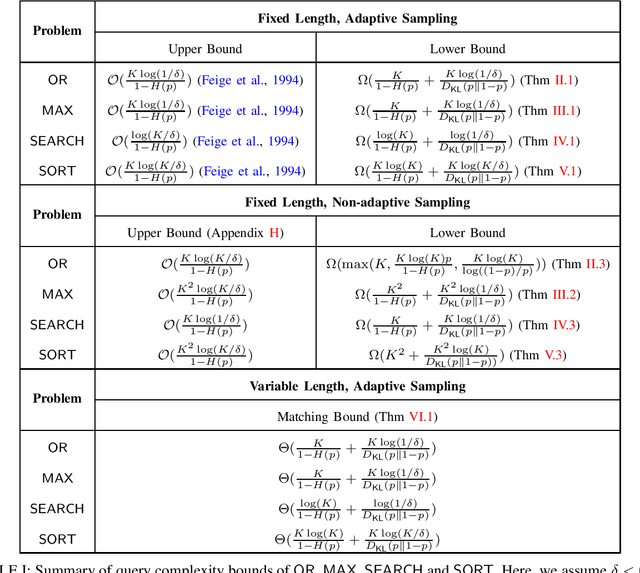
We revisit the problem of computing with noisy information considered in Feige et al. 1994, which includes computing the OR function from noisy queries, and computing the MAX, SEARCH and SORT functions from noisy pairwise comparisons. For $K$ given elements, the goal is to correctly recover the desired function with probability at least $1-\delta$ when the outcome of each query is flipped with probability $p$. We consider both the adaptive sampling setting where each query can be adaptively designed based on past outcomes, and the non-adaptive sampling setting where the query cannot depend on past outcomes. The prior work provides tight bounds on the worst-case query complexity in terms of the dependence on $K$. However, the upper and lower bounds do not match in terms of the dependence on $\delta$ and $p$. We improve the lower bounds for all the four functions under both adaptive and non-adaptive query models. Most of our lower bounds match the upper bounds up to constant factors when either $p$ or $\delta$ is bounded away from $0$, while the ratio between the best prior upper and lower bounds goes to infinity when $p\rightarrow 0$ or $p\rightarrow 1/2$. On the other hand, we also provide matching upper and lower bounds for the number of queries in expectation, improving both the upper and lower bounds for the variable-length query model.
PINNacle: A Comprehensive Benchmark of Physics-Informed Neural Networks for Solving PDEs
Jun 15, 2023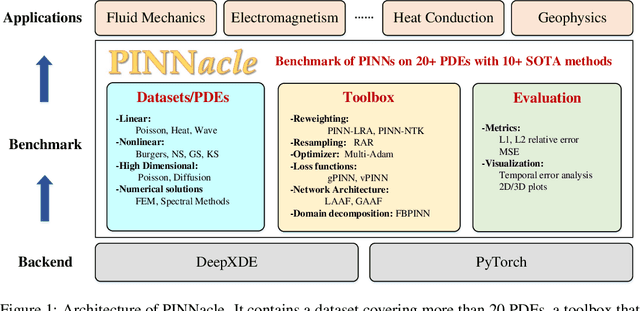

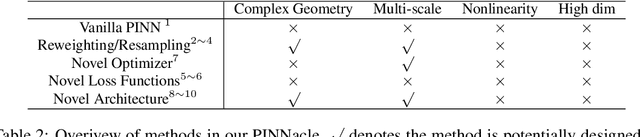
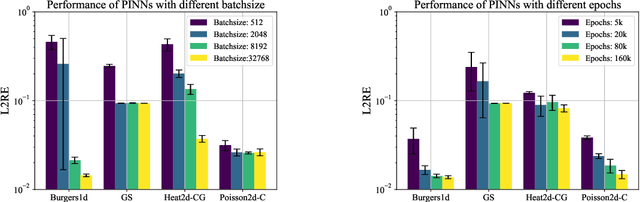
While significant progress has been made on Physics-Informed Neural Networks (PINNs), a comprehensive comparison of these methods across a wide range of Partial Differential Equations (PDEs) is still lacking. This study introduces PINNacle, a benchmarking tool designed to fill this gap. PINNacle provides a diverse dataset, comprising over 20 distinct PDEs from various domains including heat conduction, fluid dynamics, biology, and electromagnetics. These PDEs encapsulate key challenges inherent to real-world problems, such as complex geometry, multi-scale phenomena, nonlinearity, and high dimensionality. PINNacle also offers a user-friendly toolbox, incorporating about 10 state-of-the-art PINN methods for systematic evaluation and comparison. We have conducted extensive experiments with these methods, offering insights into their strengths and weaknesses. In addition to providing a standardized means of assessing performance, PINNacle also offers an in-depth analysis to guide future research, particularly in areas such as domain decomposition methods and loss reweighting for handling multi-scale problems and complex geometry. While PINNacle does not guarantee success in all real-world scenarios, it represents a significant contribution to the field by offering a robust, diverse, and comprehensive benchmark suite that will undoubtedly foster further research and development in PINNs.