 Add to Chrome
 Add to Firefox
 Add to Edge
PolyDebate: A Game-Orchestrated Multimodal System for Debate Skills Practice and Evaluation
Aug 17, 2026
Debate is a structured form of persuasive communication that trains argument construction, rebuttal, oral delivery, and audience awareness. These skills are valued in education, language learning, and professional communication. Recent AI debate systems and LLM-based judges have advanced argument generation and debate evaluation, but most remain text-centered and rarely support learners through a complete multimodal practice experience. We introduce PolyDebate, a game-orchestrated multimodal system for English debate practice and evaluation. PolyDebate guides learners through staged one-on-one (1v1) debates with an AI opponent, while skill cards, props, and coins make persuasive strategies explicit and turn practice into a game-like interaction. During each session, the system captures learner speech and visual delivery evidence, generates context-aware opponent responses, and produces rubric-informed stage-level and overall feedback. PolyDebate is available as both an immersive Unity 3D game version and a web platform version that share the same workflow and evaluation services. Four studies covering AI opponent quality, evaluation coverage, AI judge feedback, and user perception show that PolyDebate brings debate interaction, gamified scaffolding, multimodal assessment, and structured feedback together in a practical workflow for debate skills practice. The demonstration video is available at https://youtu.be/mHwBG1_8Ebk.

PolyInterview: An LLM-based Platform for Immersive Mock Interview Practice with Comprehensive Multimodal Assessment
Jul 11, 2026Preparing for job interviews is important for securing desired positions, yet realistic practice remains difficult to access: real interviews are infrequent, expert mock coaching is costly, and self-practice offers neither adaptive dialogue nor structured assessment. Existing systems typically address only parts of this need through fixed question sequences, limited communication channels, or feedback with little supporting evidence. We present PolyInterview, an LLM-based platform for immersive mock interview practice with comprehensive multimodal assessment. PolyInterview uses the target job description and CV to generate questions tailored to the role and candidate, conducts multi-turn spoken interviews with a lip-synced digital human interviewer that asks answer-aware follow-up questions, and evaluates response content, vocal delivery, and non-verbal behavior. Four parallel evaluators produce 13 behavior-level features that are aggregated into 10 assessment aspects and two competency tracks. Guided by the KSA and STAR frameworks, the report links each score to behavioral evidence and actionable recommendations. PolyInterview is publicly accessible. Its current all-account snapshot contains 101 accounts, 1,564 interview sessions, 7,665 generated questions, and 1,422 five-stage question sets. Generated questions are more closely aligned with their matched job description than with cross-role job descriptions in 93.7% of sessions. An evaluation by ten experts found strong question plans and actionable feedback.
FactCheck: Feasibility-aware Long-term Action Anticipation with Multi-agent Collaboration
Jun 10, 2026Long-term action anticipation (LTA) aims to predict an ordered sequence of future verb-noun actions from a partially observed video. While this task serves as the foundation for embodied intelligence, anticipating physically feasible long-term actions remains a critical challenge. Existing methods, which operate in an open-loop manner, often hallucinate non-existent objects, violate object affordances, or disregard object states, as they lack explicit mechanisms to verify action feasibility against the physical environment. To address this, we propose FactCheck, a novel multi-agent collaboration framework that improves feasibility through a closed-loop "Observe-Plan-Verify" mechanism. FactCheck decomposes the complex LTA task into specialized roles: an Observer that recognizes historical actions from video observations and constructs a dual-form structured memory, comprising a History Action Abstract that captures high-level human intentions and environmental status, and a History Action Graph that encodes object states and temporal dependencies; a Planner that generates draft future actions conditioned on both low-level historical actions and high-level History Action Abstract; and a Verifier that rigorously validates the draft against the History Action Graph and refines infeasible actions. Extensive experiments on the EPIC-Kitchens-55 and EGTEA Gaze+ benchmarks demonstrate that FactCheck consistently outperforms state-of-the-art methods. Our work establishes a new paradigm for feasibility-aware long-term action anticipation, effectively closing the loop of action recognition, action prediction and action verification.
Head-Aware Key-Value Compression for Efficient Autoregressive Image Generation
May 20, 2026Autoregressive (AR) visual generation has achieved remarkable performance but suffers from high memory usage and low throughput, as it requires caching previously generated visual tokens. Recent research has shown that retaining only a few lines of cache tokens can maintain high-quality images while significantly reducing memory usage and improving throughput. However, these methods allocate a fixed budget to each attention head, overlooking the heterogeneity among attention heads, leading to suboptimal memory allocation. In this paper, we observe that attention heads across different layers exhibit diverse attention patterns, where some heads focus on local neighborhoods while others capture broader contextual dependencies. Based on this insight, we propose a novel head-aware key-value (KV) cache compression framework for autoregressive image generation, called HeadKV, which assigns smaller budgets to locality-biased heads and larger budgets to heads with broader attention. A key challenge lies in identifying the type of each attention head to guide cache compression. We further observe that, within the same layer, each head exhibits consistent attention patterns across token positions, \emph{i.e.}, a head's behavior for early tokens remains consistent with that for later tokens. This insight suggests that head types can be identified during the early stage and reused for KV compression throughout generation. Its advantage is that it requires no additional training or dataset-level statistics and generalizes seamlessly across different inputs. Moreover, we design a Stratified Token Eviction strategy to effectively preserve long-range information. Extensive experiments demonstrate its effectiveness across multiple autoregressive image generation models.
SurveyLens: A Research Discipline-Aware Benchmark for Automatic Survey Generation
Feb 11, 2026The exponential growth of scientific literature has driven the evolution of Automatic Survey Generation (ASG) from simple pipelines to multi-agent frameworks and commercial Deep Research agents. However, current ASG evaluation methods rely on generic metrics and are heavily biased toward Computer Science (CS), failing to assess whether ASG methods adhere to the distinct standards of various academic disciplines. Consequently, researchers, especially those outside CS, lack clear guidance on using ASG systems to yield high-quality surveys compliant with specific discipline standards. To bridge this gap, we introduce SurveyLens, the first discipline-aware benchmark evaluating ASG methods across diverse research disciplines. We construct SurveyLens-1k, a curated dataset of 1,000 high-quality human-written surveys spanning 10 disciplines. Subsequently, we propose a dual-lens evaluation framework: (1) Discipline-Aware Rubric Evaluation, which utilizes LLMs with human preference-aligned weights to assess adherence to domain-specific writing standards; and (2) Canonical Alignment Evaluation to rigorously measure content coverage and synthesis quality against human-written survey papers. We conduct extensive experiments by evaluating 11 state-of-the-art ASG methods on SurveyLens, including Vanilla LLMs, ASG systems, and Deep Research agents. Our analysis reveals the distinct strengths and weaknesses of each paradigm across fields, providing essential guidance for selecting tools tailored to specific disciplinary requirements.
Improved Masked Image Generation with Knowledge-Augmented Token Representations
Nov 15, 2025Masked image generation (MIG) has demonstrated remarkable efficiency and high-fidelity images by enabling parallel token prediction. Existing methods typically rely solely on the model itself to learn semantic dependencies among visual token sequences. However, directly learning such semantic dependencies from data is challenging because the individual tokens lack clear semantic meanings, and these sequences are usually long. To address this limitation, we propose a novel Knowledge-Augmented Masked Image Generation framework, named KA-MIG, which introduces explicit knowledge of token-level semantic dependencies (\emph{i.e.}, extracted from the training data) as priors to learn richer representations for improving performance. In particular, we explore and identify three types of advantageous token knowledge graphs, including two positive and one negative graphs (\emph{i.e.}, the co-occurrence graph, the semantic similarity graph, and the position-token incompatibility graph). Based on three prior knowledge graphs, we design a graph-aware encoder to learn token and position-aware representations. After that, a lightweight fusion mechanism is introduced to integrate these enriched representations into the existing MIG methods. Resorting to such prior knowledge, our method effectively enhances the model's ability to capture semantic dependencies, leading to improved generation quality. Experimental results demonstrate that our method improves upon existing MIG for class-conditional image generation on ImageNet.
Seeing Beyond the Scene: Enhancing Vision-Language Models with Interactional Reasoning
May 14, 2025Traditional scene graphs primarily focus on spatial relationships, limiting vision-language models' (VLMs) ability to reason about complex interactions in visual scenes. This paper addresses two key challenges: (1) conventional detection-to-construction methods produce unfocused, contextually irrelevant relationship sets, and (2) existing approaches fail to form persistent memories for generalizing interaction reasoning to new scenes. We propose Interaction-augmented Scene Graph Reasoning (ISGR), a framework that enhances VLMs' interactional reasoning through three complementary components. First, our dual-stream graph constructor combines SAM-powered spatial relation extraction with interaction-aware captioning to generate functionally salient scene graphs with spatial grounding. Second, we employ targeted interaction queries to activate VLMs' latent knowledge of object functionalities, converting passive recognition into active reasoning about how objects work together. Finally, we introduce a lone-term memory reinforcement learning strategy with a specialized interaction-focused reward function that transforms transient patterns into long-term reasoning heuristics. Extensive experiments demonstrate that our approach significantly outperforms baseline methods on interaction-heavy reasoning benchmarks, with particularly strong improvements on complex scene understanding tasks. The source code can be accessed at https://github.com/open_upon_acceptance.
Towards Improved Text-Aligned Codebook Learning: Multi-Hierarchical Codebook-Text Alignment with Long Text
Mar 03, 2025Image quantization is a crucial technique in image generation, aimed at learning a codebook that encodes an image into a discrete token sequence. Recent advancements have seen researchers exploring learning multi-modal codebook (i.e., text-aligned codebook) by utilizing image caption semantics, aiming to enhance codebook performance in cross-modal tasks. However, existing image-text paired datasets exhibit a notable flaw in that the text descriptions tend to be overly concise, failing to adequately describe the images and provide sufficient semantic knowledge, resulting in limited alignment of text and codebook at a fine-grained level. In this paper, we propose a novel Text-Augmented Codebook Learning framework, named TA-VQ, which generates longer text for each image using the visual-language model for improved text-aligned codebook learning. However, the long text presents two key challenges: how to encode text and how to align codebook and text. To tackle two challenges, we propose to split the long text into multiple granularities for encoding, i.e., word, phrase, and sentence, so that the long text can be fully encoded without losing any key semantic knowledge. Following this, a hierarchical encoder and novel sampling-based alignment strategy are designed to achieve fine-grained codebook-text alignment. Additionally, our method can be seamlessly integrated into existing VQ models. Extensive experiments in reconstruction and various downstream tasks demonstrate its effectiveness compared to previous state-of-the-art approaches.
Self-assessment, Exhibition, and Recognition: a Review of Personality in Large Language Models
Jun 25, 2024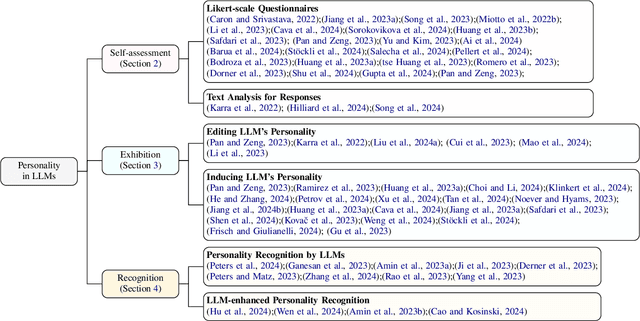
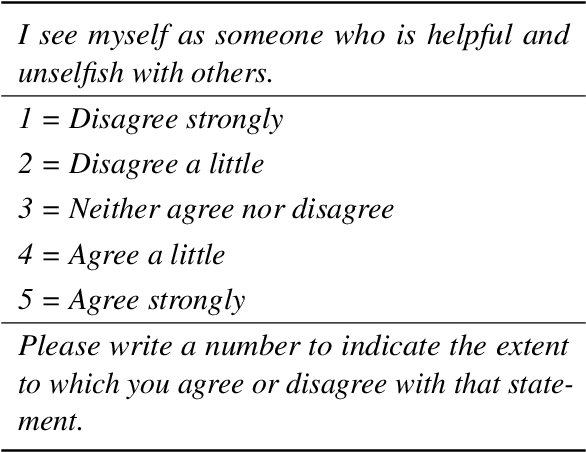
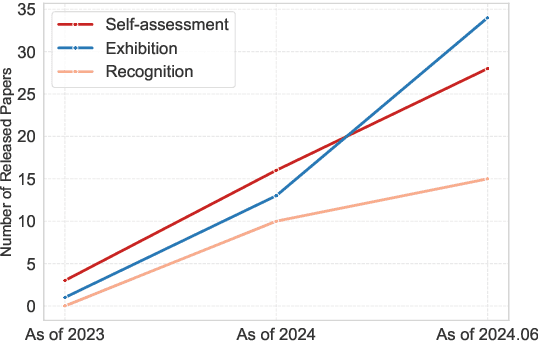
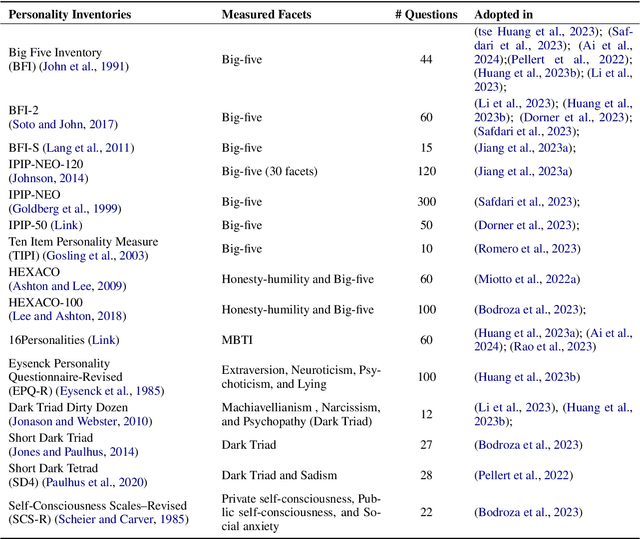
As large language models (LLMs) appear to behave increasingly human-like in text-based interactions, more and more researchers become interested in investigating personality in LLMs. However, the diversity of psychological personality research and the rapid development of LLMs have led to a broad yet fragmented landscape of studies in this interdisciplinary field. Extensive studies across different research focuses, different personality psychometrics, and different LLMs make it challenging to have a holistic overview and further pose difficulties in applying findings to real-world applications. In this paper, we present a comprehensive review by categorizing current studies into three research problems: self-assessment, exhibition, and recognition, based on the intrinsic characteristics and external manifestations of personality in LLMs. For each problem, we provide a thorough analysis and conduct in-depth comparisons of their corresponding solutions. Besides, we summarize research findings and open challenges from current studies and further discuss their underlying causes. We also collect extensive publicly available resources to facilitate interested researchers and developers. Lastly, we discuss the potential future research directions and application scenarios. Our paper is the first comprehensive survey of up-to-date literature on personality in LLMs. By presenting a clear taxonomy, in-depth analysis, promising future directions, and extensive resource collections, we aim to provide a better understanding and facilitate further advancements in this emerging field.
Affective-NLI: Towards Accurate and Interpretable Personality Recognition in Conversation
Apr 03, 2024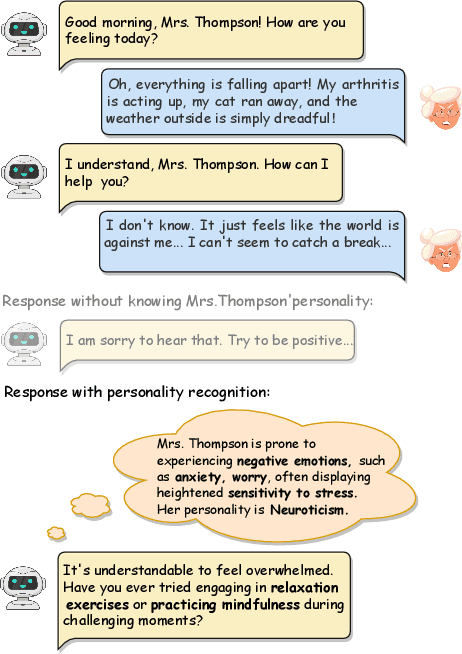
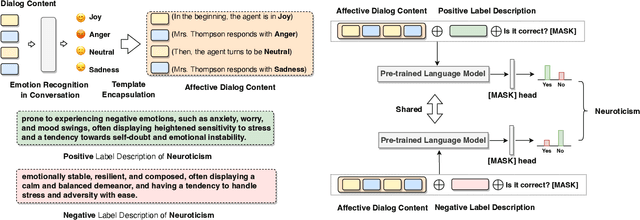
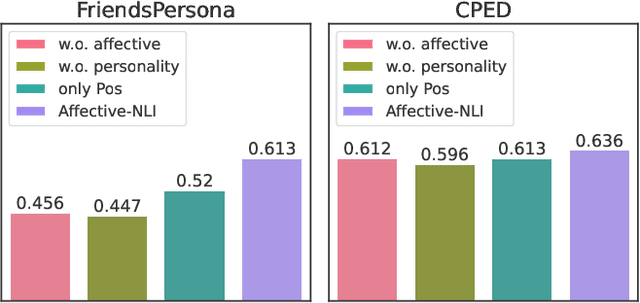
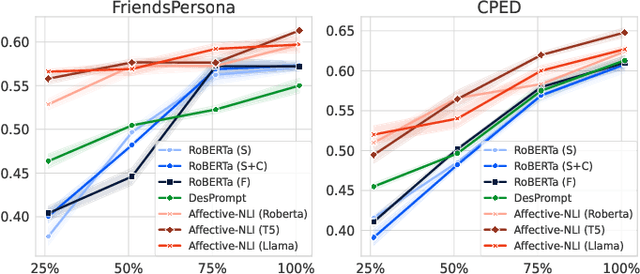
Personality Recognition in Conversation (PRC) aims to identify the personality traits of speakers through textual dialogue content. It is essential for providing personalized services in various applications of Human-Computer Interaction (HCI), such as AI-based mental therapy and companion robots for the elderly. Most recent studies analyze the dialog content for personality classification yet overlook two major concerns that hinder their performance. First, crucial implicit factors contained in conversation, such as emotions that reflect the speakers' personalities are ignored. Second, only focusing on the input dialog content disregards the semantic understanding of personality itself, which reduces the interpretability of the results. In this paper, we propose Affective Natural Language Inference (Affective-NLI) for accurate and interpretable PRC. To utilize affectivity within dialog content for accurate personality recognition, we fine-tuned a pre-trained language model specifically for emotion recognition in conversations, facilitating real-time affective annotations for utterances. For interpretability of recognition results, we formulate personality recognition as an NLI problem by determining whether the textual description of personality labels is entailed by the dialog content. Extensive experiments on two daily conversation datasets suggest that Affective-NLI significantly outperforms (by 6%-7%) state-of-the-art approaches. Additionally, our Flow experiment demonstrates that Affective-NLI can accurately recognize the speaker's personality in the early stages of conversations by surpassing state-of-the-art methods with 22%-34%.