 Add to Chrome
 Add to Firefox
 Add to Edge
InCaRPose: In-Cabin Relative Camera Pose Estimation Model and Dataset
Apr 04, 2026
Camera extrinsic calibration is a fundamental task in computer vision. However, precise relative pose estimation in constrained, highly distorted environments, such as in-cabin automotive monitoring (ICAM), remains challenging. We present InCaRPose, a Transformer-based architecture designed for robust relative pose prediction between image pairs, which can be used for camera extrinsic calibration. By leveraging frozen backbone features such as DINOv3 and a Transformer-based decoder, our model effectively captures the geometric relationship between a reference and a target view. Unlike traditional methods, our approach achieves absolute metric-scale translation within the physically plausible adjustment range of in-cabin camera mounts in a single inference step, which is critical for ICAM, where accurate real-world distances are required for safety-relevant perception. We specifically address the challenges of highly distorted fisheye cameras in automotive interiors by training exclusively on synthetic data. Our model is capable of generalization to real-world cabin environments without relying on the exact same camera intrinsics and additionally achieves competitive performance on the public 7-Scenes dataset. Despite having limited training data, InCaRPose maintains high precision in both rotation and translation, even with a ViT-Small backbone. This enables real-time performance for time-critical inference, such as driver monitoring in supervised autonomous driving. We release our real-world In-Cabin-Pose test dataset consisting of highly distorted vehicle-interior images and our code at https://github.com/felixstillger/InCaRPose.

Goal-Oriented Reactive Simulation for Closed-Loop Trajectory Prediction
Mar 25, 2026Current trajectory prediction models are primarily trained in an open-loop manner, which often leads to covariate shift and compounding errors when deployed in real-world, closed-loop settings. Furthermore, relying on static datasets or non-reactive log-replay simulators severs the interactive loop, preventing the ego agent from learning to actively negotiate surrounding traffic. In this work, we propose an on-policy closed-loop training paradigm optimized for high-frequency, receding horizon ego prediction. To ground the ego prediction in a realistic representation of traffic interactions and to achieve reactive consistency, we introduce a goal-oriented, transformer-based scene decoder, resulting in an inherently reactive training simulation. By exposing the ego agent to a mixture of open-loop data and simulated, self-induced states, the model learns recovery behaviors to correct its own execution errors. Extensive evaluation demonstrates that closed-loop training significantly enhances collision avoidance capabilities at high replanning frequencies, yielding relative collision rate reductions of up to 27.0% on nuScenes and 79.5% in dense DeepScenario intersections compared to open-loop baselines. Additionally, we show that a hybrid simulation combining reactive with non-reactive surrounding agents achieves optimal balance between immediate interactivity and long-term behavioral stability.
Rectify, Don't Regret: Avoiding Pitfalls of Differentiable Simulation in Trajectory Prediction
Mar 24, 2026Current open-loop trajectory models struggle in real-world autonomous driving because minor initial deviations often cascade into compounding errors, pushing the agent into out-of-distribution states. While fully differentiable closed-loop simulators attempt to address this, they suffer from shortcut learning: the loss gradients flow backward through induced state inputs, inadvertently leaking future ground truth information directly into the model's own previous predictions. The model exploits these signals to artificially avoid drift, non-causally "regretting" past mistakes rather than learning genuinely reactive recovery. To address this, we introduce a detached receding horizon rollout. By explicitly severing the computation graph between simulation steps, the model learns genuine recovery behaviors from drifted states, forcing it to "rectify" mistakes rather than non-causally optimizing past predictions. Extensive evaluations on the nuScenes and DeepScenario datasets show our approach yields more robust recovery strategies, reducing target collisions by up to 33.24% compared to fully differentiable closed-loop training at high replanning frequencies. Furthermore, compared to standard open-loop baselines, our non-differentiable framework decreases collisions by up to 27.74% in dense environments while simultaneously improving multi-modal prediction diversity and lane alignment.
Failure Modes for Deep Learning-Based Online Mapping: How to Measure and Address Them
Mar 20, 2026Deep learning-based online mapping has emerged as a cornerstone of autonomous driving, yet these models frequently fail to generalize beyond familiar environments. We propose a framework to identify and measure the underlying failure modes by disentangling two effects: Memorization of input features and overfitting to known map geometries. We propose measures based on evaluation subsets that control for geographical proximity and geometric similarity between training and validation scenes. We introduce Fréchet distance-based reconstruction statistics that capture per-element shape fidelity without threshold tuning, and define complementary failure-mode scores: a localization overfitting score quantifying the performance drop when geographic cues disappear, and a map geometry overfitting score measuring degradation as scenes become geometrically novel. Beyond models, we analyze dataset biases and contribute map geometry-aware diagnostics: A minimum-spanning-tree (MST) diversity measure for training sets and a symmetric coverage measure to quantify geometric similarity between splits. Leveraging these, we formulate an MST-based sparsification strategy that reduces redundancy and improves balancing and performance while shrinking training size. Experiments on nuScenes and Argoverse 2 across multiple state-of-the-art models yield more trustworthy assessment of generalization and show that map geometry-diverse and balanced training sets lead to improved performance. Our results motivate failure-mode-aware protocols and map geometry-centric dataset design for deployable online mapping.
EXCODER: EXplainable Classification Of DiscretE time series Representations
Feb 13, 2026Deep learning has significantly improved time series classification, yet the lack of explainability in these models remains a major challenge. While Explainable AI (XAI) techniques aim to make model decisions more transparent, their effectiveness is often hindered by the high dimensionality and noise present in raw time series data. In this work, we investigate whether transforming time series into discrete latent representations-using methods such as Vector Quantized Variational Autoencoders (VQ-VAE) and Discrete Variational Autoencoders (DVAE)-not only preserves but enhances explainability by reducing redundancy and focusing on the most informative patterns. We show that applying XAI methods to these compressed representations leads to concise and structured explanations that maintain faithfulness without sacrificing classification performance. Additionally, we propose Similar Subsequence Accuracy (SSA), a novel metric that quantitatively assesses the alignment between XAI-identified salient subsequences and the label distribution in the training data. SSA provides a systematic way to validate whether the features highlighted by XAI methods are truly representative of the learned classification patterns. Our findings demonstrate that discrete latent representations not only retain the essential characteristics needed for classification but also offer a pathway to more compact, interpretable, and computationally efficient explanations in time series analysis.
Graph Query Networks for Object Detection with Automotive Radar
Nov 19, 2025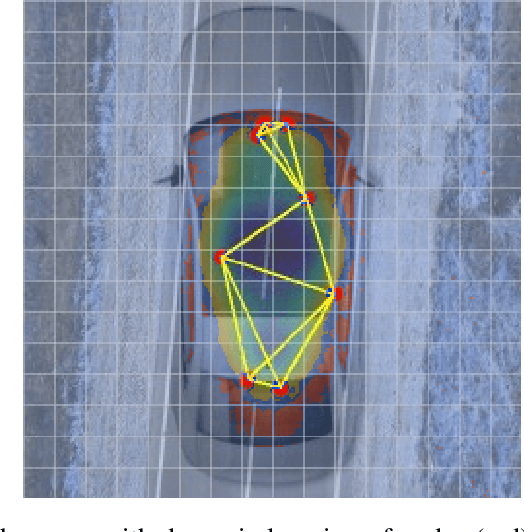
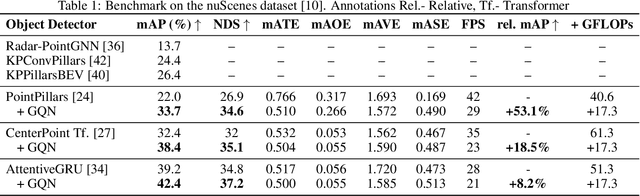
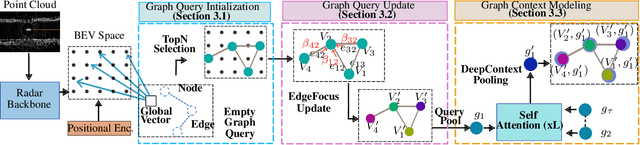

Object detection with 3D radar is essential for 360-degree automotive perception, but radar's long wavelengths produce sparse and irregular reflections that challenge traditional grid and sequence-based convolutional and transformer detectors. This paper introduces Graph Query Networks (GQN), an attention-based framework that models objects sensed by radar as graphs, to extract individualized relational and contextual features. GQN employs a novel concept of graph queries to dynamically attend over the bird's-eye view (BEV) space, constructing object-specific graphs processed by two novel modules: EdgeFocus for relational reasoning and DeepContext Pooling for contextual aggregation. On the NuScenes dataset, GQN improves relative mAP by up to +53%, including a +8.2% gain over the strongest prior radar method, while reducing peak graph construction overhead by 80% with moderate FLOPs cost.
Multi-Agent Multimodal Large Language Model Framework for Automated Interpretation of Fuel Efficiency Analytics in Public Transportation
Nov 17, 2025Enhancing fuel efficiency in public transportation requires the integration of complex multimodal data into interpretable, decision-relevant insights. However, traditional analytics and visualization methods often yield fragmented outputs that demand extensive human interpretation, limiting scalability and consistency. This study presents a multi-agent framework that leverages multimodal large language models (LLMs) to automate data narration and energy insight generation. The framework coordinates three specialized agents, including a data narration agent, an LLM-as-a-judge agent, and an optional human-in-the-loop evaluator, to iteratively transform analytical artifacts into coherent, stakeholder-oriented reports. The system is validated through a real-world case study on public bus transportation in Northern Jutland, Denmark, where fuel efficiency data from 4006 trips are analyzed using Gaussian Mixture Model clustering. Comparative experiments across five state-of-the-art LLMs and three prompting paradigms identify GPT-4.1 mini with Chain-of-Thought prompting as the optimal configuration, achieving 97.3% narrative accuracy while balancing interpretability and computational cost. The findings demonstrate that multi-agent orchestration significantly enhances factual precision, coherence, and scalability in LLM-based reporting. The proposed framework establishes a replicable and domain-adaptive methodology for AI-driven narrative generation and decision support in energy informatics.
Rethinking Backbone Design for Lightweight 3D Object Detection in LiDAR
Aug 01, 2025Recent advancements in LiDAR-based 3D object detection have significantly accelerated progress toward the realization of fully autonomous driving in real-world environments. Despite achieving high detection performance, most of the approaches still rely on a VGG-based or ResNet-based backbone for feature exploration, which increases the model complexity. Lightweight backbone design is well-explored for 2D object detection, but research on 3D object detection still remains limited. In this work, we introduce Dense Backbone, a lightweight backbone that combines the benefits of high processing speed, lightweight architecture, and robust detection accuracy. We adapt multiple SoTA 3d object detectors, such as PillarNet, with our backbone and show that with our backbone, these models retain most of their detection capability at a significantly reduced computational cost. To our knowledge, this is the first dense-layer-based backbone tailored specifically for 3D object detection from point cloud data. DensePillarNet, our adaptation of PillarNet, achieves a 29% reduction in model parameters and a 28% reduction in latency with just a 2% drop in detection accuracy on the nuScenes test set. Furthermore, Dense Backbone's plug-and-play design allows straightforward integration into existing architectures, requiring no modifications to other network components.
Inferring Driving Maps by Deep Learning-based Trail Map Extraction
May 15, 2025High-definition (HD) maps offer extensive and accurate environmental information about the driving scene, making them a crucial and essential element for planning within autonomous driving systems. To avoid extensive efforts from manual labeling, methods for automating the map creation have emerged. Recent trends have moved from offline mapping to online mapping, ensuring availability and actuality of the utilized maps. While the performance has increased in recent years, online mapping still faces challenges regarding temporal consistency, sensor occlusion, runtime, and generalization. We propose a novel offline mapping approach that integrates trails - informal routes used by drivers - into the map creation process. Our method aggregates trail data from the ego vehicle and other traffic participants to construct a comprehensive global map using transformer-based deep learning models. Unlike traditional offline mapping, our approach enables continuous updates while remaining sensor-agnostic, facilitating efficient data transfer. Our method demonstrates superior performance compared to state-of-the-art online mapping approaches, achieving improved generalization to previously unseen environments and sensor configurations. We validate our approach on two benchmark datasets, highlighting its robustness and applicability in autonomous driving systems.
LMFormer: Lane based Motion Prediction Transformer
Apr 14, 2025
Motion prediction plays an important role in autonomous driving. This study presents LMFormer, a lane-aware transformer network for trajectory prediction tasks. In contrast to previous studies, our work provides a simple mechanism to dynamically prioritize the lanes and shows that such a mechanism introduces explainability into the learning behavior of the network. Additionally, LMFormer uses the lane connection information at intersections, lane merges, and lane splits, in order to learn long-range dependency in lane structure. Moreover, we also address the issue of refining the predicted trajectories and propose an efficient method for iterative refinement through stacked transformer layers. For benchmarking, we evaluate LMFormer on the nuScenes dataset and demonstrate that it achieves SOTA performance across multiple metrics. Furthermore, the Deep Scenario dataset is used to not only illustrate cross-dataset network performance but also the unification capabilities of LMFormer to train on multiple datasets and achieve better performance.