 Add to Chrome
 Add to Firefox
 Add to Edge
Beyond Weight Adaptation: Feature-Space Domain Injection for Cross-Modal Ship Re-Identification
Dec 24, 2025
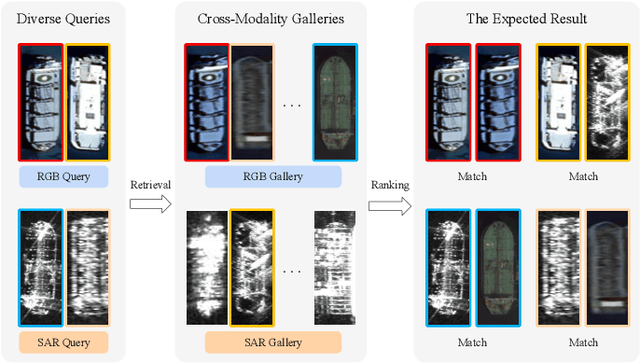
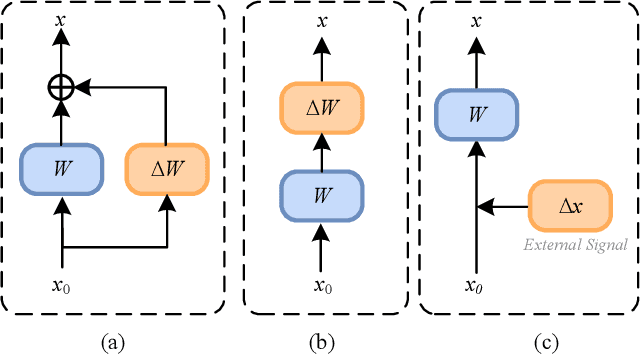
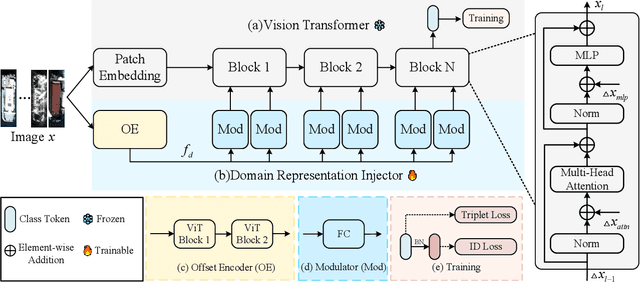
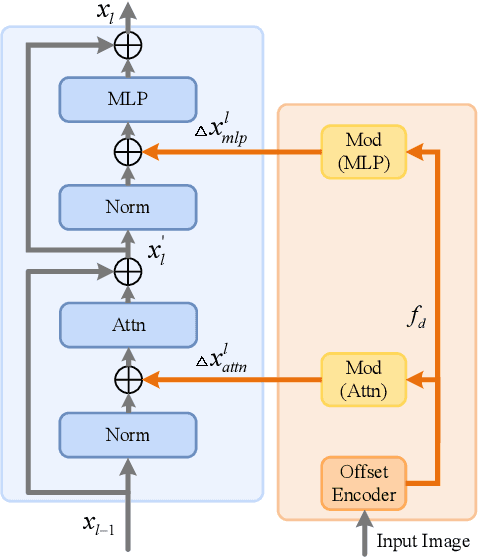
Cross-Modality Ship Re-Identification (CMS Re-ID) is critical for achieving all-day and all-weather maritime target tracking, yet it is fundamentally challenged by significant modality discrepancies. Mainstream solutions typically rely on explicit modality alignment strategies; however, this paradigm heavily depends on constructing large-scale paired datasets for pre-training. To address this, grounded in the Platonic Representation Hypothesis, we explore the potential of Vision Foundation Models (VFMs) in bridging modality gaps. Recognizing the suboptimal performance of existing generic Parameter-Efficient Fine-Tuning (PEFT) methods that operate within the weight space, particularly on limited-capacity models, we shift the optimization perspective to the feature space and propose a novel PEFT strategy termed Domain Representation Injection (DRI). Specifically, while keeping the VFM fully frozen to maximize the preservation of general knowledge, we design a lightweight, learnable Offset Encoder to extract domain-specific representations rich in modality and identity attributes from raw inputs. Guided by the contextual information of intermediate features at different layers, a Modulator adaptively transforms these representations. Subsequently, they are injected into the intermediate layers via additive fusion, dynamically reshaping the feature distribution to adapt to the downstream task without altering the VFM's pre-trained weights. Extensive experimental results demonstrate the superiority of our method, achieving State-of-the-Art (SOTA) performance with minimal trainable parameters. For instance, on the HOSS-ReID dataset, we attain 57.9\% and 60.5\% mAP using only 1.54M and 7.05M parameters, respectively. The code is available at https://github.com/TingfengXian/DRI.

Discovery of 2D Materials via Symmetry-Constrained Diffusion Model
Dec 24, 2024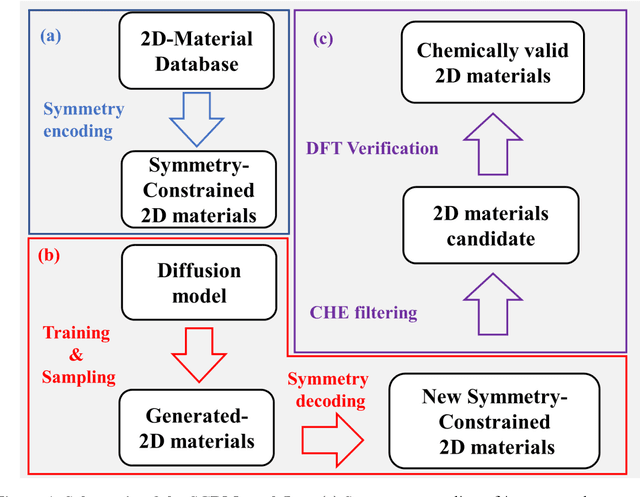

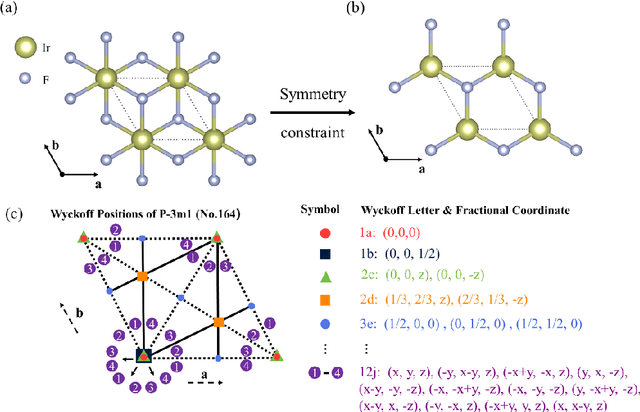
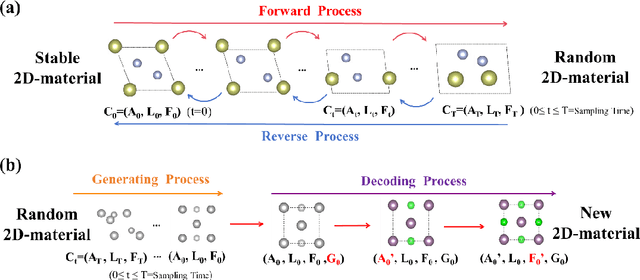
Generative model for 2D materials has shown significant promise in accelerating the material discovery process. The stability and performance of these materials are strongly influenced by their underlying symmetry. However, existing generative models for 2D materials often neglect symmetry constraints, which limits both the diversity and quality of the generated structures. Here, we introduce a symmetry-constrained diffusion model (SCDM) that integrates space group symmetry into the generative process. By incorporating Wyckoff positions, the model ensures adherence to symmetry principles, leading to the generation of 2,000 candidate structures. DFT calculations were conducted to evaluate the convex hull energies of these structures after structural relaxation. From the generated samples, 843 materials that met the energy stability criteria (Ehull < 0.6 eV/atom) were identified. Among these, six candidates were selected for further stability analysis, including phonon band structure evaluations and electronic properties investigations, all of which exhibited phonon spectrum stability. To benchmark the performance of SCDM, a symmetry-unconstrained diffusion model was also evaluated via crystal structure prediction model. The results highlight that incorporating symmetry constraints enhances the effectiveness of generated 2D materials, making a contribution to the discovery of 2D materials through generative modeling.
Generative Design of Crystal Structures by Point Cloud Representations and Diffusion Model
Jan 31, 2024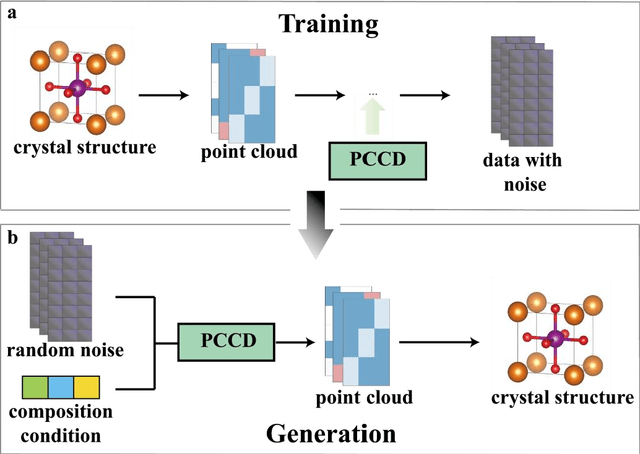
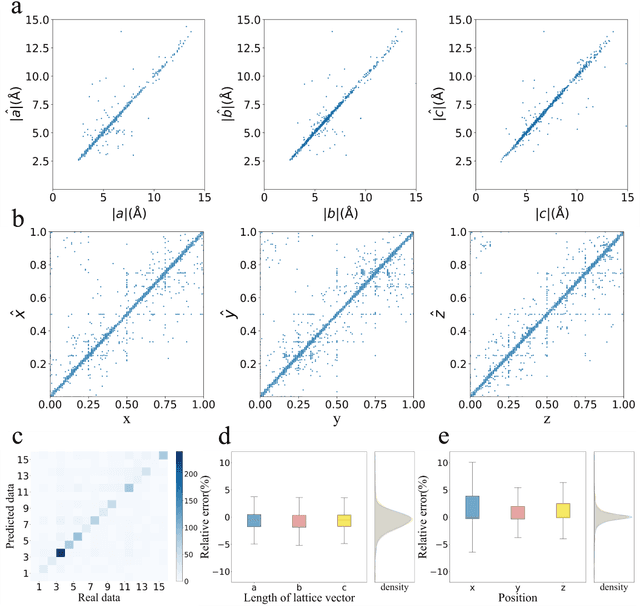
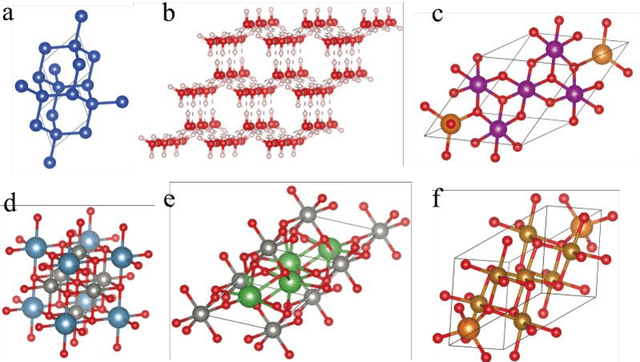
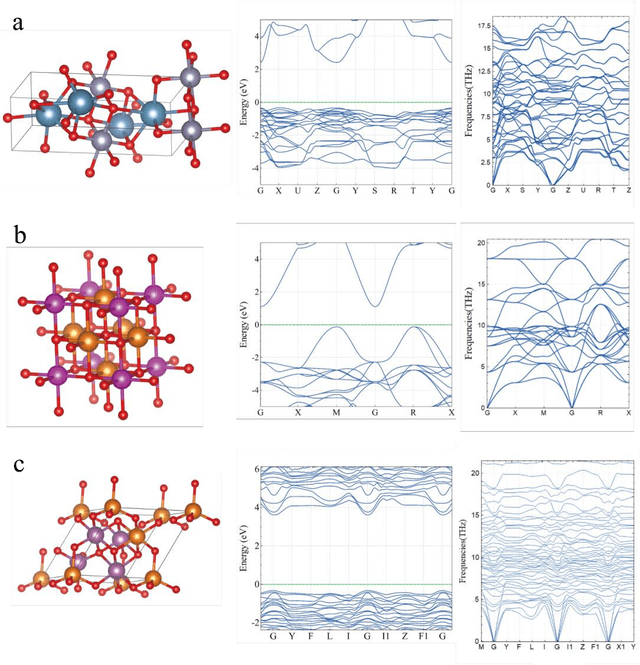
Efficiently generating energetically stable crystal structures has long been a challenge in material design, primarily due to the immense arrangement of atoms in a crystal lattice. To facilitate the discovery of stable material, we present a framework for the generation of synthesizable materials, leveraging a point cloud representation to encode intricate structural information. At the heart of this framework lies the introduction of a diffusion model as its foundational pillar. To gauge the efficacy of our approach, we employ it to reconstruct input structures from our training datasets, rigorously validating its high reconstruction performance. Furthermore, we demonstrate the profound potential of Point Cloud-Based Crystal Diffusion (PCCD) by generating entirely new materials, emphasizing their synthesizability. Our research stands as a noteworthy contribution to the advancement of materials design and synthesis through the cutting-edge avenue of generative design instead of the conventional substitution or experience-based discovery.