 Add to Chrome
 Add to Firefox
 Add to Edge
Share First, Route What Remains: A Unified Framework for Token-Adaptive MoE Computation
Aug 11, 2026
Mixture-of-experts (MoE) models have recently moved beyond routing a fixed number of complete experts. Shared-expert designs preserve reusable knowledge, fine-grained methods vary computation within experts, and dynamic routers adapt the number of active experts. Yet these decisions are usually made independently, overlooking a basic dependency: extracting reusable computation changes both what remains and how much expert capacity the remainder needs. We study this dependency by decomposing sparsely upcycled feed-forward experts into key-value channels. Co-activated experts align at a subset of value positions; removing these positions changes expert preference; and greater shared coverage is associated with lower residual expert demand. These observations lead to one principle: share first, then route what remains. We instantiate it in UniF-MoE, a unified framework for token-adaptive MoE computation. Each expert is partitioned into aligned blocks. A shared-demand score sets the shared block count and pathway weight, key prototypes select the shared content, and the complementary demand determines the residual expert count through cumulative routing mass. A Gram regularizer separates and normalizes router embeddings, promoting diverse routing directions, sparse expert overlap, and a simple routing geometry. Experiments on DomainBed and GLUE show that this unified design improves predictive performance over representative static and dynamic MoEs while reducing activated computation, inference latency, and memory. Code is available at https://github.com/existence0420/UniF-MoE.

Learning-Based Motion Planning for Dynamic Environments: From Foundational Algorithms to Emerging Paradigms
Aug 01, 2026Motion planning in dynamic environments is a fundamental problem in robotics, aiming to generate safe and efficient paths, trajectories, or control actions in the presence of moving obstacles, uncertain predictions, and multi-agent interactions. It has broad applications in autonomous driving, service robotics, warehouse logistics, human-robot collaboration, crowd navigation, and multi-robot systems. This survey reviews representative works published primarily between 2015 and 2025, with a particular focus on how recent learning-based advances extend, complement, or interact with classical planning foundations. We first revisit classical planning methods as algorithmic foundations and reference frameworks for learning-based extensions. We then propose a role-of-learning taxonomy that categorizes existing methods according to how learning participates in the planning pipeline, including direct policy learning, learning-augmented classical planning, hybrid planning, and training enhancement methods. For each category, we summarize the main problem settings, representative algorithms, key ideas, integration mechanisms, strengths, and limitations. We further analyze how observation representations, prediction uncertainty, interaction modeling, planner integration, safety constraints, and training strategies shape learning-based motion planning in dynamic environments. Finally, we discuss open challenges and future directions, including sim-to-real gap, safe and certifiable planning, dense crowd navigation, perception-planning coupling, and embodied AI.
Coverage Path Planning: Classical Foundations, Recent Advances, and Future Directions
Jul 12, 2026Coverage path planning (CPP) is a fundamental problem in robot motion planning, whose aim is to produce robot trajectories that provide complete coverage of target workspaces while minimizing task-specific objectives such as path length, overlap, number of turns, and energy consumption. CPP has widespread applications in cleaning, inspection, mapping, agriculture, manufacturing, surveillance, demining, and environmental monitoring. Although classical CPP has been extensively studied, recent advances have extended CPP beyond single-robot settings to multi-robot systems, complex 3D environments, constrained platforms, learning-based coverage planning, and visual coverage tasks. This paper presents a comprehensive survey of 125 representative works published primarily between 2015 and 2026, while presenting the evolution of recent developments in light of the classical CPP methods published before 2015. The CPP methods are organized into six main categories: single-robot CPP, multi-robot CPP, 3D CPP, constrained CPP, learning-based CPP, and visual CPP. For each category, the review summarizes the main planning formulations, representative algorithms, strengths, and limitations. In addition, the review analyzes how environmental knowledge, workspace geometry, robot constraints, sensing objectives, and coordination requirements shape the CPP problem. The survey further discusses open challenges in scalable online planning, multi-robot coordination, 3D and visual coverage, unified platform-constrained and resource-aware coverage, and learning-enhanced coverage. Thus, the survey provides a structured overview of recent CPP developments and future research directions.
Learning universal approximations for partial differential equations with Physics-Informed Broad Learning System
Jun 18, 2026Partial differential equations (PDEs) play a central role in modeling complex physical, biological, and engineering systems. While traditional numerical solvers are robust, they often incur prohibitive computational costs due to mesh dependencies, whereas recent Physics-Informed Neural Networks (PINNs) offer a mesh-free alternative but frequently suffer from slow convergence and optimization instability. To bridge this gap, this article proposes the Physics-Informed Broad Learning System (PIBLS), a novel backpropagation-free framework that reformulates PDE solving as a direct least-squares optimization. We improved an algorithm within this framework to handle nonlinear PDEs efficiently and provide a rigorous mathematical proof establishing the universal approximation property of PIBLS for these equations. Experiments on linear and nonlinear PDEs demonstrate that PIBLS is one to three orders of magnitude faster than conventional PINNs while achieving significantly higher solution accuracy. This framework provides a computationally efficient paradigm for scientific machine learning, offering a practical, high-speed alternative for real-time simulation and design optimization tasks.
P$^2$-DPO: Grounding Hallucination in Perceptual Processing via Calibration Direct Preference Optimization
Jun 03, 2026Hallucination has recently garnered significant research attention in Large Vision-Language Models (LVLMs). Direct Preference Optimization (DPO) aims to learn directly from the corrected preferences provided by humans, thereby addressing the hallucination issue. Despite its success, this paradigm has yet to specifically target the perceptual bottleneck in attended regions or address insufficient Visual Robustness against image degradation. Furthermore, existing preference pairs are often vision-agnostic and their inherently off-policy nature limits their effectiveness in guiding model learning. To address these challenges, we propose Perceptual Processing Direct Preference Optimization (P$^2$-DPO), a novel training paradigm in which the model generates and learns from its own preference pairs, thereby directly addressing the identified visual bottlenecks while inherently avoiding the issues of vision-agnostic and off-policy data. It introduces: (1) an on-policy preference pairs construction method targeting Focus-and-Enhance perception and Visual Robustness, and (2) a well-designed Calibration Loss to precisely align visual signals with the causal generation of text. Experimental results demonstrate that with a comparable amount of training data and cost, P$^2$-DPO outperforms strong baselines that rely on costly human feedback on benchmarks. Furthermore, evaluations on Attention Region Fidelity (ARF) and image degradation scenarios validate the effectiveness of P$^2$-DPO in addressing perceptual bottleneck in attended regions and improving Visual Robustness against degraded inputs.
A Cosine Network for Image Super-Resolution
Jan 23, 2026Deep convolutional neural networks can use hierarchical information to progressively extract structural information to recover high-quality images. However, preserving the effectiveness of the obtained structural information is important in image super-resolution. In this paper, we propose a cosine network for image super-resolution (CSRNet) by improving a network architecture and optimizing the training strategy. To extract complementary homologous structural information, odd and even heterogeneous blocks are designed to enlarge the architectural differences and improve the performance of image super-resolution. Combining linear and non-linear structural information can overcome the drawback of homologous information and enhance the robustness of the obtained structural information in image super-resolution. Taking into account the local minimum of gradient descent, a cosine annealing mechanism is used to optimize the training procedure by performing warm restarts and adjusting the learning rate. Experimental results illustrate that the proposed CSRNet is competitive with state-of-the-art methods in image super-resolution.
Consistency-Regularized GAN for Few-Shot SAR Target Recognition
Jan 22, 2026Few-shot recognition in synthetic aperture radar (SAR) imagery remains a critical bottleneck for real-world applications due to extreme data scarcity. A promising strategy involves synthesizing a large dataset with a generative adversarial network (GAN), pre-training a model via self-supervised learning (SSL), and then fine-tuning on the few labeled samples. However, this approach faces a fundamental paradox: conventional GANs themselves require abundant data for stable training, contradicting the premise of few-shot learning. To resolve this, we propose the consistency-regularized generative adversarial network (Cr-GAN), a novel framework designed to synthesize diverse, high-fidelity samples even when trained under these severe data limitations. Cr-GAN introduces a dual-branch discriminator that decouples adversarial training from representation learning. This architecture enables a channel-wise feature interpolation strategy to create novel latent features, complemented by a dual-domain cycle consistency mechanism that ensures semantic integrity. Our Cr-GAN framework is adaptable to various GAN architectures, and its synthesized data effectively boosts multiple SSL algorithms. Extensive experiments on the MSTAR and SRSDD datasets validate our approach, with Cr-GAN achieving a highly competitive accuracy of 71.21% and 51.64%, respectively, in the 8-shot setting, significantly outperforming leading baselines, while requiring only ~5 of the parameters of state-of-the-art diffusion models. Code is available at: https://github.com/yikuizhai/Cr-GAN.
Test-time Adaptive Hierarchical Co-enhanced Denoising Network for Reliable Multimodal Classification
Jan 12, 2026Reliable learning on low-quality multimodal data is a widely concerning issue, especially in safety-critical applications. However, multimodal noise poses a major challenge in this domain and leads existing methods to suffer from two key limitations. First, they struggle to reliably remove heterogeneous data noise, hindering robust multimodal representation learning. Second, they exhibit limited adaptability and generalization when encountering previously unseen noise. To address these issues, we propose Test-time Adaptive Hierarchical Co-enhanced Denoising Network (TAHCD). On one hand, TAHCD introduces the Adaptive Stable Subspace Alignment and Sample-Adaptive Confidence Alignment to reliably remove heterogeneous noise. They account for noise at both global and instance levels and enable jointly removal of modality-specific and cross-modality noise, achieving robust learning. On the other hand, TAHCD introduces test-time cooperative enhancement, which adaptively updates the model in response to input noise in a label-free manner, improving adaptability and generalization. This is achieved by collaboratively enhancing the joint removal process of modality-specific and cross-modality noise across global and instance levels according to sample noise. Experiments on multiple benchmarks demonstrate that the proposed method achieves superior classification performance, robustness, and generalization compared with state-of-the-art reliable multimodal learning approaches.
Memo2496: Expert-Annotated Dataset and Dual-View Adaptive Framework for Music Emotion Recognition
Dec 17, 2025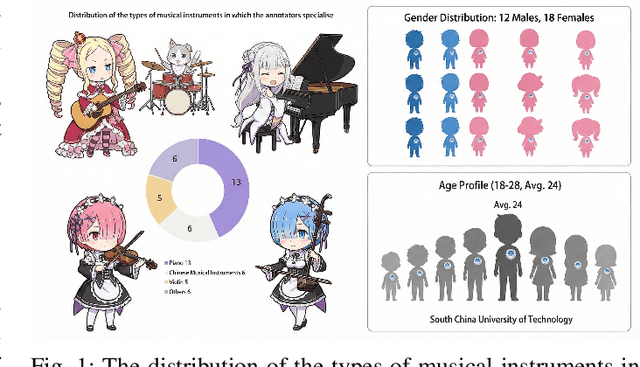
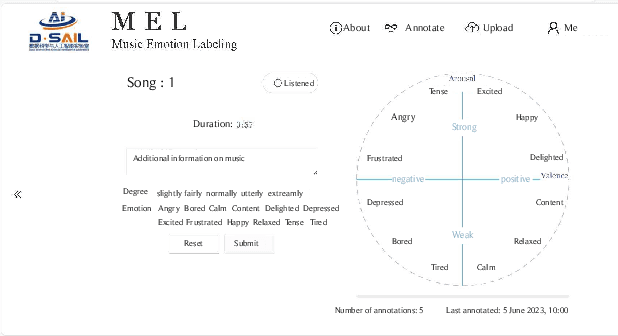
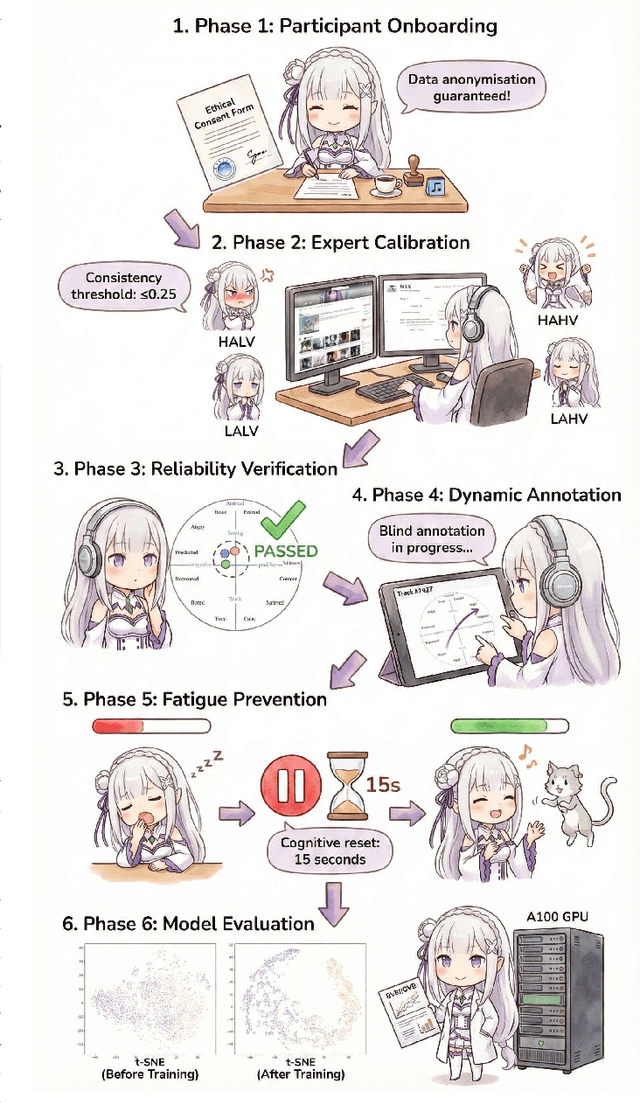
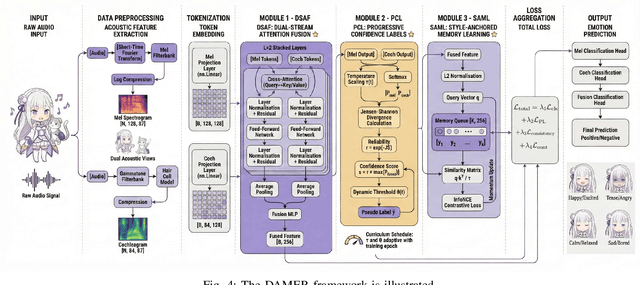
Music Emotion Recogniser (MER) research faces challenges due to limited high-quality annotated datasets and difficulties in addressing cross-track feature drift. This work presents two primary contributions to address these issues. Memo2496, a large-scale dataset, offers 2496 instrumental music tracks with continuous valence arousal labels, annotated by 30 certified music specialists. Annotation quality is ensured through calibration with extreme emotion exemplars and a consistency threshold of 0.25, measured by Euclidean distance in the valence arousal space. Furthermore, the Dual-view Adaptive Music Emotion Recogniser (DAMER) is introduced. DAMER integrates three synergistic modules: Dual Stream Attention Fusion (DSAF) facilitates token-level bidirectional interaction between Mel spectrograms and cochleagrams via cross attention mechanisms; Progressive Confidence Labelling (PCL) generates reliable pseudo labels employing curriculum-based temperature scheduling and consistency quantification using Jensen Shannon divergence; and Style Anchored Memory Learning (SAML) maintains a contrastive memory queue to mitigate cross-track feature drift. Extensive experiments on the Memo2496, 1000songs, and PMEmo datasets demonstrate DAMER's state-of-the-art performance, improving arousal dimension accuracy by 3.43%, 2.25%, and 0.17%, respectively. Ablation studies and visualisation analyses validate each module's contribution. Both the dataset and source code are publicly available.
PathFinder: Advancing Path Loss Prediction for Single-to-Multi-Transmitter Scenario
Dec 16, 2025Radio path loss prediction (RPP) is critical for optimizing 5G networks and enabling IoT, smart city, and similar applications. However, current deep learning-based RPP methods lack proactive environmental modeling, struggle with realistic multi-transmitter scenarios, and generalize poorly under distribution shifts, particularly when training/testing environments differ in building density or transmitter configurations. This paper identifies three key issues: (1) passive environmental modeling that overlooks transmitters and key environmental features; (2) overemphasis on single-transmitter scenarios despite real-world multi-transmitter prevalence; (3) excessive focus on in-distribution performance while neglecting distribution shift challenges. To address these, we propose PathFinder, a novel architecture that actively models buildings and transmitters via disentangled feature encoding and integrates Mask-Guided Low-rank Attention to independently focus on receiver and building regions. We also introduce a Transmitter-Oriented Mixup strategy for robust training and a new benchmark, single-to-multi-transmitter RPP (S2MT-RPP), tailored to evaluate extrapolation performance (multi-transmitter testing after single-transmitter training). Experimental results show PathFinder outperforms state-of-the-art methods significantly, especially in challenging multi-transmitter scenarios. Our code and project site are available at: https://emorzz1g.github.io/PathFinder/.