 Add to Chrome
 Add to Firefox
 Add to Edge
Pano360: Perspective to Panoramic Vision with Geometric Consistency
Mar 12, 2026
Prior panorama stitching approaches heavily rely on pairwise feature correspondences and are unable to leverage geometric consistency across multiple views. This leads to severe distortion and misalignment, especially in challenging scenes with weak textures, large parallax, and repetitive patterns. Given that multi-view geometric correspondences can be directly constructed in 3D space, making them more accurate and globally consistent, we extend the 2D alignment task to the 3D photogrammetric space. We adopt a novel transformer-based architecture to achieve 3D awareness and aggregate global information across all views. It directly utilizes camera poses to guide image warping for global alignment in 3D space and employs a multi-feature joint optimization strategy to compute the seams. Additionally, to establish an evaluation benchmark and train our network, we constructed a large-scale dataset of real-world scenes. Extensive experiments show that our method significantly outperforms existing alternatives in alignment accuracy and perceptual quality.

FedMSGL: A Self-Expressive Hypergraph Based Federated Multi-View Learning
Mar 12, 2025Federated learning is essential for enabling collaborative model training across decentralized data sources while preserving data privacy and security. This approach mitigates the risks associated with centralized data collection and addresses concerns related to data ownership and compliance. Despite significant advancements in federated learning algorithms that address communication bottlenecks and enhance privacy protection, existing works overlook the impact of differences in data feature dimensions, resulting in global models that disproportionately depend on participants with large feature dimensions. Additionally, current single-view federated learning methods fail to account for the unique characteristics of multi-view data, leading to suboptimal performance in processing such data. To address these issues, we propose a Self-expressive Hypergraph Based Federated Multi-view Learning method (FedMSGL). The proposed method leverages self-expressive character in the local training to learn uniform dimension subspace with latent sample relation. At the central side, an adaptive fusion technique is employed to generate the global model, while constructing a hypergraph from the learned global and view-specific subspace to capture intricate interconnections across views. Experiments on multi-view datasets with different feature dimensions validated the effectiveness of the proposed method.
Partially Shared Semi-supervised Deep Matrix Factorization with Multi-view Data
Dec 02, 2020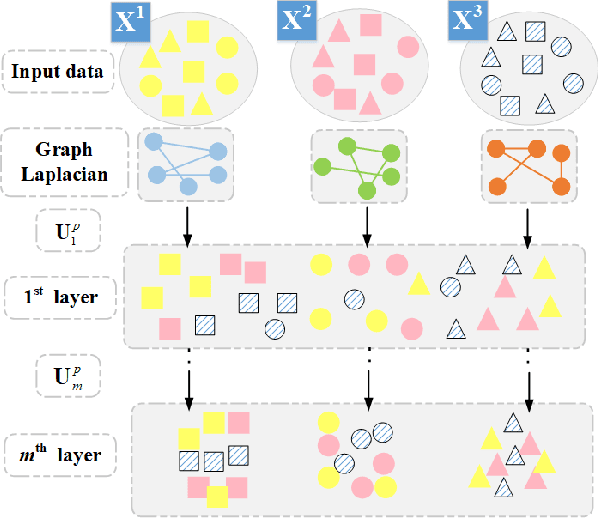
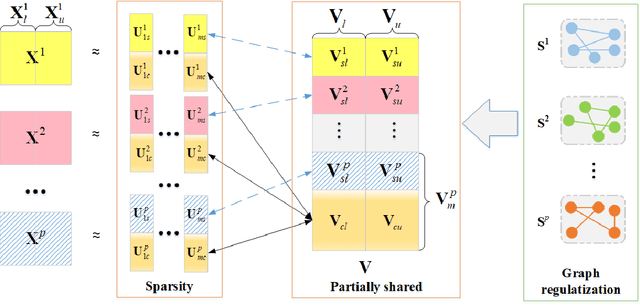
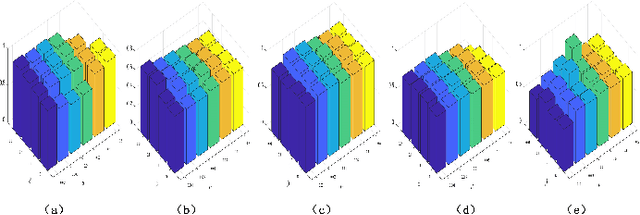
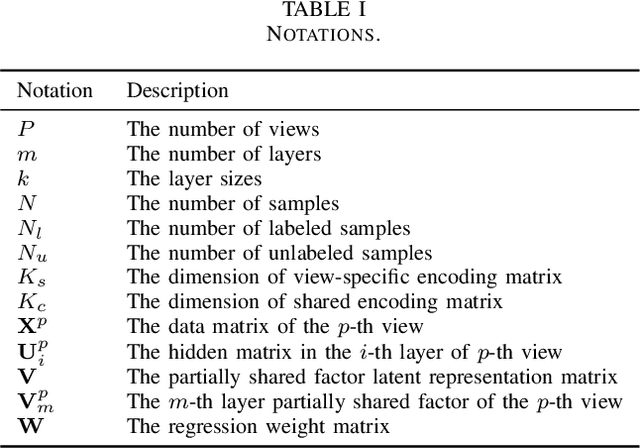
Since many real-world data can be described from multiple views, multi-view learning has attracted considerable attention. Various methods have been proposed and successfully applied to multi-view learning, typically based on matrix factorization models. Recently, it is extended to the deep structure to exploit the hierarchical information of multi-view data, but the view-specific features and the label information are seldom considered. To address these concerns, we present a partially shared semi-supervised deep matrix factorization model (PSDMF). By integrating the partially shared deep decomposition structure, graph regularization and the semi-supervised regression model, PSDMF can learn a compact and discriminative representation through eliminating the effects of uncorrelated information. In addition, we develop an efficient iterative updating algorithm for PSDMF. Extensive experiments on five benchmark datasets demonstrate that PSDMF can achieve better performance than the state-of-the-art multi-view learning approaches. The MATLAB source code is available at https://github.com/libertyhhn/PartiallySharedDMF.