 Add to Chrome
 Add to Firefox
 Add to Edge
Population-Scalable Multi-Agent World Modeling
Aug 09, 2026
World models have recently achieved impressive progress in visual prediction and interactive generation, but extending them to multi-agent environments introduces a fundamental scalability challenge. Existing methods generally assume a fixed number of agents during training and inference, which ties the model to a pre-determined agent population and limits inference-time scalability. Our key insight is that cross-view consistency should arise from a shared world state whose evolution does not assume a predefined number of agents, while agent-specific observations should be generated by querying this state through a unified rendering interface. Based on this insight, we propose Khora, a scalable multi-agent world model that supports inference-time expansion to arbitrary numbers of agents without retraining. Our framework decouples world-state evolution from visual rendering and introduces a population-agnostic rendering mechanism for incorporating other agent information. This design maintains cross-view consistency through the shared world state rather than through dense interactions among observation streams inside the expensive video generator, enabling approximately linear practical scaling with the number of queried views. Qualitative experiments demonstrate that our approach generalizes to unseen numbers of agents while maintaining visual quality and multi-agent consistency. We further implement a real-time interactive system to demonstrate scalable open-world simulation.

TCAM-Diff: Triplane-Aware Cross-Attention Medical Diffusion Model
Jul 15, 2026We introduce TCAM-Diff, a novel 3D medical image generation model that reduces the memory requirements to encode and generate high-resolution 3D data. This model utilizes a decoder-only autoencoder method to learn triplane representation from dense volume and leverages generalization operations to prevent overfitting. Subsequently, it uses a triplane-aware cross-attention diffusion model to learn and integrate these features effectively. Furthermore, the features generated by the diffusion model can be rapidly transformed into 3D volumes using a pre-trained decoder module. Our experiments on three different scales of medical datasets, BrainTumour 128 x 128 x 128, Pancreas 256 x 256 x 256, and Colon 512 x 512 x 512, demonstrate outstanding results. We utilized MSE and SSIM to assess reconstruction quality and leveraged the Wasserstein Generative Adversarial Network (W-GAN) critic to assess generative quality. Comparisons with existing approaches show that our method gives better reconstruction and generation results than other encoder-decoder methods with similar-sized latent spaces.
* Accepted at AAAI 2025. Code is available at https://github.com/Fredy-Zhang/TCAM-Diff
HAT-4D: Lifting Monocular Video for 4D Multi-Object Interactions via Human-Agent Collaboration
Jun 26, 2026Extracting dynamic 4D object interactions from massive, in-the-wild monocular videos offers a highly efficient data collection pathway for scaling Embodied AI and training VLAs. However, existing monocular 4D reconstruction methods primarily focus on isolated objects, often failing under the severe occlusions and complex dynamics inherent in multi-object interactions. To bridge this gap, we propose HAT-4D, the first agentic framework designed to reconstruct the 3D geometry, temporal dynamics, and physical interactions of multiple objects from a single video. By integrating VLMs with a multi-level human-in-the-loop feedback mechanism, HAT-4D efficiently resolves depth ambiguities and interaction-induced occlusions during 3D generation and 4D propagation, yielding physically plausible assets without relying on expensive multicamera rigs. As a scalable data engine, HAT-4D facilitates the creation of MVOIK-4D, an open-world benchmark for monocular 4D interaction reconstruction, accompanied by a novel multi-dimensional evaluation protocol focused on physical plausibility and temporal consistency. Extensive experiments demonstrate that HAT-4D achieves SOTA performance on most evaluation metrics, while maintaining competitive semantic alignment. Ablation studies show that introducing a small amount of human feedback improves interaction reconstruction. Moreover, the data produced by HAT-4D effectively improves baseline performance when used for fine-tuning. Our data and code are available at https://lijiaxin0111.github.io/HAT4D/
From Sparse X-rays to 3D CT: Training-Free Reconstruction with Diffusion Priors
Jun 18, 2026Solving 3D medical inverse problems typically requires training dedicated supervised models for each specific task and measurement setting. To break this dependency, we present TF-PRDiT: a training-free conditional sampling framework that converts a frozen voxel-level 3D Diffusion Transformer prior into a versatile inverse medical problem solver. Building on the posterior-sampling view of diffusion inverse solvers, TF-PRDiT enforces measurement consistency during sampling via a task-specific forward operator rather than updating model weights, enabling a single pretrained prior to be reused across diverse conditional settings. Our method combines a predictor-corrector sampler with likelihood-based guidance on the denoised prediction, providing stable data-fidelity correction while preserving the underlying 3D anatomical prior. We highlight our framework's capability on the challenging task of X-ray-to-CT reconstruction by integrating a differentiable DRR projector to allow gradients to propagate directly from projection space back to voxels without any retraining. Experiments on LIDC-IDRI demonstrate that TF-PRDiT achieves strong reconstruction quality and uniquely scales to an arbitrary number of input X-rays (1-12) under a unified model, with performance improving consistently as additional views are provided. Beyond X-ray-to-CT, we show that simply swapping the forward operator extends the same frozen model to 3D super-resolution, volumetric infilling, and deblurring without any task-specific retraining, demonstrating that a single 3D diffusion prior can serve as a universal solver for volumetric medical inverse problems.
Pixel-Level Residual Diffusion Transformer: Scalable 3D CT Volume Generation
Jun 18, 2026Generating high-resolution 3D CT volumes with fine details remains challenging due to substantial computational demands and optimization difficulties inherent to existing generative models. In this paper, we propose the Pixel-Level Residual Diffusion Transformer (PRDiT), a scalable generative framework that synthesizes high-quality 3D medical volumes directly at voxel-level. PRDiT introduces a two-stage training architecture comprising 1) a local denoiser in the form of an MLP-based blind estimator operating on overlapping 3D patches to separate low-frequency structures efficiently, and 2) a global residual diffusion transformer employing memory-efficient attention to model and refine high-frequency residuals across entire volumes. This coarse-to-fine modeling strategy simplifies optimization, enhances training stability, and effectively preserves subtle structures without the limitations of an autoencoder bottleneck. Extensive experiments conducted on the LIDC-IDRI and RAD-ChestCT datasets demonstrate that PRDiT consistently outperforms state-of-the-art models, such as HA-GAN, 3D LDM and WDM-3D, achieving significantly lower 3D FID, MMD and Wasserstein distance scores.
GPU-Fuzz: Finding Memory Errors in Deep Learning Frameworks
Feb 13, 2026GPU memory errors are a critical threat to deep learning (DL) frameworks, leading to crashes or even security issues. We introduce GPU-Fuzz, a fuzzer locating these issues efficiently by modeling operator parameters as formal constraints. GPU-Fuzz utilizes a constraint solver to generate test cases that systematically probe error-prone boundary conditions in GPU kernels. Applied to PyTorch, TensorFlow, and PaddlePaddle, we uncovered 13 unknown bugs, demonstrating the effectiveness of GPU-Fuzz in finding memory errors.
Improving Denoising Diffusion Models via Simultaneous Estimation of Image and Noise
Oct 26, 2023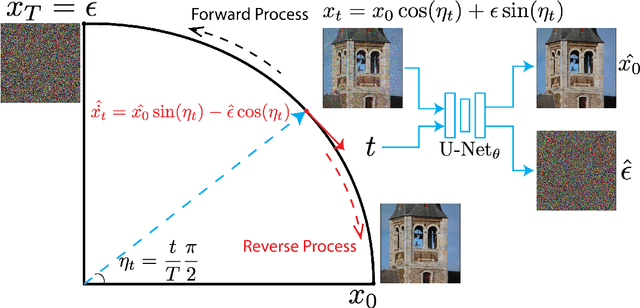
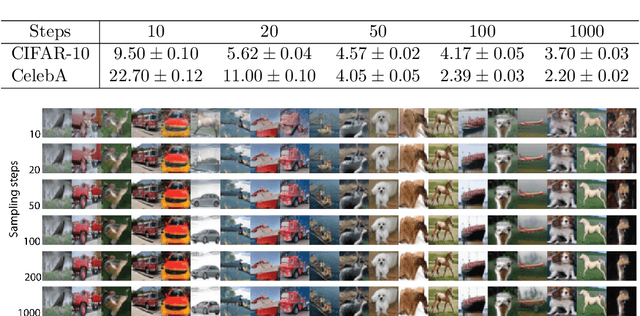
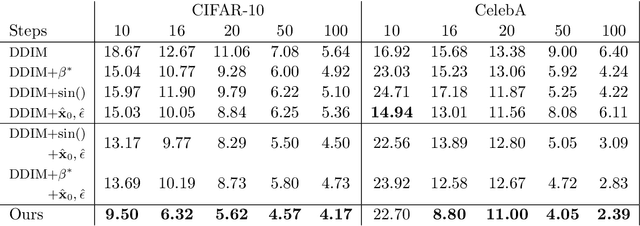
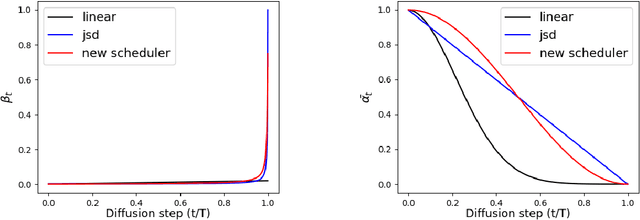
This paper introduces two key contributions aimed at improving the speed and quality of images generated through inverse diffusion processes. The first contribution involves reparameterizing the diffusion process in terms of the angle on a quarter-circular arc between the image and noise, specifically setting the conventional $\displaystyle \sqrt{\bar{\alpha}}=\cos(\eta)$. This reparameterization eliminates two singularities and allows for the expression of diffusion evolution as a well-behaved ordinary differential equation (ODE). In turn, this allows higher order ODE solvers such as Runge-Kutta methods to be used effectively. The second contribution is to directly estimate both the image ($\mathbf{x}_0$) and noise ($\mathbf{\epsilon}$) using our network, which enables more stable calculations of the update step in the inverse diffusion steps, as accurate estimation of both the image and noise are crucial at different stages of the process. Together with these changes, our model achieves faster generation, with the ability to converge on high-quality images more quickly, and higher quality of the generated images, as measured by metrics such as Frechet Inception Distance (FID), spatial Frechet Inception Distance (sFID), precision, and recall.
Multiscale Representation for Real-Time Anti-Aliasing Neural Rendering
Apr 20, 2023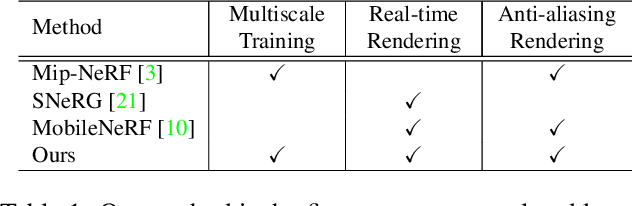
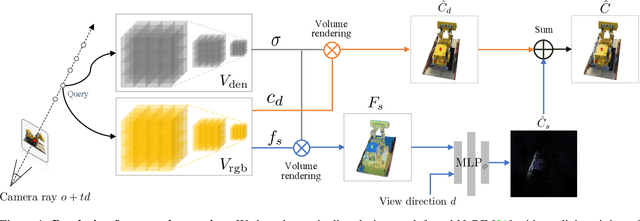
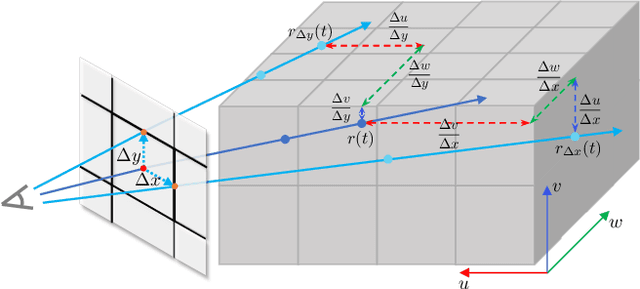

The rendering scheme in neural radiance field (NeRF) is effective in rendering a pixel by casting a ray into the scene. However, NeRF yields blurred rendering results when the training images are captured at non-uniform scales, and produces aliasing artifacts if the test images are taken in distant views. To address this issue, Mip-NeRF proposes a multiscale representation as a conical frustum to encode scale information. Nevertheless, this approach is only suitable for offline rendering since it relies on integrated positional encoding (IPE) to query a multilayer perceptron (MLP). To overcome this limitation, we propose mip voxel grids (Mip-VoG), an explicit multiscale representation with a deferred architecture for real-time anti-aliasing rendering. Our approach includes a density Mip-VoG for scene geometry and a feature Mip-VoG with a small MLP for view-dependent color. Mip-VoG encodes scene scale using the level of detail (LOD) derived from ray differentials and uses quadrilinear interpolation to map a queried 3D location to its features and density from two neighboring downsampled voxel grids. To our knowledge, our approach is the first to offer multiscale training and real-time anti-aliasing rendering simultaneously. We conducted experiments on multiscale datasets, and the results show that our approach outperforms state-of-the-art real-time rendering baselines.
Open Set Recognition using Vision Transformer with an Additional Detection Head
Mar 16, 2022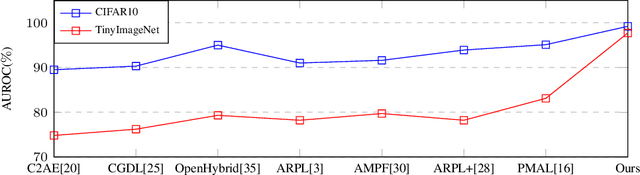
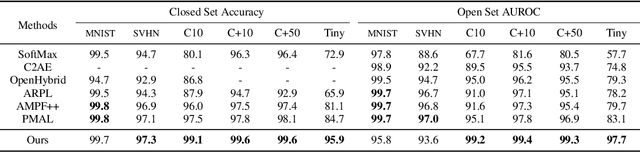
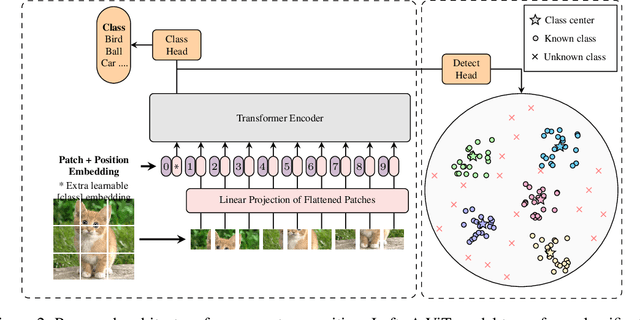
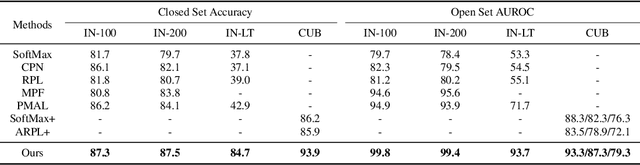
Deep neural networks have demonstrated prominent capacities for image classification tasks in a closed set setting, where the test data come from the same distribution as the training data. However, in a more realistic open set scenario, traditional classifiers with incomplete knowledge cannot tackle test data that are not from the training classes. Open set recognition (OSR) aims to address this problem by both identifying unknown classes and distinguishing known classes simultaneously. In this paper, we propose a novel approach to OSR that is based on the vision transformer (ViT) technique. Specifically, our approach employs two separate training stages. First, a ViT model is trained to perform closed set classification. Then, an additional detection head is attached to the embedded features extracted by the ViT, trained to force the representations of known data to class-specific clusters compactly. Test examples are identified as known or unknown based on their distance to the cluster centers. To the best of our knowledge, this is the first time to leverage ViT for the purpose of OSR, and our extensive evaluation against several OSR benchmark datasets reveals that our approach significantly outperforms other baseline methods and obtains new state-of-the-art performance.