 Add to Chrome
 Add to Firefox
 Add to Edge
TCAM-Diff: Triplane-Aware Cross-Attention Medical Diffusion Model
Jul 15, 2026
We introduce TCAM-Diff, a novel 3D medical image generation model that reduces the memory requirements to encode and generate high-resolution 3D data. This model utilizes a decoder-only autoencoder method to learn triplane representation from dense volume and leverages generalization operations to prevent overfitting. Subsequently, it uses a triplane-aware cross-attention diffusion model to learn and integrate these features effectively. Furthermore, the features generated by the diffusion model can be rapidly transformed into 3D volumes using a pre-trained decoder module. Our experiments on three different scales of medical datasets, BrainTumour 128 x 128 x 128, Pancreas 256 x 256 x 256, and Colon 512 x 512 x 512, demonstrate outstanding results. We utilized MSE and SSIM to assess reconstruction quality and leveraged the Wasserstein Generative Adversarial Network (W-GAN) critic to assess generative quality. Comparisons with existing approaches show that our method gives better reconstruction and generation results than other encoder-decoder methods with similar-sized latent spaces.
* Accepted at AAAI 2025. Code is available at https://github.com/Fredy-Zhang/TCAM-Diff

Pixel-Level Residual Diffusion Transformer: Scalable 3D CT Volume Generation
Jun 18, 2026Generating high-resolution 3D CT volumes with fine details remains challenging due to substantial computational demands and optimization difficulties inherent to existing generative models. In this paper, we propose the Pixel-Level Residual Diffusion Transformer (PRDiT), a scalable generative framework that synthesizes high-quality 3D medical volumes directly at voxel-level. PRDiT introduces a two-stage training architecture comprising 1) a local denoiser in the form of an MLP-based blind estimator operating on overlapping 3D patches to separate low-frequency structures efficiently, and 2) a global residual diffusion transformer employing memory-efficient attention to model and refine high-frequency residuals across entire volumes. This coarse-to-fine modeling strategy simplifies optimization, enhances training stability, and effectively preserves subtle structures without the limitations of an autoencoder bottleneck. Extensive experiments conducted on the LIDC-IDRI and RAD-ChestCT datasets demonstrate that PRDiT consistently outperforms state-of-the-art models, such as HA-GAN, 3D LDM and WDM-3D, achieving significantly lower 3D FID, MMD and Wasserstein distance scores.
From Sparse X-rays to 3D CT: Training-Free Reconstruction with Diffusion Priors
Jun 18, 2026Solving 3D medical inverse problems typically requires training dedicated supervised models for each specific task and measurement setting. To break this dependency, we present TF-PRDiT: a training-free conditional sampling framework that converts a frozen voxel-level 3D Diffusion Transformer prior into a versatile inverse medical problem solver. Building on the posterior-sampling view of diffusion inverse solvers, TF-PRDiT enforces measurement consistency during sampling via a task-specific forward operator rather than updating model weights, enabling a single pretrained prior to be reused across diverse conditional settings. Our method combines a predictor-corrector sampler with likelihood-based guidance on the denoised prediction, providing stable data-fidelity correction while preserving the underlying 3D anatomical prior. We highlight our framework's capability on the challenging task of X-ray-to-CT reconstruction by integrating a differentiable DRR projector to allow gradients to propagate directly from projection space back to voxels without any retraining. Experiments on LIDC-IDRI demonstrate that TF-PRDiT achieves strong reconstruction quality and uniquely scales to an arbitrary number of input X-rays (1-12) under a unified model, with performance improving consistently as additional views are provided. Beyond X-ray-to-CT, we show that simply swapping the forward operator extends the same frozen model to 3D super-resolution, volumetric infilling, and deblurring without any task-specific retraining, demonstrating that a single 3D diffusion prior can serve as a universal solver for volumetric medical inverse problems.
SVoT: State-aware Visualization-of-Thought for Spatial Reasoning via Reinforcement Learning
Jun 10, 2026Spatial reasoning remains a challenge for Multimodal Large Language Models (MLLMs), as it requires reliable multi-hop inference over both intermediate states and state transitions. Current studies often leave intermediate states unverified and treat state transitions as implicit processes, which limits reliability in multi-hop spatial reasoning. To address this, we propose State-aware Visualization-of-Thought (SVoT), a reinforcement learning framework that generates interleaved, verifiable intermediate states and visualizations. SVoT integrates transition reasoning chains into the generation processes, enabling the model to verify action preconditions and effects through interleaved textual and visual reasoning. We train SVoT via Group Relative Policy Optimization (GRPO), instantiating verification through reward design and evaluating the efficacy of different fine-grained rewards. As existing benchmarks reduce state transitions to single-variable updates, substantially simplifying the problems, we establish five domains by extending classical environments and introducing two novel domains, Pacman and Gather, that require multi-object interactions and numerical reasoning. These domains support systematic evaluation of multi-hop spatial reasoning with quantitative verification of generated intermediate states and transition reasoning. SVoT with transition-aware supervision achieves state-of-the-art performance across the introduced domains, yielding up to a 65% absolute accuracy gain on out-of-distribution test sets.
Investigating The Functional Roles of Attention Heads in Vision Language Models: Evidence for Reasoning Modules
Dec 11, 2025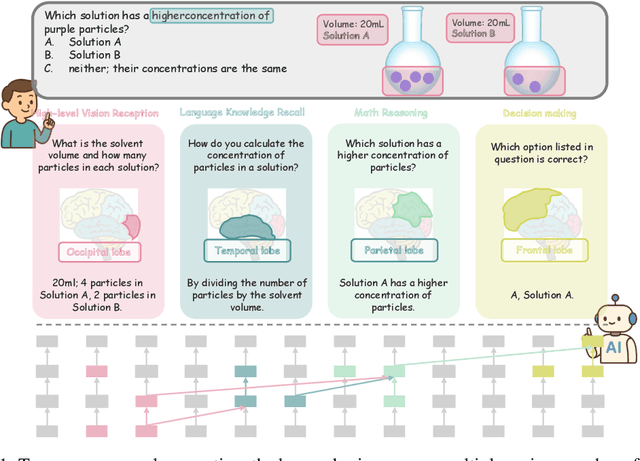
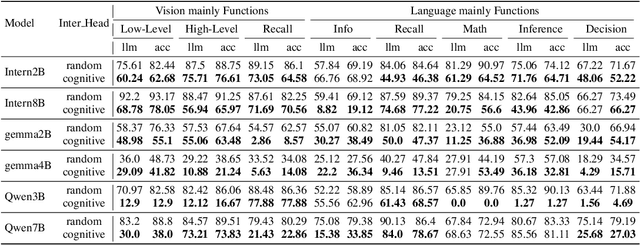
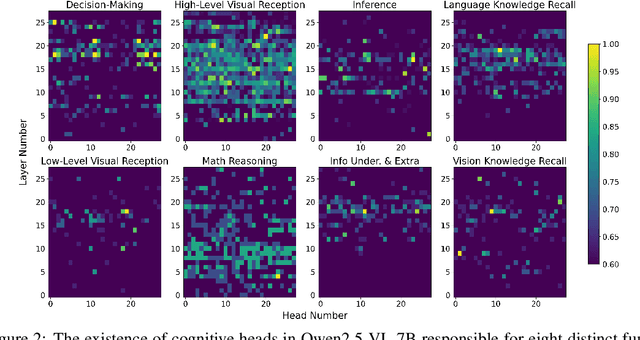

Despite excelling on multimodal benchmarks, vision-language models (VLMs) largely remain a black box. In this paper, we propose a novel interpretability framework to systematically analyze the internal mechanisms of VLMs, focusing on the functional roles of attention heads in multimodal reasoning. To this end, we introduce CogVision, a dataset that decomposes complex multimodal questions into step-by-step subquestions designed to simulate human reasoning through a chain-of-thought paradigm, with each subquestion associated with specific receptive or cognitive functions such as high-level visual reception and inference. Using a probing-based methodology, we identify attention heads that specialize in these functions and characterize them as functional heads. Our analysis across diverse VLM families reveals that these functional heads are universally sparse, vary in number and distribution across functions, and mediate interactions and hierarchical organization. Furthermore, intervention experiments demonstrate their critical role in multimodal reasoning: removing functional heads leads to performance degradation, while emphasizing them enhances accuracy. These findings provide new insights into the cognitive organization of VLMs and suggest promising directions for designing models with more human-aligned perceptual and reasoning abilities.
Beyond Perception: Evaluating Abstract Visual Reasoning through Multi-Stage Task
May 28, 2025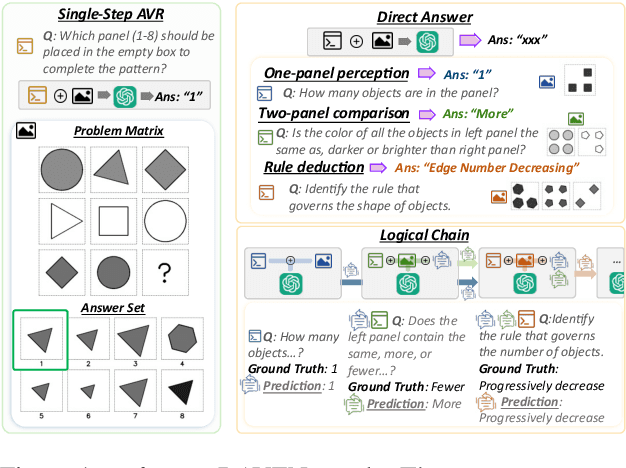
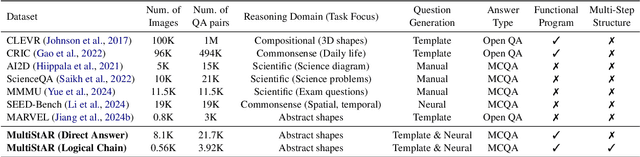
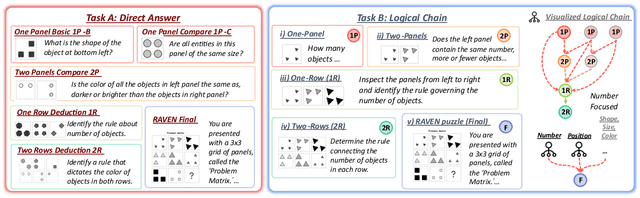
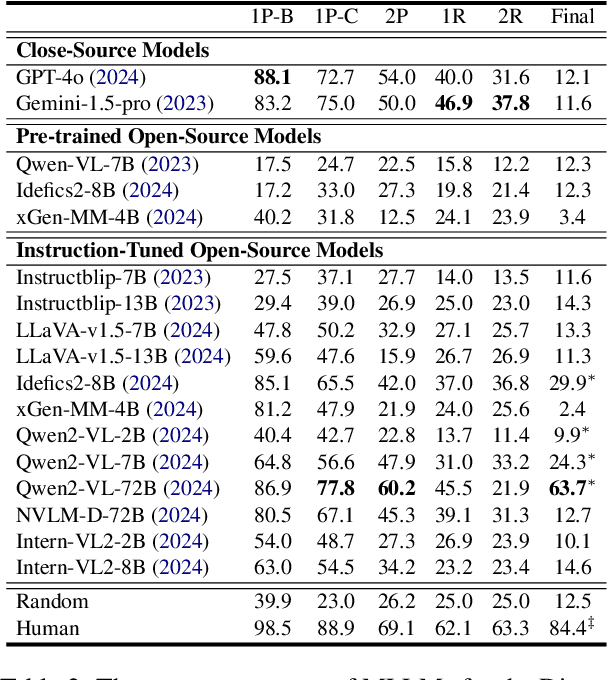
Current Multimodal Large Language Models (MLLMs) excel in general visual reasoning but remain underexplored in Abstract Visual Reasoning (AVR), which demands higher-order reasoning to identify abstract rules beyond simple perception. Existing AVR benchmarks focus on single-step reasoning, emphasizing the end result but neglecting the multi-stage nature of reasoning process. Past studies found MLLMs struggle with these benchmarks, but it doesn't explain how they fail. To address this gap, we introduce MultiStAR, a Multi-Stage AVR benchmark, based on RAVEN, designed to assess reasoning across varying levels of complexity. Additionally, existing metrics like accuracy only focus on the final outcomes while do not account for the correctness of intermediate steps. Therefore, we propose a novel metric, MSEval, which considers the correctness of intermediate steps in addition to the final outcomes. We conduct comprehensive experiments on MultiStAR using 17 representative close-source and open-source MLLMs. The results reveal that while existing MLLMs perform adequately on basic perception tasks, they continue to face challenges in more complex rule detection stages.
From Reasoning to Generalization: Knowledge-Augmented LLMs for ARC Benchmark
May 23, 2025Recent reasoning-oriented LLMs have demonstrated strong performance on challenging tasks such as mathematics and science examinations. However, core cognitive faculties of human intelligence, such as abstract reasoning and generalization, remain underexplored. To address this, we evaluate recent reasoning-oriented LLMs on the Abstraction and Reasoning Corpus (ARC) benchmark, which explicitly demands both faculties. We formulate ARC as a program synthesis task and propose nine candidate solvers. Experimental results show that repeated-sampling planning-aided code generation (RSPC) achieves the highest test accuracy and demonstrates consistent generalization across most LLMs. To further improve performance, we introduce an ARC solver, Knowledge Augmentation for Abstract Reasoning (KAAR), which encodes core knowledge priors within an ontology that classifies priors into three hierarchical levels based on their dependencies. KAAR progressively expands LLM reasoning capacity by gradually augmenting priors at each level, and invokes RSPC to generate candidate solutions after each augmentation stage. This stage-wise reasoning reduces interference from irrelevant priors and improves LLM performance. Empirical results show that KAAR maintains strong generalization and consistently outperforms non-augmented RSPC across all evaluated LLMs, achieving around 5% absolute gains and up to 64.52% relative improvement. Despite these achievements, ARC remains a challenging benchmark for reasoning-oriented LLMs, highlighting future avenues of progress in LLMs.
State-Based Disassembly Planning
Jan 09, 2025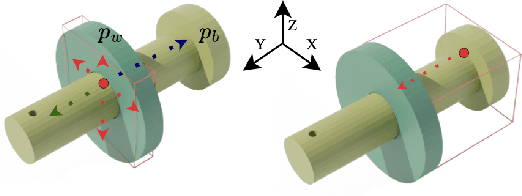
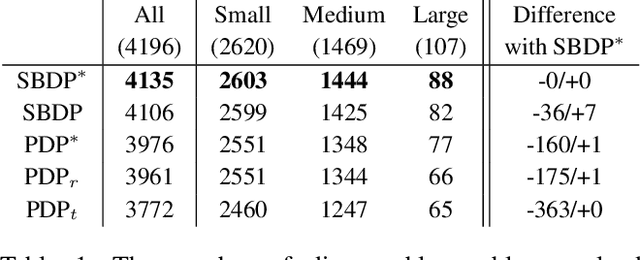


It has been shown recently that physics-based simulation significantly enhances the disassembly capabilities of real-world assemblies with diverse 3D shapes and stringent motion constraints. However, the efficiency suffers when tackling intricate disassembly tasks that require numerous simulations and increased simulation time. In this work, we propose a State-Based Disassembly Planning (SBDP) approach, prioritizing physics-based simulation with translational motion over rotational motion to facilitate autonomy, reducing dependency on human input, while storing intermediate motion states to improve search scalability. We introduce two novel evaluation functions derived from new Directional Blocking Graphs (DBGs) enriched with state information to scale up the search. Our experiments show that SBDP with new evaluation functions and DBGs constraints outperforms the state-of-the-art in disassembly planning in terms of success rate and computational efficiency over benchmark datasets consisting of thousands of physically valid industrial assemblies.
Planning-Driven Programming: A Large Language Model Programming Workflow
Nov 21, 2024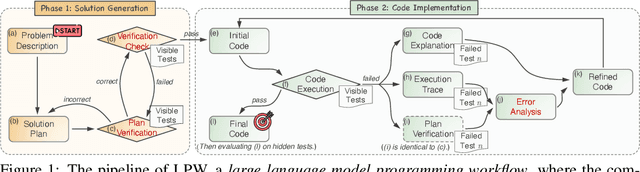
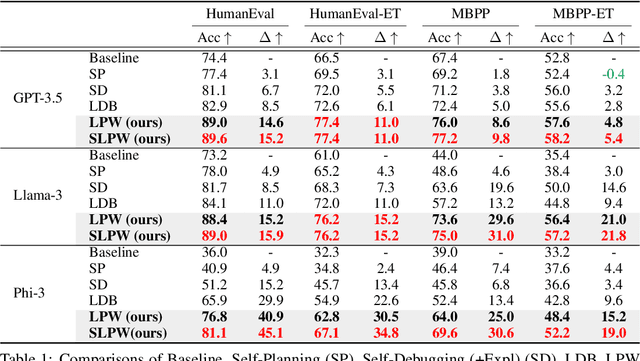
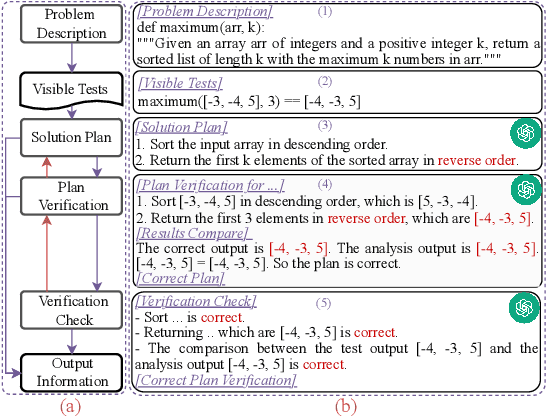

The strong performance of large language models (LLMs) on natural language processing tasks raises extensive discussion on their application to code generation. Recent work suggests multiple sampling approaches to improve initial code generation accuracy or program repair approaches to refine the code. However, these methods suffer from LLMs' inefficiencies and limited reasoning capacity. In this work, we propose an LLM programming workflow (LPW) designed to improve both initial code generation and subsequent refinements within a structured two-phase workflow. Specifically, in the solution generation phase, the LLM first outlines a solution plan that decomposes the problem into manageable sub-problems and then verifies the generated solution plan through visible test cases. Subsequently, in the code implementation phase, the LLM initially drafts a code according to the solution plan and its verification. If the generated code fails the visible tests, the plan verification serves as the intended natural language solution to inform the refinement process for correcting bugs. We further introduce SLPW, a sampling variant of LPW, which initially generates multiple solution plans and plan verifications, produces a program for each plan and its verification, and refines each program as necessary until one successfully passes the visible tests. Compared to the state-of-the-art methods across various existing LLMs, our experimental results show that LPW significantly improves the Pass@1 accuracy by up to 16.4% on well-established text-to-code generation benchmarks, especially with a notable improvement of around 10% on challenging benchmarks. Additionally, SLPW demonstrates up to a 5.6% improvement over LPW and sets new state-of-the-art Pass@1 accuracy on various benchmarks, e.g., 98.2% on HumanEval, 84.8% on MBPP, 64.0% on APPS, and 35.3% on CodeContest, using GPT-4o as the backbone.
Open-World Amodal Appearance Completion
Nov 20, 2024Understanding and reconstructing occluded objects is a challenging problem, especially in open-world scenarios where categories and contexts are diverse and unpredictable. Traditional methods, however, are typically restricted to closed sets of object categories, limiting their use in complex, open-world scenes. We introduce Open-World Amodal Appearance Completion, a training-free framework that expands amodal completion capabilities by accepting flexible text queries as input. Our approach generalizes to arbitrary objects specified by both direct terms and abstract queries. We term this capability reasoning amodal completion, where the system reconstructs the full appearance of the queried object based on the provided image and language query. Our framework unifies segmentation, occlusion analysis, and inpainting to handle complex occlusions and generates completed objects as RGBA elements, enabling seamless integration into applications such as 3D reconstruction and image editing. Extensive evaluations demonstrate the effectiveness of our approach in generalizing to novel objects and occlusions, establishing a new benchmark for amodal completion in open-world settings. The code and datasets will be released after paper acceptance.