 Add to Chrome
 Add to Firefox
 Add to Edge
Frequency-Domain Multi-Modality Transportation Modeling
Jul 09, 2026
Multi-modality transportation refers to urban systems composed of multiple transportation modes, such as traffic flow and public transit, whose dynamics are coupled by shared temporal patterns. Accurate multi-modality transportation forecasting remains challenging because (1) different modalities exhibit distinct spectral characteristics and (2) interact unevenly across frequencies, whereas most existing methods operate primarily in the time domain or rely on coarse feature fusion. To address these limitations, we propose a lightweight yet effective Frequency-Domain Multi-Modality modeling (FreMo) that explicitly exploits the frequency domain to enable adaptive and selective cross-modality synergy. FreMo disentangles modality-wise spectral refinement from cross-modality synergy and supports plug-and-play integration with general time series backbones. Specifically, FreMo introduces a Modality-Wise Frequency Filter (MFF) to adaptively refine spectral components within each modality, emphasizing informative frequencies while suppressing noise. FreMo further incorporates a Frequency-Guided Synergy Integrator (FSI) that selectively aggregates information across modalities based on their relative contribution at each frequency, facilitating effective cross-modality knowledge sharing while mitigating negative transfer. Extensive experiments on real-world datasets show that FreMo consistently outperforms state-of-the-art baselines, with superior performance and generalization across diverse forecasting scenarios. The code is available at https://github.com/beginner-sketch/FreMo.

TimeClaw: A Time-Series AI Agent with Exploratory Execution Learning
May 11, 2026Time series analysis underpins forecasting, monitoring, and decision making in domains such as finance and weather, where solving a task often requires both numerical accuracy and contextual reasoning. Recent progress has moved from specialized neural predictors to approaches built on LLMs and foundation models that can reason over time series inputs and use external tools. However, most such systems remain execution-centric: they focus on solving the current instance but learn little from exploratory execution. This is especially limiting in verifiable numeric settings, where multiple candidate executions and tool-use procedures may all be task-valid yet differ sharply in quantitative quality, and where early success can trigger tool-prior collapse that suppresses further exploration. To address this limitation, we present TimeClaw, an exploratory execution learning framework that turns exploratory execution into reusable hierarchical distilled experience through a four-stage loop: Explore, Compare, Distill, and Reinject. TimeClaw combines metric-supervised exploratory execution learning, task-aware tool dropout, and hierarchical distilled experience for inference-time reinjection, while keeping the base model frozen and avoiding online test-time adaptation. In an MTBench-aligned evaluation with 17 tasks that span finance and weather prediction and reasoning tasks, TimeClaw delivers consistent gains over the baselines. These results suggest that, for scientific systems, the bottleneck is not only execution-time capability, but how exploratory experience is compared, distilled, and reused.
Multi-Modality Spatio-Temporal Forecasting via Self-Supervised Learning
May 06, 2024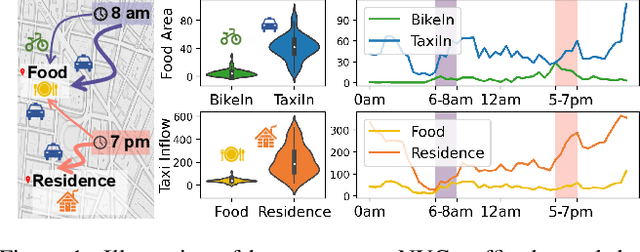
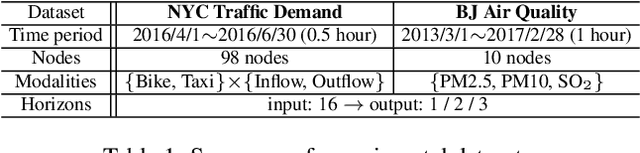
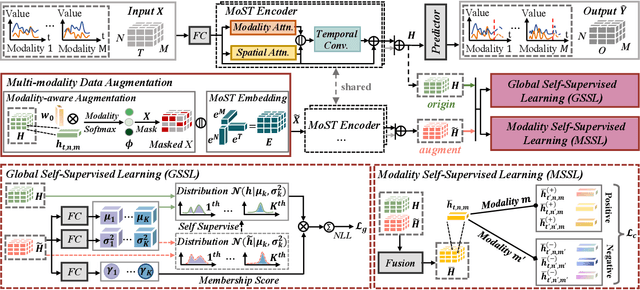

Multi-modality spatio-temporal (MoST) data extends spatio-temporal (ST) data by incorporating multiple modalities, which is prevalent in monitoring systems, encompassing diverse traffic demands and air quality assessments. Despite significant strides in ST modeling in recent years, there remains a need to emphasize harnessing the potential of information from different modalities. Robust MoST forecasting is more challenging because it possesses (i) high-dimensional and complex internal structures and (ii) dynamic heterogeneity caused by temporal, spatial, and modality variations. In this study, we propose a novel MoST learning framework via Self-Supervised Learning, namely MoSSL, which aims to uncover latent patterns from temporal, spatial, and modality perspectives while quantifying dynamic heterogeneity. Experiment results on two real-world MoST datasets verify the superiority of our approach compared with the state-of-the-art baselines. Model implementation is available at https://github.com/beginner-sketch/MoSSL.
STAEformer: Spatio-Temporal Adaptive Embedding Makes Vanilla Transformer SOTA for Traffic Forecasting
Aug 26, 2023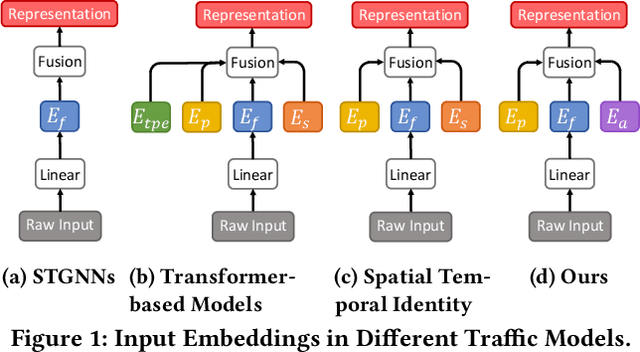
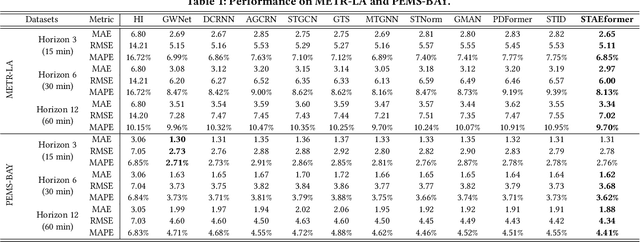
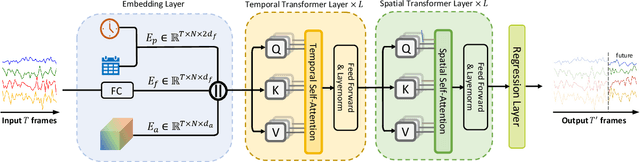

With the rapid development of the Intelligent Transportation System (ITS), accurate traffic forecasting has emerged as a critical challenge. The key bottleneck lies in capturing the intricate spatio-temporal traffic patterns. In recent years, numerous neural networks with complicated architectures have been proposed to address this issue. However, the advancements in network architectures have encountered diminishing performance gains. In this study, we present a novel component called spatio-temporal adaptive embedding that can yield outstanding results with vanilla transformers. Our proposed Spatio-Temporal Adaptive Embedding transformer (STAEformer) achieves state-of-the-art performance on five real-world traffic forecasting datasets. Further experiments demonstrate that spatio-temporal adaptive embedding plays a crucial role in traffic forecasting by effectively capturing intrinsic spatio-temporal relations and chronological information in traffic time series.
Learning Gaussian Mixture Representations for Tensor Time Series Forecasting
Jun 07, 2023Tensor time series (TTS) data, a generalization of one-dimensional time series on a high-dimensional space, is ubiquitous in real-world scenarios, especially in monitoring systems involving multi-source spatio-temporal data (e.g., transportation demands and air pollutants). Compared to modeling time series or multivariate time series, which has received much attention and achieved tremendous progress in recent years, tensor time series has been paid less effort. Properly coping with the tensor time series is a much more challenging task, due to its high-dimensional and complex inner structure. In this paper, we develop a novel TTS forecasting framework, which seeks to individually model each heterogeneity component implied in the time, the location, and the source variables. We name this framework as GMRL, short for Gaussian Mixture Representation Learning. Experiment results on two real-world TTS datasets verify the superiority of our approach compared with the state-of-the-art baselines. Code and data are published on https://github.com/beginner-sketch/GMRL.
DL-Traff: Survey and Benchmark of Deep Learning Models for Urban Traffic Prediction
Aug 20, 2021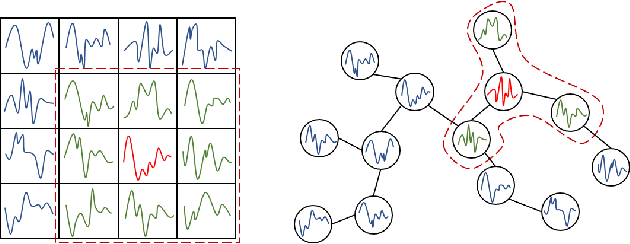
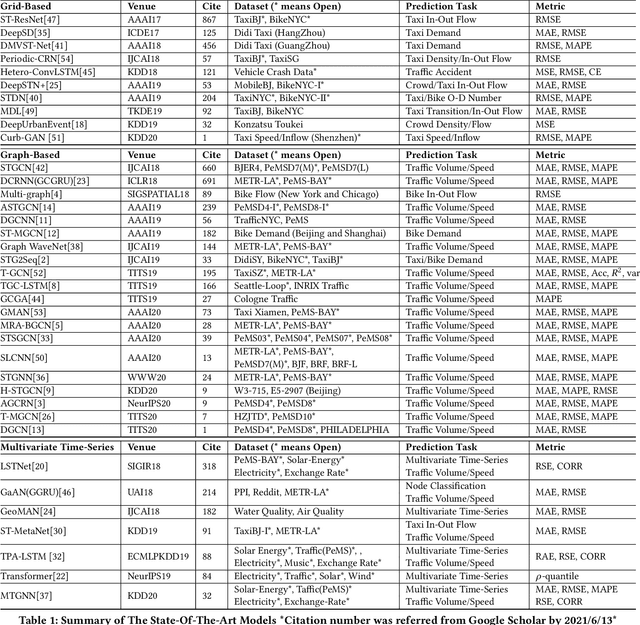
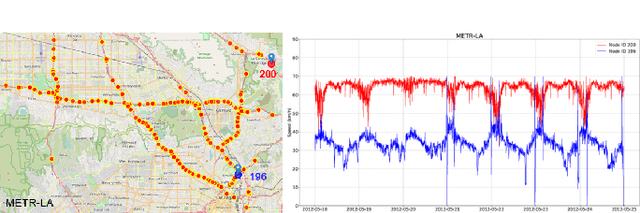
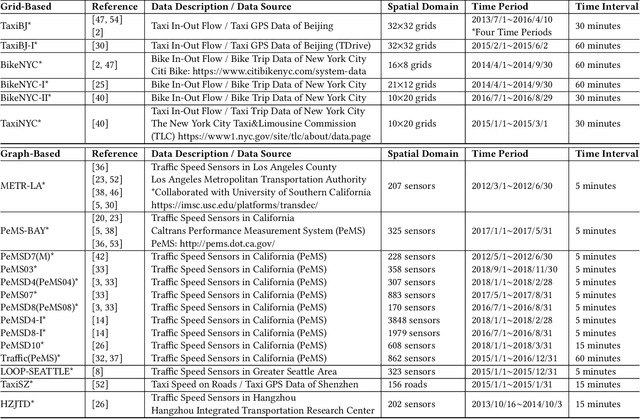
Nowadays, with the rapid development of IoT (Internet of Things) and CPS (Cyber-Physical Systems) technologies, big spatiotemporal data are being generated from mobile phones, car navigation systems, and traffic sensors. By leveraging state-of-the-art deep learning technologies on such data, urban traffic prediction has drawn a lot of attention in AI and Intelligent Transportation System community. The problem can be uniformly modeled with a 3D tensor (T, N, C), where T denotes the total time steps, N denotes the size of the spatial domain (i.e., mesh-grids or graph-nodes), and C denotes the channels of information. According to the specific modeling strategy, the state-of-the-art deep learning models can be divided into three categories: grid-based, graph-based, and multivariate time-series models. In this study, we first synthetically review the deep traffic models as well as the widely used datasets, then build a standard benchmark to comprehensively evaluate their performances with the same settings and metrics. Our study named DL-Traff is implemented with two most popular deep learning frameworks, i.e., TensorFlow and PyTorch, which is already publicly available as two GitHub repositories https://github.com/deepkashiwa20/DL-Traff-Grid and https://github.com/deepkashiwa20/DL-Traff-Graph. With DL-Traff, we hope to deliver a useful resource to researchers who are interested in spatiotemporal data analysis.