 Add to Chrome
 Add to Firefox
 Add to Edge
GCPO: Diagnosing and Constraining Subspace Geometry in Rollout RL for LLMs
Aug 12, 2026
On-policy rollout methods such as GRPO are central to post-training of large language models, yet they frequently suffer from training instabilities, cross-task capability degradation, and response-length inflation. Although prior work has characterized the subspace geometry of aggregate updates, the stepwise variation of this geometry and its relationship to model performance remain unclear. We introduce Principal-Subspace Overlap, a dimension-corrected measure of individual rollout updates relative to the dominant singular subspaces of pretrained weights. Despite low average overlap, transient spikes often precede performance degradation. To address this, we propose GCPO (Geometrically Constrained Policy Optimization), which applies hard bilateral orthogonal projections to constrain updates to the complementary subspaces, preventing such excursions by construction. Across mathematical reasoning, code generation, and tool-use tasks on Qwen3-8B and GLM4-9B, GCPO consistently outperforms GRPO and recent variants, including DAPO and GSPO, improving over the base models and the strongest baseline by up to 27.69 and 2.37 points, respectively. Furthermore, GCPO preserves general capabilities, eliminates response-length inflation, and stabilizes policy entropy. Our findings provide a new diagnostic lens and a principled design perspective for stable reinforcement learning post-training.

GAC: Noise-Aware Adaptive Mixing for Hybrid SFT-RL Post-Training
May 25, 2026Hybrid post-training usually combines supervised fine-tuning and reinforcement learning, but fixed mixing schedules cannot adapt when the relative noise of the two signals changes over time. We propose GAC, a noise-aware controller that derives an adaptive mixing weight from online estimates of gradient variance and disagreement between the two training signals. The method adds smoothing, prior guidance, and bounded updates while reusing existing training tensors. Experiments on math, code, science, and logic benchmarks show that GAC consistently improves hybrid post-training over strong fixed and rule-based baselines, with larger gains at larger model scales and less than 1% training overhead.
AuditRepairBench: A Paired-Execution Trace Corpus for Evaluator-Channel Ranking Instability in Agent Repair
May 06, 2026Agent-repair leaderboards reorder under evaluator reconfiguration, and a measurable share of the reordering is produced by methods that consult evaluator-derived signal during internal selection of candidate repairs. We document this failure mode on a public leaderboard and release AuditRepairBench, a paired-execution trace corpus of 576,000 registered cells (96,000 executed) that operationalizes evaluator-channel-blocking ranking instability within a declared observability boundary. A modular screening architecture decides pathway-blocking through four interchangeable implementations, a learned influence proxy, a rule-based channel-exposure ratio that uses no trained model, a counterfactual sensitivity proxy, and a sparse human-audit proxy, combined into a screening posterior that feeds a cell-level flip functional, a set-valued label, a stratified system score, and a set-valued leaderboard. The resource is supported by mechanism-anchored validation on an 80-case source-level channel-surgery subset, an independent-discovery protocol under which two annotator groups separated from the pipeline developers discover coupling patterns blinded to the screening design and the frozen ensemble attains pooled AUROC 0.83 on their 79 cases, implementation robustness, uncertainty propagation that raises 95% coverage from 0.81 to 0.95, and forward transfer with pooled community-evaluator Spearman \r{ho} = 0.65. Screening-guided blinding patches reduce rank displacement by 55--74% (mean 62%) at fewer than 50 lines of code, whereas random channel blinding produces at most 7% reduction and generic retraining at most 13%. AuditRepairBench-Lite, a rule-only configuration on a 12,000-cell subset, preserves the leaderboard at Kendall τ = 0.88 under twenty-four GPU-hours and is the primary release artifact at 42 GB.
Hidden Failure Modes of Gradient Modification under Adam in Continual Learning, and Adaptive Decoupled Moment Routing as a Repair
Apr 24, 2026Many continual-learning methods modify gradients upstream (e.g., projection, penalty rescaling, replay mixing) while treating Adam as a neutral backend. We show this composition has a hidden failure mode. In a high-overlap, non-adaptive 8-domain continual LM, all shared-routing projection baselines collapse close to vanilla forgetting (12.5--12.8 vs. 13.2). A 0.5% replay buffer is the strongest shared alternative but still reaches 11.6, while fixed-strength decoupling falls below vanilla at 14.1. Only adaptive decoupled routing remains stable at 9.4, improving over vanilla by 3.8 units. On a 16-domain stream, its gain over the strongest shared-routing projection baseline grows to 4.5--4.8 units. The failure is largely invisible on clean benchmarks. We explain this effect through Adam's second-moment pathway: in the tested regime, projection induces a 1/(1-alpha) inflation of the old-direction effective learning rate, matching measurements within 8% across eight alpha values. The same conflict appears with penalty methods, replay mixing, and at 7B scale under LoRA. Our fix routes the modified gradient only to the first moment while preserving magnitude-faithful second-moment statistics, with overlap-aware adaptive strength. This simple change is the only tested configuration that consistently avoids collapse across methods, optimizers, and scale.
LatexBlend: Scaling Multi-concept Customized Generation with Latent Textual Blending
Mar 10, 2025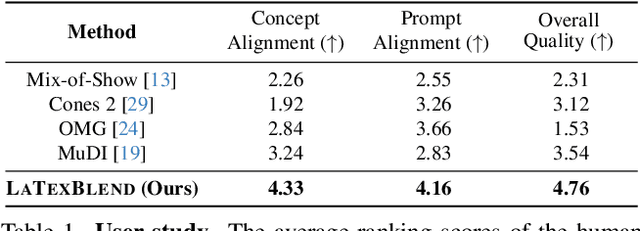
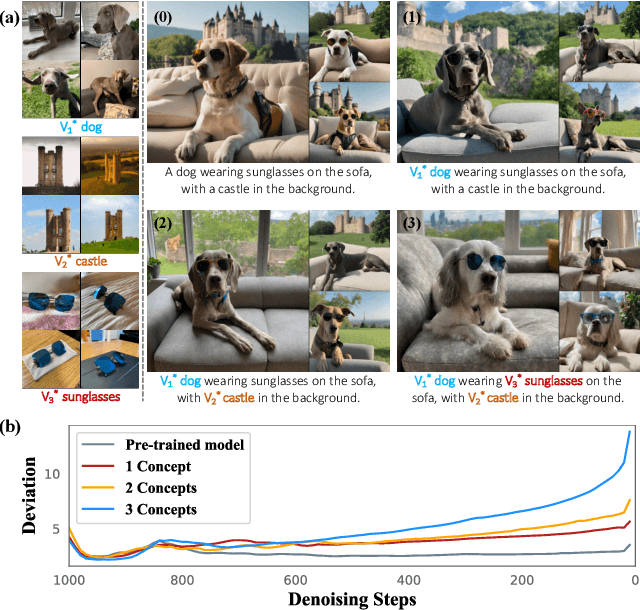
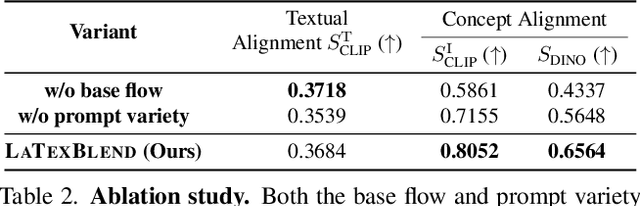
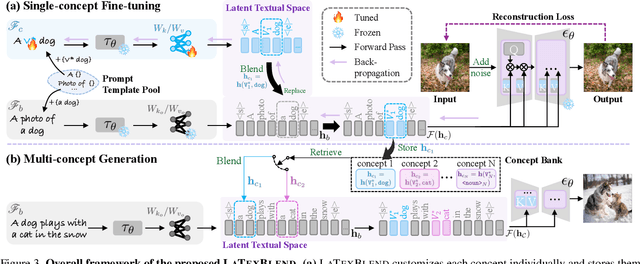
Customized text-to-image generation renders user-specified concepts into novel contexts based on textual prompts. Scaling the number of concepts in customized generation meets a broader demand for user creation, whereas existing methods face challenges with generation quality and computational efficiency. In this paper, we propose LaTexBlend, a novel framework for effectively and efficiently scaling multi-concept customized generation. The core idea of LaTexBlend is to represent single concepts and blend multiple concepts within a Latent Textual space, which is positioned after the text encoder and a linear projection. LaTexBlend customizes each concept individually, storing them in a concept bank with a compact representation of latent textual features that captures sufficient concept information to ensure high fidelity. At inference, concepts from the bank can be freely and seamlessly combined in the latent textual space, offering two key merits for multi-concept generation: 1) excellent scalability, and 2) significant reduction of denoising deviation, preserving coherent layouts. Extensive experiments demonstrate that LaTexBlend can flexibly integrate multiple customized concepts with harmonious structures and high subject fidelity, substantially outperforming baselines in both generation quality and computational efficiency. Our code will be publicly available.
Inferring Fluid Dynamics via Inverse Rendering
Apr 10, 2023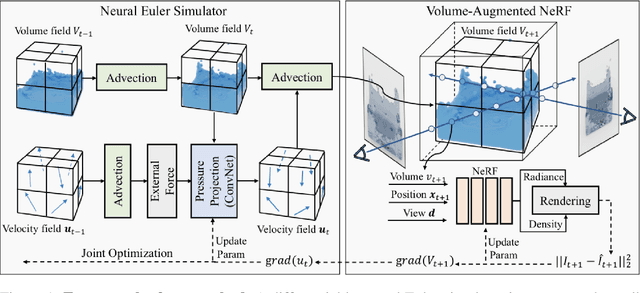

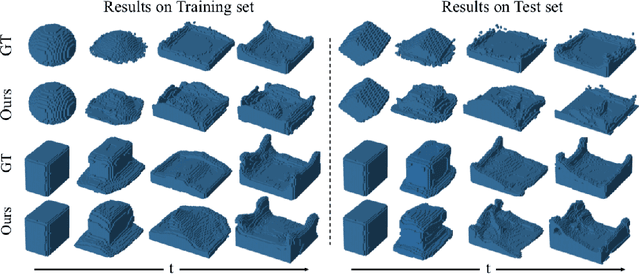
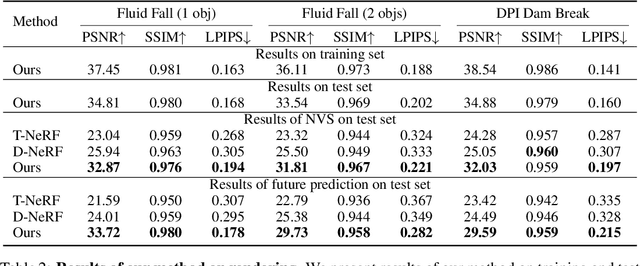
Humans have a strong intuitive understanding of physical processes such as fluid falling by just a glimpse of such a scene picture, i.e., quickly derived from our immersive visual experiences in memory. This work achieves such a photo-to-fluid-dynamics reconstruction functionality learned from unannotated videos, without any supervision of ground-truth fluid dynamics. In a nutshell, a differentiable Euler simulator modeled with a ConvNet-based pressure projection solver, is integrated with a volumetric renderer, supporting end-to-end/coherent differentiable dynamic simulation and rendering. By endowing each sampled point with a fluid volume value, we derive a NeRF-like differentiable renderer dedicated from fluid data; and thanks to this volume-augmented representation, fluid dynamics could be inversely inferred from the error signal between the rendered result and ground-truth video frame (i.e., inverse rendering). Experiments on our generated Fluid Fall datasets and DPI Dam Break dataset are conducted to demonstrate both effectiveness and generalization ability of our method.
Skeleton2Humanoid: Animating Simulated Characters for Physically-plausible Motion In-betweening
Oct 09, 2022
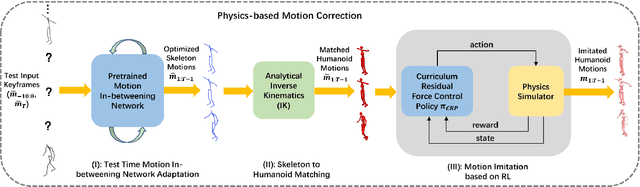

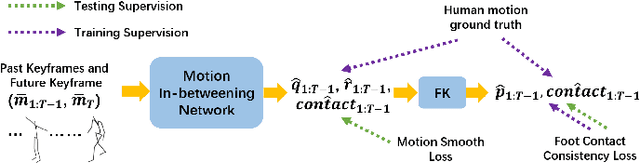
Human motion synthesis is a long-standing problem with various applications in digital twins and the Metaverse. However, modern deep learning based motion synthesis approaches barely consider the physical plausibility of synthesized motions and consequently they usually produce unrealistic human motions. In order to solve this problem, we propose a system ``Skeleton2Humanoid'' which performs physics-oriented motion correction at test time by regularizing synthesized skeleton motions in a physics simulator. Concretely, our system consists of three sequential stages: (I) test time motion synthesis network adaptation, (II) skeleton to humanoid matching and (III) motion imitation based on reinforcement learning (RL). Stage I introduces a test time adaptation strategy, which improves the physical plausibility of synthesized human skeleton motions by optimizing skeleton joint locations. Stage II performs an analytical inverse kinematics strategy, which converts the optimized human skeleton motions to humanoid robot motions in a physics simulator, then the converted humanoid robot motions can be served as reference motions for the RL policy to imitate. Stage III introduces a curriculum residual force control policy, which drives the humanoid robot to mimic complex converted reference motions in accordance with the physical law. We verify our system on a typical human motion synthesis task, motion-in-betweening. Experiments on the challenging LaFAN1 dataset show our system can outperform prior methods significantly in terms of both physical plausibility and accuracy. Code will be released for research purposes at: https://github.com/michaelliyunhao/Skeleton2Humanoid
Object Wake-up: 3-D Object Reconstruction, Animation, and in-situ Rendering from a Single Image
Aug 05, 2021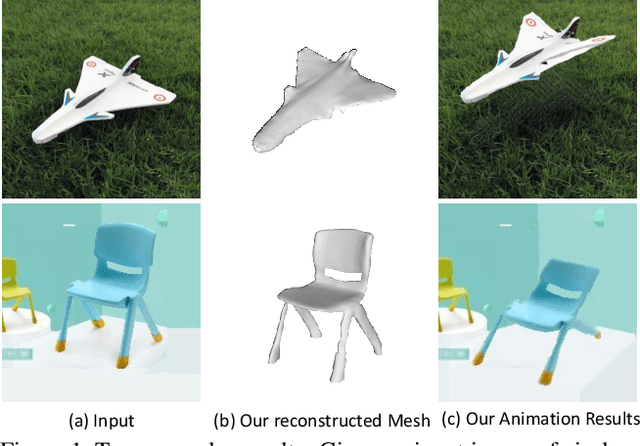
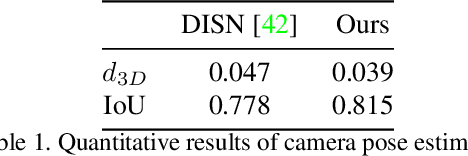
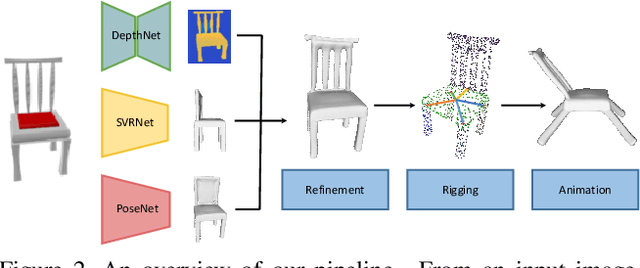
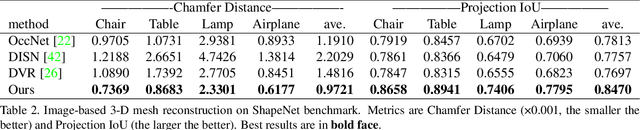
Given a picture of a chair, could we extract the 3-D shape of the chair, animate its plausible articulations and motions, and render in-situ in its original image space? The above question prompts us to devise an automated approach to extract and manipulate articulated objects in single images. Comparing with previous efforts on object manipulation, our work goes beyond 2-D manipulation and focuses on articulable objects, thus introduces greater flexibility for possible object deformations. The pipeline of our approach starts by reconstructing and refining a 3-D mesh representation of the object of interest from an input image; its control joints are predicted by exploiting the semantic part segmentation information; the obtained object 3-D mesh is then rigged \& animated by non-rigid deformation, and rendered to perform in-situ motions in its original image space. Quantitative evaluations are carried out on 3-D reconstruction from single images, an established task that is related to our pipeline, where our results surpass those of the SOTAs by a noticeable margin. Extensive visual results also demonstrate the applicability of our approach.