 Add to Chrome
 Add to Firefox
 Add to Edge
GAC: Noise-Aware Adaptive Mixing for Hybrid SFT-RL Post-Training
May 25, 2026
Hybrid post-training usually combines supervised fine-tuning and reinforcement learning, but fixed mixing schedules cannot adapt when the relative noise of the two signals changes over time. We propose GAC, a noise-aware controller that derives an adaptive mixing weight from online estimates of gradient variance and disagreement between the two training signals. The method adds smoothing, prior guidance, and bounded updates while reusing existing training tensors. Experiments on math, code, science, and logic benchmarks show that GAC consistently improves hybrid post-training over strong fixed and rule-based baselines, with larger gains at larger model scales and less than 1% training overhead.

AuditRepairBench: A Paired-Execution Trace Corpus for Evaluator-Channel Ranking Instability in Agent Repair
May 06, 2026Agent-repair leaderboards reorder under evaluator reconfiguration, and a measurable share of the reordering is produced by methods that consult evaluator-derived signal during internal selection of candidate repairs. We document this failure mode on a public leaderboard and release AuditRepairBench, a paired-execution trace corpus of 576,000 registered cells (96,000 executed) that operationalizes evaluator-channel-blocking ranking instability within a declared observability boundary. A modular screening architecture decides pathway-blocking through four interchangeable implementations, a learned influence proxy, a rule-based channel-exposure ratio that uses no trained model, a counterfactual sensitivity proxy, and a sparse human-audit proxy, combined into a screening posterior that feeds a cell-level flip functional, a set-valued label, a stratified system score, and a set-valued leaderboard. The resource is supported by mechanism-anchored validation on an 80-case source-level channel-surgery subset, an independent-discovery protocol under which two annotator groups separated from the pipeline developers discover coupling patterns blinded to the screening design and the frozen ensemble attains pooled AUROC 0.83 on their 79 cases, implementation robustness, uncertainty propagation that raises 95% coverage from 0.81 to 0.95, and forward transfer with pooled community-evaluator Spearman \r{ho} = 0.65. Screening-guided blinding patches reduce rank displacement by 55--74% (mean 62%) at fewer than 50 lines of code, whereas random channel blinding produces at most 7% reduction and generic retraining at most 13%. AuditRepairBench-Lite, a rule-only configuration on a 12,000-cell subset, preserves the leaderboard at Kendall τ = 0.88 under twenty-four GPU-hours and is the primary release artifact at 42 GB.
Hidden Failure Modes of Gradient Modification under Adam in Continual Learning, and Adaptive Decoupled Moment Routing as a Repair
Apr 24, 2026Many continual-learning methods modify gradients upstream (e.g., projection, penalty rescaling, replay mixing) while treating Adam as a neutral backend. We show this composition has a hidden failure mode. In a high-overlap, non-adaptive 8-domain continual LM, all shared-routing projection baselines collapse close to vanilla forgetting (12.5--12.8 vs. 13.2). A 0.5% replay buffer is the strongest shared alternative but still reaches 11.6, while fixed-strength decoupling falls below vanilla at 14.1. Only adaptive decoupled routing remains stable at 9.4, improving over vanilla by 3.8 units. On a 16-domain stream, its gain over the strongest shared-routing projection baseline grows to 4.5--4.8 units. The failure is largely invisible on clean benchmarks. We explain this effect through Adam's second-moment pathway: in the tested regime, projection induces a 1/(1-alpha) inflation of the old-direction effective learning rate, matching measurements within 8% across eight alpha values. The same conflict appears with penalty methods, replay mixing, and at 7B scale under LoRA. Our fix routes the modified gradient only to the first moment while preserving magnitude-faithful second-moment statistics, with overlap-aware adaptive strength. This simple change is the only tested configuration that consistently avoids collapse across methods, optimizers, and scale.
Entropy-Gated Selective Policy Optimization:Token-Level Gradient Allocation for Hybrid Training of Large Language Models
Feb 03, 2026Hybrid training methods for large language models combine supervised fine tuning (SFT) on expert demonstrations with reinforcement learning (RL) on model rollouts, typically at the sample level. We propose Entropy Gated Selective Policy Optimization (EGSPO), a three stage framework that extends sample level mixing with token level gradient modulation. Stage 1, SFT expert learning, establishes a reliable warm up policy using expert demonstrations with a pure SFT loss. Stage 2, RL rollout generation, samples trajectories from the current policy and computes per token predictive entropy. Stage 3, the EGSPO mechanism, applies entropy gated gradient allocation: a predictive entropy module routes high entropy tokens to full PPO updates to encourage exploration, and low entropy tokens to attenuated PPO updates to reduce variance and preserve knowledge. Critically, both branches incorporate the advantage function A_t, ensuring that incorrect trajectories receive consistent negative learning signals and preventing reinforcement of confident errors. EGSPO achieves consistent improvements on mathematical reasoning benchmarks, with gains of 3.8 percent on AIME and 2.9 percent on MATH over the CHORD phi baseline, while incurring only 3.4 percent additional computational overhead.
MeetBench-XL: Calibrated Multi-Dimensional Evaluation and Learned Dual-Policy Agents for Real-Time Meetings
Feb 03, 2026Enterprise meeting environments require AI assistants that handle diverse operational tasks, from rapid fact checking during live discussions to cross meeting analysis for strategic planning, under strict latency, cost, and privacy constraints. Existing meeting benchmarks mainly focus on simplified question answering and fail to reflect real world enterprise workflows, where queries arise organically from multi stakeholder collaboration, span long temporal contexts, and require tool augmented reasoning. We address this gap through a grounded dataset and a learned agent framework. First, we introduce MeetAll, a bilingual and multimodal corpus derived from 231 enterprise meetings totaling 140 hours. Questions are injected using an enterprise informed protocol validated by domain expert review and human discriminability studies. Unlike purely synthetic benchmarks, this protocol is grounded in four enterprise critical dimensions: cognitive load, temporal context span, domain expertise, and actionable task execution, calibrated through interviews with stakeholders across finance, healthcare, and technology sectors. Second, we propose MeetBench XL, a multi dimensional evaluation protocol aligned with human judgment that measures factual fidelity, intent alignment, response efficiency, structural clarity, and completeness. Third, we present MeetMaster XL, a learned dual policy agent that jointly optimizes query routing between fast and slow reasoning paths and tool invocation, including retrieval, cross meeting aggregation, and web search. A lightweight classifier enables accurate routing with minimal overhead, achieving a superior quality latency tradeoff over single model baselines. Experiments against commercial systems show consistent gains, supported by ablations, robustness tests, and a real world deployment case study.Resources: https://github.com/huyuelin/MeetBench.
Rate-Aware Learned Speech Compression
Jan 21, 2025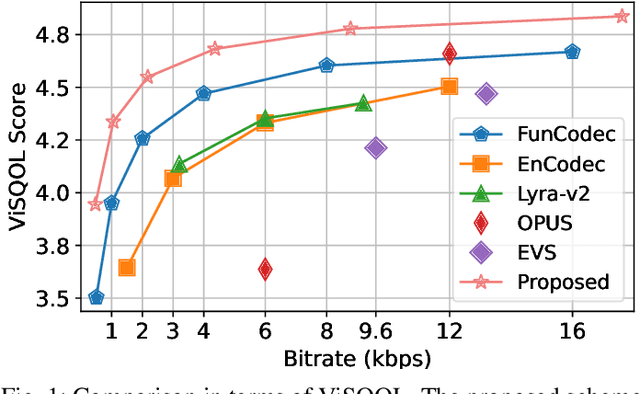

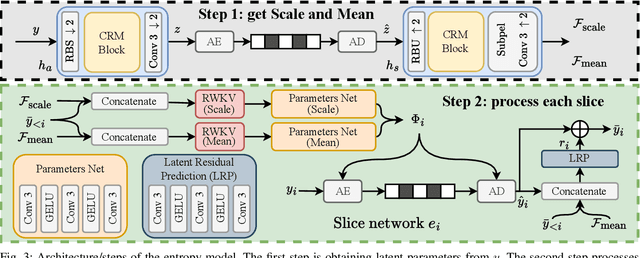
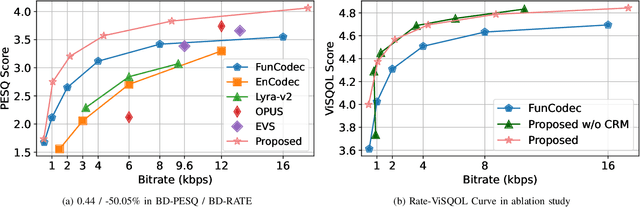
The rapid rise of real-time communication and large language models has significantly increased the importance of speech compression. Deep learning-based neural speech codecs have outperformed traditional signal-level speech codecs in terms of rate-distortion (RD) performance. Typically, these neural codecs employ an encoder-quantizer-decoder architecture, where audio is first converted into latent code feature representations and then into discrete tokens. However, this architecture exhibits insufficient RD performance due to two main drawbacks: (1) the inadequate performance of the quantizer, challenging training processes, and issues such as codebook collapse; (2) the limited representational capacity of the encoder and decoder, making it difficult to meet feature representation requirements across various bitrates. In this paper, we propose a rate-aware learned speech compression scheme that replaces the quantizer with an advanced channel-wise entropy model to improve RD performance, simplify training, and avoid codebook collapse. We employ multi-scale convolution and linear attention mixture blocks to enhance the representational capacity and flexibility of the encoder and decoder. Experimental results demonstrate that the proposed method achieves state-of-the-art RD performance, obtaining 53.51% BD-Rate bitrate saving in average, and achieves 0.26 BD-VisQol and 0.44 BD-PESQ gains.