 Add to Chrome
 Add to Firefox
 Add to Edge
GLocFM: A Geometry-Aware Foundation Model for 3D Indoor Wireless Localization
Aug 10, 2026
Learning-based wireless localizers often fail to utilize geometric information about the propagation environment, limiting their ability to exploit non-line-of-sight (NLoS) propagation and generalize across scenes. To bridge this gap, we propose GLocFM, a Geometry-aware Localization Foundation Model, which jointly exploits WiFi measurements and scene geometry represented as a 3D point cloud. We formulate localization as a maximum-likelihood (ML) estimation problem, where the goal is to find a transmitter position that maximizes the likelihood of the wireless observations conditioned on the scene geometry. The likelihood of a candidate transmitter position is calculated by a learned scoring function that matches the observed delay--angle-of-arrival (AoA) spectrum against the spectrum predicted for that candidate. A hierarchical scene encoder extracts propagation-relevant features to produce geometric priors for LoS and one-bounce reflection paths. For scenarios with imperfect synchronization, we further introduce a time-of-flight (ToF)-robust GLocFM model to handle unknown ToF offsets. GLocFM is trained on a multi-modal synthetic indoor localization dataset comprising 221 diverse scenes whose associated wireless signals are generated using Sionna RT. On both synthetic and the NeRF$^{2}$ dataset based on real measurements, GLocFM reduces mean 3D localization error relative to one of the state-of-the-art localization baselines by 49.5\% and 48.8\%, respectively. Ablations across different number of receiver, bandwidths, and array sizes further demonstrate the effectiveness and robustness of the proposed framework.

Point2Radio: A Foundation Model for Cross-Scene Radio Fields from Material-Aware Point Clouds
Jul 31, 2026High-fidelity radio fields are typically simulated for every scene--transmitter configuration or fitted separately to each scene, failing to exploit propagation structures shared across environments. We present Point2Radio, a foundation model that learns a transferable propagation prior from multiple environments. Given a material-aware point cloud and a transmitter (TX) setting, a common encoder produces a TX-conditioned scene representation that can be queried at arbitrary receiver (RX) locations. Task-specific query decoders map this representation to different radio quantities, e.g., three-dimensional (3D) path-gain (PG) fields and power angular spectra (PAS). At inference for a new scene, the model uses only a material-aware point cloud and transceiver queries, running in milliseconds on a single GPU without meshes or explicit path tracing. We evaluate PG prediction on a scene-disjoint split of a 337-scene corpus containing 86,272 TX-conditioned fields. Point2Radio achieves 0.871 dB mean absolute error (MAE), reducing error by 76.7% relative to a same-split UNet-style baseline. The same encoder also supports PAS prediction via a task-specific decoder. Experiments further show that light target-scene fine-tuning improves adaptation to a specific environment.
AttriMem: Attribution-Guided Process Feedback for Agent Memory Learning
Jul 23, 2026Effective memory is crucial for LLM agents, yet constructing it effectively remains challenging. A memory-construction policy decides what information to extract, store, update, compress, or discard as interactions accumulate. Heuristic memory methods rely on subjective, task-specific rules, which can misalign with downstream objectives and limit cross-task adaptability. RL-based methods, by contrast, learn from task feedback but mainly use outcome- or module-level rewards. These coarse signals indicate task success but cannot identify which intermediate memory contents support the final answer, creating a fine-grained credit-assignment bottleneck. However, constructing such process feedback is prohibitively difficult because intermediate memory decisions lack unique ground-truth targets, while the appropriate credit varies with the agent's uncertain reasoning trajectory and therefore cannot be specified in advance. We propose AttriMem, an attribution-guided process-feedback framework for learning memory-construction policies with RL. AttriMem augments the global outcome reward with local rewards derived from token-level contributions to the final answer. Experiments on long-horizon dialogue question answering show that AttriMem outperforms retrieval-based, heuristic, and RL-based baselines, generalizes across benchmarks and answer models, stabilizes RL optimization.
GI-GS: Global Illumination Decomposition on Gaussian Splatting for Inverse Rendering
Oct 03, 2024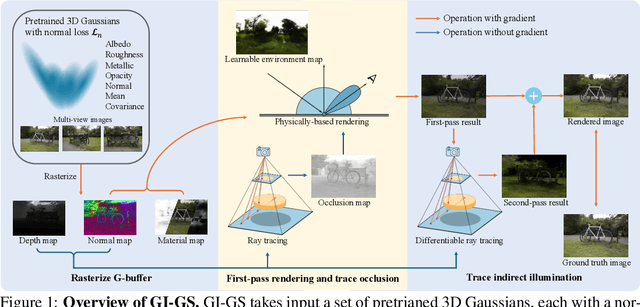


We present GI-GS, a novel inverse rendering framework that leverages 3D Gaussian Splatting (3DGS) and deferred shading to achieve photo-realistic novel view synthesis and relighting. In inverse rendering, accurately modeling the shading processes of objects is essential for achieving high-fidelity results. Therefore, it is critical to incorporate global illumination to account for indirect lighting that reaches an object after multiple bounces across the scene. Previous 3DGS-based methods have attempted to model indirect lighting by characterizing indirect illumination as learnable lighting volumes or additional attributes of each Gaussian, while using baked occlusion to represent shadow effects. These methods, however, fail to accurately model the complex physical interactions between light and objects, making it impossible to construct realistic indirect illumination during relighting. To address this limitation, we propose to calculate indirect lighting using efficient path tracing with deferred shading. In our framework, we first render a G-buffer to capture the detailed geometry and material properties of the scene. Then, we perform physically-based rendering (PBR) only for direct lighting. With the G-buffer and previous rendering results, the indirect lighting can be calculated through a lightweight path tracing. Our method effectively models indirect lighting under any given lighting conditions, thereby achieving better novel view synthesis and relighting. Quantitative and qualitative results show that our GI-GS outperforms existing baselines in both rendering quality and efficiency.