 Add to Chrome
 Add to Firefox
 Add to Edge
ClinEnv: An Interactive Multi-Stage Long Horizon EHR Environment for Agents
Jun 01, 2026
Clinical practice is not the selection of an answer from enumerated options: a physician gathers heterogeneous information incrementally and commits to sequential, irreversible decisions under uncertainty. Static benchmarks cannot probe and existing interactive medical benchmarks each compromise on at least one of them. We present ClinEnv, an interactive benchmark that evaluates LLMs as attending physicians over real inpatient admissions under a paradigm we term Longitudinal Inpatient Simulation. Each case is automatically constructed into an ordered sequence of decision stages; at every stage the model must actively query four specialized agents before committing to medications, procedures, and diagnoses. ClinEnv scores both what the model decides, through deterministic ontology-grounded matching, and how it gathers information. Across seven models, the strongest reaches only 0.31 decision F1, and outcome quality is sharply decoupled from process quality. Difficulty concentrates in management decisions and later stages, where models recover discharge diagnoses far more reliably than management actions (0.51 vs. 0.17 F1) and continue to issue redundant queries as cases progress. ClinEnv makes this information-acquisition gap, invisible to outcome-only evaluation, directly measurable.

RobustMedSAM: Degradation-Resilient Medical Image Segmentation via Robust Foundation Model Adaptation
Apr 10, 2026Medical image segmentation models built on Segment Anything Model (SAM) achieve strong performance on clean benchmarks, yet their reliability often degrades under realistic image corruptions such as noise, blur, motion artifacts, and modality-specific distortions. Existing approaches address either medical-domain adaptation or corruption robustness, but not both jointly. In SAM, we find that these capabilities are concentrated in complementary modules: the image encoder preserves medical priors, while the mask decoder governs corruption robustness. Motivated by this observation, we propose RobustMedSAM, which adopts module-wise checkpoint fusion by initializing the image encoder from MedSAM and the mask decoder from RobustSAM under a shared ViT-B architecture. We then fine-tune only the mask decoder on 35 medical datasets from MedSegBench, spanning six imaging modalities and 12 corruption types, while freezing the remaining components to preserve pretrained medical representations. We additionally investigate an SVD-based parameter-efficient variant for limited encoder adaptation. Experiments on both in-distribution and out-of-distribution benchmarks show that RobustMedSAM improves degraded-image Dice from 0.613 to 0.719 (+0.106) over SAM, demonstrating that structured fusion of complementary pretrained models is an effective and practical approach for robust medical image segmentation.
Tree-of-Evidence: Efficient "System 2" Search for Faithful Multimodal Grounding
Apr 09, 2026Large Multimodal Models (LMMs) achieve state-of-the-art performance in high-stakes domains like healthcare, yet their reasoning remains opaque. Current interpretability methods, such as attention mechanisms or post-hoc saliency, often fail to faithfully represent the model's decision-making process, particularly when integrating heterogeneous modalities like time-series and text. We introduce Tree-of-Evidence (ToE), an inference-time search algorithm that frames interpretability as a discrete optimization problem. Rather than relying on soft attention weights, ToE employs lightweight Evidence Bottlenecks that score coarse groups or units of data (e.g., vital-sign windows, report sentences) and performs a beam search to identify the compact evidence set required to reproduce the model's prediction. We evaluate ToE across six tasks spanning three datasets and two domains: four clinical prediction tasks on MIMIC-IV, cross-center validation on eICU, and non-clinical fault detection on LEMMA-RCA. ToE produces auditable evidence traces while maintaining predictive performance, retaining over 0.98 of full-model AUROC with as few as five evidence units across all settings. Under sparse evidence budgets, ToE achieves higher decision agreement and lower probability fidelity error than other approaches. Qualitative analyses show that ToE adapts its search strategy: it often resolves straightforward cases using only vitals, while selectively incorporating text when physiological signals are ambiguous. ToE therefore provides a practical mechanism for auditing multimodal models by revealing which discrete evidence units support each prediction.
EvidenceRL: Reinforcing Evidence Consistency for Trustworthy Language Models
Mar 20, 2026Large Language Models (LLMs) are fluent but prone to hallucinations, producing answers that appear plausible yet are unsupported by available evidence. This failure is especially problematic in high-stakes domains where decisions must be justified by verifiable information. We introduce \textbf{EvidenceRL}, a reinforcement learning framework that enforces evidence adherence during training. EvidenceRL scores candidate responses for grounding (entailment with retrieved evidence and context) and correctness (agreement with reference answers) and optimizes the generator using Group Relative Policy Optimization (GRPO). We evaluate across two high-stakes domains, cardiac diagnosis and legal reasoning, where EvidenceRL consistently improves evidence grounding and faithfulness without sacrificing task accuracy. On cardiac diagnosis, F1@3 increases from 37.0 to 54.5 on Llama-3.2-3B while grounding ($G_{\max}@3$) rises from 47.6 to 78.2; hallucinations drop nearly 5$\times$ and evidence-supported diagnoses increase from 31.8\% to 61.6\%. On legal reasoning, EvidenceRL raises Faithfulness from 32.8\% to 67.6\% on Llama-3.1-8B, demonstrating consistent behavioral change across domains. Our code is open-sourced at https://github.com/Wizaaard/EvidenceRL.git.
KindSleep: Knowledge-Informed Diagnosis of Obstructive Sleep Apnea from Oximetry
Mar 05, 2026Obstructive sleep apnea (OSA) is a sleep disorder that affects nearly one billion people globally and significantly elevates cardiovascular risk. Traditional diagnosis through polysomnography is resource-intensive and limits widespread access, creating a critical need for accurate and efficient alternatives. In this paper, we introduce KindSleep, a deep learning framework that integrates clinical knowledge with single-channel patient-specific oximetry signals and clinical data for precise OSA diagnosis. KindSleep first learns to identify clinically interpretable concepts, such as desaturation indices and respiratory disturbance events, directly from raw oximetry signals. It then fuses these AI-derived concepts with multimodal clinical data to estimate the Apnea-Hypopnea Index (AHI). We evaluate KindSleep on three large, independent datasets from the National Sleep Research Resource (SHHS, CFS, MrOS; total n = 9,815). KindSleep demonstrates excellent performance in estimating AHI scores (R2 = 0.917, ICC = 0.957) and consistently outperforms existing approaches in classifying OSA severity, achieving weighted F1-scores from 0.827 to 0.941 across diverse populations. By grounding its predictions in a layer of clinically meaningful concepts, KindSleep provides a more transparent and trustworthy diagnostic tool for sleep medicine practices.
LinguaMap: Which Layers of LLMs Speak Your Language and How to Tune Them?
Jan 27, 2026Despite multilingual pretraining, large language models often struggle with non-English tasks, particularly in language control, the ability to respond in the intended language. We identify and characterize two key failure modes: the multilingual transfer bottleneck (correct language, incorrect task response) and the language consistency bottleneck (correct task response, wrong language). To systematically surface these issues, we design a four-scenario evaluation protocol spanning MMLU, MGSM, and XQuAD benchmarks. To probe these issues with interpretability, we extend logit lens analysis to track language probabilities layer by layer and compute cross-lingual semantic similarity of hidden states. The results reveal a three-phase internal structure: early layers align inputs into a shared semantic space, middle layers perform task reasoning, and late layers drive language-specific generation. Guided by these insights, we introduce selective fine-tuning of only the final layers responsible for language control. On Qwen-3-32B and Bloom-7.1B, this method achieves over 98 percent language consistency across six languages while fine-tuning only 3-5 percent of parameters, without sacrificing task accuracy. Importantly, this result is nearly identical to that of full-scope fine-tuning (for example, above 98 percent language consistency for both methods across all prompt scenarios) but uses a fraction of the computational resources. To the best of our knowledge, this is the first approach to leverage layer-localization of language control for efficient multilingual adaptation.
LLM-as-RNN: A Recurrent Language Model for Memory Updates and Sequence Prediction
Jan 19, 2026Large language models are strong sequence predictors, yet standard inference relies on immutable context histories. After making an error at generation step t, the model lacks an updatable memory mechanism that improves predictions for step t+1. We propose LLM-as-RNN, an inference-only framework that turns a frozen LLM into a recurrent predictor by representing its hidden state as natural-language memory. This state, implemented as a structured system-prompt summary, is updated at each timestep via feedback-driven text rewrites, enabling learning without parameter updates. Under a fixed token budget, LLM-as-RNN corrects errors and retains task-relevant patterns, effectively performing online learning through language. We evaluate the method on three sequential benchmarks in healthcare, meteorology, and finance across Llama, Gemma, and GPT model families. LLM-as-RNN significantly outperforms zero-shot, full-history, and MemPrompt baselines, improving predictive accuracy by 6.5% on average, while producing interpretable, human-readable learning traces absent in standard context accumulation.
Advancing Problem-Based Learning in Biomedical Engineering in the Era of Generative AI
Mar 20, 2025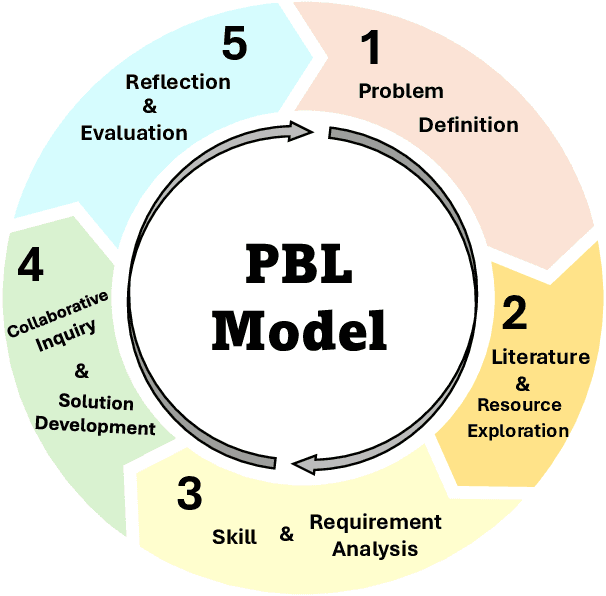
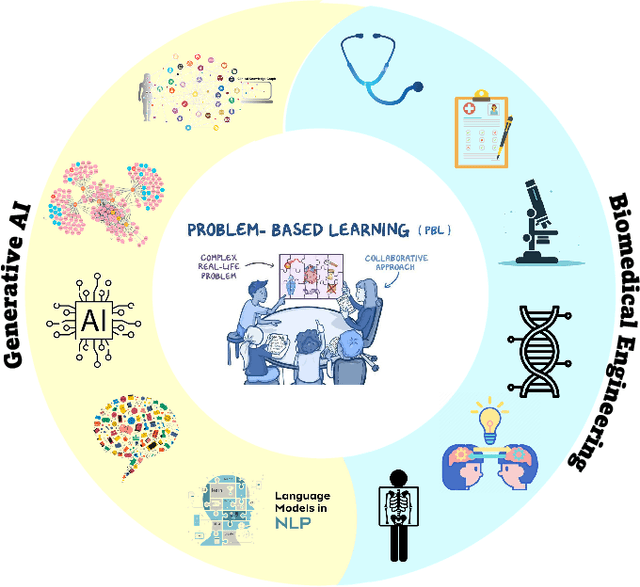

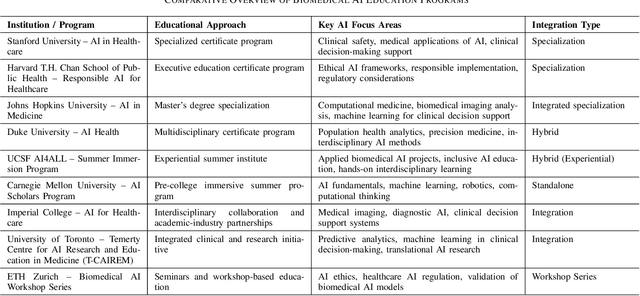
Problem-Based Learning (PBL) has significantly impacted biomedical engineering (BME) education since its introduction in the early 2000s, effectively enhancing critical thinking and real-world knowledge application among students. With biomedical engineering rapidly converging with artificial intelligence (AI), integrating effective AI education into established curricula has become challenging yet increasingly necessary. Recent advancements, including AI's recognition by the 2024 Nobel Prize, have highlighted the importance of training students comprehensively in biomedical AI. However, effective biomedical AI education faces substantial obstacles, such as diverse student backgrounds, limited personalized mentoring, constrained computational resources, and difficulties in safely scaling hands-on practical experiments due to privacy and ethical concerns associated with biomedical data. To overcome these issues, we conducted a three-year (2021-2023) case study implementing an advanced PBL framework tailored specifically for biomedical AI education, involving 92 undergraduate and 156 graduate students from the joint Biomedical Engineering program of Georgia Institute of Technology and Emory University. Our approach emphasizes collaborative, interdisciplinary problem-solving through authentic biomedical AI challenges. The implementation led to measurable improvements in learning outcomes, evidenced by high research productivity (16 student-authored publications), consistently positive peer evaluations, and successful development of innovative computational methods addressing real biomedical challenges. Additionally, we examined the role of generative AI both as a teaching subject and an educational support tool within the PBL framework. Our study presents a practical and scalable roadmap for biomedical engineering departments aiming to integrate robust AI education into their curricula.