 Add to Chrome
 Add to Firefox
 Add to Edge
RobustMedSAM: Degradation-Resilient Medical Image Segmentation via Robust Foundation Model Adaptation
Apr 10, 2026
Medical image segmentation models built on Segment Anything Model (SAM) achieve strong performance on clean benchmarks, yet their reliability often degrades under realistic image corruptions such as noise, blur, motion artifacts, and modality-specific distortions. Existing approaches address either medical-domain adaptation or corruption robustness, but not both jointly. In SAM, we find that these capabilities are concentrated in complementary modules: the image encoder preserves medical priors, while the mask decoder governs corruption robustness. Motivated by this observation, we propose RobustMedSAM, which adopts module-wise checkpoint fusion by initializing the image encoder from MedSAM and the mask decoder from RobustSAM under a shared ViT-B architecture. We then fine-tune only the mask decoder on 35 medical datasets from MedSegBench, spanning six imaging modalities and 12 corruption types, while freezing the remaining components to preserve pretrained medical representations. We additionally investigate an SVD-based parameter-efficient variant for limited encoder adaptation. Experiments on both in-distribution and out-of-distribution benchmarks show that RobustMedSAM improves degraded-image Dice from 0.613 to 0.719 (+0.106) over SAM, demonstrating that structured fusion of complementary pretrained models is an effective and practical approach for robust medical image segmentation.

Tree-of-Evidence: Efficient "System 2" Search for Faithful Multimodal Grounding
Apr 09, 2026Large Multimodal Models (LMMs) achieve state-of-the-art performance in high-stakes domains like healthcare, yet their reasoning remains opaque. Current interpretability methods, such as attention mechanisms or post-hoc saliency, often fail to faithfully represent the model's decision-making process, particularly when integrating heterogeneous modalities like time-series and text. We introduce Tree-of-Evidence (ToE), an inference-time search algorithm that frames interpretability as a discrete optimization problem. Rather than relying on soft attention weights, ToE employs lightweight Evidence Bottlenecks that score coarse groups or units of data (e.g., vital-sign windows, report sentences) and performs a beam search to identify the compact evidence set required to reproduce the model's prediction. We evaluate ToE across six tasks spanning three datasets and two domains: four clinical prediction tasks on MIMIC-IV, cross-center validation on eICU, and non-clinical fault detection on LEMMA-RCA. ToE produces auditable evidence traces while maintaining predictive performance, retaining over 0.98 of full-model AUROC with as few as five evidence units across all settings. Under sparse evidence budgets, ToE achieves higher decision agreement and lower probability fidelity error than other approaches. Qualitative analyses show that ToE adapts its search strategy: it often resolves straightforward cases using only vitals, while selectively incorporating text when physiological signals are ambiguous. ToE therefore provides a practical mechanism for auditing multimodal models by revealing which discrete evidence units support each prediction.
EvidenceRL: Reinforcing Evidence Consistency for Trustworthy Language Models
Mar 20, 2026Large Language Models (LLMs) are fluent but prone to hallucinations, producing answers that appear plausible yet are unsupported by available evidence. This failure is especially problematic in high-stakes domains where decisions must be justified by verifiable information. We introduce \textbf{EvidenceRL}, a reinforcement learning framework that enforces evidence adherence during training. EvidenceRL scores candidate responses for grounding (entailment with retrieved evidence and context) and correctness (agreement with reference answers) and optimizes the generator using Group Relative Policy Optimization (GRPO). We evaluate across two high-stakes domains, cardiac diagnosis and legal reasoning, where EvidenceRL consistently improves evidence grounding and faithfulness without sacrificing task accuracy. On cardiac diagnosis, F1@3 increases from 37.0 to 54.5 on Llama-3.2-3B while grounding ($G_{\max}@3$) rises from 47.6 to 78.2; hallucinations drop nearly 5$\times$ and evidence-supported diagnoses increase from 31.8\% to 61.6\%. On legal reasoning, EvidenceRL raises Faithfulness from 32.8\% to 67.6\% on Llama-3.1-8B, demonstrating consistent behavioral change across domains. Our code is open-sourced at https://github.com/Wizaaard/EvidenceRL.git.
Advancing Problem-Based Learning in Biomedical Engineering in the Era of Generative AI
Mar 20, 2025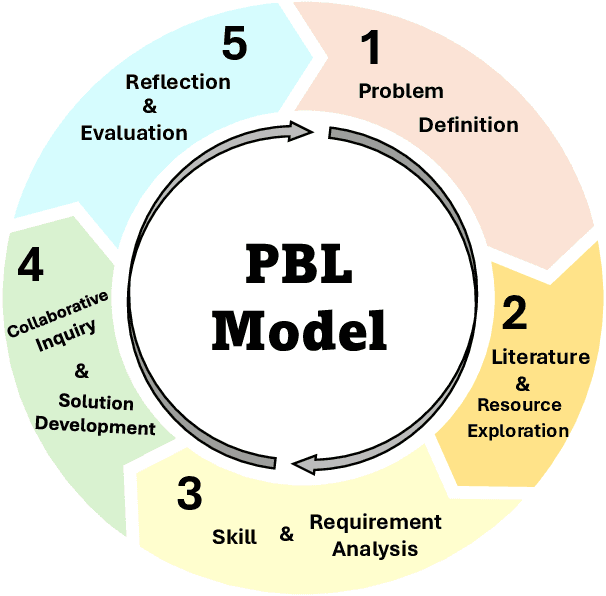
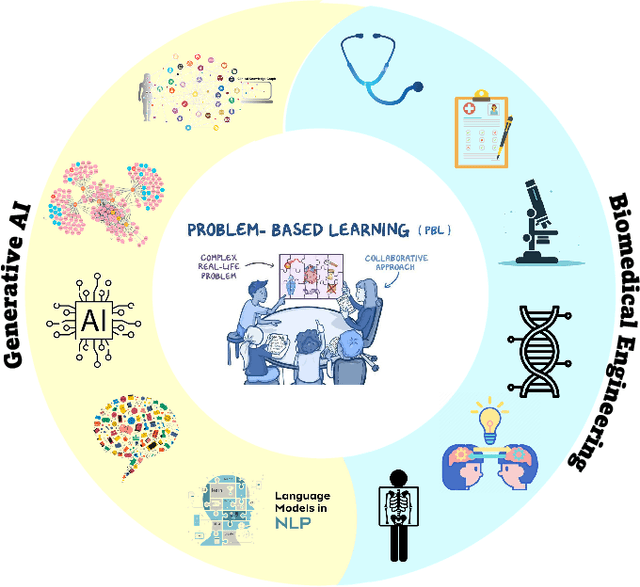

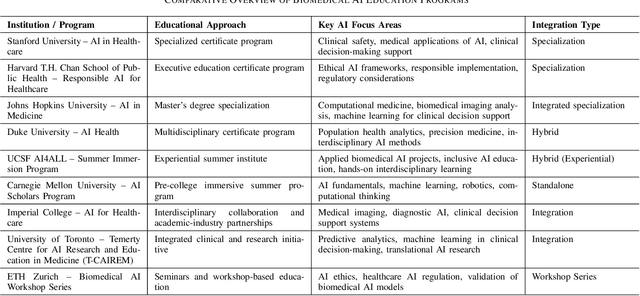
Problem-Based Learning (PBL) has significantly impacted biomedical engineering (BME) education since its introduction in the early 2000s, effectively enhancing critical thinking and real-world knowledge application among students. With biomedical engineering rapidly converging with artificial intelligence (AI), integrating effective AI education into established curricula has become challenging yet increasingly necessary. Recent advancements, including AI's recognition by the 2024 Nobel Prize, have highlighted the importance of training students comprehensively in biomedical AI. However, effective biomedical AI education faces substantial obstacles, such as diverse student backgrounds, limited personalized mentoring, constrained computational resources, and difficulties in safely scaling hands-on practical experiments due to privacy and ethical concerns associated with biomedical data. To overcome these issues, we conducted a three-year (2021-2023) case study implementing an advanced PBL framework tailored specifically for biomedical AI education, involving 92 undergraduate and 156 graduate students from the joint Biomedical Engineering program of Georgia Institute of Technology and Emory University. Our approach emphasizes collaborative, interdisciplinary problem-solving through authentic biomedical AI challenges. The implementation led to measurable improvements in learning outcomes, evidenced by high research productivity (16 student-authored publications), consistently positive peer evaluations, and successful development of innovative computational methods addressing real biomedical challenges. Additionally, we examined the role of generative AI both as a teaching subject and an educational support tool within the PBL framework. Our study presents a practical and scalable roadmap for biomedical engineering departments aiming to integrate robust AI education into their curricula.