 Add to Chrome
 Add to Firefox
 Add to Edge
Caved or Convinced: Temporal Sampling Gates Claim Deference in Video Large Language Models
Aug 04, 2026
When asked which of two events came first, video large language models can fail in two opposite ways: cave to a false claim, or reject a true one. Prior video sycophancy work measures only the first and mitigates it by teaching the model to trust the user less, a fix known in text and image models to worsen the second. In video, both failures come from two causes the literature treats as one: availability, whether the sparse sampled frames contain the two events, and weighting, whether that evidence is trusted over the user. We separate them with two interventions that keep the claim fixed: a frame-preserving reorder that flips the claim's truth, and a sampling-offset shift that captures or misses both events at a fixed frame budget. When the events are missed, the two twins present identical frames, so each of the nine models we evaluate accepts a true and a false claim at the same rate, making Youden's $J=0$ by construction. Availability is necessary but not sufficient. Five of the nine read the order, yet four of those five still cave to the false claim, so their deference hits a weighting ceiling. Since trust cannot be calibrated over evidence that was never sampled, we propose a reversal test that cancels the model's order prior by scoring the sampled frames forward and reversed, then answers, resamples, or abstains without reading the claim. The test raises the order accuracy to 0.92-1.00 on the models that read the order and abstains rather than guesses on those that cannot.

SpreadMark: Robust Image Watermarking via Spread-Spectrum Embedding
Aug 04, 2026Invisible image watermarks are increasingly used for deepfake detection and provenance tracking, where they must survive not only incidental distortions but also deliberate removal. We revisit spread-spectrum embedding, a classical watermarking principle, inside a modern neural post-hoc watermarking architecture. Our starting point is a measurement: in existing encoder-decoder schemes each message bit occupies only a small fraction of the image, a shared contributing factor to their fragility, since removal then need only disturb the region a bit occupies. SpreadMark instead spreads each bit as a dense pseudo-random codeword over the whole image and recovers it by matched-filtering a learned cover-suppressed chip representation, with a parallel convolutional decoding path and sparsification-aware training. A conditional chip-space analysis shows that, under a codeword-independent perturbation model, dense spreading increases the budget required to disrupt matched-filter recovery. Evaluated on COCO and DIV2K against nine schemes, SpreadMark is the only evaluated method retaining high detection under both the regeneration and the latent-space sparsification settings we test, with competitive JPEG and additive-noise robustness. It keeps the embedded watermark imperceptible, maintaining high perceptual quality on both COCO and DIV2K.
VideoSTF: Stress-Testing Output Repetition in Video Large Language Models
Feb 11, 2026Video Large Language Models (VideoLLMs) have recently achieved strong performance in video understanding tasks. However, we identify a previously underexplored generation failure: severe output repetition, where models degenerate into self-reinforcing loops of repeated phrases or sentences. This failure mode is not captured by existing VideoLLM benchmarks, which focus primarily on task accuracy and factual correctness. We introduce VideoSTF, the first framework for systematically measuring and stress-testing output repetition in VideoLLMs. VideoSTF formalizes repetition using three complementary n-gram-based metrics and provides a standardized testbed of 10,000 diverse videos together with a library of controlled temporal transformations. Using VideoSTF, we conduct pervasive testing, temporal stress testing, and adversarial exploitation across 10 advanced VideoLLMs. We find that output repetition is widespread and, critically, highly sensitive to temporal perturbations of video inputs. Moreover, we show that simple temporal transformations can efficiently induce repetitive degeneration in a black-box setting, exposing output repetition as an exploitable security vulnerability. Our results reveal output repetition as a fundamental stability issue in modern VideoLLMs and motivate stability-aware evaluation for video-language systems. Our evaluation code and scripts are available at: https://github.com/yuxincao22/VideoSTF_benchmark.
E2E-VGuard: Adversarial Prevention for Production LLM-based End-To-End Speech Synthesis
Nov 10, 2025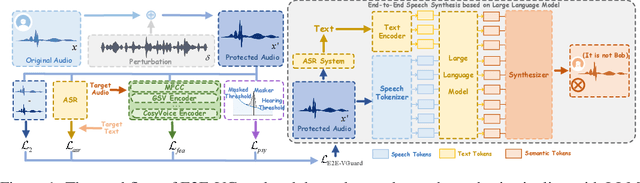
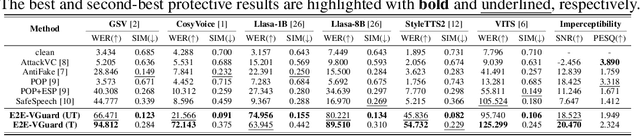

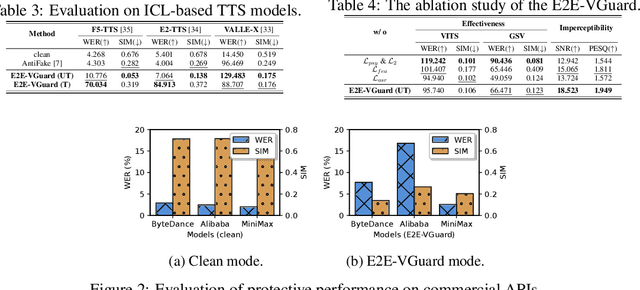
Recent advancements in speech synthesis technology have enriched our daily lives, with high-quality and human-like audio widely adopted across real-world applications. However, malicious exploitation like voice-cloning fraud poses severe security risks. Existing defense techniques struggle to address the production large language model (LLM)-based speech synthesis. While previous studies have considered the protection for fine-tuning synthesizers, they assume manually annotated transcripts. Given the labor intensity of manual annotation, end-to-end (E2E) systems leveraging automatic speech recognition (ASR) to generate transcripts are becoming increasingly prevalent, e.g., voice cloning via commercial APIs. Therefore, this E2E speech synthesis also requires new security mechanisms. To tackle these challenges, we propose E2E-VGuard, a proactive defense framework for two emerging threats: (1) production LLM-based speech synthesis, and (2) the novel attack arising from ASR-driven E2E scenarios. Specifically, we employ the encoder ensemble with a feature extractor to protect timbre, while ASR-targeted adversarial examples disrupt pronunciation. Moreover, we incorporate the psychoacoustic model to ensure perturbative imperceptibility. For a comprehensive evaluation, we test 16 open-source synthesizers and 3 commercial APIs across Chinese and English datasets, confirming E2E-VGuard's effectiveness in timbre and pronunciation protection. Real-world deployment validation is also conducted. Our code and demo page are available at https://wxzyd123.github.io/e2e-vguard/.
ALMGuard: Safety Shortcuts and Where to Find Them as Guardrails for Audio-Language Models
Oct 30, 2025Recent advances in Audio-Language Models (ALMs) have significantly improved multimodal understanding capabilities. However, the introduction of the audio modality also brings new and unique vulnerability vectors. Previous studies have proposed jailbreak attacks that specifically target ALMs, revealing that defenses directly transferred from traditional audio adversarial attacks or text-based Large Language Model (LLM) jailbreaks are largely ineffective against these ALM-specific threats. To address this issue, we propose ALMGuard, the first defense framework tailored to ALMs. Based on the assumption that safety-aligned shortcuts naturally exist in ALMs, we design a method to identify universal Shortcut Activation Perturbations (SAPs) that serve as triggers that activate the safety shortcuts to safeguard ALMs at inference time. To better sift out effective triggers while preserving the model's utility on benign tasks, we further propose Mel-Gradient Sparse Mask (M-GSM), which restricts perturbations to Mel-frequency bins that are sensitive to jailbreaks but insensitive to speech understanding. Both theoretical analyses and empirical results demonstrate the robustness of our method against both seen and unseen attacks. Overall, \MethodName reduces the average success rate of advanced ALM-specific jailbreak attacks to 4.6% across four models, while maintaining comparable utility on benign benchmarks, establishing it as the new state of the art. Our code and data are available at https://github.com/WeifeiJin/ALMGuard.
Intriguing Frequency Interpretation of Adversarial Robustness for CNNs and ViTs
Jun 15, 2025Adversarial examples have attracted significant attention over the years, yet understanding their frequency-based characteristics remains insufficient. In this paper, we investigate the intriguing properties of adversarial examples in the frequency domain for the image classification task, with the following key findings. (1) As the high-frequency components increase, the performance gap between adversarial and natural examples becomes increasingly pronounced. (2) The model performance against filtered adversarial examples initially increases to a peak and declines to its inherent robustness. (3) In Convolutional Neural Networks, mid- and high-frequency components of adversarial examples exhibit their attack capabilities, while in Transformers, low- and mid-frequency components of adversarial examples are particularly effective. These results suggest that different network architectures have different frequency preferences and that differences in frequency components between adversarial and natural examples may directly influence model robustness. Based on our findings, we further conclude with three useful proposals that serve as a valuable reference to the AI model security community.
SafeSpeech: Robust and Universal Voice Protection Against Malicious Speech Synthesis
Apr 14, 2025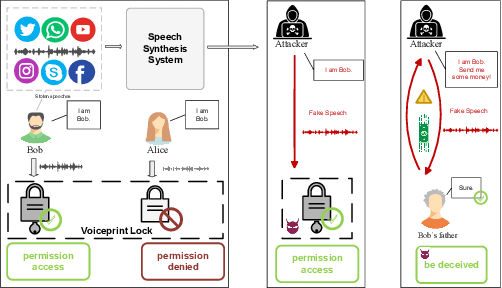
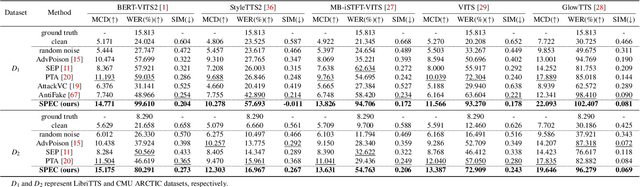
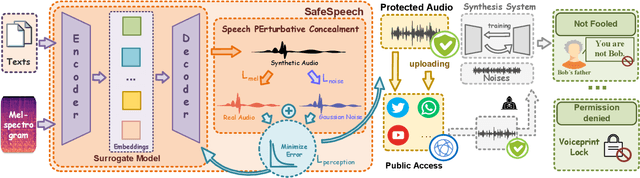

Speech synthesis technology has brought great convenience, while the widespread usage of realistic deepfake audio has triggered hazards. Malicious adversaries may unauthorizedly collect victims' speeches and clone a similar voice for illegal exploitation (\textit{e.g.}, telecom fraud). However, the existing defense methods cannot effectively prevent deepfake exploitation and are vulnerable to robust training techniques. Therefore, a more effective and robust data protection method is urgently needed. In response, we propose a defensive framework, \textit{\textbf{SafeSpeech}}, which protects the users' audio before uploading by embedding imperceptible perturbations on original speeches to prevent high-quality synthetic speech. In SafeSpeech, we devise a robust and universal proactive protection technique, \textbf{S}peech \textbf{PE}rturbative \textbf{C}oncealment (\textbf{SPEC}), that leverages a surrogate model to generate universally applicable perturbation for generative synthetic models. Moreover, we optimize the human perception of embedded perturbation in terms of time and frequency domains. To evaluate our method comprehensively, we conduct extensive experiments across advanced models and datasets, both subjectively and objectively. Our experimental results demonstrate that SafeSpeech achieves state-of-the-art (SOTA) voice protection effectiveness and transferability and is highly robust against advanced adaptive adversaries. Moreover, SafeSpeech has real-time capability in real-world tests. The source code is available at \href{https://github.com/wxzyd123/SafeSpeech}{https://github.com/wxzyd123/SafeSpeech}.
Whispering Under the Eaves: Protecting User Privacy Against Commercial and LLM-powered Automatic Speech Recognition Systems
Apr 01, 2025The widespread application of automatic speech recognition (ASR) supports large-scale voice surveillance, raising concerns about privacy among users. In this paper, we concentrate on using adversarial examples to mitigate unauthorized disclosure of speech privacy thwarted by potential eavesdroppers in speech communications. While audio adversarial examples have demonstrated the capability to mislead ASR models or evade ASR surveillance, they are typically constructed through time-intensive offline optimization, restricting their practicality in real-time voice communication. Recent work overcame this limitation by generating universal adversarial perturbations (UAPs) and enhancing their transferability for black-box scenarios. However, they introduced excessive noise that significantly degrades audio quality and affects human perception, thereby limiting their effectiveness in practical scenarios. To address this limitation and protect live users' speech against ASR systems, we propose a novel framework, AudioShield. Central to this framework is the concept of Transferable Universal Adversarial Perturbations in the Latent Space (LS-TUAP). By transferring the perturbations to the latent space, the audio quality is preserved to a large extent. Additionally, we propose target feature adaptation to enhance the transferability of UAPs by embedding target text features into the perturbations. Comprehensive evaluation on four commercial ASR APIs (Google, Amazon, iFlytek, and Alibaba), three voice assistants, two LLM-powered ASR and one NN-based ASR demonstrates the protection superiority of AudioShield over existing competitors, and both objective and subjective evaluations indicate that AudioShield significantly improves the audio quality. Moreover, AudioShield also shows high effectiveness in real-time end-to-end scenarios, and demonstrates strong resilience against adaptive countermeasures.
Mitigating Unauthorized Speech Synthesis for Voice Protection
Oct 28, 2024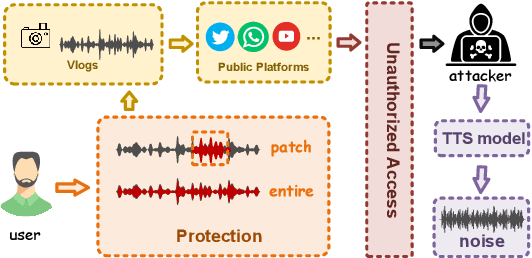


With just a few speech samples, it is possible to perfectly replicate a speaker's voice in recent years, while malicious voice exploitation (e.g., telecom fraud for illegal financial gain) has brought huge hazards in our daily lives. Therefore, it is crucial to protect publicly accessible speech data that contains sensitive information, such as personal voiceprints. Most previous defense methods have focused on spoofing speaker verification systems in timbre similarity but the synthesized deepfake speech is still of high quality. In response to the rising hazards, we devise an effective, transferable, and robust proactive protection technology named Pivotal Objective Perturbation (POP) that applies imperceptible error-minimizing noises on original speech samples to prevent them from being effectively learned for text-to-speech (TTS) synthesis models so that high-quality deepfake speeches cannot be generated. We conduct extensive experiments on state-of-the-art (SOTA) TTS models utilizing objective and subjective metrics to comprehensively evaluate our proposed method. The experimental results demonstrate outstanding effectiveness and transferability across various models. Compared to the speech unclarity score of 21.94% from voice synthesizers trained on samples without protection, POP-protected samples significantly increase it to 127.31%. Moreover, our method shows robustness against noise reduction and data augmentation techniques, thereby greatly reducing potential hazards.
Query-Efficient Video Adversarial Attack with Stylized Logo
Aug 22, 2024Video classification systems based on Deep Neural Networks (DNNs) have demonstrated excellent performance in accurately verifying video content. However, recent studies have shown that DNNs are highly vulnerable to adversarial examples. Therefore, a deep understanding of adversarial attacks can better respond to emergency situations. In order to improve attack performance, many style-transfer-based attacks and patch-based attacks have been proposed. However, the global perturbation of the former will bring unnatural global color, while the latter is difficult to achieve success in targeted attacks due to the limited perturbation space. Moreover, compared to a plethora of methods targeting image classifiers, video adversarial attacks are still not that popular. Therefore, to generate adversarial examples with a low budget and to provide them with a higher verisimilitude, we propose a novel black-box video attack framework, called Stylized Logo Attack (SLA). SLA is conducted through three steps. The first step involves building a style references set for logos, which can not only make the generated examples more natural, but also carry more target class features in the targeted attacks. Then, reinforcement learning (RL) is employed to determine the style reference and position parameters of the logo within the video, which ensures that the stylized logo is placed in the video with optimal attributes. Finally, perturbation optimization is designed to optimize perturbations to improve the fooling rate in a step-by-step manner. Sufficient experimental results indicate that, SLA can achieve better performance than state-of-the-art methods and still maintain good deception effects when facing various defense methods.