 Add to Chrome
 Add to Firefox
 Add to Edge
HiFi-BRep: High-Fidelity Latent Representation for Robust B-Rep Generation
Aug 18, 2026
Boundary representation (B-Rep) generation is a fundamental task in computer-aided design, yet the direct synthesis of high-fidelity and structurally valid B-Reps remains a major challenge. Existing deep generative methods suffer from two forms of brittleness: representation brittleness, caused by padding noise and feature contamination in the latent space, and generation brittleness, stemming from sequential error propagation and a train-inference mismatch due to non-differentiable validity enforcement. We propose HiFi-BRep, a novel framework that addresses these limitations through two synergistic contributions. First, a topology-aware encoder constructs a high-fidelity latent representation by eliminating padding via learnable queries and preventing feature contamination with topology-guided attention. Second, a single-stage decoder jointly predicts geometry and topology in parallel, embedding core manifold constraints as a differentiable learning objective. This design ensures mutual guidance between geometry and topology while avoiding cascaded errors. Extensive experiments show that HiFi-BRep significantly outperforms state-of-the-art methods in both structural validity and geometric fidelity, providing a robust solution for high-quality B-Rep synthesis. Code and models are publicly available at https://github.com/1nnoh/HiFi-BRep.

InCarEmo: A Multimodal Dataset for In-Cabin Emotion Recognition and Driver State Monitoring
Jul 16, 2026Understanding driver emotion and state is critical for the next generation of intelligent in-cabin systems that ensure safety and enhance human-vehicle interaction. However, existing public datasets for in-cabin affective computing are largely limited to visual modalities and rarely include conversational information, making it difficult to capture the linguistic and interactive cues underlying driver emotion. To address these gaps, we introduce InCarEmo, a multimodal dataset for in-cabin emotion recognition and driver state monitoring. InCarEmo integrates RGB and infrared video, in-cabin audio, and dialogue text collected from scripted in-cabin scenarios designed to simulate realistic driver behaviors, covering diverse lighting conditions and driving contexts. The dataset supports three primary tasks: 1) multimodal emotion recognition, 2) fatigue detection, and 3) distraction monitoring. In addition to the original Chinese data, we construct an auxiliary English benchmark to support preliminary cross-lingual evaluation. We provide a unified benchmark with extensive baseline results across unimodal and multimodal methods, including analyses under modality-missing and noise conditions. Experimental results demonstrate the benefits of multimodal fusion and reveal remaining challenges under real-world noise and low-light conditions. By releasing InCarEmo, we aim to establish a comprehensive foundation for robust, interpretable, and human-centric in-cabin affective understanding, promoting safer and more empathetic driver-vehicle interaction.
Benchmarking the CoW with the TopCoW Challenge: Topology-Aware Anatomical Segmentation of the Circle of Willis for CTA and MRA
Dec 29, 2023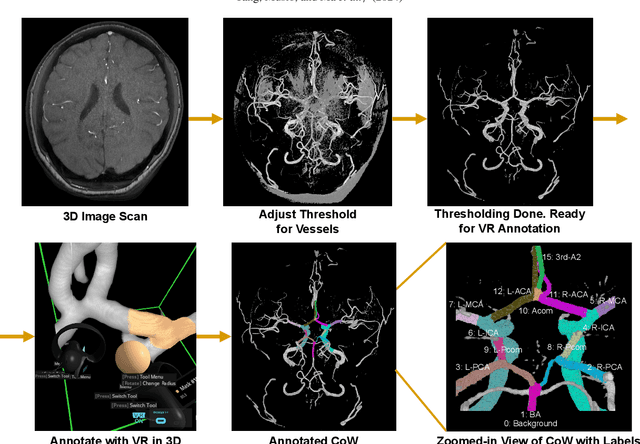
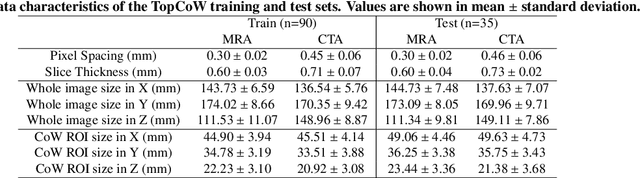
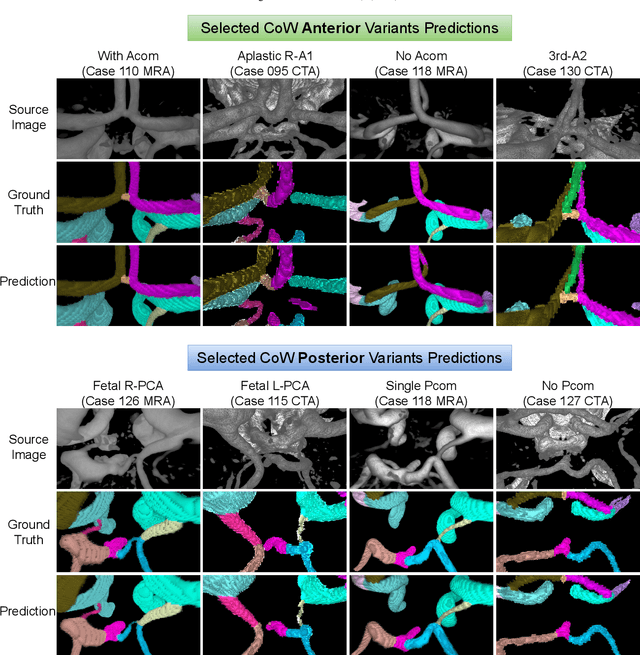
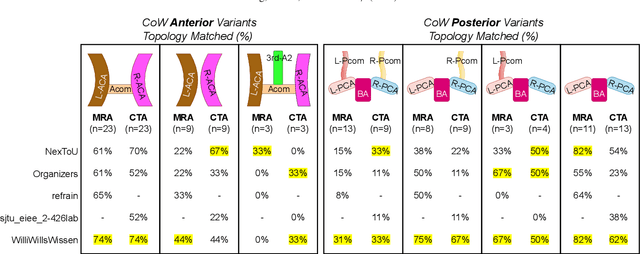
The Circle of Willis (CoW) is an important network of arteries connecting major circulations of the brain. Its vascular architecture is believed to affect the risk, severity, and clinical outcome of serious neuro-vascular diseases. However, characterizing the highly variable CoW anatomy is still a manual and time-consuming expert task. The CoW is usually imaged by two angiographic imaging modalities, magnetic resonance angiography (MRA) and computed tomography angiography (CTA), but there exist limited public datasets with annotations on CoW anatomy, especially for CTA. Therefore we organized the TopCoW Challenge in 2023 with the release of an annotated CoW dataset and invited submissions worldwide for the CoW segmentation task, which attracted over 140 registered participants from four continents. TopCoW dataset was the first public dataset with voxel-level annotations for CoW's 13 vessel components, made possible by virtual-reality (VR) technology. It was also the first dataset with paired MRA and CTA from the same patients. TopCoW challenge aimed to tackle the CoW characterization problem as a multiclass anatomical segmentation task with an emphasis on topological metrics. The top performing teams managed to segment many CoW components to Dice scores around 90%, but with lower scores for communicating arteries and rare variants. There were also topological mistakes for predictions with high Dice scores. Additional topological analysis revealed further areas for improvement in detecting certain CoW components and matching CoW variant's topology accurately. TopCoW represented a first attempt at benchmarking the CoW anatomical segmentation task for MRA and CTA, both morphologically and topologically.
Intergrated Segmentation and Detection Models for Dentex Challenge 2023
Sep 04, 2023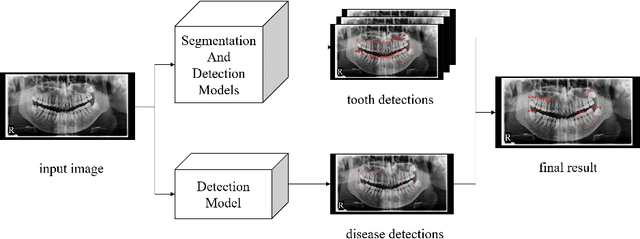
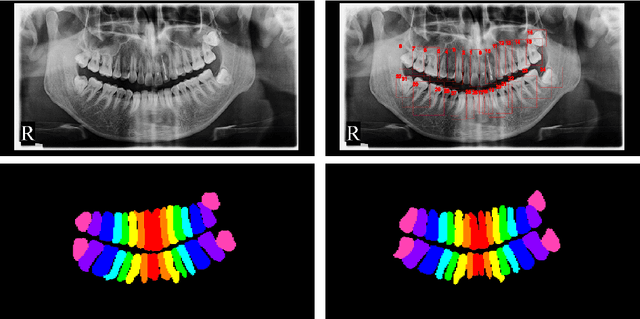
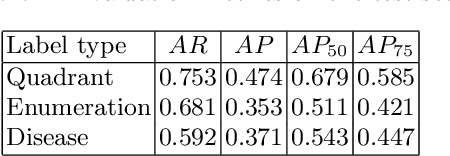
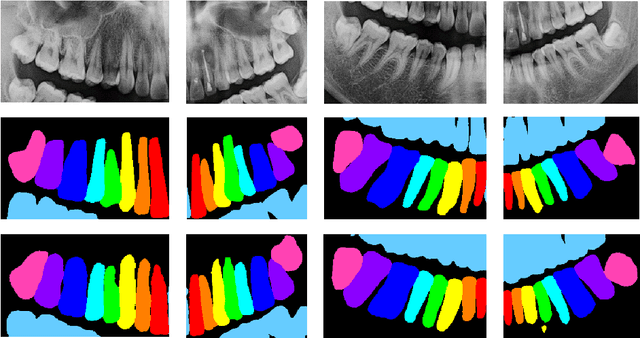
Dental panoramic x-rays are commonly used in dental diagnosing. With the development of deep learning, auto detection of diseases from dental panoramic x-rays can help dentists to diagnose diseases more efficiently.The Dentex Challenge 2023 is a competition for automatic detection of abnormal teeth along with their enumeration ids from dental panoramic x-rays. In this paper, we propose a method integrating segmentation and detection models to detect abnormal teeth as well as obtain their enumeration ids.Our codes are available at https://github.com/xyzlancehe/DentexSegAndDet.
Inferior Alveolar Nerve Segmentation in CBCT images using Connectivity-Based Selective Re-training
Aug 18, 2023


Inferior Alveolar Nerve (IAN) canal detection in CBCT is an important step in many dental and maxillofacial surgery applications to prevent irreversible damage to the nerve during the procedure.The ToothFairy2023 Challenge aims to establish a 3D maxillofacial dataset consisting of all sparse labels and partial dense labels, and improve the ability of automatic IAN segmentation. In this work, in order to avoid the negative impact brought by sparse labeling, we transform the mixed supervised problem into a semi-supervised problem. Inspired by self-training via pseudo labeling, we propose a selective re-training framework based on IAN connectivity. Our method is quantitatively evaluated on the ToothFairy verification cases, achieving the dice similarity coefficient (DSC) of 0.7956, and 95\% hausdorff distance (HD95) of 4.4905, and wining the champion in the competition. Code is available at https://github.com/GaryNico517/SSL-IAN-Retraining.
XVoxel-Based Parametric Design Optimization of Feature Models
Mar 17, 2023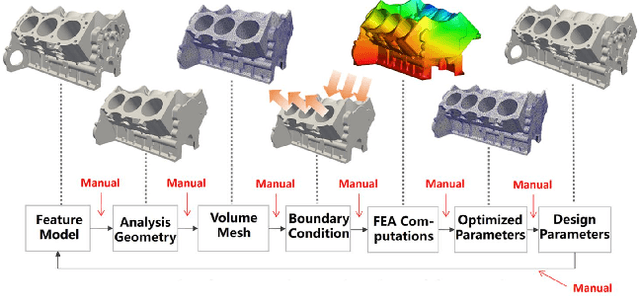
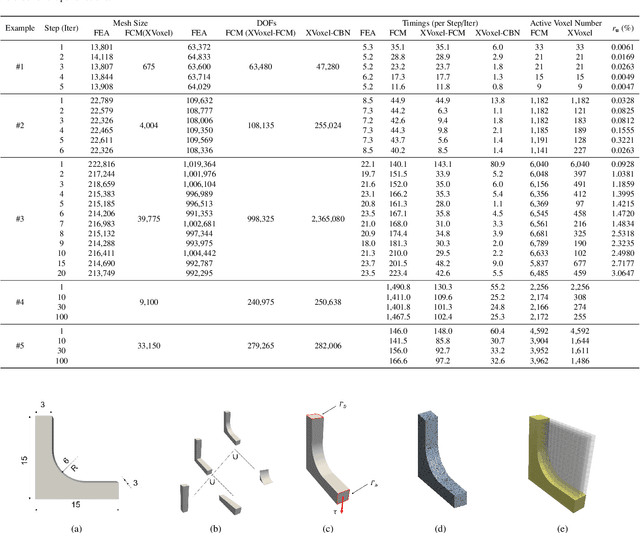
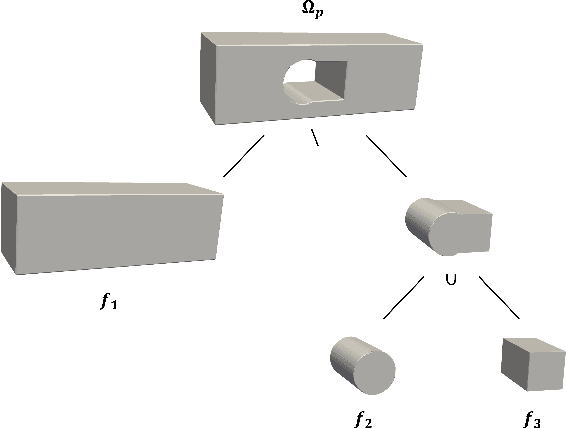

Parametric optimization is an important product design technique, especially in the context of the modern parametric feature-based CAD paradigm. Realizing its full potential, however, requires a closed loop between CAD and CAE (i.e., CAD/CAE integration) with automatic design modifications and simulation updates. Conventionally the approach of model conversion is often employed to form the loop, but this way of working is hard to automate and requires manual inputs. As a result, the overall optimization process is too laborious to be acceptable. To address this issue, a new method for parametric optimization is introduced in this paper, based on a unified model representation scheme called eXtended Voxels (XVoxels). This scheme hybridizes feature models and voxel models into a new concept of semantic voxels, where the voxel part is responsible for FEM solving, and the semantic part is responsible for high-level information to capture both design and simulation intents. As such, it can establish a direct mapping between design models and analysis models, which in turn enables automatic updates on simulation results for design modifications, and vice versa -- effectively a closed loop between CAD and CAE. In addition, robust and efficient geometric algorithms for manipulating XVoxel models and efficient numerical methods (based on the recent finite cell method) for simulating XVoxel models are provided. The presented method has been validated by a series of case studies of increasing complexity to demonstrate its effectiveness. In particular, a computational efficiency improvement of up to 55.8 times the existing FCM method has been seen.
A Multi-Stage Framework for the 2022 Multi-Structure Segmentation for Renal Cancer Treatment
Jul 19, 2022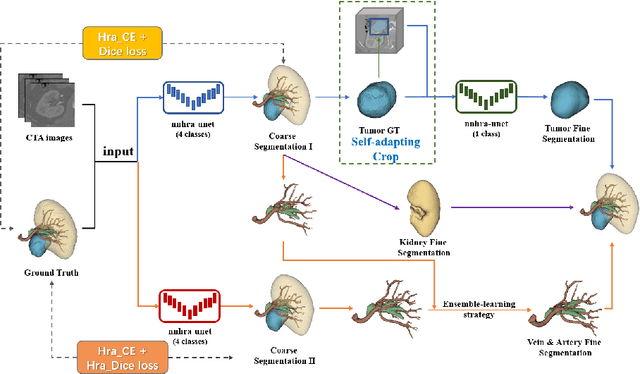
Three-dimensional (3D) kidney parsing on computed tomography angiography (CTA) images is of great clinical significance. Automatic segmentation of kidney, renal tumor, renal vein and renal artery benefits a lot on surgery-based renal cancer treatment. In this paper, we propose a new nnhra-unet network, and use a multi-stage framework which is based on it to segment the multi-structure of kidney and participate in the KiPA2022 challenge.