 Add to Chrome
 Add to Firefox
 Add to Edge
HiFi-BRep: High-Fidelity Latent Representation for Robust B-Rep Generation
Aug 18, 2026
Boundary representation (B-Rep) generation is a fundamental task in computer-aided design, yet the direct synthesis of high-fidelity and structurally valid B-Reps remains a major challenge. Existing deep generative methods suffer from two forms of brittleness: representation brittleness, caused by padding noise and feature contamination in the latent space, and generation brittleness, stemming from sequential error propagation and a train-inference mismatch due to non-differentiable validity enforcement. We propose HiFi-BRep, a novel framework that addresses these limitations through two synergistic contributions. First, a topology-aware encoder constructs a high-fidelity latent representation by eliminating padding via learnable queries and preventing feature contamination with topology-guided attention. Second, a single-stage decoder jointly predicts geometry and topology in parallel, embedding core manifold constraints as a differentiable learning objective. This design ensures mutual guidance between geometry and topology while avoiding cascaded errors. Extensive experiments show that HiFi-BRep significantly outperforms state-of-the-art methods in both structural validity and geometric fidelity, providing a robust solution for high-quality B-Rep synthesis. Code and models are publicly available at https://github.com/1nnoh/HiFi-BRep.

Drawing2CAD: Sequence-to-Sequence Learning for CAD Generation from Vectorized Drawings
Aug 26, 2025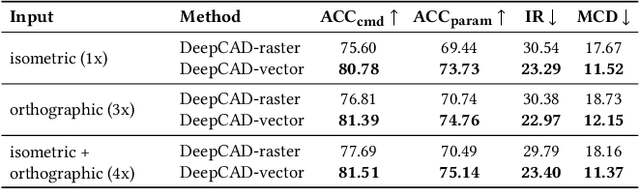
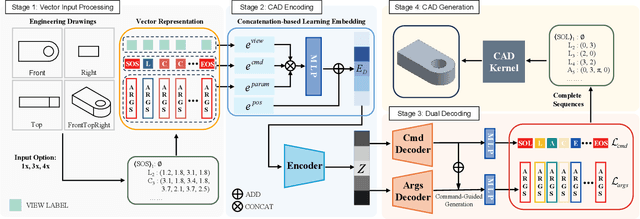
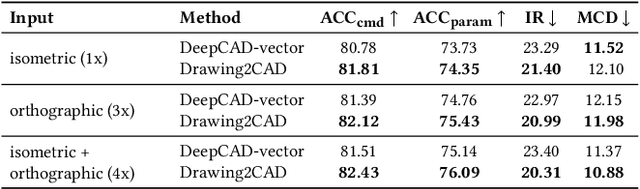
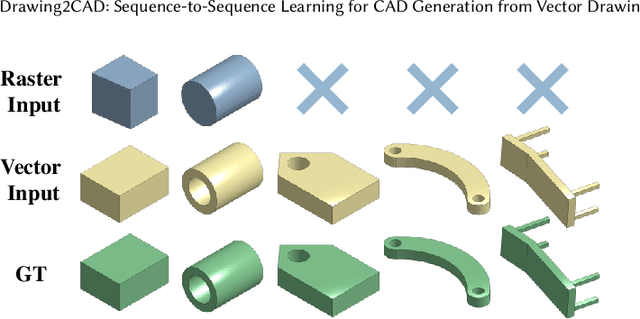
Computer-Aided Design (CAD) generative modeling is driving significant innovations across industrial applications. Recent works have shown remarkable progress in creating solid models from various inputs such as point clouds, meshes, and text descriptions. However, these methods fundamentally diverge from traditional industrial workflows that begin with 2D engineering drawings. The automatic generation of parametric CAD models from these 2D vector drawings remains underexplored despite being a critical step in engineering design. To address this gap, our key insight is to reframe CAD generation as a sequence-to-sequence learning problem where vector drawing primitives directly inform the generation of parametric CAD operations, preserving geometric precision and design intent throughout the transformation process. We propose Drawing2CAD, a framework with three key technical components: a network-friendly vector primitive representation that preserves precise geometric information, a dual-decoder transformer architecture that decouples command type and parameter generation while maintaining precise correspondence, and a soft target distribution loss function accommodating inherent flexibility in CAD parameters. To train and evaluate Drawing2CAD, we create CAD-VGDrawing, a dataset of paired engineering drawings and parametric CAD models, and conduct thorough experiments to demonstrate the effectiveness of our method. Code and dataset are available at https://github.com/lllssc/Drawing2CAD.