 Add to Chrome
 Add to Firefox
 Add to Edge
ERNIE 5.0 Technical Report
Feb 04, 2026
In this report, we introduce ERNIE 5.0, a natively autoregressive foundation model desinged for unified multimodal understanding and generation across text, image, video, and audio. All modalities are trained from scratch under a unified next-group-of-tokens prediction objective, based on an ultra-sparse mixture-of-experts (MoE) architecture with modality-agnostic expert routing. To address practical challenges in large-scale deployment under diverse resource constraints, ERNIE 5.0 adopts a novel elastic training paradigm. Within a single pre-training run, the model learns a family of sub-models with varying depths, expert capacities, and routing sparsity, enabling flexible trade-offs among performance, model size, and inference latency in memory- or time-constrained scenarios. Moreover, we systematically address the challenges of scaling reinforcement learning to unified foundation models, thereby guaranteeing efficient and stable post-training under ultra-sparse MoE architectures and diverse multimodal settings. Extensive experiments demonstrate that ERNIE 5.0 achieves strong and balanced performance across multiple modalities. To the best of our knowledge, among publicly disclosed models, ERNIE 5.0 represents the first production-scale realization of a trillion-parameter unified autoregressive model that supports both multimodal understanding and generation. To facilitate further research, we present detailed visualizations of modality-agnostic expert routing in the unified model, alongside comprehensive empirical analysis of elastic training, aiming to offer profound insights to the community.

AgriGPT: a Large Language Model Ecosystem for Agriculture
Aug 12, 2025
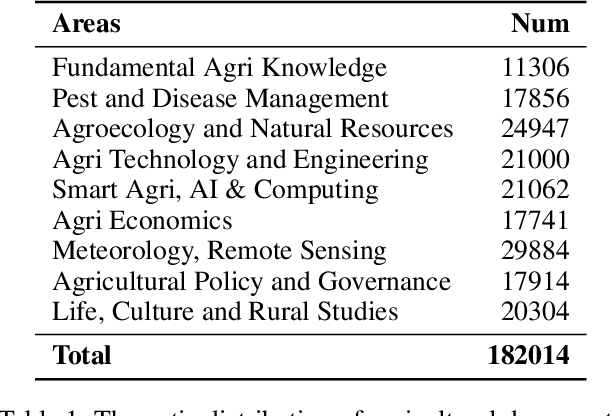
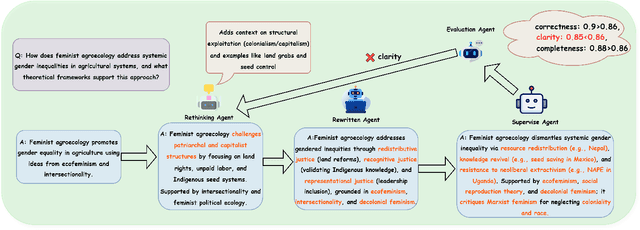
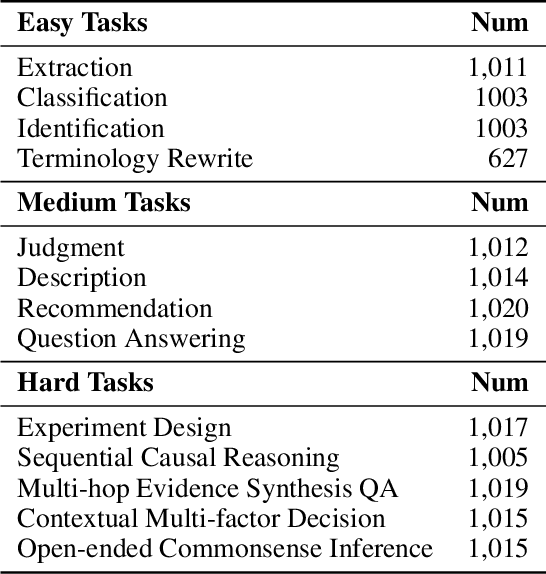
Despite the rapid progress of Large Language Models (LLMs), their application in agriculture remains limited due to the lack of domain-specific models, curated datasets, and robust evaluation frameworks. To address these challenges, we propose AgriGPT, a domain-specialized LLM ecosystem for agricultural usage. At its core, we design a multi-agent scalable data engine that systematically compiles credible data sources into Agri-342K, a high-quality, standardized question-answer (QA) dataset. Trained on this dataset, AgriGPT supports a broad range of agricultural stakeholders, from practitioners to policy-makers. To enhance factual grounding, we employ Tri-RAG, a three-channel Retrieval-Augmented Generation framework combining dense retrieval, sparse retrieval, and multi-hop knowledge graph reasoning, thereby improving the LLM's reasoning reliability. For comprehensive evaluation, we introduce AgriBench-13K, a benchmark suite comprising 13 tasks with varying types and complexities. Experiments demonstrate that AgriGPT significantly outperforms general-purpose LLMs on both domain adaptation and reasoning. Beyond the model itself, AgriGPT represents a modular and extensible LLM ecosystem for agriculture, comprising structured data construction, retrieval-enhanced generation, and domain-specific evaluation. This work provides a generalizable framework for developing scientific and industry-specialized LLMs. All models, datasets, and code will be released to empower agricultural communities, especially in underserved regions, and to promote open, impactful research.