 Add to Chrome
 Add to Firefox
 Add to Edge
FairJudge: An Adaptive, Debiased, and Consistent LLM-as-a-Judge
Feb 06, 2026
Existing LLM-as-a-Judge systems suffer from three fundamental limitations: limited adaptivity to task- and domain-specific evaluation criteria, systematic biases driven by non-semantic cues such as position, length, format, and model provenance, and evaluation inconsistency that leads to contradictory judgments across different evaluation modes (e.g., pointwise versus pairwise). To address these issues, we propose FairJudge, an adaptive, debiased, and consistent LLM-as-a-Judge. Unlike prior approaches that treat the judge as a static evaluator, FairJudge models judging behavior itself as a learnable and regularized policy. From a data-centric perspective, we construct a high-information-density judging dataset that explicitly injects supervision signals aligned with evaluation behavior. Building on this dataset, we adopt a curriculum-style SFT-DPO-GRPO training paradigm that progressively aligns rubric adherence, bias mitigation, and cross-mode consistency, while avoiding catastrophic forgetting. Experimental results on multiple internal and public benchmarks show that FairJudge consistently improves agreement and F1, reduces non-semantic biases, and outperforms substantially larger instruction-tuned LLMs. All resources will be publicly released after acceptance to facilitate future research.

ZPD Detector: Data Selection via Capability-Difficulty Alignment for Large Language Models
Jan 16, 2026As the cost of training large language models continues to increase and high-quality training data become increasingly scarce, selecting high-value samples or synthesizing effective training data under limited data budgets has emerged as a critical research problem. Most existing data selection methods rely on static criteria, such as difficulty, uncertainty, or heuristics, and fail to model the evolving relationship between the model and the data. Inspired by the educational theory of the Zone of Proximal Development (ZPD), we propose ZPD Detector, a data selection framework that adopts a bidirectional perspective between models and data by explicitly modeling the alignment between sample difficulty and the model's current capability. ZPD Detector integrates difficulty calibration, model capability estimation based on Item Response Theory (IRT), and a capability-difficulty matching score to dynamically identify the most informative samples at each learning stage, improving data utilization efficiency; moreover, this dynamic matching strategy provides new insights into training strategy design. All code and data will be released after our work be accepted to support reproducible researc
AgriAgent: Contract-Driven Planning and Capability-Aware Tool Orchestration in Real-World Agriculture
Jan 13, 2026Intelligent agent systems in real-world agricultural scenarios must handle diverse tasks under multimodal inputs, ranging from lightweight information understanding to complex multi-step execution. However, most existing approaches rely on a unified execution paradigm, which struggles to accommodate large variations in task complexity and incomplete tool availability commonly observed in agricultural environments. To address this challenge, we propose AgriAgent, a two-level agent framework for real-world agriculture. AgriAgent adopts a hierarchical execution strategy based on task complexity: simple tasks are handled through direct reasoning by modality-specific agents, while complex tasks trigger a contract-driven planning mechanism that formulates tasks as capability requirements and performs capability-aware tool orchestration and dynamic tool generation, enabling multi-step and verifiable execution with failure recovery. Experimental results show that AgriAgent achieves higher execution success rates and robustness on complex tasks compared to existing tool-centric agent baselines that rely on unified execution paradigms. All code, data will be released at after our work be accepted to promote reproducible research.
AgriGPT-Omni: A Unified Speech-Vision-Text Framework for Multilingual Agricultural Intelligence
Dec 11, 2025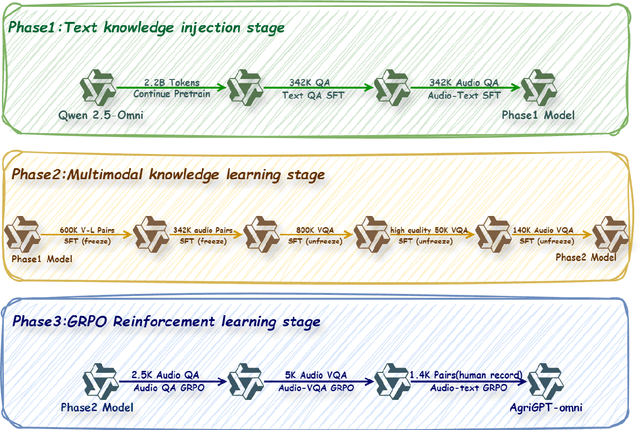
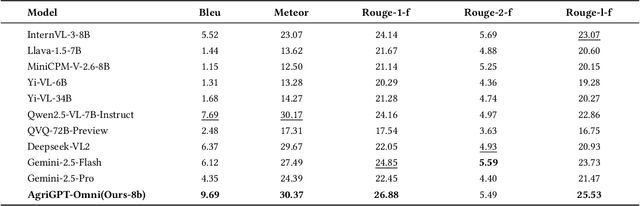
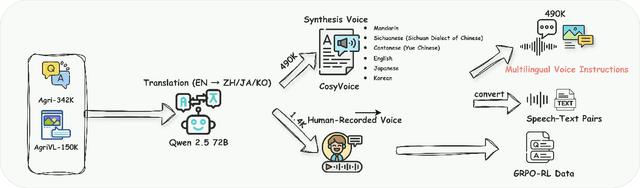
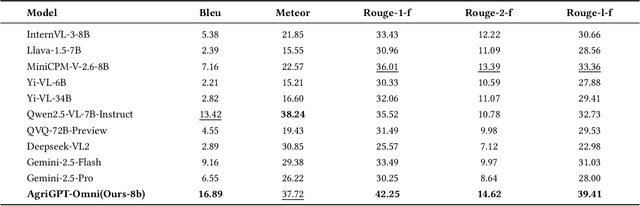
Despite rapid advances in multimodal large language models, agricultural applications remain constrained by the lack of multilingual speech data, unified multimodal architectures, and comprehensive evaluation benchmarks. To address these challenges, we present AgriGPT-Omni, an agricultural omni-framework that integrates speech, vision, and text in a unified framework. First, we construct a scalable data synthesis and collection pipeline that converts agricultural texts and images into training data, resulting in the largest agricultural speech dataset to date, including 492K synthetic and 1.4K real speech samples across six languages. Second, based on this, we train the first agricultural omni-model via a three-stage paradigm: textual knowledge injection, progressive multimodal alignment, and GRPO-based reinforcement learning, enabling unified reasoning across languages and modalities. Third, we propose AgriBench-Omni-2K, the first tri-modal benchmark for agriculture, covering diverse speech-vision-text tasks and multilingual slices, with standardized protocols and reproducible tools. Experiments show that AgriGPT-Omni significantly outperforms general-purpose baselines on multilingual and multimodal reasoning as well as real-world speech understanding. All models, data, benchmarks, and code will be released to promote reproducible research, inclusive agricultural intelligence, and sustainable AI development for low-resource regions.
AgriGPT: a Large Language Model Ecosystem for Agriculture
Aug 12, 2025
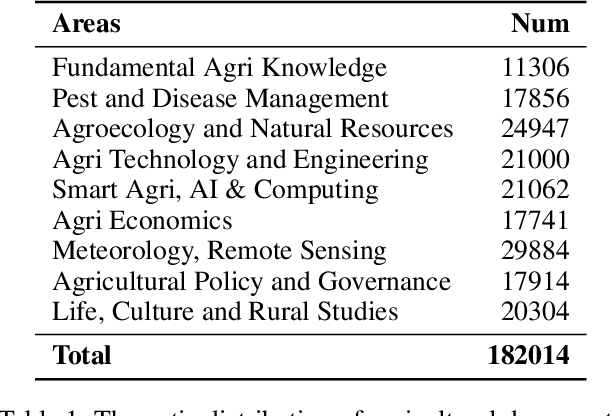
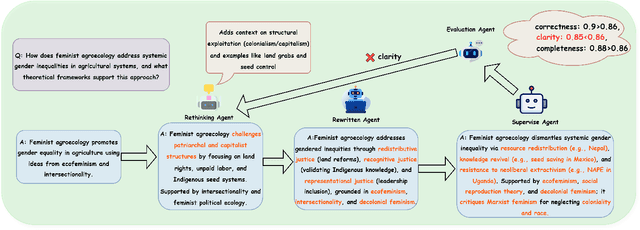
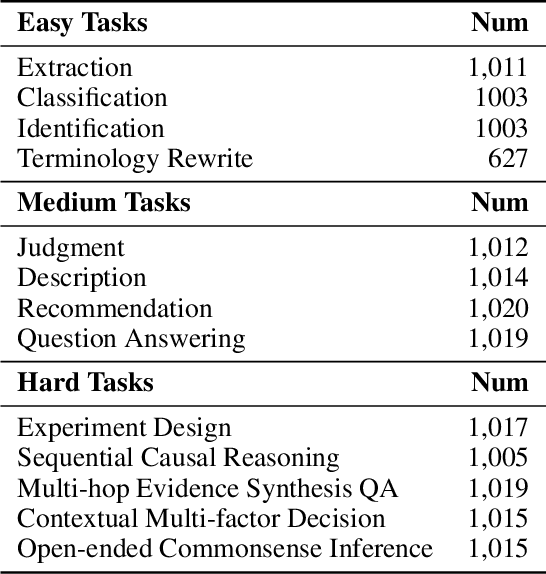
Despite the rapid progress of Large Language Models (LLMs), their application in agriculture remains limited due to the lack of domain-specific models, curated datasets, and robust evaluation frameworks. To address these challenges, we propose AgriGPT, a domain-specialized LLM ecosystem for agricultural usage. At its core, we design a multi-agent scalable data engine that systematically compiles credible data sources into Agri-342K, a high-quality, standardized question-answer (QA) dataset. Trained on this dataset, AgriGPT supports a broad range of agricultural stakeholders, from practitioners to policy-makers. To enhance factual grounding, we employ Tri-RAG, a three-channel Retrieval-Augmented Generation framework combining dense retrieval, sparse retrieval, and multi-hop knowledge graph reasoning, thereby improving the LLM's reasoning reliability. For comprehensive evaluation, we introduce AgriBench-13K, a benchmark suite comprising 13 tasks with varying types and complexities. Experiments demonstrate that AgriGPT significantly outperforms general-purpose LLMs on both domain adaptation and reasoning. Beyond the model itself, AgriGPT represents a modular and extensible LLM ecosystem for agriculture, comprising structured data construction, retrieval-enhanced generation, and domain-specific evaluation. This work provides a generalizable framework for developing scientific and industry-specialized LLMs. All models, datasets, and code will be released to empower agricultural communities, especially in underserved regions, and to promote open, impactful research.