 Add to Chrome
 Add to Firefox
 Add to Edge
HounsWorld: A Multimodal World Model for Hidden Patient-State Readout, Reconstruction, and Simulation
Aug 13, 2026
Clinical intelligence requires estimating a patient's underlying condition from incomplete observations rather than learning isolated mappings from scans to answers. Volumetric medical images provide dense observations of anatomy, attenuation, and lesions, whereas clinical language provides sparse but complementary semantic observations. We formulate CT-centered intelligence as inference over a shared latent patient state, under which readout, reconstruction, and simulation all become state-dependent prediction problems. To operationalize this view, we introduce HounsBench, a computed tomography (CT) centric patient-state benchmark that unifies these three task families with patient-disjoint splits and per-family metrics, and HounsWorld, a 3B multimodal world model that treats volumetric scans and language as observations of the shared state through Joint Understanding-Generation Learning. A shared transformer forms an implicit patient-state estimate and supports three outputs: query-conditioned answers that read out the state, reports and captions that reconstruct it in language, and condition-specific CT volumes for low-dose denoising, virtual contrast enhancement, and anatomy-constrained text-and-mask-to-volume generation. Zero-initialized CT adapters preserve pretrained multimodal mappings, while condition-explicit Hounsfield-unit window sampling exposes clinically meaningful density observations. HounsWorld shows strong performance across all three task families while consistently improving CT understanding through clinically structured completion. Our project is available at https://github.com/byhwhite/HounsWorld.git

TrustMargin: Training-Free Arbitration between Parametric Memory and Retrieved Evidence in Large Language Models
Jun 07, 2026Large language models answer knowledge-intensive questions using both parametric memory and retrieved evidence, but neither source is uniformly reliable. Retrieval can fill knowledge gaps, yet distracting passages may override correct closed-book answers. We study this post-generation conflict as answer-level source arbitration: given Direct and RAG answers from the same frozen model, decide which source to trust. We propose TRUSTMARGIN, a training-free, plug-and-play arbitration layer that scores the two existing candidates with the model's own likelihoods. It combines a parametric-prior margin, which tests whether memory accepts the retrieved answer, with an evidence-binding margin, which discounts passage-only salience and measures question-specific support. TRUSTMARGIN selects between Direct and RAG without fine-tuning, external judges, or additional generation. Across 2WIKIMQA and CWQA with three LLaMA scales, TRUSTMARGIN consistently improves over Direct generation and BM25-RAG, recovers part of the Direct/RAG oracle gap, and generalizes to multiple training-free RAG pipelines.
Edit Where You Mean: Region-Aware Adapter Injection for Mask-Free Local Image Editing
Apr 26, 2026Large diffusion transformers (DiTs) follow global editing instructions well but consistently leak local edits into unrelated regions, because joint-attention architectures offer no explicit channel telling the network where to apply the edit. We introduce REDEdit, a co-trained, instruction- and region-aware adapter framework that retrofits a frozen DiT into a precise local editor without modifying its backbone weights. A lightweight Block Adapter at every transformer block injects a structured condition stream that factorizes what to edit (instruction semantics) from where to edit (spatial mask); a learned SpatialGate routes the adapter signal selectively into the edit region while keeping the rest of the image near-identical to the source; and a Region-Aware Loss focuses the training objective on the changing pixels. Because these components make the backbone's internal representation mask-aware end-to-end, a thin MaskPredictor head trained jointly with the editor can ground the edit region directly from the instruction and source image eliminating any user-mask requirement at deployment. We evaluate on two complementary benchmarks: MagicBrush (paired ground-truth targets) to measure pixel-level preservation and edit accuracy, and Emu-Edit Test (no ground-truth images, 9 diverse edit categories) to stress-test instruction following and generalization across edit types. On both, REDEdit achieves state-of-the-art results, simultaneously outperforming mask-free and oracle-mask baselines. A seven-variant ablation cleanly isolates the contribution of each component.
EditCaption: Human-Aligned Instruction Synthesis for Image Editing via Supervised Fine-Tuning and Direct Preference Optimization
Apr 09, 2026High-quality training triplets (source-target image pairs with precise editing instructions) are a critical bottleneck for scaling instruction-guided image editing models. Vision-language models (VLMs) are widely used for automated instruction synthesis, but we identify three systematic failure modes in image-pair settings: orientation inconsistency (e.g., left/right confusion), viewpoint ambiguity, and insufficient fine-grained attribute description. Human evaluation shows that over 47% of instructions from strong baseline VLMs contain critical errors unusable for downstream training. We propose EditCaption, a scalable two-stage post-training pipeline for VLM-based instruction synthesis. Stage 1 builds a 100K supervised fine-tuning (SFT) dataset by combining GLM automatic annotation, EditScore-based filtering, and human refinement for spatial, directional, and attribute-level accuracy. Stage 2 collects 10K human preference pairs targeting the three failure modes and applies direct preference optimization (DPO) for alignment beyond SFT alone. On Eval-400, ByteMorph-Bench, and HQ-Edit, fine-tuned Qwen3-VL models outperform open-source baselines; the 235B model reaches 4.712 on Eval-400 (vs. Gemini-3-Pro 4.706, GPT-4.1 4.220, Kimi-K2.5 4.111) and 4.588 on ByteMorph-Bench (vs. Gemini-3-Pro 4.522, GPT-4.1 3.412). Human evaluation shows critical errors falling from 47.75% to 23% and correctness rising from 41.75% to 66%. The work offers a practical path to scalable, human-aligned instruction synthesis for image editing data.
IdGlow: Dynamic Identity Modulation for Multi-Subject Generation
Feb 28, 2026Multi-subject image generation requires seamlessly harmonizing multiple reference identities within a coherent scene. However, existing methods relying on rigid spatial masks or localized attention often struggle with the "stability-plasticity dilemma," particularly failing in tasks that require complex structural deformations, such as identity-preserving age transformation. To address this, we present IdGlow, a mask-free, progressive two-stage framework built upon Flow Matching diffusion models. In the supervised fine-tuning (SFT) stage, we introduce task-adaptive timestep scheduling aligned with diffusion generative dynamics: a linear decay schedule that progressively relaxes constraints for natural group composition, and a temporal gating mechanism that concentrates identity injection within a critical semantic window, successfully preserving adult facial semantics without overriding child-like anatomical structures. To resolve attribute leakage and semantic ambiguity without explicit layout inputs, we further integrate a badcase-driven Vision-Language Model (VLM) for precise, context-aware prompt synthesis. In the second stage, we design a Fine-Grained Group-Level Direct Preference Optimization (DPO) with a weighted margin formulation to simultaneously eliminate multi-subject artifacts, elevate texture harmony, and recalibrate identity fidelity towards real-world distributions. Extensive experiments on two challenging benchmarks -- direct multi-person fusion and age-transformed group generation -- demonstrate that IdGlow fundamentally mitigates the stability-plasticity conflict, achieving a superior Pareto balance between state-of-the-art facial fidelity and commercial-grade aesthetic quality.
FS-MedSAM2: Exploring the Potential of SAM2 for Few-Shot Medical Image Segmentation without Fine-tuning
Sep 06, 2024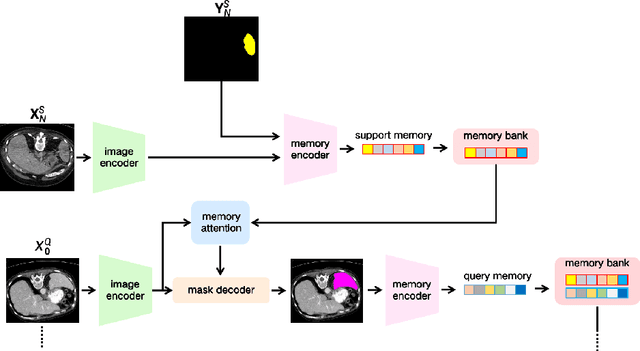


The Segment Anything Model 2 (SAM2) has recently demonstrated exceptional performance in zero-shot prompt segmentation for natural images and videos. However, it faces significant challenges when applied to medical images. Since its release, many attempts have been made to adapt SAM2's segmentation capabilities to the medical imaging domain. These efforts typically involve using a substantial amount of labeled data to fine-tune the model's weights. In this paper, we explore SAM2 from a different perspective via making the full use of its trained memory attention module and its ability of processing mask prompts. We introduce FS-MedSAM2, a simple yet effective framework that enables SAM2 to achieve superior medical image segmentation in a few-shot setting, without the need for fine-tuning. Our framework outperforms the current state-of-the-arts on two publicly available medical image datasets. The code is available at https://github.com/DeepMed-Lab-ECNU/FS_MedSAM2.
Modality-Agnostic Structural Image Representation Learning for Deformable Multi-Modality Medical Image Registration
Feb 29, 2024


Establishing dense anatomical correspondence across distinct imaging modalities is a foundational yet challenging procedure for numerous medical image analysis studies and image-guided radiotherapy. Existing multi-modality image registration algorithms rely on statistical-based similarity measures or local structural image representations. However, the former is sensitive to locally varying noise, while the latter is not discriminative enough to cope with complex anatomical structures in multimodal scans, causing ambiguity in determining the anatomical correspondence across scans with different modalities. In this paper, we propose a modality-agnostic structural representation learning method, which leverages Deep Neighbourhood Self-similarity (DNS) and anatomy-aware contrastive learning to learn discriminative and contrast-invariance deep structural image representations (DSIR) without the need for anatomical delineations or pre-aligned training images. We evaluate our method on multiphase CT, abdomen MR-CT, and brain MR T1w-T2w registration. Comprehensive results demonstrate that our method is superior to the conventional local structural representation and statistical-based similarity measures in terms of discriminability and accuracy.
Bidirectional Copy-Paste for Semi-Supervised Medical Image Segmentation
May 01, 2023In semi-supervised medical image segmentation, there exist empirical mismatch problems between labeled and unlabeled data distribution. The knowledge learned from the labeled data may be largely discarded if treating labeled and unlabeled data separately or in an inconsistent manner. We propose a straightforward method for alleviating the problem - copy-pasting labeled and unlabeled data bidirectionally, in a simple Mean Teacher architecture. The method encourages unlabeled data to learn comprehensive common semantics from the labeled data in both inward and outward directions. More importantly, the consistent learning procedure for labeled and unlabeled data can largely reduce the empirical distribution gap. In detail, we copy-paste a random crop from a labeled image (foreground) onto an unlabeled image (background) and an unlabeled image (foreground) onto a labeled image (background), respectively. The two mixed images are fed into a Student network and supervised by the mixed supervisory signals of pseudo-labels and ground-truth. We reveal that the simple mechanism of copy-pasting bidirectionally between labeled and unlabeled data is good enough and the experiments show solid gains (e.g., over 21% Dice improvement on ACDC dataset with 5% labeled data) compared with other state-of-the-arts on various semi-supervised medical image segmentation datasets. Code is available at https://github.com/DeepMed-Lab-ECNU/BCP}.
MagicNet: Semi-Supervised Multi-Organ Segmentation via Magic-Cube Partition and Recovery
Dec 29, 2022We propose a novel teacher-student model for semi-supervised multi-organ segmentation. In teacher-student model, data augmentation is usually adopted on unlabeled data to regularize the consistent training between teacher and student. We start from a key perspective that fixed relative locations and variable sizes of different organs can provide distribution information where a multi-organ CT scan is drawn. Thus, we treat the prior anatomy as a strong tool to guide the data augmentation and reduce the mismatch between labeled and unlabeled images for semi-supervised learning. More specifically, we propose a data augmentation strategy based on partition-and-recovery N$^3$ cubes cross- and within- labeled and unlabeled images. Our strategy encourages unlabeled images to learn organ semantics in relative locations from the labeled images (cross-branch) and enhances the learning ability for small organs (within-branch). For within-branch, we further propose to refine the quality of pseudo labels by blending the learned representations from small cubes to incorporate local attributes. Our method is termed as MagicNet, since it treats the CT volume as a magic-cube and $N^3$-cube partition-and-recovery process matches with the rule of playing a magic-cube. Extensive experiments on two public CT multi-organ datasets demonstrate the effectiveness of MagicNet, and noticeably outperforms state-of-the-art semi-supervised medical image segmentation approaches, with +7% DSC improvement on MACT dataset with 10% labeled images.