 Add to Chrome
 Add to Firefox
 Add to Edge
A Comprehensive Real-World Assessment of Audio Watermarking Algorithms: Will They Survive Neural Codecs?
May 26, 2025
We present a framework to foster the evaluation of deep learning-based audio watermarking algorithms, establishing a standardized benchmark and allowing systematic comparisons. To simulate real-world usage, we introduce a comprehensive audio attack pipeline, featuring various distortions such as compression, background noise, and reverberation, and propose a diverse test dataset, including speech, environmental sounds, and music recordings. By assessing the performance of four existing watermarking algorithms on our framework, two main insights stand out: (i) neural compression techniques pose the most significant challenge, even when algorithms are trained with such compressions; and (ii) training with audio attacks generally improves robustness, although it is insufficient in some cases. Furthermore, we find that specific distortions, such as polarity inversion, time stretching, or reverb, seriously affect certain algorithms. Our contributions strengthen the robustness and perceptual assessment of audio watermarking algorithms across a wide range of applications, while ensuring a fair and consistent evaluation approach. The evaluation framework, including the attack pipeline, is accessible at github.com/SonyResearch/wm_robustness_eval.

SpecMaskFoley: Steering Pretrained Spectral Masked Generative Transformer Toward Synchronized Video-to-audio Synthesis via ControlNet
May 22, 2025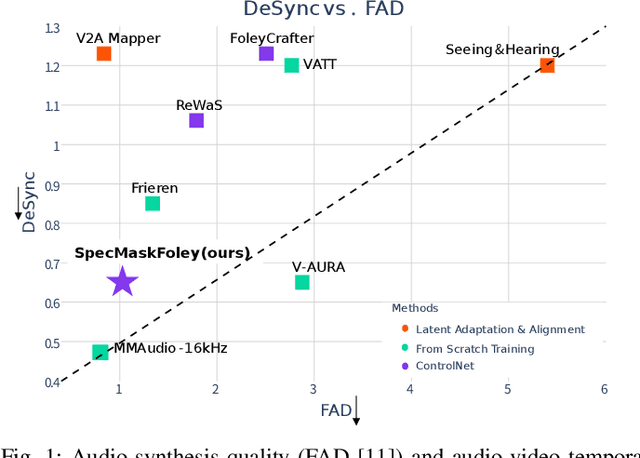
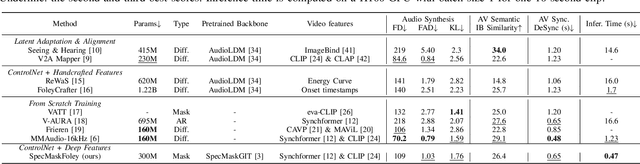
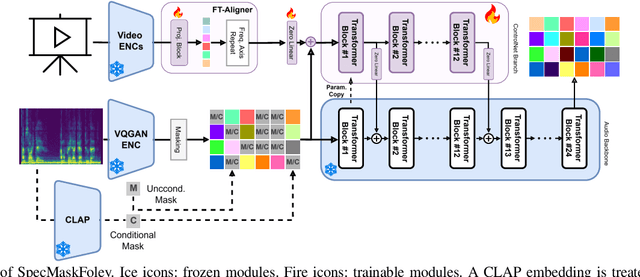
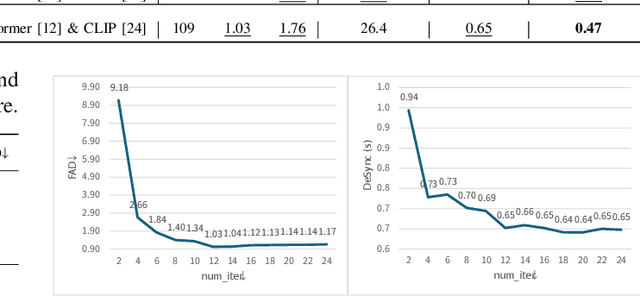
Foley synthesis aims to synthesize high-quality audio that is both semantically and temporally aligned with video frames. Given its broad application in creative industries, the task has gained increasing attention in the research community. To avoid the non-trivial task of training audio generative models from scratch, adapting pretrained audio generative models for video-synchronized foley synthesis presents an attractive direction. ControlNet, a method for adding fine-grained controls to pretrained generative models, has been applied to foley synthesis, but its use has been limited to handcrafted human-readable temporal conditions. In contrast, from-scratch models achieved success by leveraging high-dimensional deep features extracted using pretrained video encoders. We have observed a performance gap between ControlNet-based and from-scratch foley models. To narrow this gap, we propose SpecMaskFoley, a method that steers the pretrained SpecMaskGIT model toward video-synchronized foley synthesis via ControlNet. To unlock the potential of a single ControlNet branch, we resolve the discrepancy between the temporal video features and the time-frequency nature of the pretrained SpecMaskGIT via a frequency-aware temporal feature aligner, eliminating the need for complicated conditioning mechanisms widely used in prior arts. Evaluations on a common foley synthesis benchmark demonstrate that SpecMaskFoley could even outperform strong from-scratch baselines, substantially advancing the development of ControlNet-based foley synthesis models. Demo page: https://zzaudio.github.io/SpecMaskFoley_Demo/
Improving Inference-Time Optimisation for Vocal Effects Style Transfer with a Gaussian Prior
May 16, 2025Style Transfer with Inference-Time Optimisation (ST-ITO) is a recent approach for transferring the applied effects of a reference audio to a raw audio track. It optimises the effect parameters to minimise the distance between the style embeddings of the processed audio and the reference. However, this method treats all possible configurations equally and relies solely on the embedding space, which can lead to unrealistic or biased results. We address this pitfall by introducing a Gaussian prior derived from a vocal preset dataset, DiffVox, over the parameter space. The resulting optimisation is equivalent to maximum-a-posteriori estimation. Evaluations on vocal effects transfer on the MedleyDB dataset show significant improvements across metrics compared to baselines, including a blind audio effects estimator, nearest-neighbour approaches, and uncalibrated ST-ITO. The proposed calibration reduces parameter mean squared error by up to 33% and matches the reference style better. Subjective evaluations with 16 participants confirm our method's superiority, especially in limited data regimes. This work demonstrates how incorporating prior knowledge in inference time enhances audio effects transfer, paving the way for more effective and realistic audio processing systems.
Dyadic Mamba: Long-term Dyadic Human Motion Synthesis
May 14, 2025Generating realistic dyadic human motion from text descriptions presents significant challenges, particularly for extended interactions that exceed typical training sequence lengths. While recent transformer-based approaches have shown promising results for short-term dyadic motion synthesis, they struggle with longer sequences due to inherent limitations in positional encoding schemes. In this paper, we introduce Dyadic Mamba, a novel approach that leverages State-Space Models (SSMs) to generate high-quality dyadic human motion of arbitrary length. Our method employs a simple yet effective architecture that facilitates information flow between individual motion sequences through concatenation, eliminating the need for complex cross-attention mechanisms. We demonstrate that Dyadic Mamba achieves competitive performance on standard short-term benchmarks while significantly outperforming transformer-based approaches on longer sequences. Additionally, we propose a new benchmark for evaluating long-term motion synthesis quality, providing a standardized framework for future research. Our results demonstrate that SSM-based architectures offer a promising direction for addressing the challenging task of long-term dyadic human motion synthesis from text descriptions.
Forging and Removing Latent-Noise Diffusion Watermarks Using a Single Image
Apr 27, 2025Watermarking techniques are vital for protecting intellectual property and preventing fraudulent use of media. Most previous watermarking schemes designed for diffusion models embed a secret key in the initial noise. The resulting pattern is often considered hard to remove and forge into unrelated images. In this paper, we propose a black-box adversarial attack without presuming access to the diffusion model weights. Our attack uses only a single watermarked example and is based on a simple observation: there is a many-to-one mapping between images and initial noises. There are regions in the clean image latent space pertaining to each watermark that get mapped to the same initial noise when inverted. Based on this intuition, we propose an adversarial attack to forge the watermark by introducing perturbations to the images such that we can enter the region of watermarked images. We show that we can also apply a similar approach for watermark removal by learning perturbations to exit this region. We report results on multiple watermarking schemes (Tree-Ring, RingID, WIND, and Gaussian Shading) across two diffusion models (SDv1.4 and SDv2.0). Our results demonstrate the effectiveness of the attack and expose vulnerabilities in the watermarking methods, motivating future research on improving them.
DiffVox: A Differentiable Model for Capturing and Analysing Professional Effects Distributions
Apr 20, 2025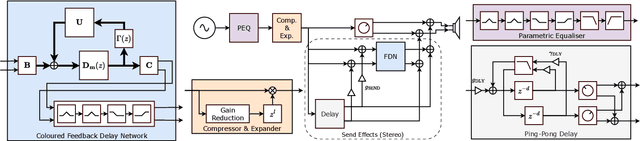
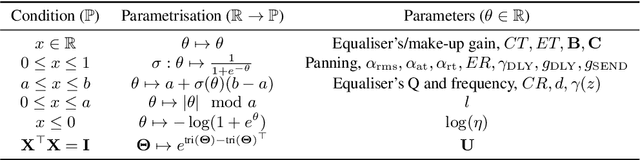
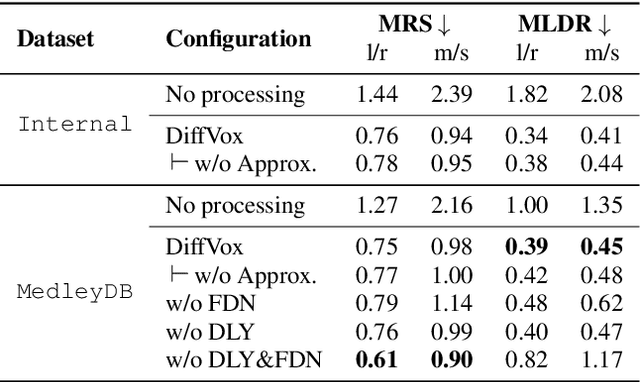
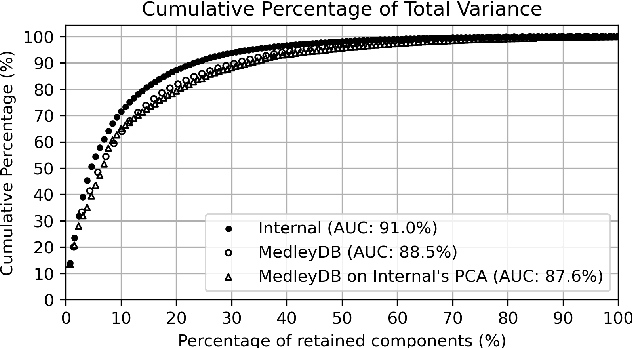
This study introduces a novel and interpretable model, DiffVox, for matching vocal effects in music production. DiffVox, short for ``Differentiable Vocal Fx", integrates parametric equalisation, dynamic range control, delay, and reverb with efficient differentiable implementations to enable gradient-based optimisation for parameter estimation. Vocal presets are retrieved from two datasets, comprising 70 tracks from MedleyDB and 365 tracks from a private collection. Analysis of parameter correlations highlights strong relationships between effects and parameters, such as the high-pass and low-shelf filters often behaving together to shape the low end, and the delay time correlates with the intensity of the delayed signals. Principal component analysis reveals connections to McAdams' timbre dimensions, where the most crucial component modulates the perceived spaciousness while the secondary components influence spectral brightness. Statistical testing confirms the non-Gaussian nature of the parameter distribution, highlighting the complexity of the vocal effects space. These initial findings on the parameter distributions set the foundation for future research in vocal effects modelling and automatic mixing. Our source code and datasets are accessible at https://github.com/SonyResearch/diffvox.
SteerMusic: Enhanced Musical Consistency for Zero-shot Text-Guided and Personalized Music Editing
Apr 15, 2025Music editing is an important step in music production, which has broad applications, including game development and film production. Most existing zero-shot text-guided methods rely on pretrained diffusion models by involving forward-backward diffusion processes for editing. However, these methods often struggle to maintain the music content consistency. Additionally, text instructions alone usually fail to accurately describe the desired music. In this paper, we propose two music editing methods that enhance the consistency between the original and edited music by leveraging score distillation. The first method, SteerMusic, is a coarse-grained zero-shot editing approach using delta denoising score. The second method, SteerMusic+, enables fine-grained personalized music editing by manipulating a concept token that represents a user-defined musical style. SteerMusic+ allows for the editing of music into any user-defined musical styles that cannot be achieved by the text instructions alone. Experimental results show that our methods outperform existing approaches in preserving both music content consistency and editing fidelity. User studies further validate that our methods achieve superior music editing quality. Audio examples are available on https://steermusic.pages.dev/.
D^2USt3R: Enhancing 3D Reconstruction with 4D Pointmaps for Dynamic Scenes
Apr 08, 2025We address the task of 3D reconstruction in dynamic scenes, where object motions degrade the quality of previous 3D pointmap regression methods, such as DUSt3R, originally designed for static 3D scene reconstruction. Although these methods provide an elegant and powerful solution in static settings, they struggle in the presence of dynamic motions that disrupt alignment based solely on camera poses. To overcome this, we propose D^2USt3R that regresses 4D pointmaps that simultaneiously capture both static and dynamic 3D scene geometry in a feed-forward manner. By explicitly incorporating both spatial and temporal aspects, our approach successfully encapsulates spatio-temporal dense correspondence to the proposed 4D pointmaps, enhancing downstream tasks. Extensive experimental evaluations demonstrate that our proposed approach consistently achieves superior reconstruction performance across various datasets featuring complex motions.
CARE: Aligning Language Models for Regional Cultural Awareness
Apr 07, 2025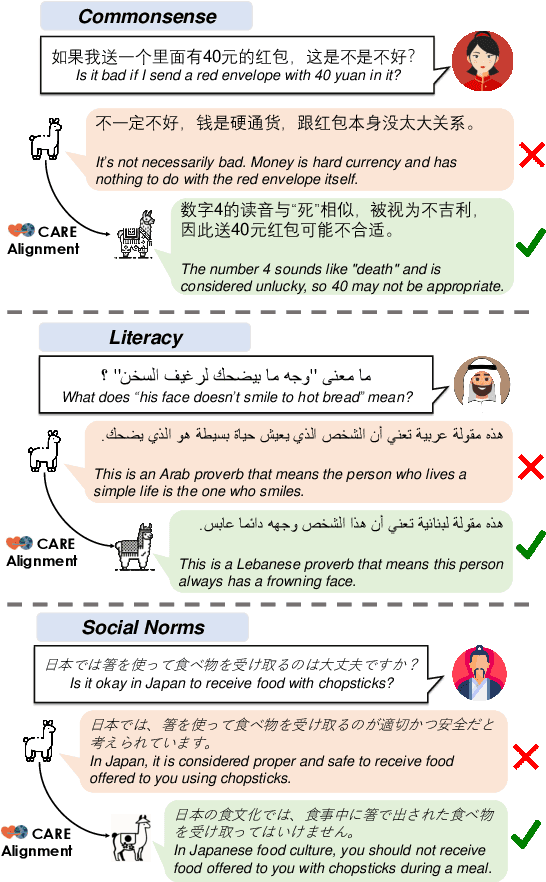
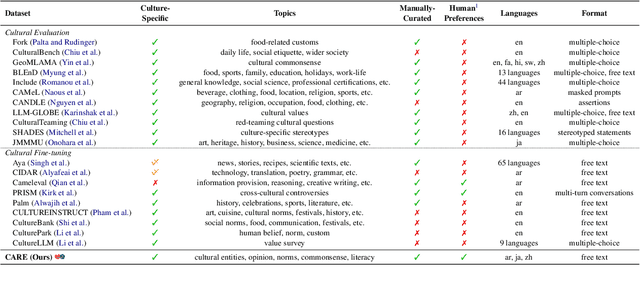
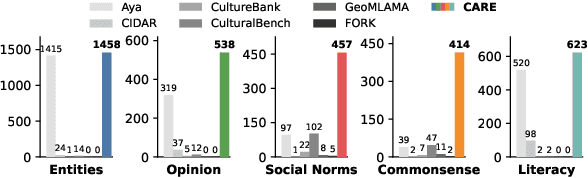
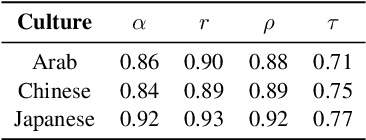
Existing language models (LMs) often exhibit a Western-centric bias and struggle to represent diverse cultural knowledge. Previous attempts to address this rely on synthetic data and express cultural knowledge only in English. In this work, we study whether a small amount of human-written, multilingual cultural preference data can improve LMs across various model families and sizes. We first introduce CARE, a multilingual resource of 24.1k responses with human preferences on 2,580 questions about Chinese and Arab cultures, all carefully annotated by native speakers and offering more balanced coverage. Using CARE, we demonstrate that cultural alignment improves existing LMs beyond generic resources without compromising general capabilities. Moreover, we evaluate the cultural awareness of LMs, native speakers, and retrieved web content when queried in different languages. Our experiment reveals regional disparities among LMs, which may also be reflected in the documentation gap: native speakers often take everyday cultural commonsense and social norms for granted, while non-natives are more likely to actively seek out and document them. CARE is publicly available at https://github.com/Guochry/CARE (we plan to add Japanese data in the near future).
VinaBench: Benchmark for Faithful and Consistent Visual Narratives
Mar 26, 2025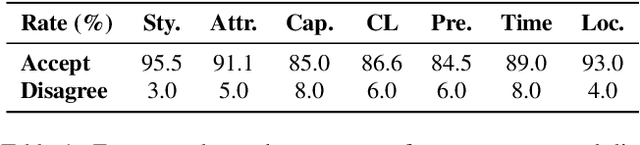
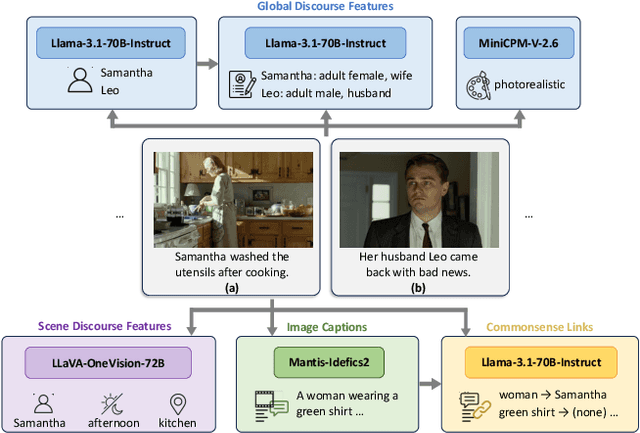
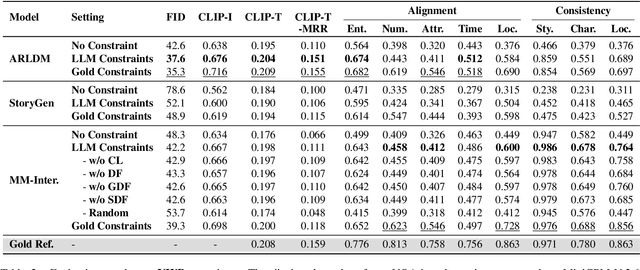
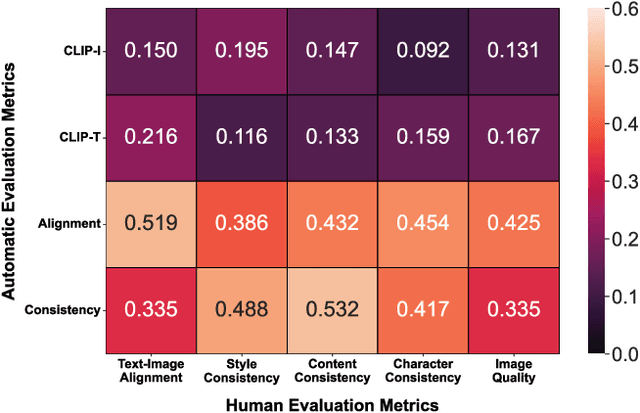
Visual narrative generation transforms textual narratives into sequences of images illustrating the content of the text. However, generating visual narratives that are faithful to the input text and self-consistent across generated images remains an open challenge, due to the lack of knowledge constraints used for planning the stories. In this work, we propose a new benchmark, VinaBench, to address this challenge. Our benchmark annotates the underlying commonsense and discourse constraints in visual narrative samples, offering systematic scaffolds for learning the implicit strategies of visual storytelling. Based on the incorporated narrative constraints, we further propose novel metrics to closely evaluate the consistency of generated narrative images and the alignment of generations with the input textual narrative. Our results across three generative vision models demonstrate that learning with VinaBench's knowledge constraints effectively improves the faithfulness and cohesion of generated visual narratives.