 Add to Chrome
 Add to Firefox
 Add to Edge
MVTrack4Gen: Multi-View Point Tracking as Geometric Supervision for 4D Video Generation
Jun 24, 2026
Synthesizing a novel-view video from a monocular reference video along a target camera trajectory requires both geometric consistency and motion fidelity with respect to the reference video. Existing methods based on explicit 3D representations are limited by the accuracy of off-the-shelf reconstruction modules, which often produce inaccurate geometry for dynamic objects in monocular videos. In contrast, camera-conditioning-only methods can achieve high visual quality but often struggle to preserve geometric and motion consistency. In this work, we introduce MVTrack4Gen (Multi-View point Tracking for Novel-View Generation), a motion-aware training framework that leverages multi-view point tracking as an additional geometric and motion supervision signal for camera-conditioning-only novel-view video diffusion models. Our key finding is that specific attention layers encode strong correspondence cues, where query features attend to key features at geometrically corresponding locations across views and over time, and the misalignment of these correspondences causes motion inconsistency. Based on this observation, we route these features into an auxiliary multi-view tracking head and jointly train the diffusion model with a point-tracking objective. By explicitly strengthening these motion-aware correspondences, MVTrack4Gen improves existing models to better follow the motion in the reference view and maintain cross-view geometric consistency. Across diverse benchmarks, our method achieves state-of-the-art geometric consistency and competitive camera accuracy.

Geometric Action Model for Robot Policy Learning
Jun 15, 2026Generalist robot policies must follow user instructions while reasoning about how objects, cameras, and robot actions interact in the 3D physical world. Recent vision-language-action models (VLAs) and video world-action models (WAMs) inherit strong semantic or temporal priors from large-scale foundation models, but they still operate primarily on 2D image frames or 2D-derived latent spaces, leaving implicit the 3D geometry required for contact-rich manipulation. We propose the Geometric Action Model (GAM), a language-conditioned manipulation policy that directly repurposes a pretrained geometric foundation model (GFM) as a shared substrate for perception, temporal prediction, and action decoding. GAM splits the GFM at an intermediate layer: the shallow layers serve as an observation encoder, and a causal future predictor inserted at the split layer forecasts future latent tokens conditioned on language, proprioception, and action history. The predicted future tokens are then routed through the remaining GFM blocks for feature propagation and decoding, allowing a single backbone to produce both future geometry and actions. This design equips the GFM with language-conditioned temporal world modeling through minimal architectural modification while preserving its rich geometric priors. Across a broad suite of simulation and real-robot manipulation benchmarks, GAM is more accurate, more robust, faster, and lighter than current foundation-model-scale baselines.
Learning Global Motion with Compact Gaussians for Feed-Forward 4D Reconstruction
May 29, 2026Dynamic scene reconstruction from monocular video remains a fundamental challenge in computer vision. Existing feed-forward methods predict 3D Gaussians pixel-wise for each frame, suffering from duplicated Gaussians and view-dependent biases that hinder effective learning of scene motion. We present C4G, a feed-forward 4D reconstruction framework built upon a compact set of timestamp-conditioned learnable Gaussian query tokens. Each token aggregates corresponding features across the full temporal context and decodes a 3D Gaussian whose position is modulated by the target timestamp, enabling globally coherent motion modeling without per-scene optimization. To capture fine-grained details, we further introduce a video diffusion model-based rendering enhancement module. Since our framework effectively aggregates features into Gaussians, we extend this capability to feature lifting, producing a 4D feature field that supports point tracking and dynamic scene understanding. C4G achieves strong novel-view synthesis performance using significantly fewer Gaussians and without requiring camera poses, while exhibiting stronger motion modeling and robustness to large temporal gaps.
TrackCraft3R: Repurposing Video Diffusion Transformers for Dense 3D Tracking
May 12, 2026Dense 3D tracking from monocular video is fundamental to dynamic scene understanding. While recent 3D foundation models provide reliable per-frame geometry, recovering object motion in this geometry remains challenging and benefits from strong motion priors learned from real-world videos. Existing 3D trackers either follow iterative paradigms trained from scratch on synthetic data or fine-tune 3D reconstruction models learned from static multi-view images, both lacking real-world motion priors. Pre-trained video diffusion transformers (video DiTs) offer rich spatio-temporal priors from internet-scale videos, making them a promising foundation for 3D tracking. However, their frame-anchored formulation, which generates each frame's content, is fundamentally mismatched with reference-anchored dense 3D tracking, which must follow the same physical points from a reference frame across time. We present TrackCraft3R, the first method to repurpose a video DiT as a feed-forward dense 3D tracker. Given a monocular video and its frame-anchored reconstruction pointmap, TrackCraft3R predicts a reference-anchored tracking pointmap that follows every pixel of the first frame across time in a single forward pass, along with its visibility. We achieve this through two designs: (i) a dual-latent representation that uses per-frame geometry latents and reference-anchored track latents as dense queries, and (ii) temporal RoPE alignment, which specifies the target timestamp of each track latent. Together, these designs convert the per-frame generative paradigm of video DiTs into a reference-anchored tracking formulation with LoRA fine-tuning. TrackCraft3R achieves state-of-the-art performance on standard sparse and dense 3D tracking benchmarks, while running 1.3x faster and using 4.6x less peak memory than the strongest prior method. We further demonstrate robustness to large motions and long videos.
Entropy-Gradient Grounding: Training-Free Evidence Retrieval in Vision-Language Models
Apr 09, 2026Despite rapid progress, pretrained vision-language models still struggle when answers depend on tiny visual details or on combining clues spread across multiple regions, as in documents and compositional queries. We address this by framing grounding as test-time evidence retrieval: given a query, the model should actively identify where to look next to resolve ambiguity. To this end, we propose a training-free, model-intrinsic grounding method that uses uncertainty as supervision. Specifically, we compute the entropy of the model's next-token distribution and backpropagate it to the visual token embeddings to obtain an entropy-gradient relevance map, without auxiliary detectors or attention-map heuristics. We then extract and rank multiple coherent regions to support multi-evidence queries, and introduce an iterative zoom-and-reground procedure with a spatial-entropy stopping rule to avoid over-refinement. Experiments on seven benchmarks across four VLM architectures demonstrate consistent improvements over existing methods, with the largest gains on detail-critical and high-resolution settings, while also producing more interpretable evidence localizations.
Visual Representation Alignment for Multimodal Large Language Models
Sep 09, 2025Multimodal large language models (MLLMs) trained with visual instruction tuning have achieved strong performance across diverse tasks, yet they remain limited in vision-centric tasks such as object counting or spatial reasoning. We attribute this gap to the prevailing text-only supervision paradigm, which provides only indirect guidance for the visual pathway and often leads MLLMs to discard fine-grained visual details during training. In this paper, we present VIsual Representation ALignment (VIRAL), a simple yet effective regularization strategy that aligns the internal visual representations of MLLMs with those of pre-trained vision foundation models (VFMs). By explicitly enforcing this alignment, VIRAL enables the model not only to retain critical visual details from the input vision encoder but also to complement additional visual knowledge from VFMs, thereby enhancing its ability to reason over complex visual inputs. Our experiments demonstrate consistent improvements across all tasks on widely adopted multimodal benchmarks. Furthermore, we conduct comprehensive ablation studies to validate the key design choices underlying our framework. We believe this simple finding opens up an important direction for the effective integration of visual information in training MLLMs.
Vid-CamEdit: Video Camera Trajectory Editing with Generative Rendering from Estimated Geometry
Jun 16, 2025We introduce Vid-CamEdit, a novel framework for video camera trajectory editing, enabling the re-synthesis of monocular videos along user-defined camera paths. This task is challenging due to its ill-posed nature and the limited multi-view video data for training. Traditional reconstruction methods struggle with extreme trajectory changes, and existing generative models for dynamic novel view synthesis cannot handle in-the-wild videos. Our approach consists of two steps: estimating temporally consistent geometry, and generative rendering guided by this geometry. By integrating geometric priors, the generative model focuses on synthesizing realistic details where the estimated geometry is uncertain. We eliminate the need for extensive 4D training data through a factorized fine-tuning framework that separately trains spatial and temporal components using multi-view image and video data. Our method outperforms baselines in producing plausible videos from novel camera trajectories, especially in extreme extrapolation scenarios on real-world footage.
D^2USt3R: Enhancing 3D Reconstruction with 4D Pointmaps for Dynamic Scenes
Apr 08, 2025We address the task of 3D reconstruction in dynamic scenes, where object motions degrade the quality of previous 3D pointmap regression methods, such as DUSt3R, originally designed for static 3D scene reconstruction. Although these methods provide an elegant and powerful solution in static settings, they struggle in the presence of dynamic motions that disrupt alignment based solely on camera poses. To overcome this, we propose D^2USt3R that regresses 4D pointmaps that simultaneiously capture both static and dynamic 3D scene geometry in a feed-forward manner. By explicitly incorporating both spatial and temporal aspects, our approach successfully encapsulates spatio-temporal dense correspondence to the proposed 4D pointmaps, enhancing downstream tasks. Extensive experimental evaluations demonstrate that our proposed approach consistently achieves superior reconstruction performance across various datasets featuring complex motions.
URECA: Unique Region Caption Anything
Apr 07, 2025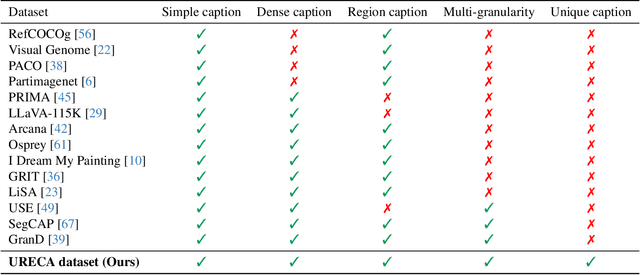
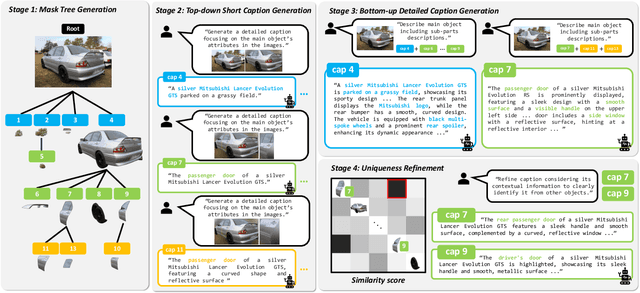
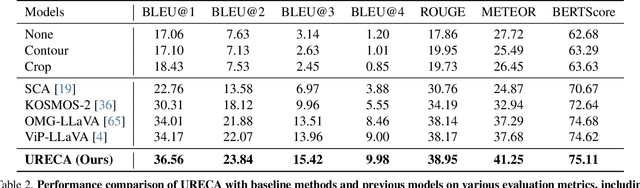
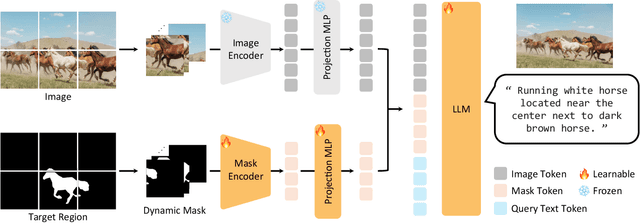
Region-level captioning aims to generate natural language descriptions for specific image regions while highlighting their distinguishing features. However, existing methods struggle to produce unique captions across multi-granularity, limiting their real-world applicability. To address the need for detailed region-level understanding, we introduce URECA dataset, a large-scale dataset tailored for multi-granularity region captioning. Unlike prior datasets that focus primarily on salient objects, URECA dataset ensures a unique and consistent mapping between regions and captions by incorporating a diverse set of objects, parts, and background elements. Central to this is a stage-wise data curation pipeline, where each stage incrementally refines region selection and caption generation. By leveraging Multimodal Large Language Models (MLLMs) at each stage, our pipeline produces distinctive and contextually grounded captions with improved accuracy and semantic diversity. Building upon this dataset, we present URECA, a novel captioning model designed to effectively encode multi-granularity regions. URECA maintains essential spatial properties such as position and shape through simple yet impactful modifications to existing MLLMs, enabling fine-grained and semantically rich region descriptions. Our approach introduces dynamic mask modeling and a high-resolution mask encoder to enhance caption uniqueness. Experiments show that URECA achieves state-of-the-art performance on URECA dataset and generalizes well to existing region-level captioning benchmarks.
Cross-View Completion Models are Zero-shot Correspondence Estimators
Dec 12, 2024In this work, we explore new perspectives on cross-view completion learning by drawing an analogy to self-supervised correspondence learning. Through our analysis, we demonstrate that the cross-attention map within cross-view completion models captures correspondence more effectively than other correlations derived from encoder or decoder features. We verify the effectiveness of the cross-attention map by evaluating on both zero-shot matching and learning-based geometric matching and multi-frame depth estimation. Project page is available at https://cvlab-kaist.github.io/ZeroCo/.