 Add to Chrome
 Add to Firefox
 Add to Edge
SMoA: Spectrum Modulation Adapter for Parameter-Efficient Fine-Tuning
May 20, 2026
As the number of model parameters increases, parameter-efficient fine-tuning (PEFT) has become the go-to choice for tailoring pre-trained large language models. Low-rank Adaptation (LoRA) uses a low-rank update method to simulate full parameter fine-tuning, which is widely used to reduce resource requirements. However, decreasing the rank encounters challenges with limited representational capacity. Theory suggests that LoRA fine-tuning with rank r converges toward the top r singular values of the pre-trained weight matrix. As the rank increases, more principal singular directions are preserved, which generally improves the model's performance. However, a larger rank also introduces more trainable parameters, leading to higher computational cost. To overcome this dilemma, we propose SMoA, a \textbf{S}pectrum \textbf{Mo}dulation \textbf{A}dapter that enlarges the accessible family of spectrum-aware updates under a smaller parameter budget. SMoA partitions the layer into multiple aligned spectral blocks and applies one in-block Hadamard-modulated low-rank branch to each diagonal block, yielding broader coverage of pretrained spectral directions. We provide theoretical analysis and empirical results on multiple tasks. In our experiments, SMoA improves average performance in the current lower-budget setting over LoRA and competitive LoRA-style baselines.

ChunkFT: Byte-Streamed Optimization for Memory-Efficient Full Fine-Tuning
May 20, 2026This work presents \textsc{ChunkFT}, a memory-efficient fine-tuning framework that reformulates full-parameter fine-tuning around a dynamically activated working set. \textsc{ChunkFT} enables gradient computation for arbitrary sub-tensors without modifying the network architecture, providing an algorithmic foundation for optimizing arbitrary sub-networks while avoiding standard dense gradient computation. We provide a theoretical convergence analysis of \textsc{ChunkFT} in the deterministic setting. Empirically, we apply \textsc{ChunkFT} to fine-tune Llama 3-8B and Llama 3-70B using a single RTX 4090-24GB GPU and 2$\times$ H800-80GB GPUs, respectively. Full-parameter fine-tuning of a 7B model with a 1K input length requires only 13.72GB of GPU memory. The results demonstrate the effectiveness of \textsc{ChunkFT} in memory usage, running time, and optimization quality. Moreover, downstream evaluations on language understanding, mathematical reasoning, and MT-Bench show that \textsc{ChunkFT} consistently outperforms existing memory-efficient baselines. Notably, \textsc{ChunkFT} achieves performance comparable to, and in some cases exceeding, full-parameter fine-tuning. Our repository is on https://github.com/misonsky/chunk.
DiM\textsuperscript{3}: Bridging Multilingual and Multimodal Models via Direction- and Magnitude-Aware Merging
May 13, 2026Towards more general and human-like intelligence, large language models should seamlessly integrate both multilingual and multimodal capabilities; however, extending an existing multimodal model to many languages typically requires expensive multilingual multimodal data construction and repeated end-to-end retraining. We study a training-free alternative: injecting multilingual capability into an existing multimodal model by composing residual updates in the shared language model backbone. The key challenge is that multilingual and multimodal updates are heterogeneous, reflecting different functional roles in the shared model. To address this, we propose Direction- and Magnitude-aware Multilingual Multimodal merging (DiM3), which selectively composes the two updates at each parameter dimension while preserving the original vision encoder and multimodal projector. Experiments on multilingual benchmarks in both text-only and vision-language settings, covering 57 languages across LLaVA- and Qwen-based backbones, show that DiM3 consistently outperforms existing merging baselines, substantially improves multilingual performance over the original multimodal model, and remains competitive with dedicated multilingual multimodal fine-tuning while largely retaining general multimodal ability. We further show that DiM3 can be directly applied to already trained multilingual multimodal models and still yield additional gains. Further interpretability analysis shows that DiM3 primarily reshapes intermediate-layer semantic representations, strengthening cross-lingual alignment under both text-only and multimodal inputs while preserving higher-layer task-sensitive structure. Our repository is on https://github.com/wzj1718/DiM3.
Speech-Worthy Alignment for Japanese SpeechLLMs via Direct Preference Optimization
Mar 13, 2026SpeechLLMs typically combine ASR-trained encoders with text-based LLM backbones, leading them to inherit written-style output patterns unsuitable for text-to-speech synthesis. This mismatch is particularly pronounced in Japanese, where spoken and written registers differ substantially in politeness markers, sentence-final particles, and syntactic complexity. We propose a preference-based alignment approach to adapt Japanese SpeechLLMs for speech-worthy outputs: text that is concise, conversational, and readily synthesized as natural speech. To rigorously evaluate this task, we introduce SpokenElyza, a benchmark for Japanese speech-worthiness derived from ELYZA-tasks-100 with auditory verification by native experts. Experiments show that our approach achieves substantial improvement on SpokenElyza while largely preserving performance on the original written-style evaluation. We will release SpokenElyza to support future research on Japanese spoken dialog systems.
Streaming Translation and Transcription Through Speech-to-Text Causal Alignment
Mar 12, 2026Simultaneous machine translation (SiMT) has traditionally relied on offline machine translation models coupled with human-engineered heuristics or learned policies. We propose Hikari, a policy-free, fully end-to-end model that performs simultaneous speech-to-text translation and streaming transcription by encoding READ/WRITE decisions into a probabilistic WAIT token mechanism. We also introduce Decoder Time Dilation, a mechanism that reduces autoregressive overhead and ensures a balanced training distribution. Additionally, we present a supervised fine-tuning strategy that trains the model to recover from delays, significantly improving the quality-latency trade-off. Evaluated on English-to-Japanese, German, and Russian, Hikari achieves new state-of-the-art BLEU scores in both low- and high-latency regimes, outperforming recent baselines.
Deep Whole-body Parkour
Jan 12, 2026Current approaches to humanoid control generally fall into two paradigms: perceptive locomotion, which handles terrain well but is limited to pedal gaits, and general motion tracking, which reproduces complex skills but ignores environmental capabilities. This work unites these paradigms to achieve perceptive general motion control. We present a framework where exteroceptive sensing is integrated into whole-body motion tracking, permitting a humanoid to perform highly dynamic, non-locomotion tasks on uneven terrain. By training a single policy to perform multiple distinct motions across varied terrestrial features, we demonstrate the non-trivial benefit of integrating perception into the control loop. Our results show that this framework enables robust, highly dynamic multi-contact motions, such as vaulting and dive-rolling, on unstructured terrain, significantly expanding the robot's traversability beyond simple walking or running. https://project-instinct.github.io/deep-whole-body-parkour
High-Rank Structured Modulation for Parameter-Efficient Fine-Tuning
Jan 12, 2026As the number of model parameters increases, parameter-efficient fine-tuning (PEFT) has become the go-to choice for tailoring pre-trained large language models. Low-rank Adaptation (LoRA) uses a low-rank update method to simulate full parameter fine-tuning, which is widely used to reduce resource requirements. However, decreasing the rank encounters challenges with limited representational capacity when compared to full parameter fine-tuning. We present \textbf{SMoA}, a high-rank \textbf{S}tructured \textbf{MO}dulation \textbf{A}dapter that uses fewer trainable parameters while maintaining a higher rank, thereby improving the model's representational capacity and offering improved performance potential. The core idea is to freeze the original pretrained weights and selectively amplify or suppress important features of the original weights across multiple subspaces. The subspace mechanism provides an efficient way to increase the capacity and complexity of a model. We conduct both theoretical analyses and empirical studies on various tasks. Experiment results show that SMoA outperforms LoRA and its variants on 10 tasks, with extensive ablation studies validating its effectiveness.
Hiking in the Wild: A Scalable Perceptive Parkour Framework for Humanoids
Jan 12, 2026Achieving robust humanoid hiking in complex, unstructured environments requires transitioning from reactive proprioception to proactive perception. However, integrating exteroception remains a significant challenge: mapping-based methods suffer from state estimation drift; for instance, LiDAR-based methods do not handle torso jitter well. Existing end-to-end approaches often struggle with scalability and training complexity; specifically, some previous works using virtual obstacles are implemented case-by-case. In this work, we present \textit{Hiking in the Wild}, a scalable, end-to-end parkour perceptive framework designed for robust humanoid hiking. To ensure safety and training stability, we introduce two key mechanisms: a foothold safety mechanism combining scalable \textit{Terrain Edge Detection} with \textit{Foot Volume Points} to prevent catastrophic slippage on edges, and a \textit{Flat Patch Sampling} strategy that mitigates reward hacking by generating feasible navigation targets. Our approach utilizes a single-stage reinforcement learning scheme, mapping raw depth inputs and proprioception directly to joint actions, without relying on external state estimation. Extensive field experiments on a full-size humanoid demonstrate that our policy enables robust traversal of complex terrains at speeds up to 2.5 m/s. The training and deployment code is open-sourced to facilitate reproducible research and deployment on real robots with minimal hardware modifications.
Time-Vertex Machine Learning for Optimal Sensor Placement in Temporal Graph Signals: Applications in Structural Health Monitoring
Dec 22, 2025Structural Health Monitoring (SHM) plays a crucial role in maintaining the safety and resilience of infrastructure. As sensor networks grow in scale and complexity, identifying the most informative sensors becomes essential to reduce deployment costs without compromising monitoring quality. While Graph Signal Processing (GSP) has shown promise by leveraging spatial correlations among sensor nodes, conventional approaches often overlook the temporal dynamics of structural behavior. To overcome this limitation, we propose Time-Vertex Machine Learning (TVML), a novel framework that integrates GSP, time-domain analysis, and machine learning to enable interpretable and efficient sensor placement by identifying representative nodes that minimize redundancy while preserving critical information. We evaluate the proposed approach on two bridge datasets for damage detection and time-varying graph signal reconstruction tasks. The results demonstrate the effectiveness of our approach in enhancing SHM systems by providing a robust, adaptive, and efficient solution for sensor placement.
VinaBench: Benchmark for Faithful and Consistent Visual Narratives
Mar 26, 2025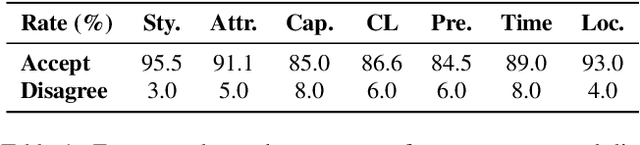
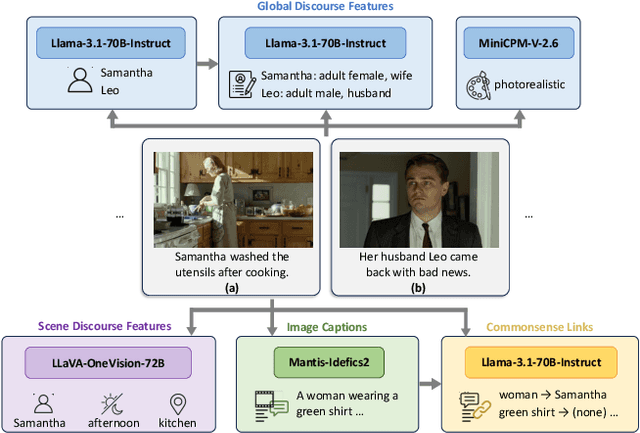
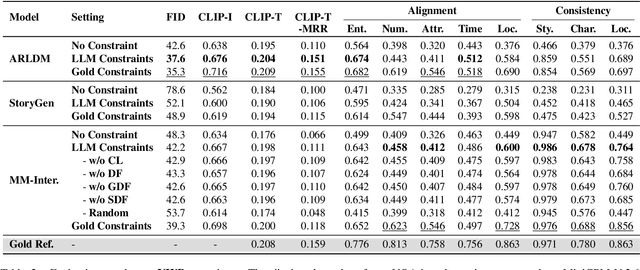
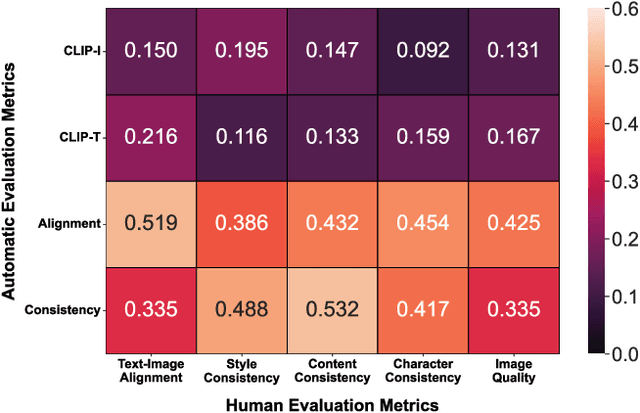
Visual narrative generation transforms textual narratives into sequences of images illustrating the content of the text. However, generating visual narratives that are faithful to the input text and self-consistent across generated images remains an open challenge, due to the lack of knowledge constraints used for planning the stories. In this work, we propose a new benchmark, VinaBench, to address this challenge. Our benchmark annotates the underlying commonsense and discourse constraints in visual narrative samples, offering systematic scaffolds for learning the implicit strategies of visual storytelling. Based on the incorporated narrative constraints, we further propose novel metrics to closely evaluate the consistency of generated narrative images and the alignment of generations with the input textual narrative. Our results across three generative vision models demonstrate that learning with VinaBench's knowledge constraints effectively improves the faithfulness and cohesion of generated visual narratives.