 Add to Chrome
 Add to Firefox
 Add to Edge
FoleyBench: A Benchmark For Video-to-Audio Models
Nov 17, 2025
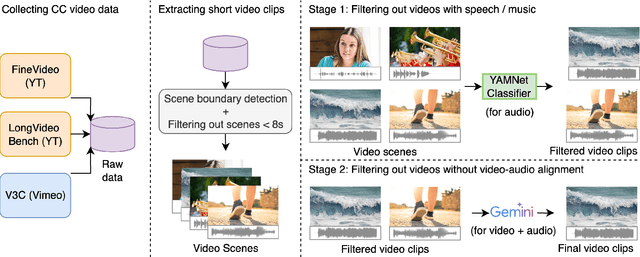
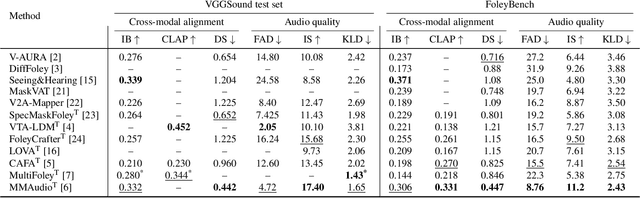
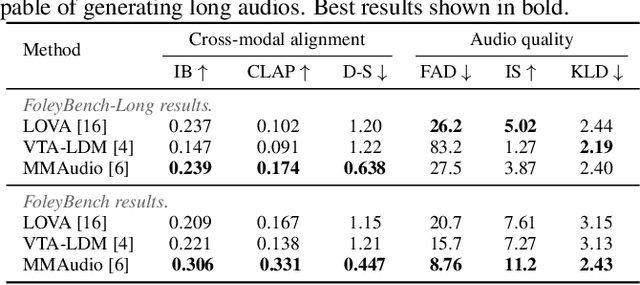
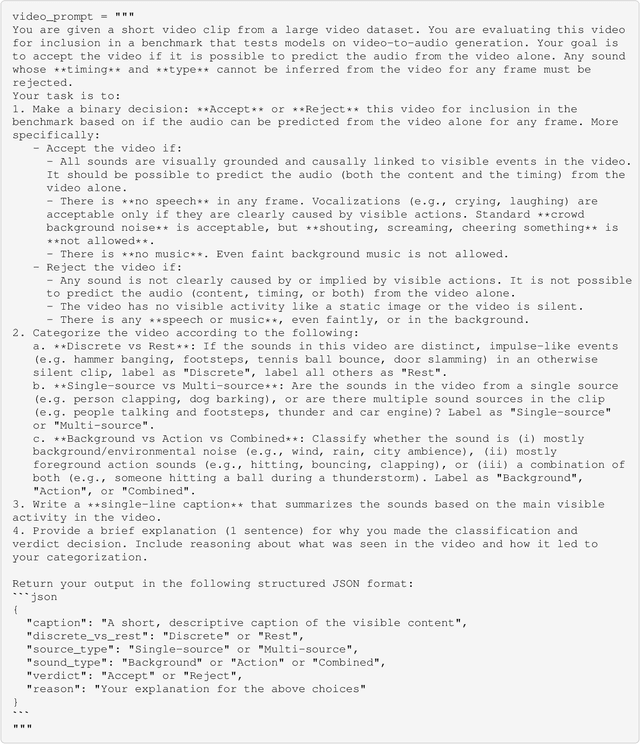
Video-to-audio generation (V2A) is of increasing importance in domains such as film post-production, AR/VR, and sound design, particularly for the creation of Foley sound effects synchronized with on-screen actions. Foley requires generating audio that is both semantically aligned with visible events and temporally aligned with their timing. Yet, there is a mismatch between evaluation and downstream applications due to the absence of a benchmark tailored to Foley-style scenarios. We find that 74% of videos from past evaluation datasets have poor audio-visual correspondence. Moreover, they are dominated by speech and music, domains that lie outside the use case for Foley. To address this gap, we introduce FoleyBench, the first large-scale benchmark explicitly designed for Foley-style V2A evaluation. FoleyBench contains 5,000 (video, ground-truth audio, text caption) triplets, each featuring visible sound sources with audio causally tied to on-screen events. The dataset is built using an automated, scalable pipeline applied to in-the-wild internet videos from YouTube-based and Vimeo-based sources. Compared to past datasets, we show that videos from FoleyBench have stronger coverage of sound categories from a taxonomy specifically designed for Foley sound. Each clip is further labeled with metadata capturing source complexity, UCS/AudioSet category, and video length, enabling fine-grained analysis of model performance and failure modes. We benchmark several state-of-the-art V2A models, evaluating them on audio quality, audio-video alignment, temporal synchronization, and audio-text consistency. Samples are available at: https://gclef-cmu.org/foleybench

MeanFlow Transformers with Representation Autoencoders
Nov 17, 2025MeanFlow (MF) is a diffusion-motivated generative model that enables efficient few-step generation by learning long jumps directly from noise to data. In practice, it is often used as a latent MF by leveraging the pre-trained Stable Diffusion variational autoencoder (SD-VAE) for high-dimensional data modeling. However, MF training remains computationally demanding and is often unstable. During inference, the SD-VAE decoder dominates the generation cost, and MF depends on complex guidance hyperparameters for class-conditional generation. In this work, we develop an efficient training and sampling scheme for MF in the latent space of a Representation Autoencoder (RAE), where a pre-trained vision encoder (e.g., DINO) provides semantically rich latents paired with a lightweight decoder. We observe that naive MF training in the RAE latent space suffers from severe gradient explosion. To stabilize and accelerate training, we adopt Consistency Mid-Training for trajectory-aware initialization and use a two-stage scheme: distillation from a pre-trained flow matching teacher to speed convergence and reduce variance, followed by an optional bootstrapping stage with a one-point velocity estimator to further reduce deviation from the oracle mean flow. This design removes the need for guidance, simplifies training configurations, and reduces computation in both training and sampling. Empirically, our method achieves a 1-step FID of 2.03, outperforming vanilla MF's 3.43, while reducing sampling GFLOPS by 38% and total training cost by 83% on ImageNet 256. We further scale our approach to ImageNet 512, achieving a competitive 1-step FID of 3.23 with the lowest GFLOPS among all baselines. Code is available at https://github.com/sony/mf-rae.
Automatic Music Mixing using a Generative Model of Effect Embeddings
Nov 11, 2025Music mixing involves combining individual tracks into a cohesive mixture, a task characterized by subjectivity where multiple valid solutions exist for the same input. Existing automatic mixing systems treat this task as a deterministic regression problem, thus ignoring this multiplicity of solutions. Here we introduce MEGAMI (Multitrack Embedding Generative Auto MIxing), a generative framework that models the conditional distribution of professional mixes given unprocessed tracks. MEGAMI uses a track-agnostic effects processor conditioned on per-track generated embeddings, handles arbitrary unlabeled tracks through a permutation-equivariant architecture, and enables training on both dry and wet recordings via domain adaptation. Our objective evaluation using distributional metrics shows consistent improvements over existing methods, while listening tests indicate performances approaching human-level quality across diverse musical genres.
Twenty-Five Years of MIR Research: Achievements, Practices, Evaluations, and Future Challenges
Nov 10, 2025In this paper, we trace the evolution of Music Information Retrieval (MIR) over the past 25 years. While MIR gathers all kinds of research related to music informatics, a large part of it focuses on signal processing techniques for music data, fostering a close relationship with the IEEE Audio and Acoustic Signal Processing Technical Commitee. In this paper, we reflect the main research achievements of MIR along the three EDICS related to music analysis, processing and generation. We then review a set of successful practices that fuel the rapid development of MIR research. One practice is the annual research benchmark, the Music Information Retrieval Evaluation eXchange, where participants compete on a set of research tasks. Another practice is the pursuit of reproducible and open research. The active engagement with industry research and products is another key factor for achieving large societal impacts and motivating younger generations of students to join the field. Last but not the least, the commitment to diversity, equity and inclusion ensures MIR to be a vibrant and open community where various ideas, methodologies, and career pathways collide. We finish by providing future challenges MIR will have to face.
Attribution-by-design: Ensuring Inference-Time Provenance in Generative Music Systems
Oct 09, 2025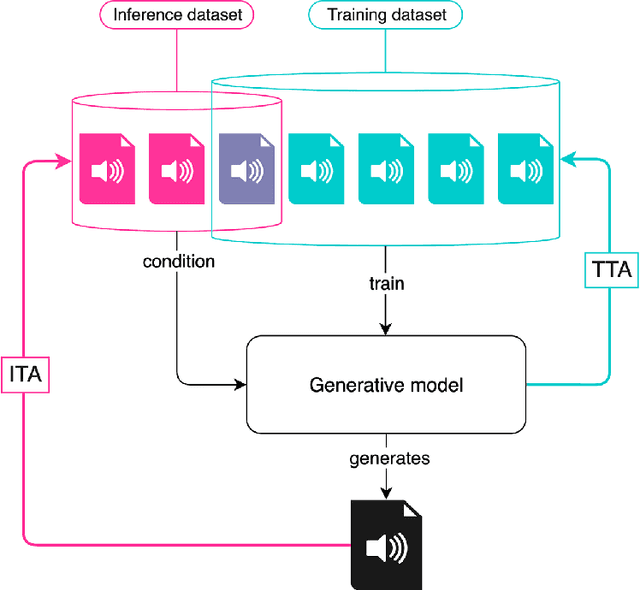

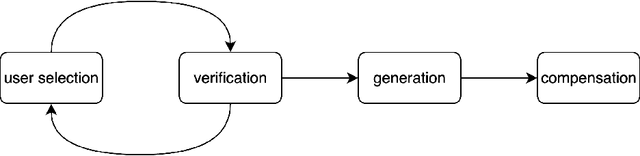

The rise of AI-generated music is diluting royalty pools and revealing structural flaws in existing remuneration frameworks, challenging the well-established artist compensation systems in the music industry. Existing compensation solutions, such as piecemeal licensing agreements, lack scalability and technical rigour, while current data attribution mechanisms provide only uncertain estimates and are rarely implemented in practice. This paper introduces a framework for a generative music infrastructure centred on direct attribution, transparent royalty distribution, and granular control for artists and rights' holders. We distinguish ontologically between the training set and the inference set, which allows us to propose two complementary forms of attribution: training-time attribution and inference-time attribution. We here favour inference-time attribution, as it enables direct, verifiable compensation whenever an artist's catalogue is used to condition a generated output. Besides, users benefit from the ability to condition generations on specific songs and receive transparent information about attribution and permitted usage. Our approach offers an ethical and practical solution to the pressing need for robust compensation mechanisms in the era of AI-generated music, ensuring that provenance and fairness are embedded at the core of generative systems.
TalkCuts: A Large-Scale Dataset for Multi-Shot Human Speech Video Generation
Oct 08, 2025In this work, we present TalkCuts, a large-scale dataset designed to facilitate the study of multi-shot human speech video generation. Unlike existing datasets that focus on single-shot, static viewpoints, TalkCuts offers 164k clips totaling over 500 hours of high-quality human speech videos with diverse camera shots, including close-up, half-body, and full-body views. The dataset includes detailed textual descriptions, 2D keypoints and 3D SMPL-X motion annotations, covering over 10k identities, enabling multimodal learning and evaluation. As a first attempt to showcase the value of the dataset, we present Orator, an LLM-guided multi-modal generation framework as a simple baseline, where the language model functions as a multi-faceted director, orchestrating detailed specifications for camera transitions, speaker gesticulations, and vocal modulation. This architecture enables the synthesis of coherent long-form videos through our integrated multi-modal video generation module. Extensive experiments in both pose-guided and audio-driven settings show that training on TalkCuts significantly enhances the cinematographic coherence and visual appeal of generated multi-shot speech videos. We believe TalkCuts provides a strong foundation for future work in controllable, multi-shot speech video generation and broader multimodal learning.
SONA: Learning Conditional, Unconditional, and Mismatching-Aware Discriminator
Oct 06, 2025Deep generative models have made significant advances in generating complex content, yet conditional generation remains a fundamental challenge. Existing conditional generative adversarial networks often struggle to balance the dual objectives of assessing authenticity and conditional alignment of input samples within their conditional discriminators. To address this, we propose a novel discriminator design that integrates three key capabilities: unconditional discrimination, matching-aware supervision to enhance alignment sensitivity, and adaptive weighting to dynamically balance all objectives. Specifically, we introduce Sum of Naturalness and Alignment (SONA), which employs separate projections for naturalness (authenticity) and alignment in the final layer with an inductive bias, supported by dedicated objective functions and an adaptive weighting mechanism. Extensive experiments on class-conditional generation tasks show that \ours achieves superior sample quality and conditional alignment compared to state-of-the-art methods. Furthermore, we demonstrate its effectiveness in text-to-image generation, confirming the versatility and robustness of our approach.
Demystifying MaskGIT Sampler and Beyond: Adaptive Order Selection in Masked Diffusion
Oct 06, 2025Masked diffusion models have shown promising performance in generating high-quality samples in a wide range of domains, but accelerating their sampling process remains relatively underexplored. To investigate efficient samplers for masked diffusion, this paper theoretically analyzes the MaskGIT sampler for image modeling, revealing its implicit temperature sampling mechanism. Through this analysis, we introduce the "moment sampler," an asymptotically equivalent but more tractable and interpretable alternative to MaskGIT, which employs a "choose-then-sample" approach by selecting unmasking positions before sampling tokens. In addition, we improve the efficiency of choose-then-sample algorithms through two key innovations: a partial caching technique for transformers that approximates longer sampling trajectories without proportional computational cost, and a hybrid approach formalizing the exploration-exploitation trade-off in adaptive unmasking. Experiments in image and text domains demonstrate our theory as well as the efficiency of our proposed methods, advancing both theoretical understanding and practical implementation of masked diffusion samplers.
SoundReactor: Frame-level Online Video-to-Audio Generation
Oct 02, 2025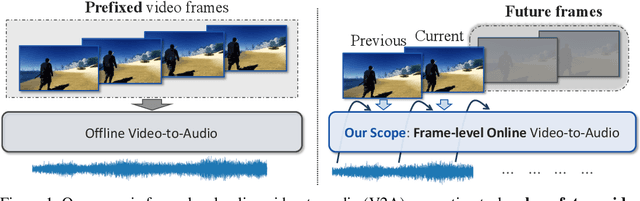
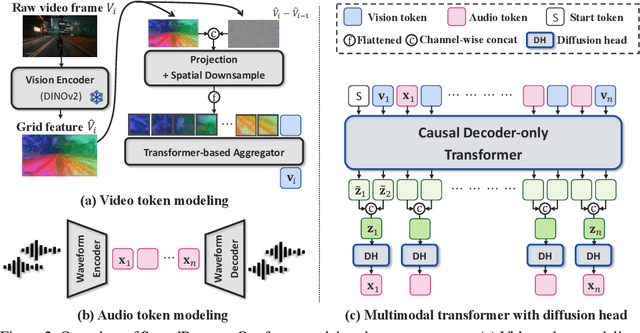
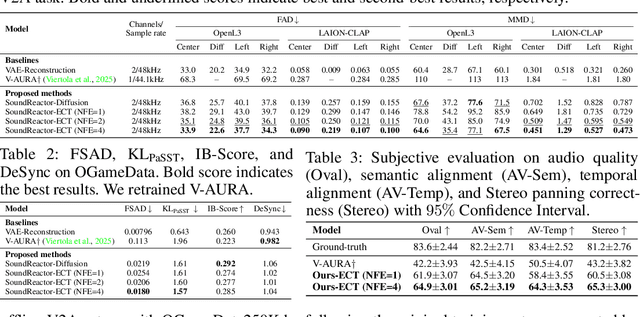

Prevailing Video-to-Audio (V2A) generation models operate offline, assuming an entire video sequence or chunks of frames are available beforehand. This critically limits their use in interactive applications such as live content creation and emerging generative world models. To address this gap, we introduce the novel task of frame-level online V2A generation, where a model autoregressively generates audio from video without access to future video frames. Furthermore, we propose SoundReactor, which, to the best of our knowledge, is the first simple yet effective framework explicitly tailored for this task. Our design enforces end-to-end causality and targets low per-frame latency with audio-visual synchronization. Our model's backbone is a decoder-only causal transformer over continuous audio latents. For vision conditioning, it leverages grid (patch) features extracted from the smallest variant of the DINOv2 vision encoder, which are aggregated into a single token per frame to maintain end-to-end causality and efficiency. The model is trained through a diffusion pre-training followed by consistency fine-tuning to accelerate the diffusion head decoding. On a benchmark of diverse gameplay videos from AAA titles, our model successfully generates semantically and temporally aligned, high-quality full-band stereo audio, validated by both objective and human evaluations. Furthermore, our model achieves low per-frame waveform-level latency (26.3ms with the head NFE=1, 31.5ms with NFE=4) on 30FPS, 480p videos using a single H100. Demo samples are available at https://koichi-saito-sony.github.io/soundreactor/.
VIRTUE: Visual-Interactive Text-Image Universal Embedder
Oct 01, 2025Multimodal representation learning models have demonstrated successful operation across complex tasks, and the integration of vision-language models (VLMs) has further enabled embedding models with instruction-following capabilities. However, existing embedding models lack visual-interactive capabilities to specify regions of interest from users (e.g., point, bounding box, mask), which have been explored in generative models to broaden their human-interactive applicability. Equipping embedding models with visual interactions not only would unlock new applications with localized grounding of user intent, which remains unexplored, but also enable the models to learn entity-level information within images to complement their global representations for conventional embedding tasks. In this paper, we propose a novel Visual-InteRactive Text-Image Universal Embedder (VIRTUE) that extends the capabilities of the segmentation model and the vision-language model to the realm of representation learning. In VIRTUE, the segmentation model can process visual prompts that pinpoint specific regions within an image, thereby enabling the embedder to handle complex and ambiguous scenarios more precisely. To evaluate the visual-interaction ability of VIRTUE, we introduce a large-scale Segmentation-and-Scene Caption Retrieval (SCaR) benchmark comprising 1M samples that aims to retrieve the text caption by jointly considering the entity with a specific object and image scene. VIRTUE consistently achieves a state-of-the-art performance with significant improvements across 36 universal MMEB (3.1%-8.5%) and five visual-interactive SCaR (15.2%-20.3%) tasks.