 Add to Chrome
 Add to Firefox
 Add to Edge
Spatio-Temporal Audio Language Modeling for Dynamic Sound Sources
Jun 12, 2026
Sound events are entities with semantic identities, locations, and trajectories, but current audio-language models usually reason about clips as global event content. Conversely, sound event localization models track source directions over time but offer limited semantic coverage for language reasoning. To address this gap, we introduce ST-AudioQA, a spatio-temporal audio QA dataset and benchmark built from first-order ambisonic (FOA) renderings of static and moving sound sources. Each scene provides source identity, activity, direction, distance, and motion metadata, enabling dense trajectory supervision and questions about what is sounding, where it is, how it moves, and how sources relate. We further propose ST-Audio Encoder, a time-resolved FOA audio encoder that learns event semantics together with source trajectories, and ST-AudioLM, which connects the audio tokens from the encoder to an LLM for spatio-temporal audio QA. Experiments show that this representation improves the semantic-localization tradeoff and yields stronger reasoning performance than static spatial and localization-oriented baselines.

GUDA: Counterfactual Group-wise Training Data Attribution for Diffusion Models via Unlearning
Jan 30, 2026Training-data attribution for vision generative models aims to identify which training data influenced a given output. While most methods score individual examples, practitioners often need group-level answers (e.g., artistic styles or object classes). Group-wise attribution is counterfactual: how would a model's behavior on a generated sample change if a group were absent from training? A natural realization of this counterfactual is Leave-One-Group-Out (LOGO) retraining, which retrains the model with each group removed; however, it becomes computationally prohibitive as the number of groups grows. We propose GUDA (Group Unlearning-based Data Attribution) for diffusion models, which approximates each counterfactual model by applying machine unlearning to a shared full-data model instead of training from scratch. GUDA quantifies group influence using differences in a likelihood-based scoring rule (ELBO) between the full model and each unlearned counterfactual. Experiments on CIFAR-10 and artistic style attribution with Stable Diffusion show that GUDA identifies primary contributing groups more reliably than semantic similarity, gradient-based attribution, and instance-level unlearning approaches, while achieving x100 speedup on CIFAR-10 over LOGO retraining.
Improved Object-Centric Diffusion Learning with Registers and Contrastive Alignment
Jan 03, 2026Slot Attention (SA) with pretrained diffusion models has recently shown promise for object-centric learning (OCL), but suffers from slot entanglement and weak alignment between object slots and image content. We propose Contrastive Object-centric Diffusion Alignment (CODA), a simple extension that (i) employs register slots to absorb residual attention and reduce interference between object slots, and (ii) applies a contrastive alignment loss to explicitly encourage slot-image correspondence. The resulting training objective serves as a tractable surrogate for maximizing mutual information (MI) between slots and inputs, strengthening slot representation quality. On both synthetic (MOVi-C/E) and real-world datasets (VOC, COCO), CODA improves object discovery (e.g., +6.1% FG-ARI on COCO), property prediction, and compositional image generation over strong baselines. Register slots add negligible overhead, keeping CODA efficient and scalable. These results indicate potential applications of CODA as an effective framework for robust OCL in complex, real-world scenes.
PAVAS: Physics-Aware Video-to-Audio Synthesis
Dec 09, 2025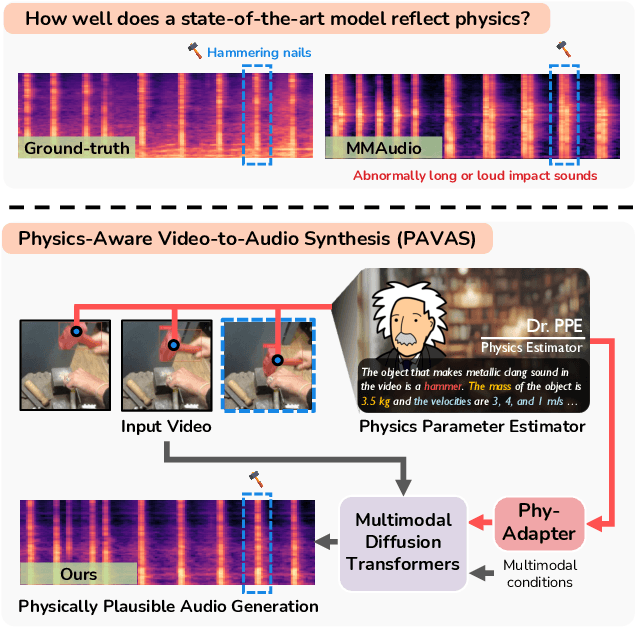
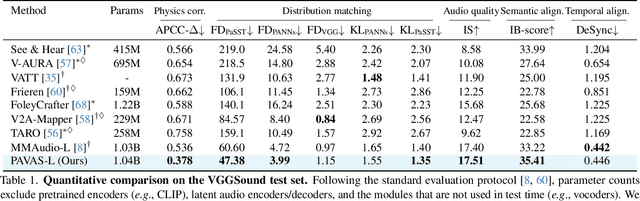
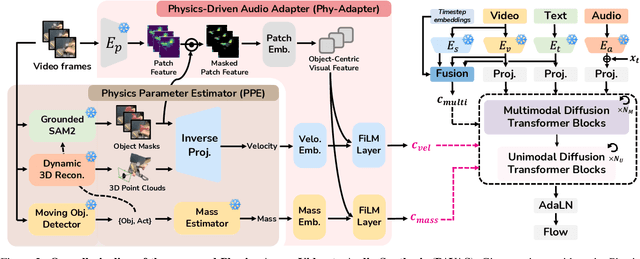
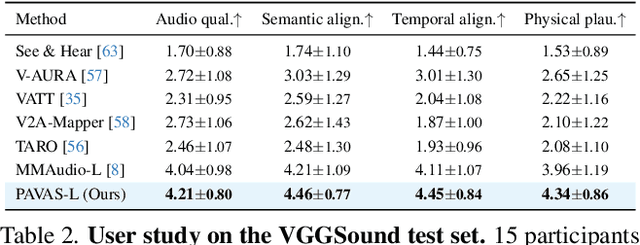
Recent advances in Video-to-Audio (V2A) generation have achieved impressive perceptual quality and temporal synchronization, yet most models remain appearance-driven, capturing visual-acoustic correlations without considering the physical factors that shape real-world sounds. We present Physics-Aware Video-to-Audio Synthesis (PAVAS), a method that incorporates physical reasoning into a latent diffusion-based V2A generation through the Physics-Driven Audio Adapter (Phy-Adapter). The adapter receives object-level physical parameters estimated by the Physical Parameter Estimator (PPE), which uses a Vision-Language Model (VLM) to infer the moving-object mass and a segmentation-based dynamic 3D reconstruction module to recover its motion trajectory for velocity computation. These physical cues enable the model to synthesize sounds that reflect underlying physical factors. To assess physical realism, we curate VGG-Impact, a benchmark focusing on object-object interactions, and introduce Audio-Physics Correlation Coefficient (APCC), an evaluation metric that measures consistency between physical and auditory attributes. Comprehensive experiments show that PAVAS produces physically plausible and perceptually coherent audio, outperforming existing V2A models in both quantitative and qualitative evaluations. Visit https://physics-aware-video-to-audio-synthesis.github.io for demo videos.
SONA: Learning Conditional, Unconditional, and Mismatching-Aware Discriminator
Oct 06, 2025Deep generative models have made significant advances in generating complex content, yet conditional generation remains a fundamental challenge. Existing conditional generative adversarial networks often struggle to balance the dual objectives of assessing authenticity and conditional alignment of input samples within their conditional discriminators. To address this, we propose a novel discriminator design that integrates three key capabilities: unconditional discrimination, matching-aware supervision to enhance alignment sensitivity, and adaptive weighting to dynamically balance all objectives. Specifically, we introduce Sum of Naturalness and Alignment (SONA), which employs separate projections for naturalness (authenticity) and alignment in the final layer with an inductive bias, supported by dedicated objective functions and an adaptive weighting mechanism. Extensive experiments on class-conditional generation tasks show that \ours achieves superior sample quality and conditional alignment compared to state-of-the-art methods. Furthermore, we demonstrate its effectiveness in text-to-image generation, confirming the versatility and robustness of our approach.
Mitigating Embedding Collapse in Diffusion Models for Categorical Data
Oct 18, 2024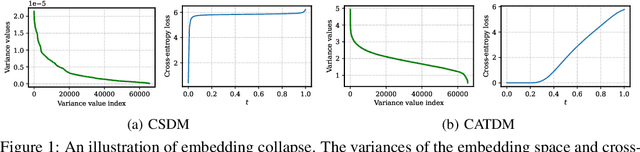
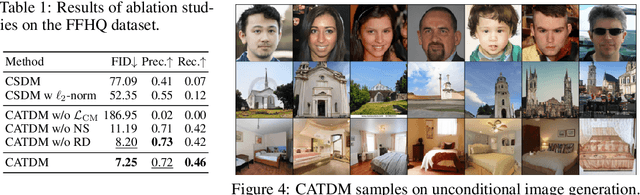

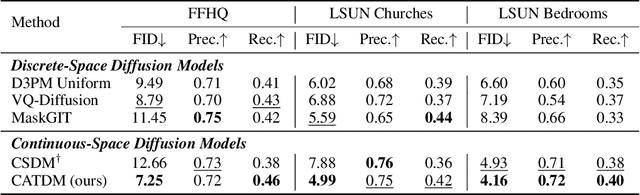
Latent diffusion models have enabled continuous-state diffusion models to handle a variety of datasets, including categorical data. However, most methods rely on fixed pretrained embeddings, limiting the benefits of joint training with the diffusion model. While jointly learning the embedding (via reconstruction loss) and the latent diffusion model (via score matching loss) could enhance performance, our analysis shows that end-to-end training risks embedding collapse, degrading generation quality. To address this issue, we introduce CATDM, a continuous diffusion framework within the embedding space that stabilizes training. We propose a novel objective combining the joint embedding-diffusion variational lower bound with a Consistency-Matching (CM) regularizer, alongside a shifted cosine noise schedule and random dropping strategy. The CM regularizer ensures the recovery of the true data distribution. Experiments on benchmarks show that CATDM mitigates embedding collapse, yielding superior results on FFHQ, LSUN Churches, and LSUN Bedrooms. In particular, CATDM achieves an FID of 6.81 on ImageNet $256\times256$ with 50 steps. It outperforms non-autoregressive models in machine translation and is on a par with previous methods in text generation.
DisMix: Disentangling Mixtures of Musical Instruments for Source-level Pitch and Timbre Manipulation
Aug 20, 2024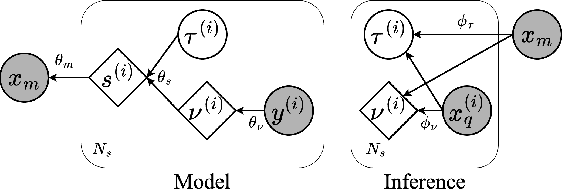
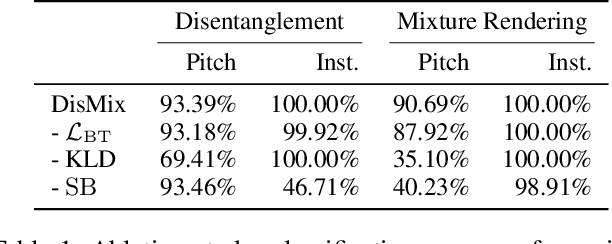
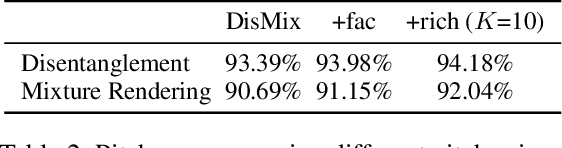
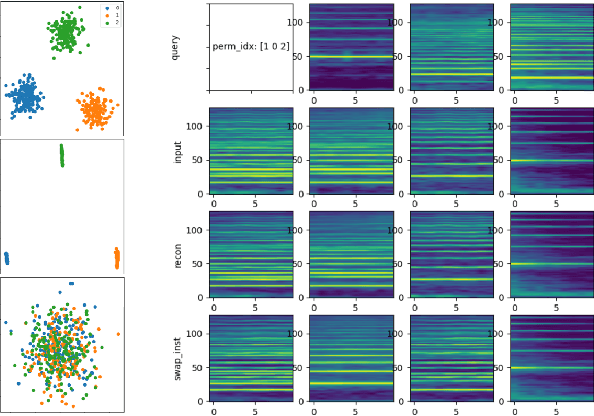
Existing work on pitch and timbre disentanglement has been mostly focused on single-instrument music audio, excluding the cases where multiple instruments are presented. To fill the gap, we propose DisMix, a generative framework in which the pitch and timbre representations act as modular building blocks for constructing the melody and instrument of a source, and the collection of which forms a set of per-instrument latent representations underlying the observed mixture. By manipulating the representations, our model samples mixtures with novel combinations of pitch and timbre of the constituent instruments. We can jointly learn the disentangled pitch-timbre representations and a latent diffusion transformer that reconstructs the mixture conditioned on the set of source-level representations. We evaluate the model using both a simple dataset of isolated chords and a realistic four-part chorales in the style of J.S. Bach, identify the key components for the success of disentanglement, and demonstrate the application of mixture transformation based on source-level attribute manipulation.
PaGoDA: Progressive Growing of a One-Step Generator from a Low-Resolution Diffusion Teacher
May 23, 2024To accelerate sampling, diffusion models (DMs) are often distilled into generators that directly map noise to data in a single step. In this approach, the resolution of the generator is fundamentally limited by that of the teacher DM. To overcome this limitation, we propose Progressive Growing of Diffusion Autoencoder (PaGoDA), a technique to progressively grow the resolution of the generator beyond that of the original teacher DM. Our key insight is that a pre-trained, low-resolution DM can be used to deterministically encode high-resolution data to a structured latent space by solving the PF-ODE forward in time (data-to-noise), starting from an appropriately down-sampled image. Using this frozen encoder in an auto-encoder framework, we train a decoder by progressively growing its resolution. From the nature of progressively growing decoder, PaGoDA avoids re-training teacher/student models when we upsample the student model, making the whole training pipeline much cheaper. In experiments, we used our progressively growing decoder to upsample from the pre-trained model's 64x64 resolution to generate 512x512 samples, achieving 2x faster inference compared to single-step distilled Stable Diffusion like LCM. PaGoDA also achieved state-of-the-art FIDs on ImageNet across all resolutions from 64x64 to 512x512. Additionally, we demonstrated PaGoDA's effectiveness in solving inverse problems and enabling controllable generation.
HQ-VAE: Hierarchical Discrete Representation Learning with Variational Bayes
Dec 31, 2023


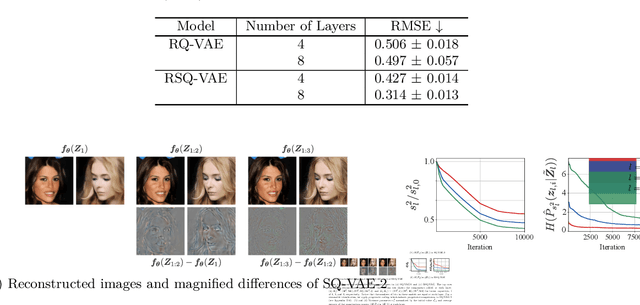
Vector quantization (VQ) is a technique to deterministically learn features with discrete codebook representations. It is commonly performed with a variational autoencoding model, VQ-VAE, which can be further extended to hierarchical structures for making high-fidelity reconstructions. However, such hierarchical extensions of VQ-VAE often suffer from the codebook/layer collapse issue, where the codebook is not efficiently used to express the data, and hence degrades reconstruction accuracy. To mitigate this problem, we propose a novel unified framework to stochastically learn hierarchical discrete representation on the basis of the variational Bayes framework, called hierarchically quantized variational autoencoder (HQ-VAE). HQ-VAE naturally generalizes the hierarchical variants of VQ-VAE, such as VQ-VAE-2 and residual-quantized VAE (RQ-VAE), and provides them with a Bayesian training scheme. Our comprehensive experiments on image datasets show that HQ-VAE enhances codebook usage and improves reconstruction performance. We also validated HQ-VAE in terms of its applicability to a different modality with an audio dataset.
Manifold Preserving Guided Diffusion
Nov 28, 2023
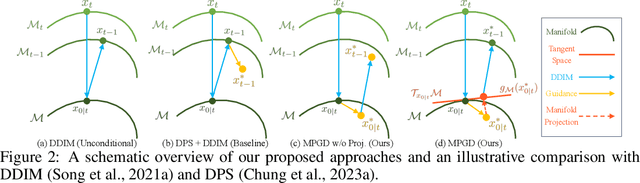


Despite the recent advancements, conditional image generation still faces challenges of cost, generalizability, and the need for task-specific training. In this paper, we propose Manifold Preserving Guided Diffusion (MPGD), a training-free conditional generation framework that leverages pretrained diffusion models and off-the-shelf neural networks with minimal additional inference cost for a broad range of tasks. Specifically, we leverage the manifold hypothesis to refine the guided diffusion steps and introduce a shortcut algorithm in the process. We then propose two methods for on-manifold training-free guidance using pre-trained autoencoders and demonstrate that our shortcut inherently preserves the manifolds when applied to latent diffusion models. Our experiments show that MPGD is efficient and effective for solving a variety of conditional generation applications in low-compute settings, and can consistently offer up to 3.8x speed-ups with the same number of diffusion steps while maintaining high sample quality compared to the baselines.