 Add to Chrome
 Add to Firefox
 Add to Edge
Bootstrapping Vision-Language Model for Hysteroscopic Surgical Scene Segmentation
Aug 11, 2026
Hysteroscopic surgical scene segmentation plays a pivotal role in understanding the hysteroscopic intraoperative environment as well as computer-assisted intervention. However, this task presents unique challenges due to the high morphological similarity among different lesions and the presence of artifacts such as specular reflections, motion blur, and fluid occlusions in surgical videos. In this work, we propose the first vision-language model (VLM)-based hysteroscopic surgical scene segmentation method, which performs pixel-wise localization for fifteen representative categories in hysteroscopic surgical scenes. Our VLM-hyster has a segmentation backbone that utilizes the pretrained image encoder for robust visual feature extraction, coupled with a transformer-based decoder for dense prediction. Moreover, we design category-specific text prompts and incorporate a masked distillation branch to filter out visual features with low correlation to the text prompts, enabling the model to focus more effectively on category-specific image regions and thereby enhancing segmentation performance. We collect a large multicentric hysteroscopic surgical scene dataset, containing 4,020 high-resolution images with detailed mask annotations, for model training and evaluation. Experimental results demonstrate that VLM-hyster substantially outperforms state-of-the-art AI models. Furthermore, extensive assessments by gynecologists, as well as multicentre and prospective validations, demonstrate VLM-hyster's robustness and generalizability. The results suggest that VLM-hyster earns considerable potential in enabling AI-assisted localization of surgical instruments and lesions in hysteroscopic surgeries. Code is available at https://github.com/viscom-tongji/VLM-hyster.

SwinSRGAN: Swin Transformer-based Generative Adversarial Network for High-Fidelity Speech Super-Resolution
Sep 04, 2025Speech super-resolution (SR) reconstructs high-frequency content from low-resolution speech signals. Existing systems often suffer from representation mismatch in two-stage mel-vocoder pipelines and from over-smoothing of hallucinated high-band content by CNN-only generators. Diffusion and flow models are computationally expensive, and their robustness across domains and sampling rates remains limited. We propose SwinSRGAN, an end-to-end framework operating on Modified Discrete Cosine Transform (MDCT) magnitudes. It is a Swin Transformer-based U-Net that captures long-range spectro-temporal dependencies with a hybrid adversarial scheme combines time-domain MPD/MSD discriminators with a multi-band MDCT discriminator specialized for the high-frequency band. We employs a sparse-aware regularizer on arcsinh-compressed MDCT to better preserve transient components. The system upsamples inputs at various sampling rates to 48 kHz in a single pass and operates in real time. On standard benchmarks, SwinSRGAN reduces objective error and improves ABX preference scores. In zero-shot tests on HiFi-TTS without fine-tuning, it outperforms NVSR and mdctGAN, demonstrating strong generalization across datasets
DreamDistribution: Prompt Distribution Learning for Text-to-Image Diffusion Models
Dec 21, 2023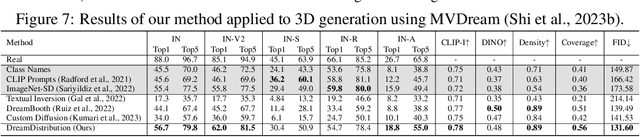
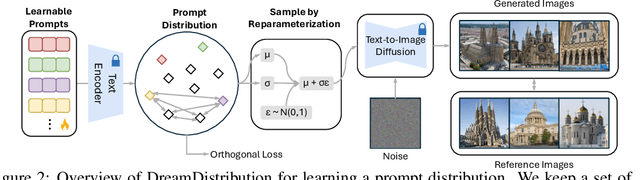
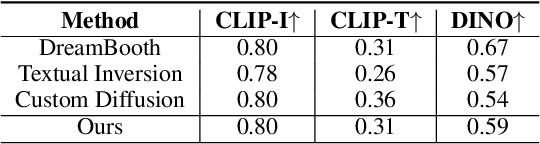
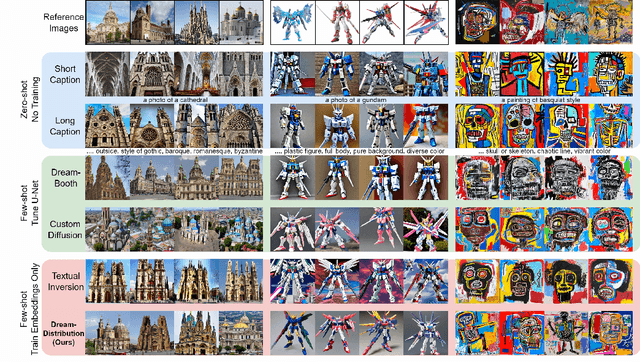
The popularization of Text-to-Image (T2I) diffusion models enables the generation of high-quality images from text descriptions. However, generating diverse customized images with reference visual attributes remains challenging. This work focuses on personalizing T2I diffusion models at a more abstract concept or category level, adapting commonalities from a set of reference images while creating new instances with sufficient variations. We introduce a solution that allows a pretrained T2I diffusion model to learn a set of soft prompts, enabling the generation of novel images by sampling prompts from the learned distribution. These prompts offer text-guided editing capabilities and additional flexibility in controlling variation and mixing between multiple distributions. We also show the adaptability of the learned prompt distribution to other tasks, such as text-to-3D. Finally we demonstrate effectiveness of our approach through quantitative analysis including automatic evaluation and human assessment. Project website: https://briannlongzhao.github.io/DreamDistribution
One-bit Spectrum Sensing with the Eigenvalue Moment Ratio Approach
Apr 08, 2021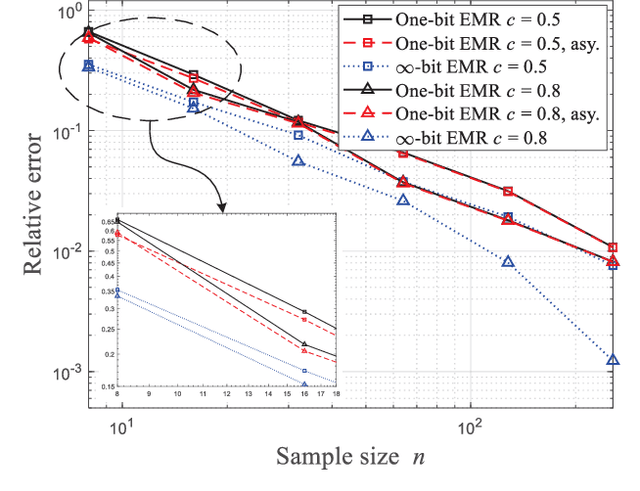
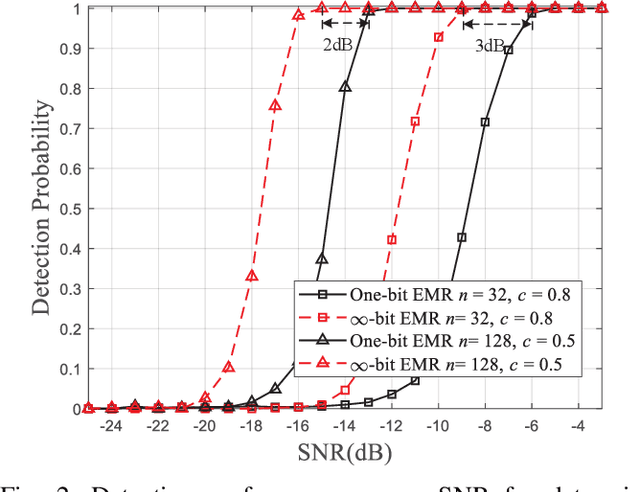
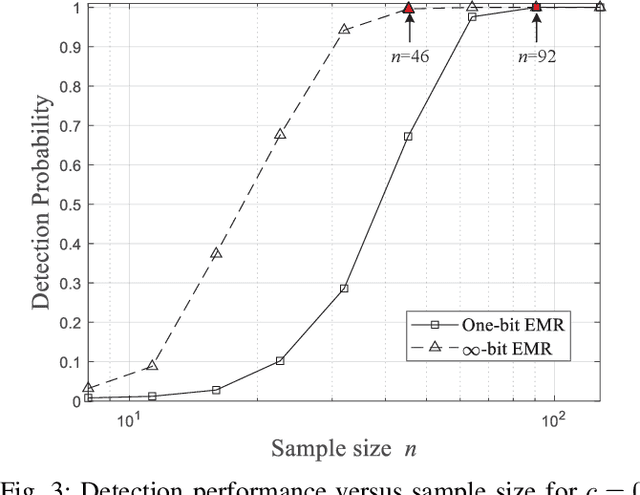
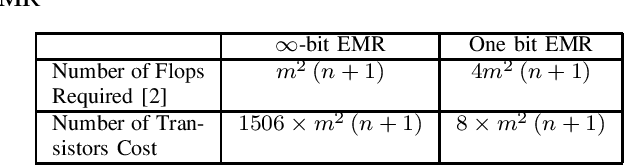
One-bit analog-to-digital converter (ADC), performing signal sampling as an extreme simple comparator, is an overwhelming technology for spectrum sensing due to its low-cost, low-power consumptions and high sampling rate. In this letter, we propose a novel one-bit sensing approach based on the eigenvalue moment ratio (EMR), which has been proved to be highly efficient for conventional multi-antenna spectrum sensing in $\infty$-bit situation. Particularly, we determine the asymptotic distribution of one-bit EMR under null hypothesis via the central limited theorem (CLT), allowing us to perform spectrum sensing with one-bit samples directly. Theoretical and simulation analysis show the new approach can provide reasonably good sensing performance at a low hardware cost.