 Add to Chrome
 Add to Firefox
 Add to Edge
Learning from Mistakes: Rollout-Retrieval Lifelong Policy Learning for Autonomous Driving
Jun 29, 2026
Autonomous driving policies should be able to improve continually as deployment exposes them to increasingly diverse and long-tail traffic situations. However, most learning-based policies are trained or fine-tuned on expert demonstrations and then rely largely on generalization to handle challenging closed-loop scenarios, lacking an explicit mechanism to correct and retain the mistakes exposed in these scenarios. This paper studies autonomous driving policy improvement from a lifelong learning perspective: Can a pretrained policy improve continually by accumulating corrective knowledge derived from its own mistakes, while retaining previously acquired driving competence? To answer this question, we propose Rollout-Retrieval Lifelong Policy Learning (R$^2$LPL), a policy learning framework that retrieves corrective targets from recoverable policy-induced mistakes and retains the resulting knowledge through lifelong policy learning. R^2LPL addresses a key bottleneck in continual policy improvement: closed-loop mistakes reveal where the policy is weak, but do not directly specify what the policy should learn. By filtering recoverable mistake-related states and retrieving feasible corrective targets, R$^2$LPL turns sparse failure evidence into compact supervised knowledge for stable and sample-efficient policy improvement. We evaluate R$^2$LPL on large-scale closed-loop nuPlan benchmarks. With only a few rollout and continual-learning cycles, R$^2$LPL elevates a learning-based planner with moderate initial performance to state-of-the-art performance across the evaluated benchmarks, especially on the challenging and long-tail Test14-hard split. These results demonstrate the effectiveness of R$^2$LPL in converting recoverable closed-loop mistakes into corrective knowledge for sustained policy improvement.

EventRadar: Long-Range Visual UAV Discovery through Spatiotemporal Event Sensing
Jun 09, 2026Unauthorized unmanned aerial vehicle (UAV) activity around airports, public venues, and other sensitive sites has made protected-airspace monitoring increasingly important. A practical sensing system must search a wide angular region, find small long-range targets, and return both bearing support and UAV-specific evidence before a restricted perimeter is breached. Existing UAV detection paths often rely on spatially organized evidence, such as body extent, silhouette, or track continuity. At long range, however, these cues become difficult to preserve and verify as the target footprint weakens and its image-plane support shrinks. EventRadar follows a complementary cue: propeller-induced temporal periodicity, which recent event-camera sensing studies have shown can reveal UAV-specific motion after appearance becomes weak. We extend this cue to kilometer-scale active sensing with an event-camera prototype. Scene-Anchored Geometry Evidence (SAGE) fuses scanning events with IMU pose to maintain a bearing-indexed scene memory, separating transient candidate support from persistent background clutter. Comb-guided Harmonic-Group Learned Iterative Shrinkage and Thresholding Algorithm (CHG) then treats each candidate as a weak high-rate timing signal and recovers phase-insensitive harmonic evidence with fixed compute. Compared with related event-camera baselines on 700-1500 m UAV event recordings, EventRadar achieves 0.990 mAP$_{.3}$ and 0.949 F1$_{.3}$, reduces FN$_{.3}$ to 0.009, and shows real-time feasibility in prototype profiling.
EventPrune: Cascaded Event-Assisted Token Pruning for Efficient First-Person Dynamic Spatial Reasoning
May 19, 2026First-person dynamic spatial reasoning requires models to track continuous motion and precise geometric structure, but the quadratic attention cost of Transformer-based Video-LLMs makes dense visual tokens computationally expensive. Existing token pruning paradigms predominantly rely on discrete static snapshots, failing to preserve the motion and geometric cues essential for reasoning. We propose Event Cascade Pruning (ECP), to our knowledge the first training-free framework that leverages the high-frequency motion cues from event cameras as a continuous event-guided motion prior to guide token selection. ECP combines three stages: Event-Triggered Causal Sampling to anchor motion-informative keyframes, Event-guided Motion Saliency Filtering to suppress event-inactive visual tokens, and Event-Attention Ranking Fusion to calibrate spatial attention with motion-salient dynamics. With 80% visual token reduction, ECP outperforms the full-token baseline (37.62% vs. 36.31%) while achieving 1.89x inference speedup and 52% GFLOPs reduction. We further introduce ESR-Real, the first real-world RGB-event benchmark for first-person spatial reasoning, where ECP improves accuracy by 2.68 percentage points over full-token baselines.
$x^2$-Fusion: Cross-Modality and Cross-Dimension Flow Estimation in Event Edge Space
Mar 17, 2026Estimating dense 2D optical flow and 3D scene flow is essential for dynamic scene understanding. Recent work combines images, LiDAR, and event data to jointly predict 2D and 3D motion, yet most approaches operate in separate heterogeneous feature spaces. Without a shared latent space that all modalities can align to, these systems rely on multiple modality-specific blocks, leaving cross-sensor mismatches unresolved and making fusion unnecessarily complex.Event cameras naturally provide a spatiotemporal edge signal, which we can treat as an intrinsic edge field to anchor a unified latent representation, termed the Event Edge Space. Building on this idea, we introduce $x^2$-Fusion, which reframes multimodal fusion as representation unification: event-derived spatiotemporal edges define an edge-centric homogeneous space, and image and LiDAR features are explicitly aligned in this shared representation.Within this space, we perform reliability-aware adaptive fusion to estimate modality reliability and emphasize stable cues under degradation. We further employ cross-dimension contrast learning to tightly couple 2D optical flow with 3D scene flow. Extensive experiments on both synthetic and real benchmarks show that $x^2$-Fusion achieves state-of-the-art accuracy under standard conditions and delivers substantial improvements in challenging scenarios.
HybridPrompt: Bridging Generative Priors and Traditional Codecs for Mobile Streaming
Feb 19, 2026In Video on Demand (VoD) scenarios, traditional codecs are the industry standard due to their high decoding efficiency. However, they suffer from severe quality degradation under low bandwidth conditions. While emerging generative neural codecs offer significantly higher perceptual quality, their reliance on heavy frame-by-frame generation makes real-time playback on mobile devices impractical. We ask: is it possible to combine the blazing-fast speed of traditional standards with the superior visual fidelity of neural approaches? We present HybridPrompt, the first generative-based video system capable of achieving real-time 1080p decoding at over 150 FPS on a commercial smartphone. Specifically, we employ a hybrid architecture that encodes Keyframes using a generative model while relying on traditional codecs for the remaining frames. A major challenge is that the two paradigms have conflicting objectives: the "hallucinated" details from generative models often misalign with the rigid prediction mechanisms of traditional codecs, causing bitrate inefficiency. To address this, we demonstrate that the traditional decoding process is differentiable, enabling an end-to-end optimization loop. This allows us to use subsequent frames as additional supervision, forcing the generative model to synthesize keyframes that are not only perceptually high-fidelity but also mathematically optimal references for the traditional codec. By integrating a two-stage generation strategy, our system outperforms pure neural baselines by orders of magnitude in speed while achieving an average LPIPS gain of 8% over traditional codecs at 200kbps.
Choosing How to Remember: Adaptive Memory Structures for LLM Agents
Feb 15, 2026Memory is critical for enabling large language model (LLM) based agents to maintain coherent behavior over long-horizon interactions. However, existing agent memory systems suffer from two key gaps: they rely on a one-size-fits-all memory structure and do not model memory structure selection as a context-adaptive decision, limiting their ability to handle heterogeneous interaction patterns and resulting in suboptimal performance. We propose a unified framework, FluxMem, that enables adaptive memory organization for LLM agents. Our framework equips agents with multiple complementary memory structures. It explicitly learns to select among these structures based on interaction-level features, using offline supervision derived from downstream response quality and memory utilization. To support robust long-horizon memory evolution, we further introduce a three-level memory hierarchy and a Beta Mixture Model-based probabilistic gate for distribution-aware memory fusion, replacing brittle similarity thresholds. Experiments on two long-horizon benchmarks, PERSONAMEM and LoCoMo, demonstrate that our method achieves average improvements of 9.18% and 6.14%.
Count Every Rotation and Every Rotation Counts: Exploring Drone Dynamics via Propeller Sensing
Nov 17, 2025As drone-based applications proliferate, paramount contactless sensing of airborne drones from the ground becomes indispensable. This work demonstrates concentrating on propeller rotational speed will substantially improve drone sensing performance and proposes an event-camera-based solution, \sysname. \sysname features two components: \textit{Count Every Rotation} achieves accurate, real-time propeller speed estimation by mitigating ultra-high sensitivity of event cameras to environmental noise. \textit{Every Rotation Counts} leverages these speeds to infer both internal and external drone dynamics. Extensive evaluations in real-world drone delivery scenarios show that \sysname achieves a sensing latency of 3$ms$ and a rotational speed estimation error of merely 0.23\%. Additionally, \sysname infers drone flight commands with 96.5\% precision and improves drone tracking accuracy by over 22\% when combined with other sensing modalities. \textit{ Demo: {\color{blue}https://eventpro25.github.io/EventPro/.} }
Enabling High-Frequency Cross-Modality Visual Positioning Service for Accurate Drone Landing
Oct 01, 2025After years of growth, drone-based delivery is transforming logistics. At its core, real-time 6-DoF drone pose tracking enables precise flight control and accurate drone landing. With the widespread availability of urban 3D maps, the Visual Positioning Service (VPS), a mobile pose estimation system, has been adapted to enhance drone pose tracking during the landing phase, as conventional systems like GPS are unreliable in urban environments due to signal attenuation and multi-path propagation. However, deploying the current VPS on drones faces limitations in both estimation accuracy and efficiency. In this work, we redesign drone-oriented VPS with the event camera and introduce EV-Pose to enable accurate, high-frequency 6-DoF pose tracking for accurate drone landing. EV-Pose introduces a spatio-temporal feature-instructed pose estimation module that extracts a temporal distance field to enable 3D point map matching for pose estimation; and a motion-aware hierarchical fusion and optimization scheme to enhance the above estimation in accuracy and efficiency, by utilizing drone motion in the \textit{early stage} of event filtering and the \textit{later stage} of pose optimization. Evaluation shows that EV-Pose achieves a rotation accuracy of 1.34$\degree$ and a translation accuracy of 6.9$mm$ with a tracking latency of 10.08$ms$, outperforming baselines by $>$50\%, \tmcrevise{thus enabling accurate drone landings.} Demo: https://ev-pose.github.io/
R-Meshfusion: Reinforcement Learning Powered Sparse-View Mesh Reconstruction with Diffusion Priors
Apr 16, 2025Mesh reconstruction from multi-view images is a fundamental problem in computer vision, but its performance degrades significantly under sparse-view conditions, especially in unseen regions where no ground-truth observations are available. While recent advances in diffusion models have demonstrated strong capabilities in synthesizing novel views from limited inputs, their outputs often suffer from visual artifacts and lack 3D consistency, posing challenges for reliable mesh optimization. In this paper, we propose a novel framework that leverages diffusion models to enhance sparse-view mesh reconstruction in a principled and reliable manner. To address the instability of diffusion outputs, we propose a Consensus Diffusion Module that filters unreliable generations via interquartile range (IQR) analysis and performs variance-aware image fusion to produce robust pseudo-supervision. Building on this, we design an online reinforcement learning strategy based on the Upper Confidence Bound (UCB) to adaptively select the most informative viewpoints for enhancement, guided by diffusion loss. Finally, the fused images are used to jointly supervise a NeRF-based model alongside sparse-view ground truth, ensuring consistency across both geometry and appearance. Extensive experiments demonstrate that our method achieves significant improvements in both geometric quality and rendering quality.
GaussVideoDreamer: 3D Scene Generation with Video Diffusion and Inconsistency-Aware Gaussian Splatting
Apr 16, 2025
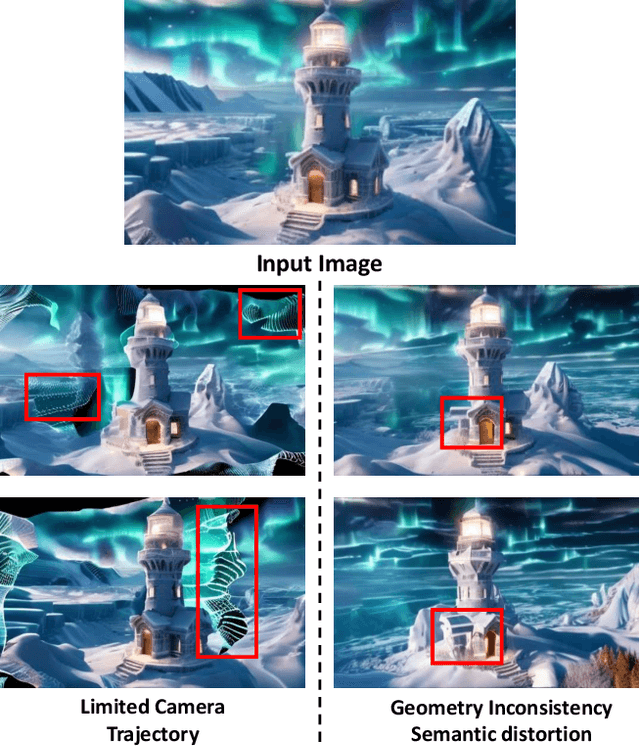
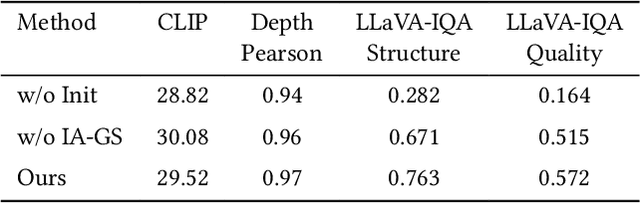
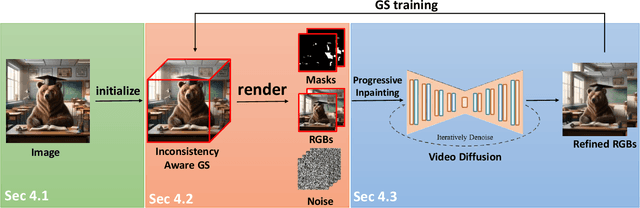
Single-image 3D scene reconstruction presents significant challenges due to its inherently ill-posed nature and limited input constraints. Recent advances have explored two promising directions: multiview generative models that train on 3D consistent datasets but struggle with out-of-distribution generalization, and 3D scene inpainting and completion frameworks that suffer from cross-view inconsistency and suboptimal error handling, as they depend exclusively on depth data or 3D smoothness, which ultimately degrades output quality and computational performance. Building upon these approaches, we present GaussVideoDreamer, which advances generative multimedia approaches by bridging the gap between image, video, and 3D generation, integrating their strengths through two key innovations: (1) A progressive video inpainting strategy that harnesses temporal coherence for improved multiview consistency and faster convergence. (2) A 3D Gaussian Splatting consistency mask to guide the video diffusion with 3D consistent multiview evidence. Our pipeline combines three core components: a geometry-aware initialization protocol, Inconsistency-Aware Gaussian Splatting, and a progressive video inpainting strategy. Experimental results demonstrate that our approach achieves 32% higher LLaVA-IQA scores and at least 2x speedup compared to existing methods while maintaining robust performance across diverse scenes.