 Add to Chrome
 Add to Firefox
 Add to Edge
Efficiently Learning Drifting Halfspaces with Massart Noise
Jun 09, 2026
We study the problem of learning a drifting concept in the presence of Massart noise. In this framework, an online learner has access to a history of independent samples whose labels are noisy versions of a target concept that may change from round to round. The goal is to output, in each round, a hypothesis with small prediction error. We study the complexity of this learning problem for the fundamental class of margin-separable linear classifiers (halfspaces). On the positive side, we give a computationally efficient learner achieving error $η+ \tilde O(Δ^{1/3}/γ)$, where $η$ upper bounds the Massart noise rate, $Δ$ is the drift rate, and $γ$ is the margin. Interestingly, in the realizable setting, an adaptation of our techniques yields an efficient learner with an improved error rate over prior work. On the lower-bound side, we provide formal evidence of an information-computation tradeoff, strongly suggesting that our algorithm's performance is essentially optimal. Specifically, while the information-theoretically optimal error scales with $Δ^{1/2}$, we prove that $Δ^{1/3}$-scaling is unavoidable for low-degree polynomial tests, even in the special case of random classification noise.

Robust Regression of General ReLUs with Queries
Jun 09, 2026We study the task of agnostically learning general (as opposed to homogeneous) ReLUs under the Gaussian distribution with respect to the squared loss. In the passive learning setting, recent work gave a computationally efficient algorithm that uses $poly(d,1/ε)$ labeled examples and outputs a hypothesis with error $O(opt)+ε$, where $opt$ is the squared loss of the best fit ReLU. Here we focus on the interactive setting, where the learner has some form of query access to the labels of unlabeled examples. Our main result is the first computationally efficient learner that uses $d polylog(1/ε)+\tilde{O}(\min\{1/p, 1/ε\})$ black-box label queries, where $p$ is the bias of the target function, and achieves error $O(opt)+ε$. We complement our algorithmic result by showing that its query complexity bound is qualitatively near-optimal, even ignoring computational constraints. Finally, we establish that query access is essentially necessary to improve on the label complexity of passive learning. Specifically, for pool-based active learning, any active learner requires $\tildeΩ(d/ε)$ labels, unless it draws a super-polynomial number of unlabeled examples.
Polynomial-Time Robust Multiclass Linear Classification under Gaussian Marginals
May 20, 2026We study the task of agnostic learning of multiclass linear classifiers under the Gaussian distribution. Given labeled examples $(x, y)$ from a distribution over $\mathbb{R}^d \times [k]$, with Gaussian $x$-marginal, the goal is to output a hypothesis whose error is comparable to that of the best $k$-class linear classifier. While the binary case $k=2$ has a well-developed algorithmic theory, much less is known for $k \ge 3$. Even for $k=3$, prior robust algorithms incur exponential dependence on the inverse of the desired accuracy in both complexity and representation size. In this work, we develop new structural results for multiclass linear classifiers and use them to design fully polynomial-time robust learners with dimension-independent error guarantees. Our first result shows that the standard multiclass perceptron algorithm requires super-polynomially many samples and updates, even with clean labels and Gaussian marginals, revealing a basic obstruction absent in the binary case. Our main positive result is a pairwise improper-learning framework which yields an efficient learner with error $\widetilde O(k^{3/2}\sqrt{\mathrm{opt}})+ε$ for general $k$. Additionally, we develop a sharper localization-based framework which leads to error $O(\mathrm{opt})+ε$ for $k=3$, and error $\mathrm{poly}(k)\mathrm{opt}+ε$ for geometrically regular $k$-class linear classifiers.
Towards Brain MRI Foundation Models for the Clinic: Findings from the FOMO25 Challenge
Apr 13, 2026Clinical deployment of automated brain MRI analysis faces a fundamental challenge: clinical data is heterogeneous and noisy, and high-quality labels are prohibitively costly to obtain. Self-supervised learning (SSL) can address this by leveraging the vast amounts of unlabeled data produced in clinical workflows to train robust \textit{foundation models} that adapt out-of-domain with minimal supervision. However, the development of foundation models for brain MRI has been limited by small pretraining datasets and in-domain benchmarking focused on high-quality, research-grade data. To address this gap, we organized the FOMO25 challenge as a satellite event at MICCAI 2025. FOMO25 provided participants with a large pretraining dataset, FOMO60K, and evaluated models on data sourced directly from clinical workflows in few-shot and out-of-domain settings. Tasks covered infarct classification, meningioma segmentation, and brain age regression, and considered both models trained on FOMO60K (method track) and any data (open track). Nineteen foundation models from sixteen teams were evaluated using a standardized containerized pipeline. Results show that (a) self-supervised pretraining improves generalization on clinical data under domain shift, with the strongest models trained \textit{out-of-domain} surpassing supervised baselines trained \textit{in-domain}. (b) No single pretraining objective benefits all tasks: MAE favors segmentation, hybrid reconstruction-contrastive objectives favor classification, and (c) strong performance was achieved by small pretrained models, and improvements from scaling model size and training duration did not yield reliable benefits.
Skilled AI Agents for Embedded and IoT Systems Development
Mar 20, 2026Large language models (LLMs) and agentic systems have shown promise for automated software development, but applying them to hardware-in-the-loop (HIL) embedded and Internet-of-Things (IoT) systems remains challenging due to the tight coupling between software logic and physical hardware behavior. Code that compiles successfully may still fail when deployed on real devices because of timing constraints, peripheral initialization requirements, or hardware-specific behaviors. To address this challenge, we introduce a skills-based agentic framework for HIL embedded development together with IoT-SkillsBench, a benchmark designed to systematically evaluate AI agents in real embedded programming environments. IoT-SkillsBench spans three representative embedded platforms, 23 peripherals, and 42 tasks across three difficulty levels, where each task is evaluated under three agent configurations (no-skills, LLM-generated skills, and human-expert skills) and validated through real hardware execution. Across 378 hardware validated experiments, we show that concise human-expert skills with structured expert knowledge enable near-perfect success rates across platforms.
Expressivity-Efficiency Tradeoffs for Hybrid Sequence Models
Mar 09, 2026Hybrid sequence models--combining Transformer and state-space model layers--seek to gain the expressive versatility of attention as well as the computational efficiency of state-space model layers. Despite burgeoning interest in hybrid models, we lack a basic understanding of the settings where--and underlying mechanisms through which--they offer benefits over their constituent models. In this paper, we study this question, focusing on a broad family of core synthetic tasks. For this family of tasks, we prove the existence of fundamental limitations for non-hybrid models. Specifically, any Transformer or state-space model that solves the underlying task requires either a large number of parameters or a large working memory. On the other hand, for two prototypical tasks within this family--namely selective copying and associative recall--we construct hybrid models of small size and working memory that provably solve these tasks, thus achieving the best of both worlds. Our experimental evaluation empirically validates our theoretical findings. Importantly, going beyond the settings in our theoretical analysis, we empirically show that learned--rather than constructed--hybrids outperform non-hybrid models with up to 6x as many parameters. We additionally demonstrate that hybrid models exhibit stronger length generalization and out-of-distribution robustness than non-hybrids.
Learning Intersections of Two Margin Halfspaces under Factorizable Distributions
Nov 16, 2025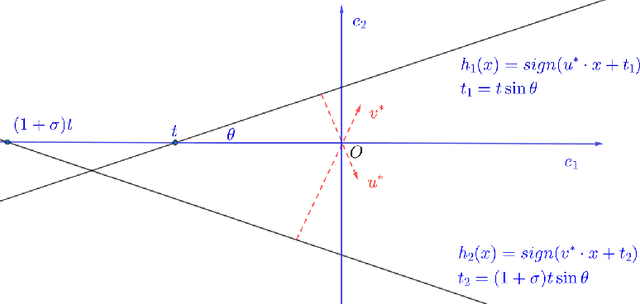
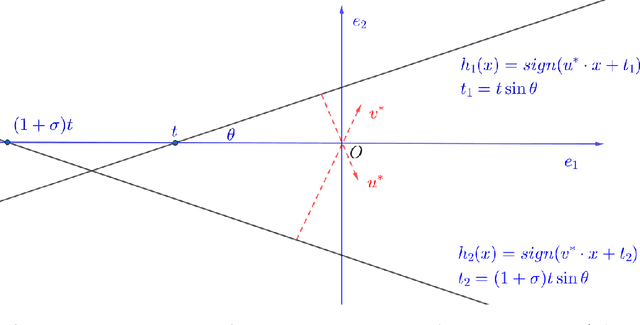
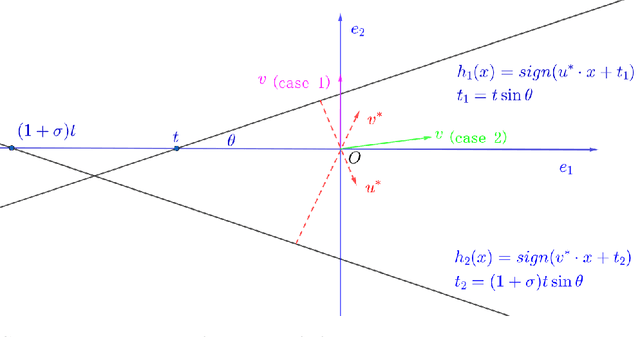
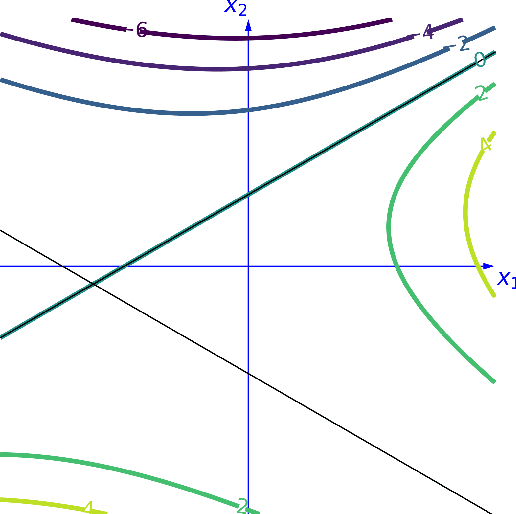
Learning intersections of halfspaces is a central problem in Computational Learning Theory. Even for just two halfspaces, it remains a major open question whether learning is possible in polynomial time with respect to the margin $γ$ of the data points and their dimensionality $d$. The best-known algorithms run in quasi-polynomial time $d^{O(\log(1/γ))}$, and it has been shown that this complexity is unavoidable for any algorithm relying solely on correlational statistical queries (CSQ). In this work, we introduce a novel algorithm that provably circumvents the CSQ hardness barrier. Our approach applies to a broad class of distributions satisfying a natural, previously studied, factorizability assumption. Factorizable distributions lie between distribution-specific and distribution-free settings, and significantly extend previously known tractable cases. Under these distributions, we show that CSQ-based methods still require quasipolynomial time even for weakly learning, whereas our algorithm achieves $poly(d,1/γ)$ time by leveraging more general statistical queries (SQ), establishing a strong separation between CSQ and SQ for this simple realizable PAC learning problem. Our result is grounded in a rigorous analysis utilizing a novel duality framework that characterizes the moment tensor structure induced by the marginal distributions. Building on these structural insights, we propose new, efficient learning algorithms. These algorithms combine a refined variant of Jennrich's Algorithm with PCA over random projections of the moment tensor, along with a gradient-descent-based non-convex optimization framework.
Statistical Query Hardness of Multiclass Linear Classification with Random Classification Noise
Feb 17, 2025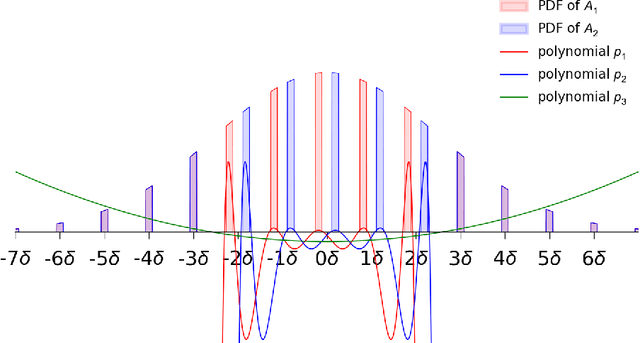
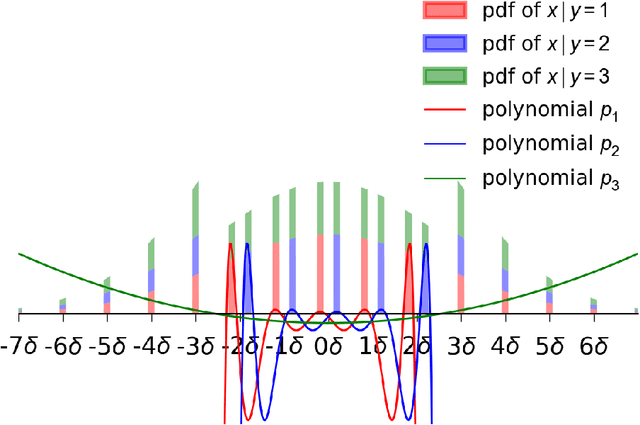
We study the task of Multiclass Linear Classification (MLC) in the distribution-free PAC model with Random Classification Noise (RCN). Specifically, the learner is given a set of labeled examples $(x, y)$, where $x$ is drawn from an unknown distribution on $R^d$ and the labels are generated by a multiclass linear classifier corrupted with RCN. That is, the label $y$ is flipped from $i$ to $j$ with probability $H_{ij}$ according to a known noise matrix $H$ with non-negative separation $\sigma: = \min_{i \neq j} H_{ii}-H_{ij}$. The goal is to compute a hypothesis with small 0-1 error. For the special case of two labels, prior work has given polynomial-time algorithms achieving the optimal error. Surprisingly, little is known about the complexity of this task even for three labels. As our main contribution, we show that the complexity of MLC with RCN becomes drastically different in the presence of three or more labels. Specifically, we prove super-polynomial Statistical Query (SQ) lower bounds for this problem. In more detail, even for three labels and constant separation, we give a super-polynomial lower bound on the complexity of any SQ algorithm achieving optimal error. For a larger number of labels and smaller separation, we show a super-polynomial SQ lower bound even for the weaker goal of achieving any constant factor approximation to the optimal loss or even beating the trivial hypothesis.
AutoCBT: An Autonomous Multi-agent Framework for Cognitive Behavioral Therapy in Psychological Counseling
Jan 16, 2025


Traditional in-person psychological counseling remains primarily niche, often chosen by individuals with psychological issues, while online automated counseling offers a potential solution for those hesitant to seek help due to feelings of shame. Cognitive Behavioral Therapy (CBT) is an essential and widely used approach in psychological counseling. The advent of large language models (LLMs) and agent technology enables automatic CBT diagnosis and treatment. However, current LLM-based CBT systems use agents with a fixed structure, limiting their self-optimization capabilities, or providing hollow, unhelpful suggestions due to redundant response patterns. In this work, we utilize Quora-like and YiXinLi single-round consultation models to build a general agent framework that generates high-quality responses for single-turn psychological consultation scenarios. We use a bilingual dataset to evaluate the quality of single-response consultations generated by each framework. Then, we incorporate dynamic routing and supervisory mechanisms inspired by real psychological counseling to construct a CBT-oriented autonomous multi-agent framework, demonstrating its general applicability. Experimental results indicate that AutoCBT can provide higher-quality automated psychological counseling services.
Active Learning of General Halfspaces: Label Queries vs Membership Queries
Dec 31, 2024We study the problem of learning general (i.e., not necessarily homogeneous) halfspaces under the Gaussian distribution on $R^d$ in the presence of some form of query access. In the classical pool-based active learning model, where the algorithm is allowed to make adaptive label queries to previously sampled points, we establish a strong information-theoretic lower bound ruling out non-trivial improvements over the passive setting. Specifically, we show that any active learner requires label complexity of $\tilde{\Omega}(d/(\log(m)\epsilon))$, where $m$ is the number of unlabeled examples. Specifically, to beat the passive label complexity of $\tilde{O} (d/\epsilon)$, an active learner requires a pool of $2^{poly(d)}$ unlabeled samples. On the positive side, we show that this lower bound can be circumvented with membership query access, even in the agnostic model. Specifically, we give a computationally efficient learner with query complexity of $\tilde{O}(\min\{1/p, 1/\epsilon\} + d\cdot polylog(1/\epsilon))$ achieving error guarantee of $O(opt)+\epsilon$. Here $p \in [0, 1/2]$ is the bias and $opt$ is the 0-1 loss of the optimal halfspace. As a corollary, we obtain a strong separation between the active and membership query models. Taken together, our results characterize the complexity of learning general halfspaces under Gaussian marginals in these models.