 Add to Chrome
 Add to Firefox
 Add to Edge
Scheduling Mixed RL Rollouts Beyond Prefix Locality
Aug 11, 2026
Modern reinforcement learning (RL) post-training pipelines for large language models (LLMs) increasingly combine rollout workloads across multiple domains and feedback paradigms. Prefix-aware routing improves inference efficiency through cache reuse and load balancing, but it does not control how heterogeneous rollout sessions compete for KV-cache capacity. When reinforcement learning with verifiable rewards (RLVR), reinforcement learning from human feedback (RLHF), and agentic rollouts share an asynchronous inference service, their distinct sequence structures, interaction patterns, and KV-residency times create substantially different serving demands. Rollout scheduling must account for this heterogeneity without distorting the workload mixture specified by the trainer. We present MISA-T, a routing-layer admission policy for mixed rollout serving. MISA-T combines adaptive session admission, workload-aware KV-capacity allocation, and residency-time-aware KV accounting. In rollout-only ablations on Step3.7 and Qwen3.6-35B-A3B, MISA-T improves rollout throughput over a sweep-tuned cache-aware vLLM Router by 53.3% and 43.6%, respectively, while maintaining high prefix-cache hit rates. In a matched 50-iteration Step3.7 experiment, it increases rollout throughput by 35.6% and reduces mean iteration time by 22.8%, while keeping the consumed workload mixture close to the trainer target and achieving comparable task scores.

Breaking the Likelihood Trap: Variance-Calibrated Modulation for Large Language Model Decoding
Jun 21, 2026In open-ended generation, LLMs frequently fall into the "likelihood trap", marked by repetitive degeneration and vocabulary dullness, creating a discrepancy between machine-generated and human-written text. While post-hoc tail truncation (e.g., Top-$p$, Min-$p$) avoids sampling from the unreliable tail, it can over-sample from the uncalibrated head and misalign generation with human lexical preferences; fixed scalar repetition penalties likewise ignore variation in logit scale across inference steps, potentially disrupting semantic coherence. To address both limitations, we propose Variance-Calibrated Modulation (VCM), a training-free pre-decoding intervention that reshapes the probability distribution before truncation through two dynamic mechanisms: (1) Contextual Searchlight via PMI, which suppresses global stopwords while elevating context-evoked tokens, and (2) Adaptive Self-Debiasing, which uses real-time logit standard deviation for scale-invariant penalization. Across open-ended generation, factual QA, and mathematical reasoning, VCM consistently mitigates the likelihood trap. With negligible computational overhead, VCM integrates with existing decoding strategies, improving diversity, coherence, and, particularly at higher decoding temperatures, reasoning accuracy.
StepAudio 2.5 Technical Report
May 22, 2026Unified audio-language modeling has emerged as a prominent trend in modern speech systems, promising to bring the reasoning capabilities of large language models to auditory tasks. However, existing unified foundations often struggle to match the depth of specialized systems across automatic speech recognition (ASR), text-to-speech synthesis (TTS), and realtime spoken interaction. Bridging this gap remains an open challenge. This report presents StepAudio 2.5, a unified audio-language foundation model that matches or exceeds specialized systems across all three capabilities. Rather than treating these tasks as architecturally distinct, we operate on the premise that once text and audio share a multimodal representational space, task specialization becomes a matter of operational regimes: data construction, optimization targets, and decoding constraints. Guided by this insight, we advance the post-training paradigm from standard supervised learning to task-tailored Reinforcement Learning from Human Feedback (RLHF), using it as the primary mechanism to define complex optimization targets. We leverage this RLHF-centric alignment, alongside specialized decoding, to shape a shared backbone into three distinct operational modes. Concretely, the ASR branch advances transcription efficiency via verifiable multi-token decoding; the TTS branch achieves controllable, expressive synthesis through preference-based RLHF and context-rich supervision; and the Realtime branch realizes low-latency, persona-consistent dialogue via generative reward modeling within an RLHF framework. On standard benchmarks, StepAudio 2.5 achieves state-of-the-art results across ASR, TTS, and Realtime, demonstrating that a singular audio-language foundation can successfully internalize the distinct deployment objectives of speech understanding, generation, and live interaction.
Beyond Temperature: Hyperfitting as a Late-Stage Geometric Expansion
May 21, 2026Recent work has identified a counterintuitive phenomenon termed "Hyperfitting", where fine-tuning Large Language Models (LLMs) to near-zero training loss on small datasets surprisingly enhances open-ended generation quality and mitigates repetition in greedy decoding. While effective, the underlying mechanism remains poorly understood, with the extremely low-entropy output distributions suggesting a potential equivalence to simple temperature scaling. In this work, we demonstrate that this phenomenon is fundamentally distinct from distribution sharpening; entropy-matched control experiments reveal that temperature scaling fails to replicate the diversity gains of hyperfitting. Furthermore, we falsify the hypothesis of static vocabulary reweighting, showing through ablation studies that hyperfitting relies on a dynamic, context-dependent rank reordering mechanism. Layer-wise analysis localizes this effect to a "Terminal Expansion" in the final transformer block, where a substantial geometric expansion of the feature space (Delta Dim approx +80.8) facilitates the promotion of deep-tail tokens. Additionally, we introduce Late-Stage LoRA, a targeted fine-tuning strategy that updates only the final 5 layers, yielding robust generation with minimal parameter updates
Follow the TRACE: Exploiting Post-Click Trajectories for Online Delayed Conversion Rate Prediction
Apr 25, 2026Delayed feedback poses a core challenge for online CVR prediction, forcing a trade-off between label accuracy and data freshness. Existing methods address this through delay modeling or sample reweighting, yet neglect how post-click behaviors evolve over the observation period. To overcome this limitation, we formalize this evolution as feedback trajectory and propose TRACE. Instead of forcing hard labels on unrevealed samples, our method evaluates how well the accumulated feedback status aligns with conversion versus non-conversion, dynamically refining posteriors without waiting for final outcomes. To counteract early-stage trajectory sparsity, we further design a reliability-gated retrospective completer that leverages full-lifecycle data to provide adaptive posterior guidance for unrevealed samples. Extensive experiments validate TRACE's superiority over state-of-the-art baselines and confirm the retrospective completion module as a model-agnostic enhancer for existing systems. Our code is available at https://github.com/LunaZhangxy/TRACE.
Min-$k$ Sampling: Decoupling Truncation from Temperature Scaling via Relative Logit Dynamics
Apr 13, 2026The quality of text generated by large language models depends critically on the decoding sampling strategy. While mainstream methods such as Top-$k$, Top-$p$, and Min-$p$ achieve a balance between diversity and accuracy through probability-space truncation, they share an inherent limitation: extreme sensitivity to the temperature parameter. Recent logit-space approaches like Top-$nσ$ achieve temperature invariance but rely on global statistics that are susceptible to long-tail noise, failing to capture fine-grained confidence structures among top candidates. We propose \textbf{Min-$k$ Sampling}, a novel dynamic truncation strategy that analyzes the local shape of the sorted logit distribution to identify "semantic cliffs": sharp transitions from high-confidence core tokens to uncertain long-tail tokens. By computing a position-weighted relative decay rate, Min-$k$ dynamically determines truncation boundaries at each generation step. We formally prove that Min-$k$ achieves strict temperature invariance and empirically demonstrate its low sensitivity to hyperparameter choices. Experiments on multiple reasoning benchmarks, creative writing tasks, and human evaluation show that Min-$k$ consistently improves text quality, maintaining robust performance even under extreme temperature settings where probability-based methods collapse. We make our code, models, and analysis tools publicly available.
Step 3.5 Flash: Open Frontier-Level Intelligence with 11B Active Parameters
Feb 11, 2026We introduce Step 3.5 Flash, a sparse Mixture-of-Experts (MoE) model that bridges frontier-level agentic intelligence and computational efficiency. We focus on what matters most when building agents: sharp reasoning and fast, reliable execution. Step 3.5 Flash pairs a 196B-parameter foundation with 11B active parameters for efficient inference. It is optimized with interleaved 3:1 sliding-window/full attention and Multi-Token Prediction (MTP-3) to reduce the latency and cost of multi-round agentic interactions. To reach frontier-level intelligence, we design a scalable reinforcement learning framework that combines verifiable signals with preference feedback, while remaining stable under large-scale off-policy training, enabling consistent self-improvement across mathematics, code, and tool use. Step 3.5 Flash demonstrates strong performance across agent, coding, and math tasks, achieving 85.4% on IMO-AnswerBench, 86.4% on LiveCodeBench-v6 (2024.08-2025.05), 88.2% on tau2-Bench, 69.0% on BrowseComp (with context management), and 51.0% on Terminal-Bench 2.0, comparable to frontier models such as GPT-5.2 xHigh and Gemini 3.0 Pro. By redefining the efficiency frontier, Step 3.5 Flash provides a high-density foundation for deploying sophisticated agents in real-world industrial environments.
GUARD: Glocal Uncertainty-Aware Robust Decoding for Effective and Efficient Open-Ended Text Generation
Aug 28, 2025
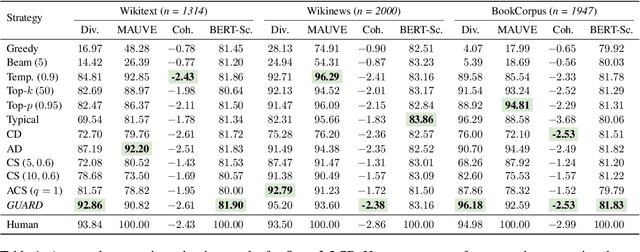
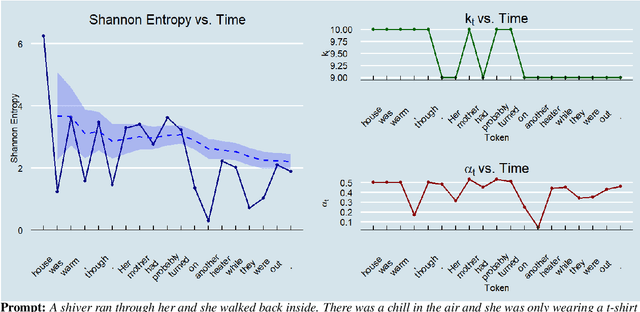
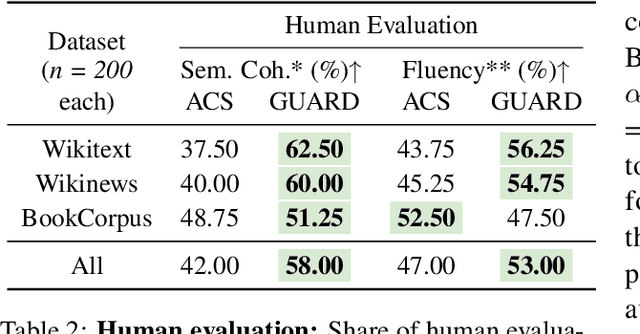
Open-ended text generation faces a critical challenge: balancing coherence with diversity in LLM outputs. While contrastive search-based decoding strategies have emerged to address this trade-off, their practical utility is often limited by hyperparameter dependence and high computational costs. We introduce GUARD, a self-adaptive decoding method that effectively balances these competing objectives through a novel "Glocal" uncertainty-driven framework. GUARD combines global entropy estimates with local entropy deviations to integrate both long-term and short-term uncertainty signals. We demonstrate that our proposed global entropy formulation effectively mitigates abrupt variations in uncertainty, such as sudden overconfidence or high entropy spikes, and provides theoretical guarantees of unbiasedness and consistency. To reduce computational overhead, we incorporate a simple yet effective token-count-based penalty into GUARD. Experimental results demonstrate that GUARD achieves a good balance between text diversity and coherence, while exhibiting substantial improvements in generation speed. In a more nuanced comparison study across different dimensions of text quality, both human and LLM evaluators validated its remarkable performance. Our code is available at https://github.com/YecanLee/GUARD.
Step-Audio 2 Technical Report
Jul 24, 2025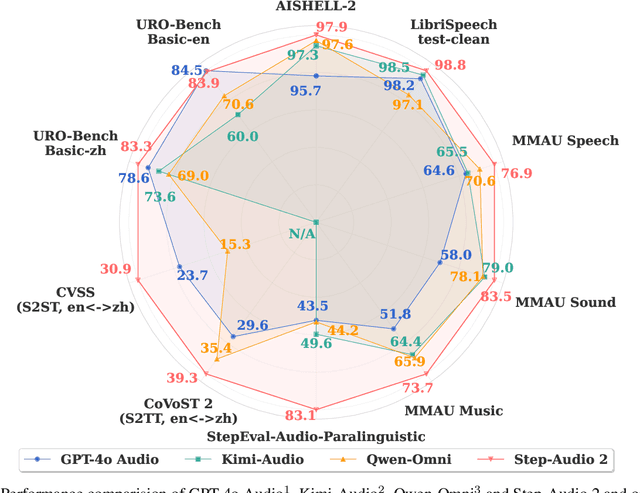
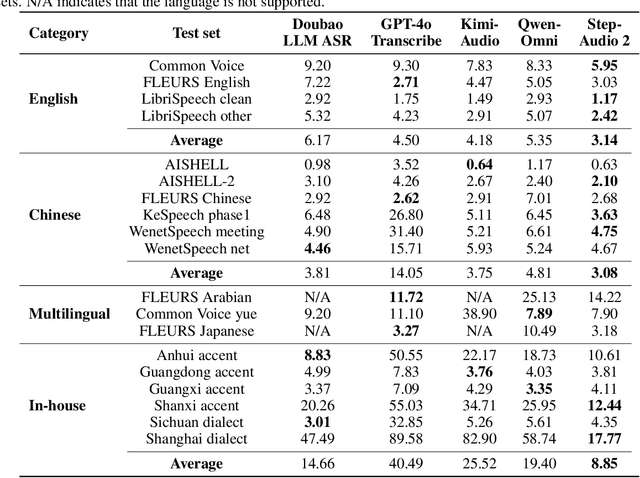
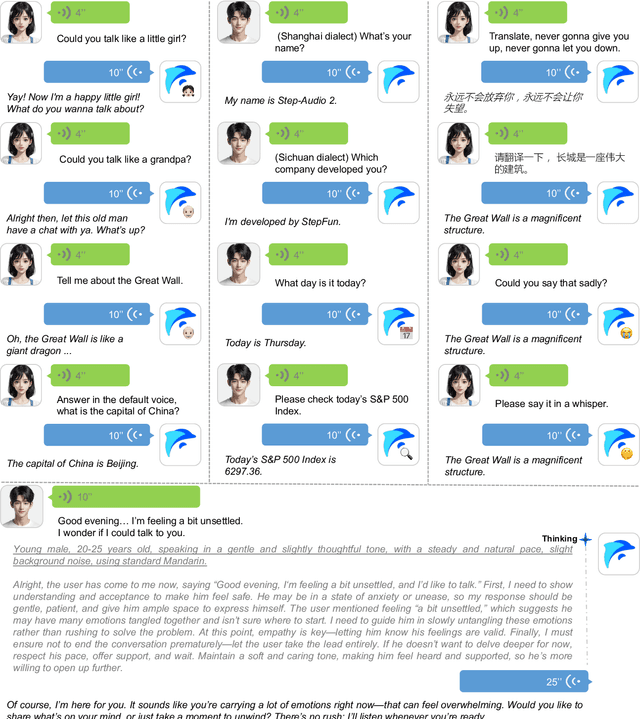
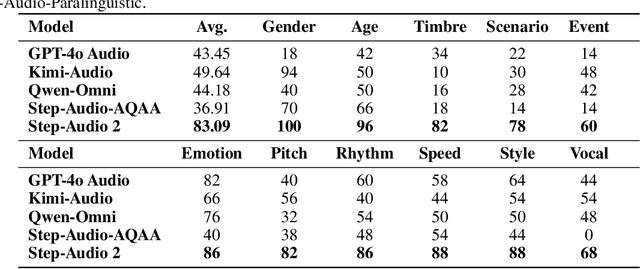
This paper presents Step-Audio 2, an end-to-end multi-modal large language model designed for industry-strength audio understanding and speech conversation. By integrating a latent audio encoder and reasoning-centric reinforcement learning (RL), Step-Audio 2 achieves promising performance in automatic speech recognition (ASR) and audio understanding. To facilitate genuine end-to-end speech conversation, Step-Audio 2 incorporates the generation of discrete audio tokens into language modeling, significantly enhancing its responsiveness to paralinguistic information such as speaking styles and emotions. To effectively leverage the rich textual and acoustic knowledge in real-world data, Step-Audio 2 integrates retrieval-augmented generation (RAG) and is able to call external tools such as web search to mitigate hallucination and audio search to switch timbres. Trained on millions of hours of speech and audio data, Step-Audio 2 delivers intelligence and expressiveness across diverse conversational scenarios. Evaluation results demonstrate that Step-Audio 2 achieves state-of-the-art performance on various audio understanding and conversational benchmarks compared to other open-source and commercial solutions. Please visit https://github.com/stepfun-ai/Step-Audio2 for more information.
Step-Audio: Unified Understanding and Generation in Intelligent Speech Interaction
Feb 18, 2025Real-time speech interaction, serving as a fundamental interface for human-machine collaboration, holds immense potential. However, current open-source models face limitations such as high costs in voice data collection, weakness in dynamic control, and limited intelligence. To address these challenges, this paper introduces Step-Audio, the first production-ready open-source solution. Key contributions include: 1) a 130B-parameter unified speech-text multi-modal model that achieves unified understanding and generation, with the Step-Audio-Chat version open-sourced; 2) a generative speech data engine that establishes an affordable voice cloning framework and produces the open-sourced lightweight Step-Audio-TTS-3B model through distillation; 3) an instruction-driven fine control system enabling dynamic adjustments across dialects, emotions, singing, and RAP; 4) an enhanced cognitive architecture augmented with tool calling and role-playing abilities to manage complex tasks effectively. Based on our new StepEval-Audio-360 evaluation benchmark, Step-Audio achieves state-of-the-art performance in human evaluations, especially in terms of instruction following. On open-source benchmarks like LLaMA Question, shows 9.3% average performance improvement, demonstrating our commitment to advancing the development of open-source multi-modal language technologies. Our code and models are available at https://github.com/stepfun-ai/Step-Audio.