 Add to Chrome
 Add to Firefox
 Add to Edge
Breaking the Likelihood Trap: Variance-Calibrated Modulation for Large Language Model Decoding
Jun 21, 2026
In open-ended generation, LLMs frequently fall into the "likelihood trap", marked by repetitive degeneration and vocabulary dullness, creating a discrepancy between machine-generated and human-written text. While post-hoc tail truncation (e.g., Top-$p$, Min-$p$) avoids sampling from the unreliable tail, it can over-sample from the uncalibrated head and misalign generation with human lexical preferences; fixed scalar repetition penalties likewise ignore variation in logit scale across inference steps, potentially disrupting semantic coherence. To address both limitations, we propose Variance-Calibrated Modulation (VCM), a training-free pre-decoding intervention that reshapes the probability distribution before truncation through two dynamic mechanisms: (1) Contextual Searchlight via PMI, which suppresses global stopwords while elevating context-evoked tokens, and (2) Adaptive Self-Debiasing, which uses real-time logit standard deviation for scale-invariant penalization. Across open-ended generation, factual QA, and mathematical reasoning, VCM consistently mitigates the likelihood trap. With negligible computational overhead, VCM integrates with existing decoding strategies, improving diversity, coherence, and, particularly at higher decoding temperatures, reasoning accuracy.

Beyond Temperature: Hyperfitting as a Late-Stage Geometric Expansion
May 21, 2026Recent work has identified a counterintuitive phenomenon termed "Hyperfitting", where fine-tuning Large Language Models (LLMs) to near-zero training loss on small datasets surprisingly enhances open-ended generation quality and mitigates repetition in greedy decoding. While effective, the underlying mechanism remains poorly understood, with the extremely low-entropy output distributions suggesting a potential equivalence to simple temperature scaling. In this work, we demonstrate that this phenomenon is fundamentally distinct from distribution sharpening; entropy-matched control experiments reveal that temperature scaling fails to replicate the diversity gains of hyperfitting. Furthermore, we falsify the hypothesis of static vocabulary reweighting, showing through ablation studies that hyperfitting relies on a dynamic, context-dependent rank reordering mechanism. Layer-wise analysis localizes this effect to a "Terminal Expansion" in the final transformer block, where a substantial geometric expansion of the feature space (Delta Dim approx +80.8) facilitates the promotion of deep-tail tokens. Additionally, we introduce Late-Stage LoRA, a targeted fine-tuning strategy that updates only the final 5 layers, yielding robust generation with minimal parameter updates
Lost in Translation? Exploring the Shift in Grammatical Gender from Latin to Occitan
May 09, 2026The diachronic evolution from Latin to the Romance languages involved a restructuring of the grammatical gender system from a tripartite configuration (masculine, feminine, neuter) to a bipartite one (masculine, feminine). In this work, we introduce an interpretable deep learning framework to investigate this phenomenon at both lexical and contextual levels. First, we show that conventional tokenization strategies are insufficiently robust for this low-resource historical setting, and that our proposed tokenizer improves performance over these baselines. At the lexical level, we evaluate the contribution of morphological features to gender prediction. At the contextual level, we quantify the contributions of different part-of-speech categories to grammatical gender prediction. Together, these analyses characterize the distribution of gender information between the lemma and its sentential context. We make our codebase, datasets, and results publicly available.
From Traditional Taggers to LLMs: A Comparative Study of POS Tagging for Medieval Romance Languages
May 09, 2026Part-of-speech (POS) tagging for Medieval Romance languages remains challenging due to orthographic variation, morphological complexity, and limited annotated resources. This paper presents a systematic empirical evaluation of large language models (LLMs) for POS tagging across three medieval varieties: Medieval Occitan, Medieval Catalan, and Medieval French. We compare traditional rule-based and statistical taggers with modern open-source LLMs under zero-shot prompting, few-shot prompting, monolingual fine-tuning, and cross-lingual transfer learning settings. Experiments on historically grounded datasets show that LLM-based approaches consistently outperform traditional taggers, with fine-tuning and multilingual training yielding the largest improvements. In particular, cross-lingual transfer learning substantially benefits under-resourced varieties, while targeted bilingual training can outperform broader multilingual configurations for specific target languages. The results highlight the importance of linguistic proximity and dataset characteristics when designing transfer strategies for historical NLP. These findings provide empirical insights into the applicability of modern neural methods to medieval text processing and provide practical guidance for deploying LLM-based POS tagging pipelines in digital humanities research. All code, models, and processed datasets are released for reproducibility.
Min-$k$ Sampling: Decoupling Truncation from Temperature Scaling via Relative Logit Dynamics
Apr 13, 2026The quality of text generated by large language models depends critically on the decoding sampling strategy. While mainstream methods such as Top-$k$, Top-$p$, and Min-$p$ achieve a balance between diversity and accuracy through probability-space truncation, they share an inherent limitation: extreme sensitivity to the temperature parameter. Recent logit-space approaches like Top-$nσ$ achieve temperature invariance but rely on global statistics that are susceptible to long-tail noise, failing to capture fine-grained confidence structures among top candidates. We propose \textbf{Min-$k$ Sampling}, a novel dynamic truncation strategy that analyzes the local shape of the sorted logit distribution to identify "semantic cliffs": sharp transitions from high-confidence core tokens to uncertain long-tail tokens. By computing a position-weighted relative decay rate, Min-$k$ dynamically determines truncation boundaries at each generation step. We formally prove that Min-$k$ achieves strict temperature invariance and empirically demonstrate its low sensitivity to hyperparameter choices. Experiments on multiple reasoning benchmarks, creative writing tasks, and human evaluation show that Min-$k$ consistently improves text quality, maintaining robust performance even under extreme temperature settings where probability-based methods collapse. We make our code, models, and analysis tools publicly available.
The Truncation Blind Spot: How Decoding Strategies Systematically Exclude Human-Like Token Choices
Mar 19, 2026Standard decoding strategies for text generation, including top-k, nucleus sampling, and contrastive search, select tokens based on likelihood, restricting selection to high-probability regions. Human language production operates differently: tokens are chosen for communicative appropriateness rather than statistical frequency. This mismatch creates a truncation blind spot: contextually appropriate but statistically rare tokens remain accessible to humans yet unreachable by likelihood-based decoding. We hypothesize this contributes to the detectability of machine-generated text. Analyzing over 1.8 million texts across eight language models, five decoding strategies, and 53 hyperparameter configurations, we find that 8-18% of human-selected tokens fall outside typical truncation boundaries. Simple classifiers trained on predictability and lexical diversity achieve remarkable detection rates. Crucially, neither model scale nor architecture correlates strongly with detectability; truncation parameters account for most variance. Configurations achieving low detectability often produce incoherent text, indicating that evading detection and producing natural text are distinct objectives. These findings suggest detectability is enhanced by likelihood-based token selection, not merely a matter of model capability.
Digitizing Nepal's Written Heritage: A Comprehensive HTR Pipeline for Old Nepali Manuscripts
Dec 18, 2025
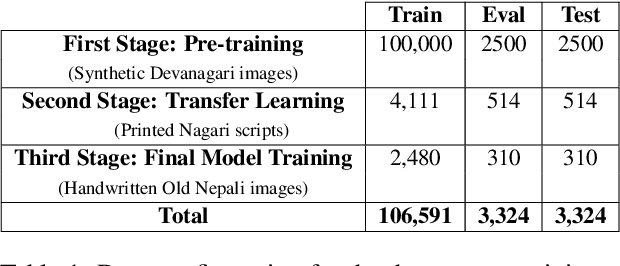


This paper presents the first end-to-end pipeline for Handwritten Text Recognition (HTR) for Old Nepali, a historically significant but low-resource language. We adopt a line-level transcription approach and systematically explore encoder-decoder architectures and data-centric techniques to improve recognition accuracy. Our best model achieves a Character Error Rate (CER) of 4.9\%. In addition, we implement and evaluate decoding strategies and analyze token-level confusions to better understand model behaviour and error patterns. While the dataset we used for evaluation is confidential, we release our training code, model configurations, and evaluation scripts to support further research in HTR for low-resource historical scripts.
GUARD: Glocal Uncertainty-Aware Robust Decoding for Effective and Efficient Open-Ended Text Generation
Aug 28, 2025
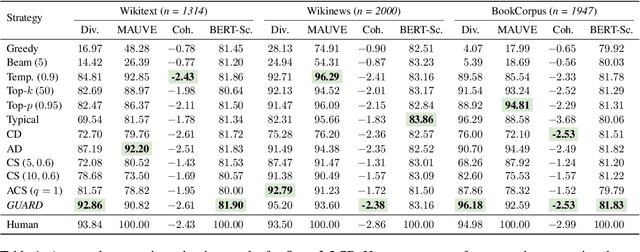
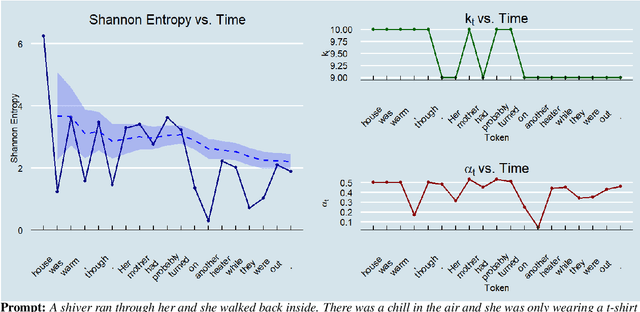
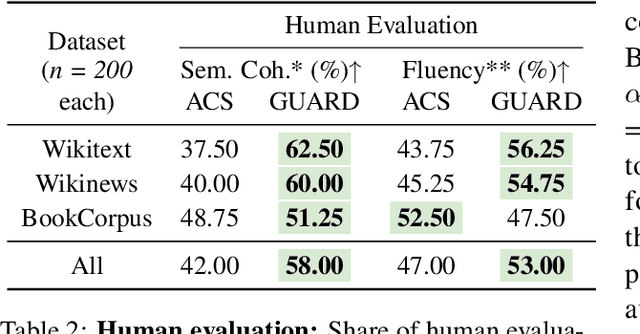
Open-ended text generation faces a critical challenge: balancing coherence with diversity in LLM outputs. While contrastive search-based decoding strategies have emerged to address this trade-off, their practical utility is often limited by hyperparameter dependence and high computational costs. We introduce GUARD, a self-adaptive decoding method that effectively balances these competing objectives through a novel "Glocal" uncertainty-driven framework. GUARD combines global entropy estimates with local entropy deviations to integrate both long-term and short-term uncertainty signals. We demonstrate that our proposed global entropy formulation effectively mitigates abrupt variations in uncertainty, such as sudden overconfidence or high entropy spikes, and provides theoretical guarantees of unbiasedness and consistency. To reduce computational overhead, we incorporate a simple yet effective token-count-based penalty into GUARD. Experimental results demonstrate that GUARD achieves a good balance between text diversity and coherence, while exhibiting substantial improvements in generation speed. In a more nuanced comparison study across different dimensions of text quality, both human and LLM evaluators validated its remarkable performance. Our code is available at https://github.com/YecanLee/GUARD.
Modern Models, Medieval Texts: A POS Tagging Study of Old Occitan
Mar 10, 2025Large language models (LLMs) have demonstrated remarkable capabilities in natural language processing, yet their effectiveness in handling historical languages remains largely unexplored. This study examines the performance of open-source LLMs in part-of-speech (POS) tagging for Old Occitan, a historical language characterized by non-standardized orthography and significant diachronic variation. Through comparative analysis of two distinct corpora-hagiographical and medical texts-we evaluate how current models handle the inherent challenges of processing a low-resource historical language. Our findings demonstrate critical limitations in LLM performance when confronted with extreme orthographic and syntactic variability. We provide detailed error analysis and specific recommendations for improving model performance in historical language processing. This research advances our understanding of LLM capabilities in challenging linguistic contexts while offering practical insights for both computational linguistics and historical language studies.
A Statistical Case Against Empirical Human-AI Alignment
Feb 20, 2025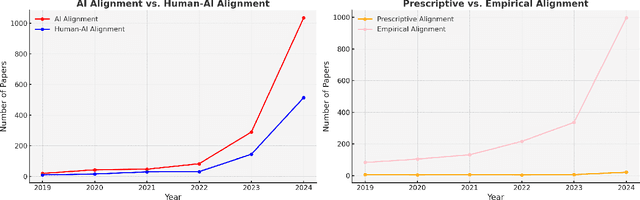
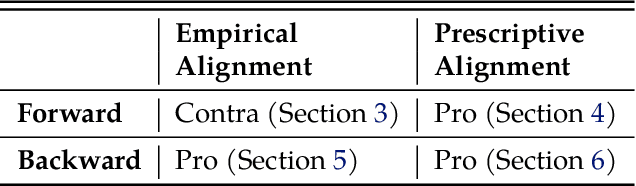


Empirical human-AI alignment aims to make AI systems act in line with observed human behavior. While noble in its goals, we argue that empirical alignment can inadvertently introduce statistical biases that warrant caution. This position paper thus advocates against naive empirical alignment, offering prescriptive alignment and a posteriori empirical alignment as alternatives. We substantiate our principled argument by tangible examples like human-centric decoding of language models.