 Add to Chrome
 Add to Firefox
 Add to Edge
SoLA: Solver-Layer Adaption of LLM for Better Logic Reasoning
Feb 19, 2024
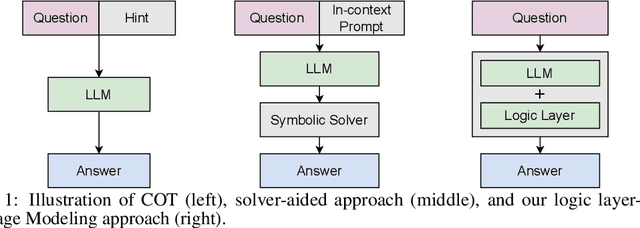


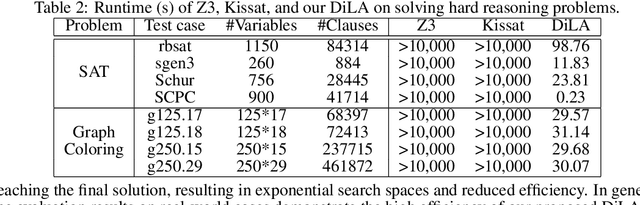
Considering the challenges faced by large language models (LLMs) on logical reasoning, prior efforts have sought to transform problem-solving through tool learning. While progress has been made on small-scale problems, solving industrial cases remains difficult due to their large scale and intricate expressions. In this paper, we propose a novel solver-layer adaptation (SoLA) method, where we introduce a solver as a new layer of the LLM to differentially guide solutions towards satisfiability. In SoLA, LLM aims to comprehend the search space described in natural language and identify local solutions of the highest quality, while the solver layer focuses solely on constraints not satisfied by the initial solution. Leveraging MaxSAT as a bridge, we define forward and backward transfer gradients, enabling the final model to converge to a satisfied solution or prove unsatisfiability. The backdoor theory ensures that SoLA can obtain accurate solutions within polynomial loops. We evaluate the performance of SoLA on various datasets and empirically demonstrate its consistent outperformance against existing symbolic solvers (including Z3 and Kissat) and tool-learning methods in terms of efficiency in large-scale problem-solving.

SMUTF: Schema Matching Using Generative Tags and Hybrid Features
Feb 06, 2024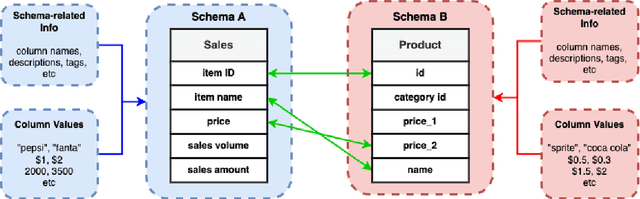
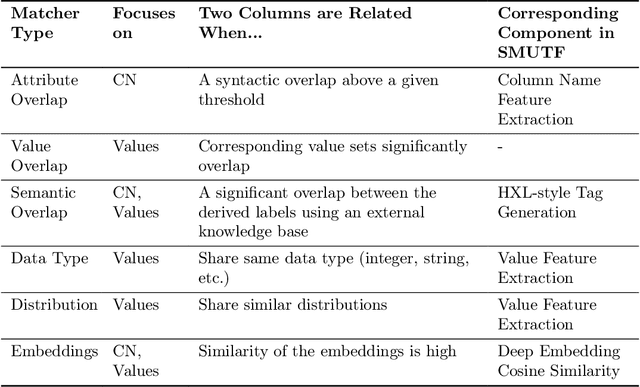
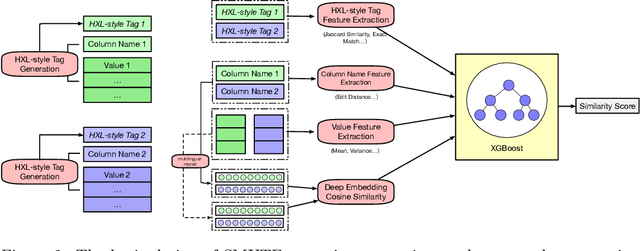
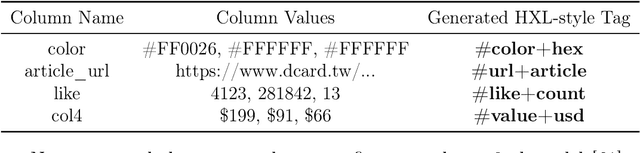
We introduce SMUTF, a unique approach for large-scale tabular data schema matching (SM), which assumes that supervised learning does not affect performance in open-domain tasks, thereby enabling effective cross-domain matching. This system uniquely combines rule-based feature engineering, pre-trained language models, and generative large language models. In an innovative adaptation inspired by the Humanitarian Exchange Language, we deploy 'generative tags' for each data column, enhancing the effectiveness of SM. SMUTF exhibits extensive versatility, working seamlessly with any pre-existing pre-trained embeddings, classification methods, and generative models. Recognizing the lack of extensive, publicly available datasets for SM, we have created and open-sourced the HDXSM dataset from the public humanitarian data. We believe this to be the most exhaustive SM dataset currently available. In evaluations across various public datasets and the novel HDXSM dataset, SMUTF demonstrated exceptional performance, surpassing existing state-of-the-art models in terms of accuracy and efficiency, and} improving the F1 score by 11.84% and the AUC of ROC by 5.08%.
Evaluating Large Language Models in Analysing Classroom Dialogue
Feb 06, 2024This study explores the application of Large Language Models (LLMs), specifically GPT-4, in the analysis of classroom dialogue, a crucial research task for both teaching diagnosis and quality improvement. Recognizing the knowledge-intensive and labor-intensive nature of traditional qualitative methods in educational research, this study investigates the potential of LLM to streamline and enhance the analysis process. The study involves datasets from a middle school, encompassing classroom dialogues across mathematics and Chinese classes. These dialogues were manually coded by educational experts and then analyzed using a customised GPT-4 model. This study focuses on comparing manual annotations with the outputs of GPT-4 to evaluate its efficacy in analyzing educational dialogues. Time efficiency, inter-coder agreement, and inter-coder reliability between human coders and GPT-4 are evaluated. Results indicate substantial time savings with GPT-4, and a high degree of consistency in coding between the model and human coders, with some discrepancies in specific codes. These findings highlight the strong potential of LLM in teaching evaluation and facilitation.
KICGPT: Large Language Model with Knowledge in Context for Knowledge Graph Completion
Feb 04, 2024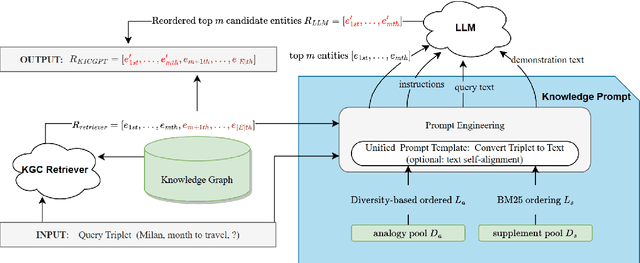
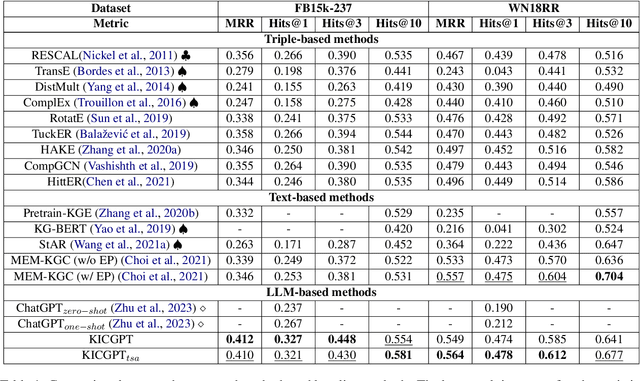
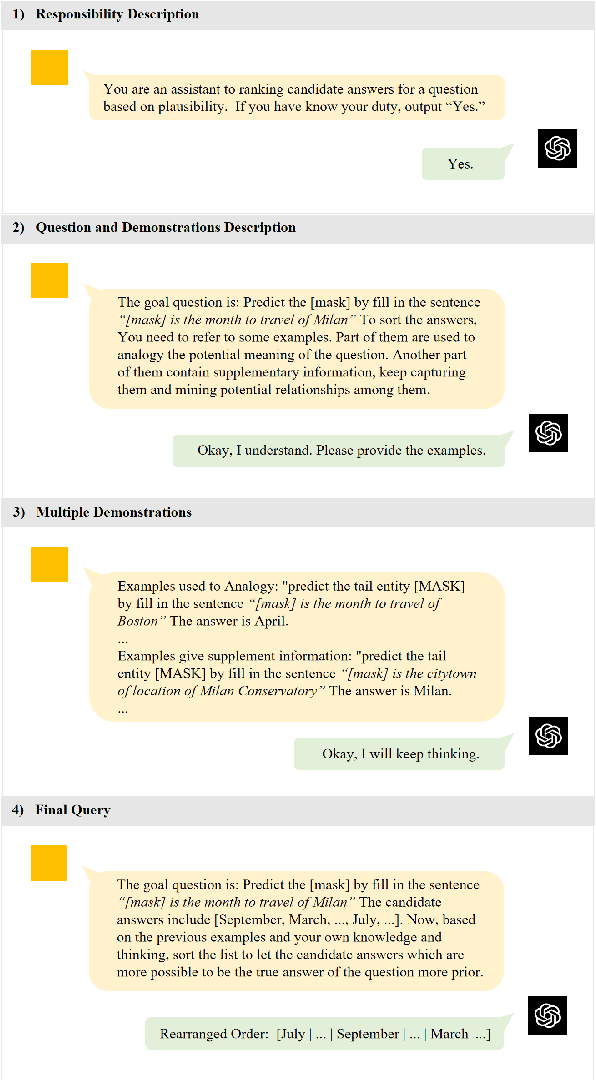
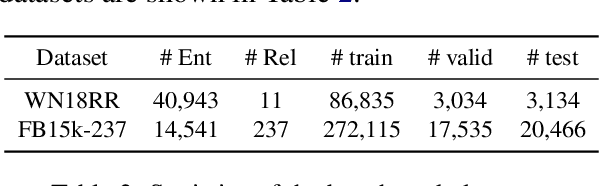
Knowledge Graph Completion (KGC) is crucial for addressing knowledge graph incompleteness and supporting downstream applications. Many models have been proposed for KGC. They can be categorized into two main classes: triple-based and text-based approaches. Triple-based methods struggle with long-tail entities due to limited structural information and imbalanced entity distributions. Text-based methods alleviate this issue but require costly training for language models and specific finetuning for knowledge graphs, which limits their efficiency. To alleviate these limitations, in this paper, we propose KICGPT, a framework that integrates a large language model (LLM) and a triple-based KGC retriever. It alleviates the long-tail problem without incurring additional training overhead. KICGPT uses an in-context learning strategy called Knowledge Prompt, which encodes structural knowledge into demonstrations to guide the LLM. Empirical results on benchmark datasets demonstrate the effectiveness of KICGPT with smaller training overhead and no finetuning.
Rendering Graphs for Graph Reasoning in Multimodal Large Language Models
Feb 03, 2024Large Language Models (LLMs) are increasingly used for various tasks with graph structures, such as robotic planning, knowledge graph completion, and common-sense reasoning. Though LLMs can comprehend graph information in a textual format, they overlook the rich visual modality, which is an intuitive way for humans to comprehend structural information and conduct graph reasoning. The potential benefits and capabilities of representing graph structures as visual images (i.e., visual graph) is still unexplored. In this paper, we take the first step in incorporating visual information into graph reasoning tasks and propose a new benchmark GITQA, where each sample is a tuple (graph, image, textual description). We conduct extensive experiments on the GITQA benchmark using state-of-the-art multimodal LLMs. Results on graph reasoning tasks show that combining textual and visual information together performs better than using one modality alone. Moreover, the LLaVA-7B/13B models finetuned on the training set achieve higher accuracy than the closed-source model GPT-4(V). We also study the effects of augmentations in graph reasoning.
Distribution-consistency Structural Causal Models
Jan 30, 2024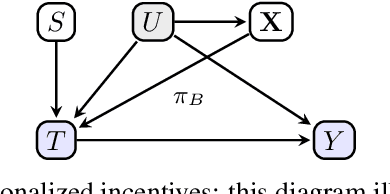
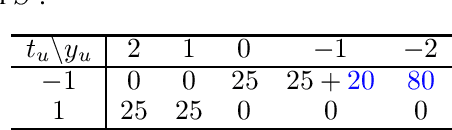
In the field of causal modeling, potential outcomes (PO) and structural causal models (SCMs) stand as the predominant frameworks. However, these frameworks face notable challenges in practically modeling counterfactuals, formalized as parameters of the joint distribution of potential outcomes. Counterfactual reasoning holds paramount importance in contemporary decision-making processes, especially in scenarios that demand personalized incentives based on the joint values of $(Y(0), Y(1))$. This paper begins with an investigation of the PO and SCM frameworks for modeling counterfactuals. Through the analysis, we identify an inherent model capacity limitation, termed as the ``degenerative counterfactual problem'', emerging from the consistency rule that is the cornerstone of both frameworks. To address this limitation, we introduce a novel \textit{distribution-consistency} assumption, and in alignment with it, we propose the Distribution-consistency Structural Causal Models (DiscoSCMs) offering enhanced capabilities to model counterfactuals. To concretely reveal the enhanced model capacity, we introduce a new identifiable causal parameter, \textit{the probability of consistency}, which holds practical significance within DiscoSCM alone, showcased with a personalized incentive example. Furthermore, we provide a comprehensive set of theoretical results about the ``Ladder of Causation'' within the DiscoSCM framework. We hope it opens new avenues for future research of counterfactual modeling, ultimately enhancing our understanding of causality and its real-world applications.
Multilingual and Fully Non-Autoregressive ASR with Large Language Model Fusion: A Comprehensive Study
Jan 23, 2024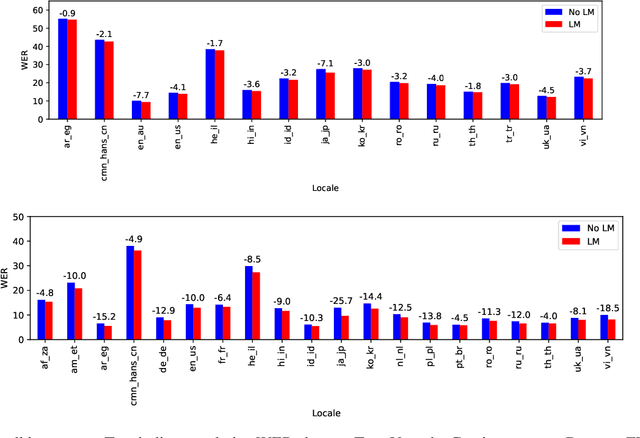
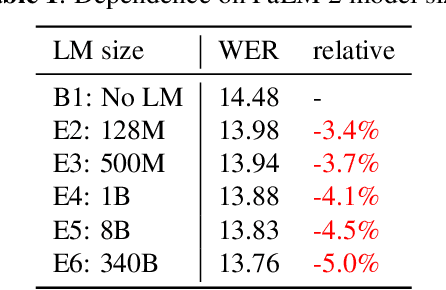
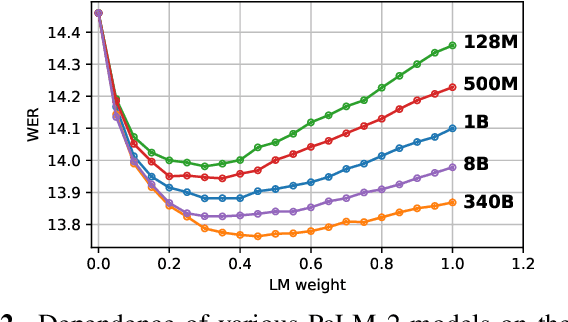
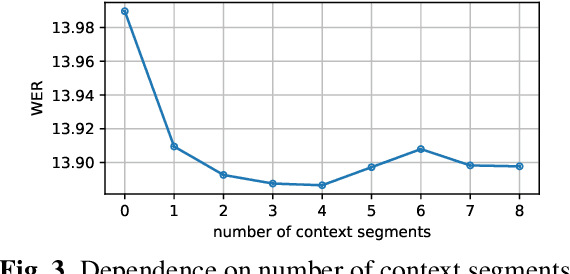
In the era of large models, the autoregressive nature of decoding often results in latency serving as a significant bottleneck. We propose a non-autoregressive LM-fused ASR system that effectively leverages the parallelization capabilities of accelerator hardware. Our approach combines the Universal Speech Model (USM) and the PaLM 2 language model in per-segment scoring mode, achieving an average relative WER improvement across all languages of 10.8% on FLEURS and 3.6% on YouTube captioning. Furthermore, our comprehensive ablation study analyzes key parameters such as LLM size, context length, vocabulary size, fusion methodology. For instance, we explore the impact of LLM size ranging from 128M to 340B parameters on ASR performance. This study provides valuable insights into the factors influencing the effectiveness of practical large-scale LM-fused speech recognition systems.
Seed-Guided Fine-Grained Entity Typing in Science and Engineering Domains
Jan 23, 2024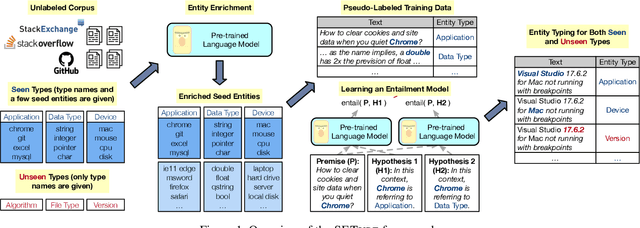
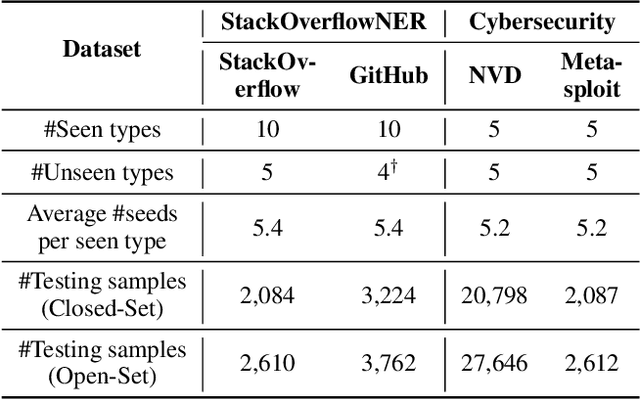
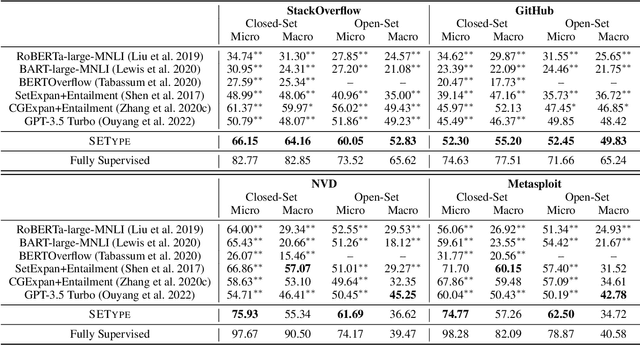
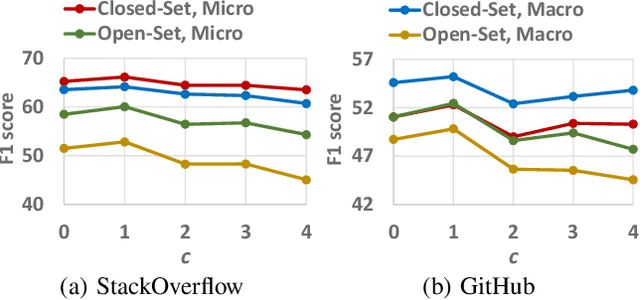
Accurately typing entity mentions from text segments is a fundamental task for various natural language processing applications. Many previous approaches rely on massive human-annotated data to perform entity typing. Nevertheless, collecting such data in highly specialized science and engineering domains (e.g., software engineering and security) can be time-consuming and costly, without mentioning the domain gaps between training and inference data if the model needs to be applied to confidential datasets. In this paper, we study the task of seed-guided fine-grained entity typing in science and engineering domains, which takes the name and a few seed entities for each entity type as the only supervision and aims to classify new entity mentions into both seen and unseen types (i.e., those without seed entities). To solve this problem, we propose SEType which first enriches the weak supervision by finding more entities for each seen type from an unlabeled corpus using the contextualized representations of pre-trained language models. It then matches the enriched entities to unlabeled text to get pseudo-labeled samples and trains a textual entailment model that can make inferences for both seen and unseen types. Extensive experiments on two datasets covering four domains demonstrate the effectiveness of SEType in comparison with various baselines.
HG3-NeRF: Hierarchical Geometric, Semantic, and Photometric Guided Neural Radiance Fields for Sparse View Inputs
Jan 22, 2024Neural Radiance Fields (NeRF) have garnered considerable attention as a paradigm for novel view synthesis by learning scene representations from discrete observations. Nevertheless, NeRF exhibit pronounced performance degradation when confronted with sparse view inputs, consequently curtailing its further applicability. In this work, we introduce Hierarchical Geometric, Semantic, and Photometric Guided NeRF (HG3-NeRF), a novel methodology that can address the aforementioned limitation and enhance consistency of geometry, semantic content, and appearance across different views. We propose Hierarchical Geometric Guidance (HGG) to incorporate the attachment of Structure from Motion (SfM), namely sparse depth prior, into the scene representations. Different from direct depth supervision, HGG samples volume points from local-to-global geometric regions, mitigating the misalignment caused by inherent bias in the depth prior. Furthermore, we draw inspiration from notable variations in semantic consistency observed across images of different resolutions and propose Hierarchical Semantic Guidance (HSG) to learn the coarse-to-fine semantic content, which corresponds to the coarse-to-fine scene representations. Experimental results demonstrate that HG3-NeRF can outperform other state-of-the-art methods on different standard benchmarks and achieve high-fidelity synthesis results for sparse view inputs.
E^2-LLM: Efficient and Extreme Length Extension of Large Language Models
Jan 18, 2024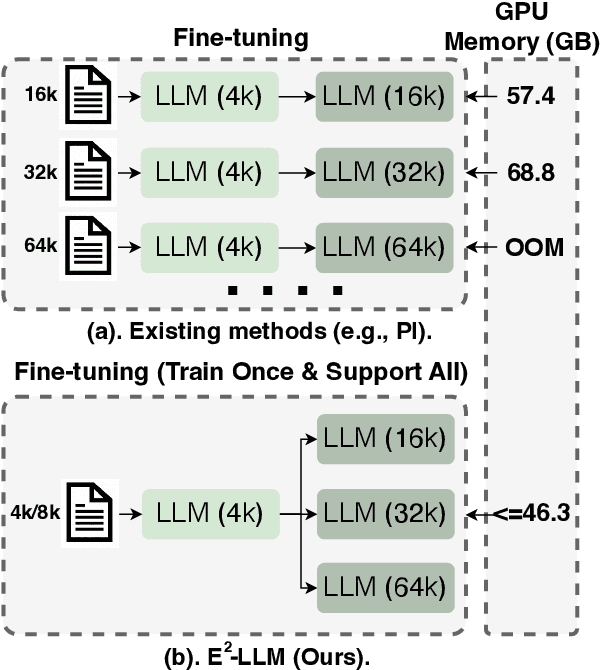
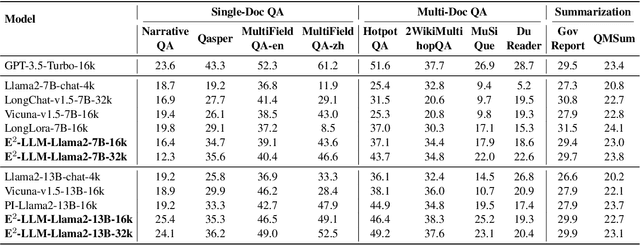

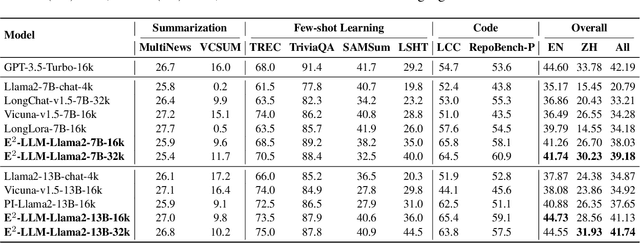
Typically, training LLMs with long context sizes is computationally expensive, requiring extensive training hours and GPU resources. Existing long-context extension methods usually need additional training procedures to support corresponding long-context windows, where the long-context training data (e.g., 32k) is needed, and high GPU training costs are assumed. To address the aforementioned issues, we propose an Efficient and Extreme length extension method for Large Language Models, called E 2 -LLM, with only one training procedure and dramatically reduced computation cost, which also removes the need to collect long-context data. Concretely, first, the training data of our E 2 -LLM only requires a short length (e.g., 4k), which reduces the tuning cost greatly. Second, the training procedure on the short training context window is performed only once time, and we can support different evaluation context windows at inference. Third, in E 2 - LLM, based on RoPE position embeddings, we introduce two different augmentation methods on the scale and position index parameters for different samples in training. It aims to make the model more robust to the different relative differences when directly interpolating the arbitrary context length at inference. Comprehensive experimental results on multiple benchmark datasets demonstrate the effectiveness of our E 2 -LLM on challenging long-context tasks.