 Add to Chrome
 Add to Firefox
 Add to Edge
Log-Linear Attention
Jun 05, 2025
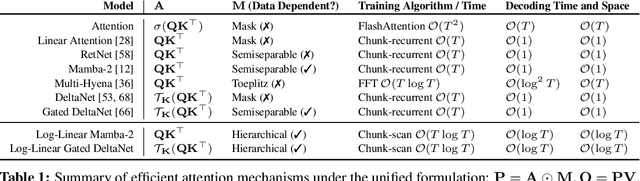
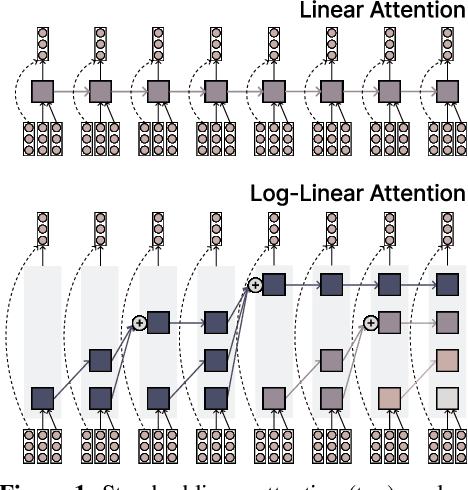

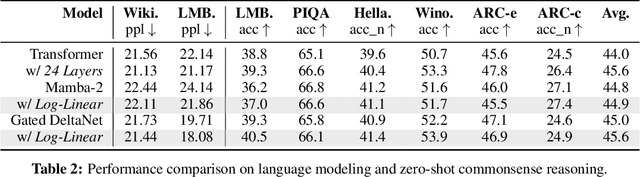
The attention mechanism in Transformers is an important primitive for accurate and scalable sequence modeling. Its quadratic-compute and linear-memory complexity however remain significant bottlenecks. Linear attention and state-space models enable linear-time, constant-memory sequence modeling and can moreover be trained efficiently through matmul-rich parallelization across sequence length. However, at their core these models are still RNNs, and thus their use of a fixed-size hidden state to model the context is a fundamental limitation. This paper develops log-linear attention, an attention mechanism that balances linear attention's efficiency and the expressiveness of softmax attention. Log-linear attention replaces the fixed-size hidden state with a logarithmically growing set of hidden states. We show that with a particular growth function, log-linear attention admits a similarly matmul-rich parallel form whose compute cost is log-linear in sequence length. Log-linear attention is a general framework and can be applied on top of existing linear attention variants. As case studies, we instantiate log-linear variants of two recent architectures -- Mamba-2 and Gated DeltaNet -- and find they perform well compared to their linear-time variants.

FlashFormer: Whole-Model Kernels for Efficient Low-Batch Inference
May 28, 2025The size and compute characteristics of modern large language models have led to an increased interest in developing specialized kernels tailored for training and inference. Existing kernels primarily optimize for compute utilization, targeting the large-batch training and inference settings. However, low-batch inference, where memory bandwidth and kernel launch overheads contribute are significant factors, remains important for many applications of interest such as in edge deployment and latency-sensitive applications. This paper describes FlashFormer, a proof-of-concept kernel for accelerating single-batch inference for transformer-based large language models. Across various model sizes and quantizations settings, we observe nontrivial speedups compared to existing state-of-the-art inference kernels.
PaTH Attention: Position Encoding via Accumulating Householder Transformations
May 22, 2025The attention mechanism is a core primitive in modern large language models (LLMs) and AI more broadly. Since attention by itself is permutation-invariant, position encoding is essential for modeling structured domains such as language. Rotary position encoding (RoPE) has emerged as the de facto standard approach for position encoding and is part of many modern LLMs. However, in RoPE the key/query transformation between two elements in a sequence is only a function of their relative position and otherwise independent of the actual input. This limits the expressivity of RoPE-based transformers. This paper describes PaTH, a flexible data-dependent position encoding scheme based on accumulated products of Householder(like) transformations, where each transformation is data-dependent, i.e., a function of the input. We derive an efficient parallel algorithm for training through exploiting a compact representation of products of Householder matrices, and implement a FlashAttention-style blockwise algorithm that minimizes I/O cost. Across both targeted synthetic benchmarks and moderate-scale real-world language modeling experiments, we find that PaTH demonstrates superior performance compared to RoPE and other recent baselines.
Multimodal LLM Augmented Reasoning for Interpretable Visual Perception Analysis
Apr 16, 2025In this paper, we advance the study of AI-augmented reasoning in the context of Human-Computer Interaction (HCI), psychology and cognitive science, focusing on the critical task of visual perception. Specifically, we investigate the applicability of Multimodal Large Language Models (MLLMs) in this domain. To this end, we leverage established principles and explanations from psychology and cognitive science related to complexity in human visual perception. We use them as guiding principles for the MLLMs to compare and interprete visual content. Our study aims to benchmark MLLMs across various explainability principles relevant to visual perception. Unlike recent approaches that primarily employ advanced deep learning models to predict complexity metrics from visual content, our work does not seek to develop a mere new predictive model. Instead, we propose a novel annotation-free analytical framework to assess utility of MLLMs as cognitive assistants for HCI tasks, using visual perception as a case study. The primary goal is to pave the way for principled study in quantifying and evaluating the interpretability of MLLMs for applications in improving human reasoning capability and uncovering biases in existing perception datasets annotated by humans.
reWordBench: Benchmarking and Improving the Robustness of Reward Models with Transformed Inputs
Mar 14, 2025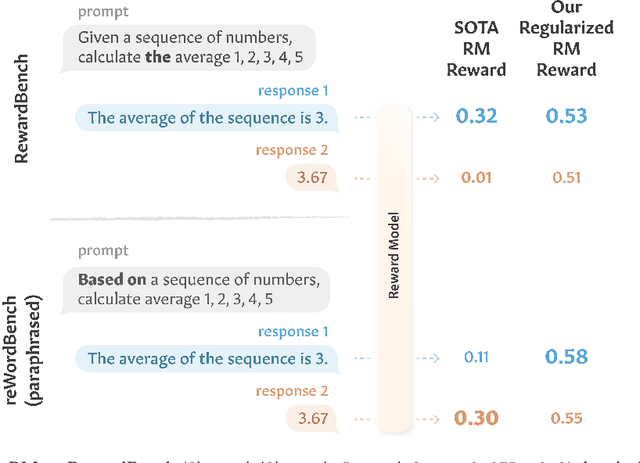

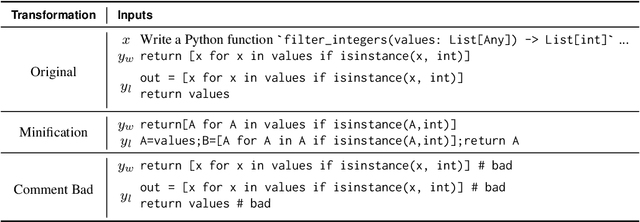
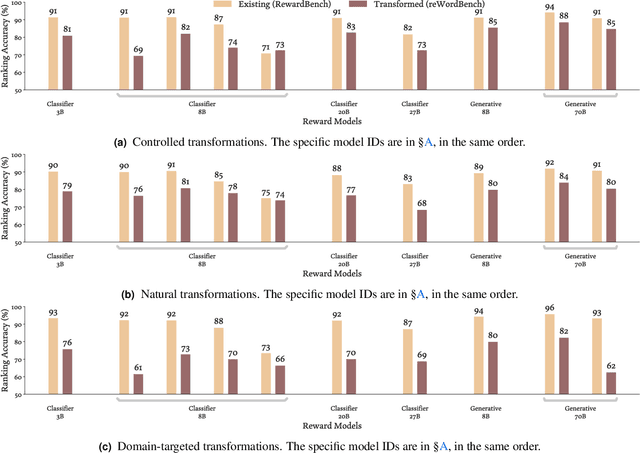
Reward models have become a staple in modern NLP, serving as not only a scalable text evaluator, but also an indispensable component in many alignment recipes and inference-time algorithms. However, while recent reward models increase performance on standard benchmarks, this may partly be due to overfitting effects, which would confound an understanding of their true capability. In this work, we scrutinize the robustness of reward models and the extent of such overfitting. We build **reWordBench**, which systematically transforms reward model inputs in meaning- or ranking-preserving ways. We show that state-of-the-art reward models suffer from substantial performance degradation even with minor input transformations, sometimes dropping to significantly below-random accuracy, suggesting brittleness. To improve reward model robustness, we propose to explicitly train them to assign similar scores to paraphrases, and find that this approach also improves robustness to other distinct kinds of transformations. For example, our robust reward model reduces such degradation by roughly half for the Chat Hard subset in RewardBench. Furthermore, when used in alignment, our robust reward models demonstrate better utility and lead to higher-quality outputs, winning in up to 59% of instances against a standardly trained RM.
On the Duality between Gradient Transformations and Adapters
Feb 19, 2025We study memory-efficient optimization of neural networks with linear gradient transformations, where the gradients are linearly mapped to a lower dimensional space than the full parameter space, thus saving memory required for gradient accumulation and optimizer state persistence. The model parameters are updated by first performing an optimization step in the lower dimensional space and then going back into the original parameter space via the linear map's transpose. We show that optimizing the model in this transformed space is equivalent to reparameterizing the original model through a linear adapter that additively modifies the model parameters, and then only optimizing the adapter's parameters. When the transformation is Kronecker-factored, this establishes an equivalence between GaLore and one-sided LoRA. We show that this duality between gradient transformations and adapter-based reparameterizations unifies existing approaches to memory-efficient training and suggests new techniques for improving training efficiency and memory use.
Vision-Language Models Do Not Understand Negation
Jan 16, 2025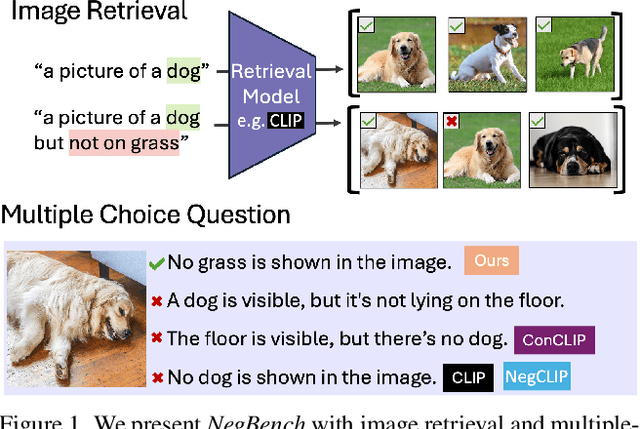
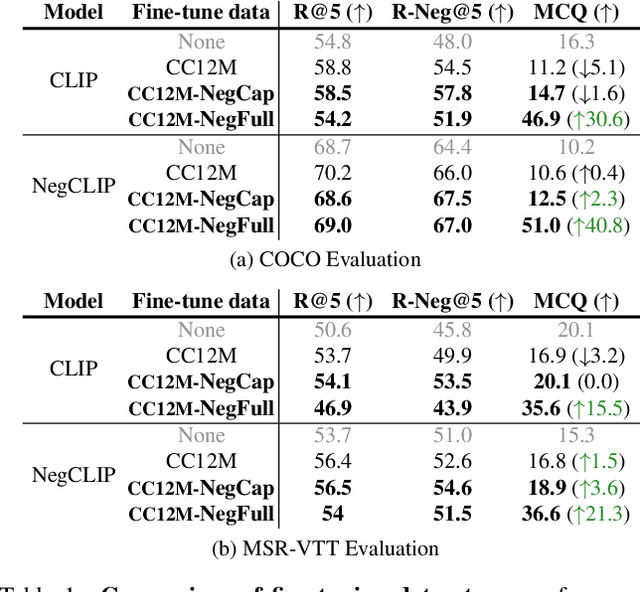
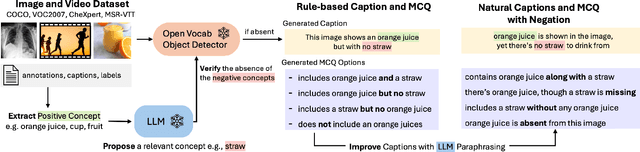
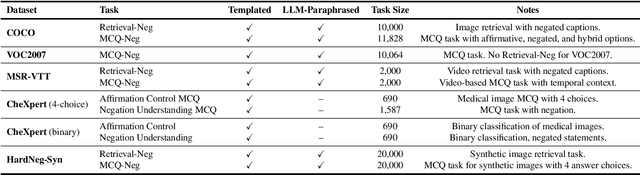
Many practical vision-language applications require models that understand negation, e.g., when using natural language to retrieve images which contain certain objects but not others. Despite advancements in vision-language models (VLMs) through large-scale training, their ability to comprehend negation remains underexplored. This study addresses the question: how well do current VLMs understand negation? We introduce NegBench, a new benchmark designed to evaluate negation understanding across 18 task variations and 79k examples spanning image, video, and medical datasets. The benchmark consists of two core tasks designed to evaluate negation understanding in diverse multimodal settings: Retrieval with Negation and Multiple Choice Questions with Negated Captions. Our evaluation reveals that modern VLMs struggle significantly with negation, often performing at chance level. To address these shortcomings, we explore a data-centric approach wherein we finetune CLIP models on large-scale synthetic datasets containing millions of negated captions. We show that this approach can result in a 10% increase in recall on negated queries and a 40% boost in accuracy on multiple-choice questions with negated captions.
Ladder-residual: parallelism-aware architecture for accelerating large model inference with communication overlapping
Jan 11, 2025


Large language model inference is both memory-intensive and time-consuming, often requiring distributed algorithms to efficiently scale. Various model parallelism strategies are used in multi-gpu training and inference to partition computation across multiple devices, reducing memory load and computation time. However, using model parallelism necessitates communication of information between GPUs, which has been a major bottleneck and limits the gains obtained by scaling up the number of devices. We introduce Ladder Residual, a simple architectural modification applicable to all residual-based models that enables straightforward overlapping that effectively hides the latency of communication. Our insight is that in addition to systems optimization, one can also redesign the model architecture to decouple communication from computation. While Ladder Residual can allow communication-computation decoupling in conventional parallelism patterns, we focus on Tensor Parallelism in this paper, which is particularly bottlenecked by its heavy communication. For a Transformer model with 70B parameters, applying Ladder Residual to all its layers can achieve 30% end-to-end wall clock speed up at inference time with TP sharding over 8 devices. We refer the resulting Transformer model as the Ladder Transformer. We train a 1B and 3B Ladder Transformer from scratch and observe comparable performance to a standard dense transformer baseline. We also show that it is possible to convert parts of the Llama-3.1 8B model to our Ladder Residual architecture with minimal accuracy degradation by only retraining for 3B tokens.
The Surprising Effectiveness of Test-Time Training for Abstract Reasoning
Nov 11, 2024
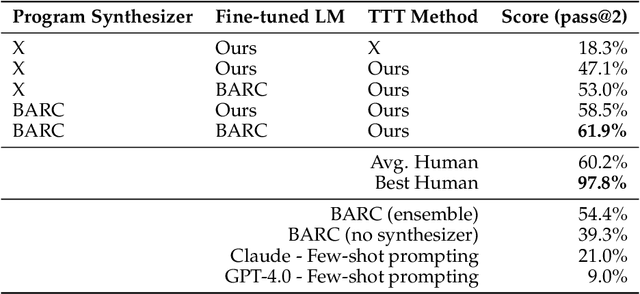


Language models have shown impressive performance on tasks within their training distribution, but often struggle with novel problems requiring complex reasoning. We investigate the effectiveness of test-time training (TTT) -- updating model parameters temporarily during inference using a loss derived from input data -- as a mechanism for improving models' reasoning capabilities, using the Abstraction and Reasoning Corpus (ARC) as a benchmark. Through systematic experimentation, we identify three crucial components for successful TTT: (1) initial finetuning on similar tasks (2) auxiliary task format and augmentations (3) per-instance training. TTT significantly improves performance on ARC tasks, achieving up to 6x improvement in accuracy compared to base fine-tuned models; applying TTT to an 8B-parameter language model, we achieve 53% accuracy on the ARC's public validation set, improving the state-of-the-art by nearly 25% for public and purely neural approaches. By ensembling our method with recent program generation approaches, we get SoTA public validation accuracy of 61.9%, matching the average human score. Our findings suggest that explicit symbolic search is not the only path to improved abstract reasoning in neural language models; additional test-time applied to continued training on few-shot examples can also be extremely effective.
The Semantic Hub Hypothesis: Language Models Share Semantic Representations Across Languages and Modalities
Nov 07, 2024


Modern language models can process inputs across diverse languages and modalities. We hypothesize that models acquire this capability through learning a shared representation space across heterogeneous data types (e.g., different languages and modalities), which places semantically similar inputs near one another, even if they are from different modalities/languages. We term this the semantic hub hypothesis, following the hub-and-spoke model from neuroscience (Patterson et al., 2007) which posits that semantic knowledge in the human brain is organized through a transmodal semantic "hub" which integrates information from various modality-specific "spokes" regions. We first show that model representations for semantically equivalent inputs in different languages are similar in the intermediate layers, and that this space can be interpreted using the model's dominant pretraining language via the logit lens. This tendency extends to other data types, including arithmetic expressions, code, and visual/audio inputs. Interventions in the shared representation space in one data type also predictably affect model outputs in other data types, suggesting that this shared representations space is not simply a vestigial byproduct of large-scale training on broad data, but something that is actively utilized by the model during input processing.